
Tungsten Carbide vs Carbide: The Drill Bit Material Guide
This post contains affiliate links. As an Amazon Associate, we earn from qualifying purchases.
Tungsten carbide and carbide drill bits are the same thing. The term “carbide” in power tools is shorthand for cemented tungsten carbide, a composite material of 70-97% tungsten carbide (WC) particles bound together by 3-30% cobalt or nickel. The specific binder percentage and tungsten carbide grain size determine hardness, toughness, and the exact failure mode, from brittle chipping under vibration to cobalt leaching in chlorinated water.
The numbers on a grade chart tell you which failure you’ll get first. A drill bit with 6% cobalt binder and fine grain structure hits a Rockwell A hardness of 92, but its transverse rupture strength is only 320,000 psi. One with 25% cobalt drops to 83.2 Ra hardness, but its strength jumps to 435,000 psi. That’s a 36% toughness increase for a 10% hardness loss.
What follows: the manufacturer spec sheets that explain this trade-off, the two failure modes no one talks about until a bit snaps or corrodes, and a direct comparison of when to use this material versus when to reach for cobalt steel.
Key Takeaways
- “Carbide” always means cemented tungsten carbide; it’s not a different material.
- The cobalt binder content is the primary dial between hardness (wear resistance) and toughness (impact resistance). More cobalt means tougher but softer.
- Solid carbide bits fail from vibration, not force. A machine tool spindle runout over 0.02mm can cause instantaneous brittle fracture.
- Cobalt binder leaches in chlorinated water, a documented failure mode for coolants using tap water.
- For handheld drilling, the instability usually makes cobalt high-speed steel (HSS-Co) a better choice than solid carbide.
What “Carbide” Actually Means in Drill Bits
In a workshop, “carbide” means one thing: cemented tungsten carbide. It’s a composite. Tungsten carbide grains provide the extreme hardness, up to 90 HRC on the Rockwell C scale. A metallic binder, almost always cobalt, holds those grains together. The binder is the ductile glue that gives the otherwise brittle ceramic-like material some shock absorption.
The confusion between “tungsten carbide” and “carbide” is purely semantic. No reputable manufacturer sells a drill bit made from a carbide compound that isn’t based on tungsten. When you see “carbide-tipped masonry bit” or “solid carbide end mill,” the active cutting material is identical. The composition of carbide drill bits is a powder metallurgy process, sintering tungsten and carbon at temperatures near 1,400°C.
A cemented carbide is a composite material comprised of individual tungsten carbide grains imbedded in a ductile metal binder matrix of either cobalt or nickel. The physical and metallurgical properties of a particular ‘grade’ of carbide are determined by its composition. . Federal Carbide Company
This is why comparing “tungsten carbide vs carbide” is a category error. You’re comparing the full name to its abbreviation. The real comparison is between different grades of cemented carbide, or between cemented carbide and other drill bit materials like high-speed steel.
Material Composition: The Binder Dictates Performance
The formula isn’t a secret. It’s printed on OEM data sheets. General Carbide’s design guide states cemented carbide is 70-97% tungsten carbide by weight. The remainder is the binder. This ratio is everything.
A higher percentage of tungsten carbide means a harder, more wear-resistant bit. A higher percentage of cobalt binder means a tougher, more impact-resistant bit. It’s a direct trade. You cannot have maximum hardness and maximum toughness in the same bit.
| Grade Designation | Binder Content (Cobalt) | Hardness (Ra) | Transverse Rupture Strength (psi) | Best-For Scenario |
|---|---|---|---|---|
| C2 / FC3 (Fine Grain) | 6% | 92.0 | 320,000 | Precision finishing, high abrasion, low impact |
| C11 / FC11 (Medium Grain) | 12% | 89.5 | 390,000 | General metal drilling, moderate impact |
| C14 / FC25 (Medium Grain) | 25% | 83.2 | 435,000 | High-impact applications, roughing |
Source: Federal Carbide Company Tungsten Carbide Grade Chart
This table uses real industry grades. The C2 grade is common for fine-detail router bits and finishing end mills where edge retention is critical. The C14 grade, with 25% cobalt, is for punishing environments like mining drill heads. For most drill bits for steel in a shop, grades around C11 (10-12% cobalt) offer the best balance.
Grain size is the other lever. Fine grain (<1 micron) increases hardness and wear resistance. Coarse grain (above 3 microns) improves toughness. Submicron grains are for applications demanding a razor edge, like drill bits for hardened metal.
Documented Failure Modes: Why Carbide Bits Break
Carbide doesn’t wear down slowly like steel. It fails suddenly, and the mode tells you what was wrong.
Brittle Fracture from Vibration. This is the most common surprise failure. Carbide has almost no ductility. It cannot bend. Under lateral load or high-frequency vibration, it reaches its transverse rupture strength limit and snaps. An analysis from Jimmy Tool notes an 8mm carbide drill bit will experience brittle fracture if machine tool spindle radial runout exceeds 0.02mm. That’s less than the thickness of a human hair. In a handheld drill, your own wrist movement creates more runout than that.
Common mistake: Using solid carbide bits in a hand drill or a worn drill press. The bit doesn’t dull, it snaps cleanly at the flutes, often on the first hole.
Thermal Cracking and Binder Degradation. The Wikipedia entry on tungsten carbide notes its high-temperature stability, but the binder is the weak link. Cobalt begins to soften around 500°C. In dry drilling or with insufficient coolant, heat builds at the tip. The cobalt binder loses integrity, tungsten carbide grains pull out, and the edge erodes catastrophically. You’ll see a blued section on the steel shank near the tip just before failure.
Cobalt Binder Leaching. This is a corrosion failure specific to the cobalt binder. Federal Carbide’s design considerations explicitly warn: “The cobalt binder in tungsten carbide is subject to attack, binder leaching, where chlorinated liquids such as city water are present.” If you use tap water as a coolant (common in some masonry drilling), chlorine ions attack the binder. The bit loses toughness from the inside out and fails by crumbling. Nickel-bound carbide grades exist for corrosive environments, but they are rare in consumer tools.
The Braze Joint (Carbide-Tipped Only). For carbide-tipped bits, the silver solder joining the carbide tip to the steel body is another failure point. Overheating weakens this joint. A tip can fly off, a genuine safety hazard. This isn’t a problem with solid carbide bits, as there’s no joint to fail.
Carbide vs. Cobalt Steel: The Rigidity Rule
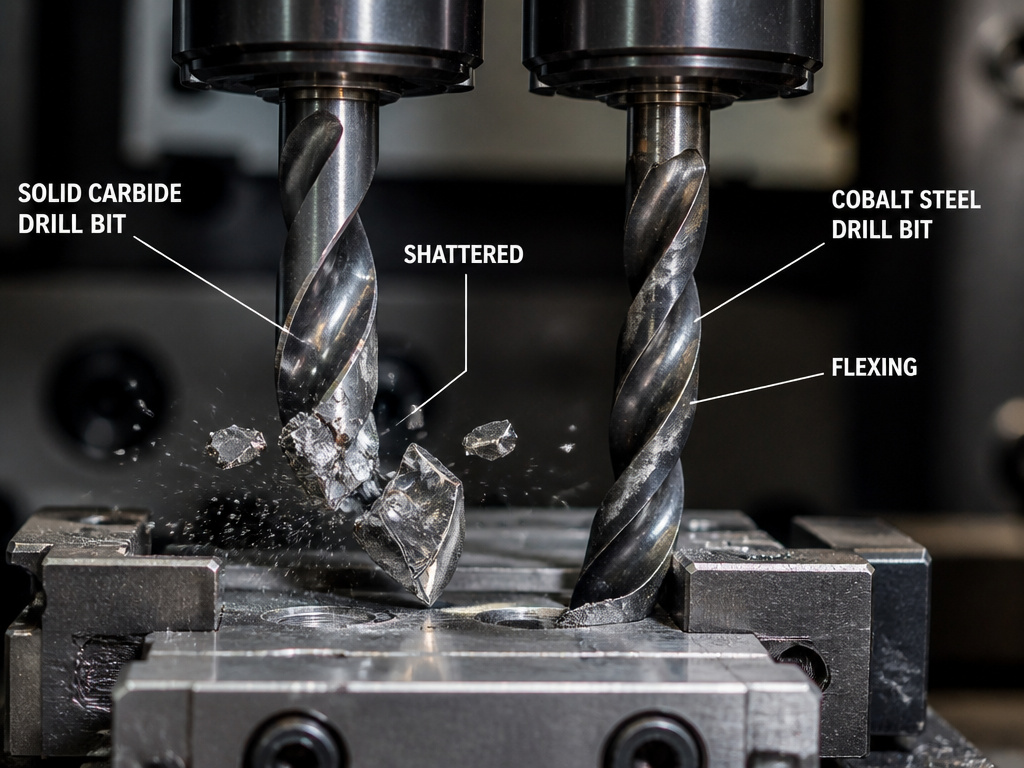
The choice between solid carbide and cobalt high-speed steel (HSS-Co) isn’t about material hardness alone. It’s about machine rigidity.
Solid carbide demands a perfectly stable setup. A CNC machine, a high-precision drill press with a vise, or a magnetic base drill is ideal. The differences between cobalt and carbide are stark here. Cobalt steel can flex. It forgives wobble. Carbide cannot.
| Aspect | Solid Carbide Drill Bit | Cobalt (HSS-Co) Drill Bit |
|---|---|---|
| Machine Requirement | High-rigidity CNC or mill | Handheld drill, standard drill press |
| Failure from Vibration | Instant brittle fracture | Gradual dulling, possible wandering |
| Best Material Application | Hardened steel (>45 HRC), high-volume production in stainless, composites | Mild steel, aluminum, stainless steel (low-volume), wood |
| Repairability | Professional sharpening only (diamond wheel) | Can be resharpened on a standard bench grinder |
| Cost Driver | Material cost (tungsten, cobalt) and grinding precision | Lower material cost, simpler manufacturing |
If your workpiece isn’t clamped rock-solid, use cobalt. If your drill chuck has any play, use cobalt. The extra hardness of carbide is useless if the bit snaps before the hole is finished. For most types of drill bits in a home shop, cobalt steel provides the best balance of performance and forgiveness.
Workplace Safety and Handling
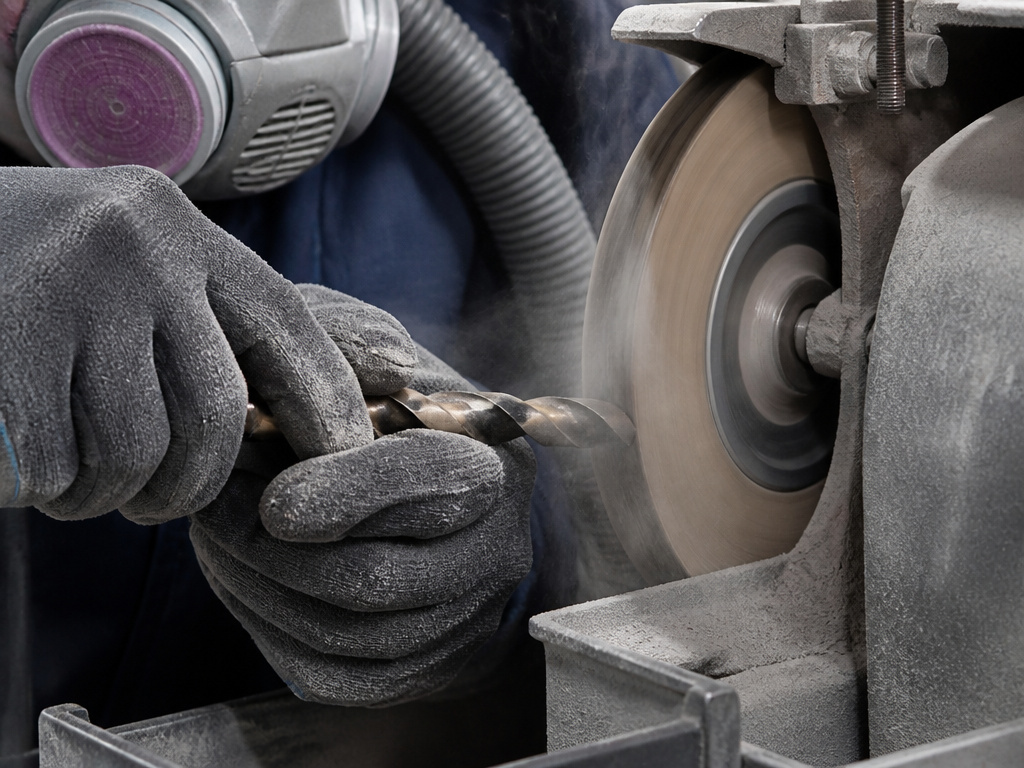
Cemented tungsten carbide is safe as a finished tool, but its manufacture and grinding produce hazardous dust. The NIOSH pocket guide for tungsten carbide classifies it as a workplace hazard when inhaled as particulate. The cobalt binder is the primary concern, linked to respiratory issues and skin sensitization.
Before you start: Never dry-grind a carbide bit without a respirator and dust collection. The dust contains cobalt, which can cause serious lung irritation and long-term health effects. Always use coolant or a wet grinding system.
This also matters for sharpening drill bits. Sharpening HSS steel on an aluminum oxide wheel is routine. Sharpening carbide requires a diamond wheel and the same respiratory protection. For most users, sending carbide tools to a professional sharpening service is safer and more cost-effective.
When to Choose Carbide Drill Bits
The decision tree is short. Use solid carbide bits only when all three conditions are true: 1. You are drilling abrasive or very hard materials (hardened steel, titanium, carbon fiber, abrasive composites). 2. Your workpiece is securely clamped in a vise or fixture. 3. Your drilling machine is a rigid CNC, mill, or a high-quality drill press with minimal runout.
For high-volume production, drilling hundreds of holes in stainless steel plate, carbide pays for itself. Shop tests cited by Amony Cutting Tools show carbide bits averaging over 600 holes in 304 stainless before dulling, compared to under 100 for HSS. The reduction in downtime for tool changes boosts output.
For everything else, general fabrication, automotive work, home DIY, or drilling with a hand-held tool, reach for a cobalt steel bit. It’s the practical choice. It’s also why cobalt bits dominate the market for strongest drill bits used in variable conditions.
The bottom line on the “titanium vs carbide” debate is simpler: titanium nitride is a coating applied to HSS or cobalt bits to reduce friction. It’s not a bulk material competitor to solid carbide.
Frequently Asked Questions
Are tungsten carbide and carbide drill bits the same?
Yes. In the context of drill bits and cutting tools, “carbide” is the universal shorthand for cemented tungsten carbide. There is no other carbide material used in mainstream drill bit manufacturing.
Why did my expensive carbide bit snap immediately?
It almost certainly encountered lateral force or vibration beyond its tolerance. Check your setup. Was the workpiece clamped? Was it a handheld drill? Even a slight wobble at high RPM can generate enough lateral load to exceed the bit’s transverse rupture strength, causing instantaneous brittle fracture.
Can I use a carbide bit in my regular drill press?
Maybe, but it’s risky. The drill press must have very low spindle runout (check with a dial indicator) and you must use a vise, not hand-hold the workpiece. Any instability turns the advantage of carbide into a liability. For a typical home workshop drill press, cobalt bits are a safer, more economical choice.
How do I identify a real carbide bit?
Solid carbide bits are heavier than steel bits of the same size due to higher density (around 14.7 g/cm³ vs. 8.0 for steel). They have a uniform, light gray color throughout. Carbide-tipped bits have a distinct silver-brazed line where the gray carbide tip meets the steel body. The materials for drill heads in these two designs are completely different.
Is carbide or cobalt better for stainless steel?
For a single hole or occasional work, a premium cobalt (HSS-Co) bit is fine. For drilling dozens or hundreds of holes in stainless, carbide is superior. Its heat resistance and wear resistance prevent the rapid work-hardening and dulling that destroy cobalt bits. Always use a cutting fluid.
The Bottom Line
Tungsten carbide is carbide. The performance variable is the grade, the precise recipe of tungsten carbide powder and cobalt binder. That recipe determines whether your bit will die from chipping, heat, or corrosion.
For the home workshop, the rigidity rule is the most important. Your drill press isn’t a CNC. Your hand isn’t a robot. The slight runout and vibration you can’t eliminate will break a carbide bit that would last forever in a perfect machine. That’s why cobalt high-speed steel remains the default for most drilling.
When you need the absolute hardest material for a precise, rigid application, you specify a fine-grain, low-cobalt carbide grade. When you need to survive impact, you specify a high-cobalt, coarse-grain grade. Everything else is just marketing noise around the same cemented composite. Choose based on how your tool will fail, not just what it can cut.
