
What Is a Hedge Trimmer? Types, Features & How They Work
This post contains affiliate links. As an Amazon Associate, we earn from qualifying purchases.
A hedge trimmer is a power tool with reciprocating blades designed specifically for cutting and shaping hedges, bushes, and shrubs. It works by using either a single moving blade against a fixed blade or two blades moving in opposite directions to shear plant material, with cutting capacities typically limited to branches up to 3/4 inch thick. The three main types are corded electric (for light duty near outlets), cordless battery-powered (for balance and mobility), and gas-powered (for heavy-duty or remote work).
Most people think picking a hedge trimmer is about power or brand. They grab the one with the longest blade or biggest motor. That’s how you end up with a tool that’s exhausting to use for twenty minutes or completely wrong for the thick holly in your yard. The real choice happens before you even look at a model number.
This guide breaks down exactly what a hedge trimmer is, how the different types work in your hands, and which features actually matter when you’re facing an overgrown privet. We’ll cover the mechanics, the pros and cons of each power source you can’t ignore, and the safety rules that aren’t just fine print.
Key Takeaways
- Hedge trimmers cut via a shearing, not a chopping, action. Using one on branches thicker than 3/4 inch risks damaging the blades, stalling the motor, and producing ragged cuts that harm the plant.
- Cordless battery trimmers now rival gas models for most suburban jobs. Their balanced weight distribution and lack of cords make them less fatiguing over a long trimming session than either corded or gas options.
- Blade teeth spacing, not length, determines your cutting capacity. A 24-inch blade with 1-inch spaced teeth will handle thicker stems than a 26-inch blade with 1/2-inch spacing.
- Always wear eye protection. A trimmer blade can flick wood chips, debris, or even a snapped piece of line back at your face at high speed in a fraction of a second.
- The single most important maintenance task is cleaning and lubricating the blades after every use. Sap and plant residue left to harden will increase friction, strain the motor, and lead to rust.
How Does a Hedge Trimmer Actually Work?
It’s not a miniature chainsaw. The mechanism is closer to electric scissors. Inside the head, an electric motor or gas engine converts rotational power into a back-and-forth linear motion. This motion drives one or two steel blades lined with sharpened teeth.
A hedge trimmer operates on a shearing principle. A single-action design uses one reciprocating blade sliding past a fixed stationary blade. A double-action design uses two reciprocating blades moving in opposite directions. The teeth on these blades are designed to grab and hold stem material as the blades pass, creating a clean scissor-cut that severs the plant cells cleanly rather than tearing them.
The clean cut matters. A torn branch is an open wound for the plant, a direct entry point for disease and pests. A sharp, sheared cut allows the plant to callus over quickly. You’ll see the difference in a few weeks—the sheared hedge sprouts new green growth evenly; the ragged one has brown, dead tips where the torn stems dried out.
If you force a cut on a stem that’s too thick, the teeth can’t grab it properly. The blades will pinch and bind, or worse, the stem will partially break and splinter. That’s when you feel the whole tool jerk violently in your hands. That kickback is the motor stalling against an immovable object, and it’s a sure sign you need a different tool, like loppers or a pruning saw for cutting branches.
The Three Main Types: Corded, Cordless, and Gas
Your power source dictates everything about the job: where you can work, how long you can work, and how much effort the work takes. The old rule was gas for big jobs, corded for small ones. Battery tech flipped that.
Corded Electric Trimmers
Plug it in and it runs forever. That’s the appeal. A corded trimmer provides consistent power without fade, and it’s usually the lightest and least expensive option upfront. The cord is also its absolute limit.
You need a heavy-duty outdoor extension cord, and every foot of cord between the outlet and the tool causes a tiny voltage drop. Go more than 100 feet with a cheap cord and you’ll hear the motor bog down on thick growth. The real hazard is the cord itself.
It’s startlingly easy to glance away for a second and slice right through it. Always use a GFCI-protected outlet or cord. If you do cut it, the circuit trips instead of delivering a shock.
Best for: Small to medium yards with hedges close to an outlet. The person who values low maintenance and doesn’t want to deal with batteries or fuel.
Cordless Battery-Powered Trimmers
This is the category that changed the game. Modern 40V and 80V lithium-ion batteries deliver enough torque for most residential hedging. The weight is better distributed—the battery in the rear acts as a counterbalance to the blade in the front. That means less strain on your wrists and forearms over an hour of trimming.
Runtime is the variable. A 2.5Ah battery on a 40V system might give you 30 minutes of continuous heavy trimming. A 5.0Ah battery might double that.
The smart move is to invest in a tool brand you already use. If you have EGO lawn mower batteries, get an EGO trimmer. If you’re in the Greenworks ecosystem, stay there. It saves hundreds on spare batteries.
Best for: Most homeowners with up to a half-acre. Anyone who values a quiet, fume-free tool and hates wrestling with a cord.
Gas-Powered Trimmers
Raw power and complete freedom. A good gas trimmer, like a Stihl HSA 86 or similar model, will chew through dense, woody growth that would stall a mid-range battery tool. There’s no cord, no battery to recharge—just refill the tank and go. That comes with baggage.
They’re the heaviest, loudest (hearing protection is mandatory), and require the most upkeep. You’re mixing oil and gas, cleaning air filters, and dealing with carburetor issues if you leave fuel sitting over the winter. The vibration from the two-stroke engine is also significantly higher, which translates to hand fatigue.
Best for: Large properties, professional landscapers, or trimming exceptionally thick, mature hedges where runtime and peak power are non-negotiable.
| Power Type | Best Use Case | Runtime / Limit | Maintenance Burden |
|---|---|---|---|
| Corded Electric | Hedges within 100 ft of an outlet | Unlimited (while plugged in) | Very Low |
| Cordless Battery | Most suburban yards, medium-sized jobs | 30 min – 2 hrs per battery | Low (battery care) |
| Gas-Powered | Large properties, remote areas, very thick growth | 45 min – 1.5 hrs per tank | High (engine upkeep) |
Key Features That Actually Matter
Blade length gets all the attention on the box. It’s the third-most important spec. Here’s what you should look at first.
Teeth Spacing (Cutting Capacity): This number, measured in inches (e.g., 3/4″, 1″), tells you the maximum branch diameter the tool can cleanly cut. Wider spacing (1 inch or more) is for woody stems like holly, privet, or conifers. Narrow spacing (1/2 inch) is for fine, soft growth like boxwood or azalea. Mismatch here and you’ll burn out the motor.
Blade Action: Single vs. Double: This is a huge factor in control and fatigue.
* Single-Action: One blade moves, one is stationary. It’s a simpler, often cheaper design. The downside is more vibration transferred to your hands, and it can struggle to pull in material for a clean cut.
* Double-Action: Both blades move in opposite directions. This counters vibration—the forces cancel each other out, making the tool feel smoother and quieter. It also provides a more positive shearing action. It’s worth the upgrade for any hedge over chest height.
Blade Length: Now you can look at length. Longer blades (24-26 inches) cover more surface area per pass, making quick work of long, flat hedge faces. Shorter blades (18-20 inches) offer more control for detail work and shaping. A longer blade is also heavier and more awkward to hold at shoulder height.
Weight and Balance: Don’t just check the spec sheet weight. Pick the tool up and hold it out in front of you, mimicking a cutting position. Where does the weight sit? A front-heavy tool will fatigue you in minutes. A well-balanced one, with weight centered near the handle or offset by a rear battery, feels like an extension of your arm.
Safety Features: This isn’t optional stuff. Look for:
* A lock-off switch that requires a deliberate two-step action to start, preventing accidental activation.
* A front hand guard that protects your forward hand from slipping onto the blade.
* A blade tip guard to prevent the sharp teeth from contacting the ground or other surfaces when not in use.
Before you start: The blade coasts for several seconds after you release the trigger. Never reach toward the cutting area until all motion has completely stopped. I saw a landscaper get six stitches because he grabbed a blade to wipe off sap while it was still winding down. It looked stopped. It wasn’t.
What a Hedge Trimmer Is NOT Designed to Do
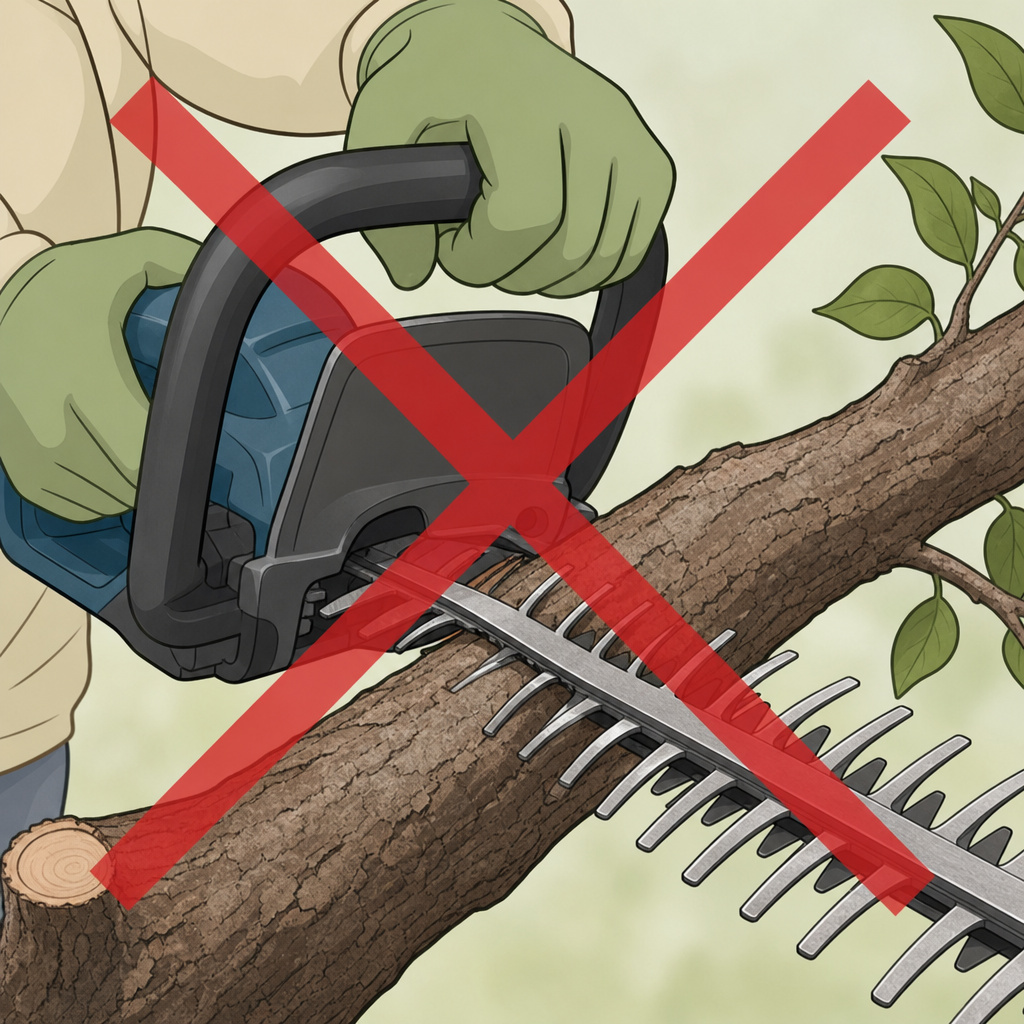
This is where most DIYers get into trouble. A hedge trimmer has one job. Trying to make it do others will break the tool, ruin your plants, or hurt you.
It’s not a brush cutter. Don’t try to clear tall grass, weeds, or woody brush piles. The fine teeth will clog instantly with fibrous material, and you risk hitting hidden rocks or fence wire.
It’s not a pruning saw. As discussed, the absolute maximum is about 3/4-inch diameter for most models. For anything thicker, or for making precise cuts on individual branches (like selective pruning on shrubs), you need hand pruners, loppers, or a saw.
It’s not a metal cutter. This should be obvious, but people try to trim back wire fencing or cut old garden stakes. Steel on steel shatters carbide teeth and can send metal fragments flying.
It’s not for wet hedges. Water lubricates the stems, causing the blades to slip and tear rather than cut. It also greatly increases the electrical hazard with corded tools and can lead to rust on the blade.
Essential Safety Gear and Prep
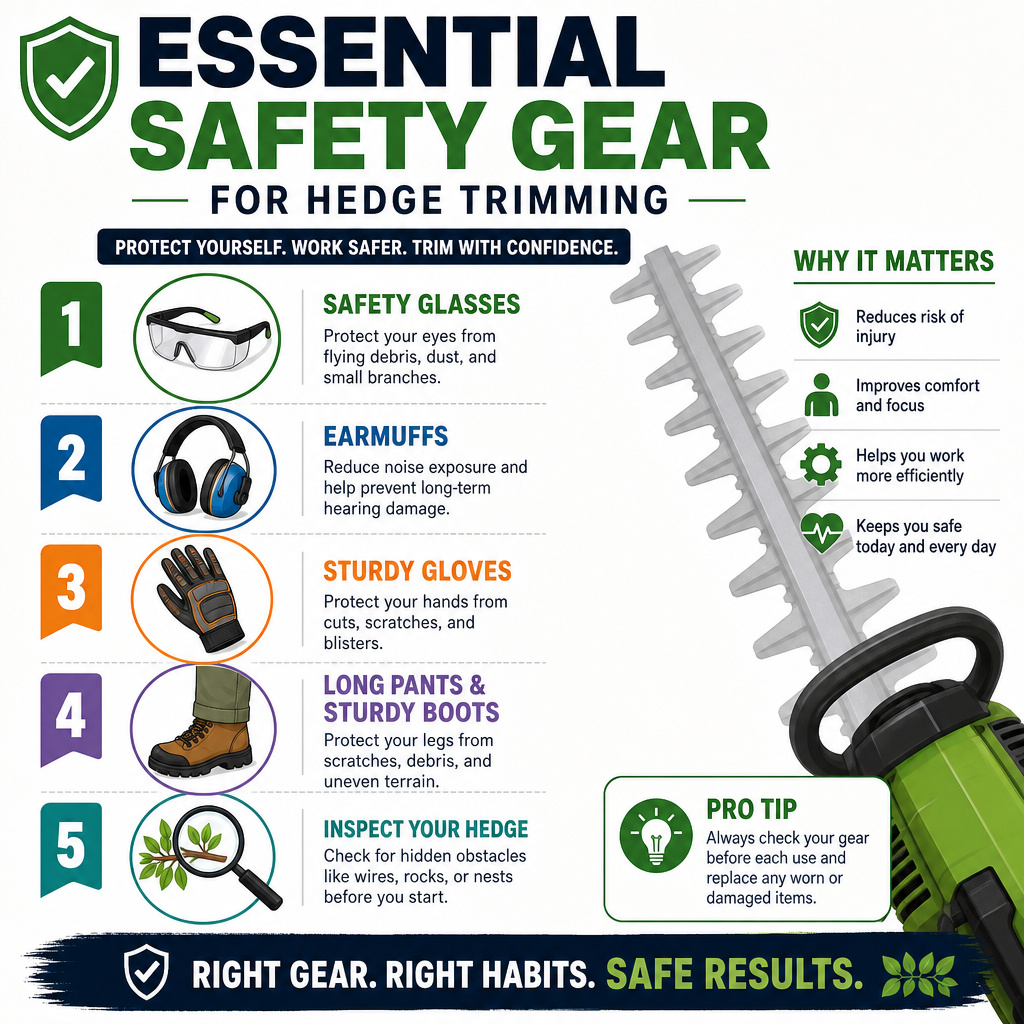
Skipping safety gear turns a simple job into a trip to the emergency room. This isn’t a drill where you might get a minor scrape.
- Eye Protection: Safety glasses or a full-face shield. Non-negotiable. Blades throw debris.
- Hearing Protection: Gas models are loud enough to cause hearing damage. Even electric models produce a high-pitched whine that’s fatiguing over time. Use earplugs or muffs.
- Gloves: Sturdy, close-fitting work gloves improve grip and protect against blisters and minor scrapes. For heavy-duty work, consider cut-resistant liners.
- Sturdy Footwear & Long Pants: Protect your feet and legs from falling debris and the tool itself if you stumble.
- Inspect the Area: Walk the hedge line first. Pull out any vines, old plant tags, or hidden irrigation lines. Look for animal nests or bee hives inside the hedge.
How to Choose the Right One for You
Follow this sequence to filter your options. Your back and your wallet will thank you.
First, assess your property.
* How many linear feet of hedge do you have?
* What’s the dominant plant type (soft boxwood or woody holly)?
* What’s the thickest stem you’ll need to cut?
* How far is the farthest hedge from a power outlet?
Second, be honest about your tolerance for maintenance.
* Are you okay with mixing fuel and winterizing an engine?
* Do you want to just grab a tool and go, or are you willing to plan around battery charging?
* Will you remember to clean and oil the blades after each use?
Third, match the tool to the task. Use the table below as a final check.
| Your Scenario | Recommended Type | Key Specs to Look For | Budget Expectation |
|---|---|---|---|
| Small urban garden, boxwood hedge | Corded Electric | 18-20″ blade, double-action | Lower |
| Suburban 1/2-acre, mixed shrubs | Cordless Battery | 40V+ system, 22-24″ blade, 1″ tooth spacing | Medium |
| Rural property, overgrown privet/large conifers | Gas-Powered | 24-26″ blade, 1.5″ tooth spacing, anti-vibration handles | Higher |
I bought a cheap corded model for my first house. It worked until I moved and had a 150-foot-long laurel hedge. The voltage drop was so bad the motor would stall on every other branch. I spent more on heavy-gauge extension cords than I would have on a decent cordless trimmer. Now I recommend skipping corded entirely unless your hedges are right outside your back door.
Basic Maintenance to Keep It Running
A hedge trimmer is simple to maintain. Neglect guarantees a short, frustrating life.
After Every Use:
- Unplug or remove the battery.
- Wipe the blades clean with a rag dampened with a mild cleaner (like simple green) to remove sap and resin.
- Spray the blades lightly with a silicone-based lubricant. This prevents rust and keeps the cutting action smooth.
Seasonal/As Needed:
- Sharpening: When cuts become ragged and the tool requires more pressure to get through stems, the blades are dull. You can use a flat file or a dedicated hedge trimmer blade sharpening guide for the job. Dull blades strain the motor and rip plants.
- Battery Care (Cordless): Store batteries in a cool, dry place indoors. Don’t leave them on the charger permanently or store them fully depleted.
- Fuel Care (Gas): For off-season storage, either run the engine until the carburetor is completely dry, or use a fuel stabilizer. Never leave mixed gas in the tank over winter.
Frequently Asked Questions
What’s the difference between a hedge trimmer and a string trimmer?
hedge trimmer uses rigid, toothed metal blades to shear hedges and shrubs. A string trimmer (weed whacker) uses a fast-spinning nylon line to cut grass and weeds. They are completely different tools for different tasks.
Can I use a hedge trimmer to cut grass?
No. The blade design will jam instantly with grass, potentially damaging the tool. It is also dangerously ineffective and unstable for that purpose.
How often should I trim my hedges?
For most formal hedges, a trim in late spring after the initial growth flush and another in early fall is sufficient. Over-trimming can stress the plant. Always research the specific needs of your hedge species.
Is a more expensive hedge trimmer worth it?
Usually, yes. The price jump often buys you a double-action blade (less vibration), better build quality, a more powerful motor or battery, and superior ergonomics. For a tool you’ll use for years, the extra cost translates directly to less fatigue and better results.
What should I do if I accidentally cut the cord on my electric trimmer?
Immediately unplug it from the wall outlet. Do not touch the cut ends of the cord. The cord must be properly repaired or replaced before the tool is used again. This is why using a GFCI outlet is a critical safety step.
Before You Go
A hedge trimmer is a specialized tool for a specific job: creating clean, healthy shapes in your shrubs and hedges. Its value isn’t in raw power, but in the right combination of blade design, power source, and balance for your yard. Forget the corded models for anything but the smallest tasks—today’s cordless batteries offer the best blend of power and convenience for most people.
Remember that its limit is about 3/4-inch wood; anything thicker needs a different tool. Finally, respect it. Wear your glasses and gloves, keep the blades clean and sharp, and it will make a tough job look easy for a long time.
