How a String Trimmer Works: The Complete Mechanical Guide
This post contains affiliate links. As an Amazon Associate, we earn from qualifying purchases.
A string trimmer converts engine or motor power into high-speed rotational force via a drive shaft and cable. This spins a nylon line spool at 7,000–10,000 RPM, using centrifugal force to stiffen the line into a cutting blade that slices vegetation.
A string trimmer works by spinning a length of durable nylon line at high speed, typically between 7,000 and 10,000 RPM. Centrifugal force stiffens the flexible line into a rigid cutting blade that slices through grass and weeds. The power to spin that line comes from either a small gasoline engine or an electric motor, transferred down the shaft via a metal drive cable to the cutting head at the bottom.
Most people think the hardest part is pulling the starter rope. The real trouble starts when you ignore what happens after the engine fires up, the clutch engagement, the line feed mechanism, and what that specific smell of burning plastic means when the head binds. This guide walks through the mechanics from the throttle trigger to the cutting swath, explains why your trimmer bogs down in tall weeds, and what to listen for before a $150 repair bill shows up.
Key Takeaways
- The centrifugal clutch is the critical link between engine power and the cutting head; it engages only at high RPM to protect you and the drive train.
- Line diameter is not a suggestion. Using .065-inch line on a trimmer rated for .095-inch will over-rev the engine and snap the line constantly, while thicker line on a weak motor will stall it.
- Two-cycle gas engines require a precise oil-to-gas mix (usually 50:1). Straight gas will seize the piston within minutes, and the repair costs more than a new trimmer.
- The bump-feed head relies on a simple ratchet mechanism. Tapping it too hard on the ground can jam the spool, while not tapping it firmly enough won’t feed new line.
- Electric and battery trimmers eliminate fuel mix and pull-start hassles, but their torque curve is different. They can bind and stall on thick vegetation where a gas engine would simply roar through it.
How Does a Gas-Powered String Trimmer Work?
You pull the rope, the engine sputters to life, and you squeeze the trigger. Between that squeeze and the line whirling at your feet, a series of mechanical events happens in under a second. Miss one, and the trimmer either does nothing or destroys itself.
The process starts at the throttle trigger. A cable runs from the trigger to the carburetor, opening a valve to allow more air and fuel into the engine. As the engine’s revolutions per minute (RPM) increase, the real magic happens at the centrifugal clutch.
A centrifugal clutch uses weighted arms or shoes mounted on the engine’s output shaft. At idle speed, springs hold these weights inward, disengaged from the drive shaft’s drum. When throttle increases and RPMs rise, centrifugal force slings the weights outward, pressing them against the drum’s inner surface. This friction locks the engine shaft to the drive shaft, transferring power down the trimmer’s tube to the head. It’s a safety feature, if the head hits an immovable object, the clutch can slip, preventing a snapped shaft or engine damage.
That drive shaft is either a solid, flexible cable inside the trimmer shaft or a rigid metal rod. It spins a gear mechanism inside the cutting head, which finally rotates the spool holding your trimmer line. The whole chain, trigger, throttle cable, engine, centrifugal clutch, drive shaft, head gears, has to be intact. A frayed throttle cable, worn clutch shoes, or a stripped plastic gear in the head will stop the show.
If the engine revs but the head doesn’t spin, the clutch is the first suspect. If the head spins weakly, the drive cable might be slipping inside its housing. You’ll hear a high-pitched whirring sound instead of the deep thrum of a loaded engine.
Electric & Battery-Powered Trimmer Mechanics
Corded electric and battery-powered trimmers swap the gasoline engine for an electric motor, which changes almost everything about the user experience, except the fundamental job of spinning a line. The motor sits in the same position as the gas engine, but instead of a carburetor and clutch, you have a switch, a circuit board, and a direct drive linkage.
The motor receives power when you pull the trigger, which closes a switch sending current from the battery or wall outlet. There’s no clutch. The motor shaft is directly coupled to the drive shaft or, in many lightweight models, even directly to the cutting head. This means the head starts spinning the instant you pull the trigger, albeit at a lower torque than a gas engine’s high-RPM punch.
That lack of a centrifugal clutch is a double-edged sword. On one hand, there’s no mechanical part to wear out. On the other, if the head jams against a tree root or a fence post, the motor faces the full force of the stall. Modern units have electronic safeguards that cut power to prevent burnout, but older or cheaper models can let the magic smoke out of the motor windings. You’ll smell it, a sharp, acrid scent of burning insulation.
Battery voltage is the key spec. A 20V trimmer is fine for lawn edges and soft weeds. For anything resembling brush, you need 40V or higher. The battery’s amp-hour (Ah) rating determines runtime, not power. A common mistake is using a lightweight 2.0Ah battery on a 40V system for heavy work; it’ll drain in 15 minutes and get hot enough to shorten its lifespan.
Corded models offer consistent, unlimited power but are tethered. The cord itself is a vulnerability. I’ve sliced through my own extension cord more than once by not keeping it over my shoulder and behind the cutting path. That mistake ends the job instantly and requires a splice repair before you can continue.
The Cutting Head: Where the Action Happens
The spinning business end of your trimmer is a deceptively simple plastic housing containing a spool of line. How that line feeds out determines your workflow and frustration level. There are three main types, and each has a specific failure mode.
Bump-Feed Heads are the most common. You tap the head on the ground while the trimmer is running at full speed. This action compresses a spring inside the head, releasing a ratchet pawl that lets the spool unwind a few inches of fresh line. The cutting guard has a sharp edge, or a separate blade, that trims the line to the correct length as it spins. The trick is the tap, too soft and no line feeds; too hard and you can jam the mechanism or break the plastic tabs holding the spool. After about two seasons of regular use, the spring loses tension and the pawl wears down. The symptom is a head that won’t feed line no matter how hard you bump it.
Automatic-Feed Heads use centrifugal force to release line as it wears down. They’re convenient but notoriously unreliable in dusty or weedy conditions. A tiny bit of grit or grass wound around the spool axle prevents the automatic mechanism from working. You’re left with a head that either won’t feed at all or feeds line uncontrollably until it’s a tangled mess.
Fixed-Line Heads use pre-cut lengths of line that you manually insert into slots on the head. There’s no spool to wind, no mechanism to fail. You trade convenience for cost, as you go through more line and have to stop to reload more often. They’re foolproof, which is why they’re popular on rental and commercial units.
The line itself is almost always nylon monofilament, chosen for its flexibility and abrasion resistance. Diameter matters. Using a line thicker than your trimmer is rated for (e.g., putting .095-inch line in a trimmer designed for .065-inch) overloads the motor, causing it to bog down and overheat.
Using a line that’s too thin makes it snap constantly, wasting line and time. The shape, round, square, twisted, affects cutting aggression. Square line cuts more aggressively but wears down faster and is louder.
| Head Type | Best For | Common Failure Mode |
|---|---|---|
| Bump-Feed | General use, mixed vegetation | Worn pawl or spring from over-bumping; jams when debris enters the head. |
| Automatic-Feed | Large, open areas with consistent grass | Grit or grass winding around the spool axle, preventing the centrifugal release. |
| Fixed-Line | Heavy-duty brush, rental scenarios | No mechanical failure; user error from inserting line incorrectly or using wrong diameter. |
Trimmer Power Sources Compared
Choosing between gas, battery, and corded electric isn’t just about power. It’s about noise, maintenance, runtime, and the specific texture of the job in front of you. Each has a place, and getting it wrong means either lugging around unnecessary weight or running out of juice halfway through the fence line.
Gas-Powered Trimmers are the traditional workhorses. They deliver the highest power-to-weight ratio and unlimited runtime as long as you have fuel. Most residential models use a two-cycle engine, which requires you to mix oil with the gasoline. This mixture lubricates the engine internally. Use straight gas, and the piston will seize within minutes of operation, a repair that often costs more than the tool. The smell of two-cycle exhaust is distinctive, and the noise requires hearing protection. They also need seasonal maintenance: stabilizing fuel, cleaning the air filter, replacing the spark plug.
Battery-Powered (Cordless) Trimmers have dominated the homeowner market for good reason. They start instantly, are much quieter, and have zero emissions. The trade-off is torque and runtime. A 40V battery might last 30 minutes on light grass but only 10 in thick weeds. The torque curve is also different; where a gas engine might grunt and power through a tangle, a battery motor will often stall or trigger a thermal cutoff. You also need to plan for battery lifecycle. Leaving a lithium-ion battery in a hot shed over winter will permanently kill its capacity.
Corded Electric Trimmers are the lightest and simplest. The motor gets power directly from the wall outlet, so there’s no battery to charge and no fuel to mix. They’re typically the least powerful of the three and are completely constrained by the length of your extension cord. They’re perfect for small, urban yards where you’re never more than 100 feet from an outlet. The cord is a constant tripping hazard and a potential target for the trimmer line itself.
My own shift happened after the third time I flooded the carburetor on my gas trimmer trying to start it on a humid spring morning. I switched to a 40V battery system for my typical yard work. For the back acre of overgrowth, I still keep a gas model. The right tool for the right job isn’t a cliché, it’s the difference between finishing in a sweat or in a rage.
| Power Source | Pros | Cons |
|---|---|---|
| Gas (2-Cycle) | Highest power, unlimited runtime, mobile | Loud, requires fuel mix, seasonal maintenance, pull-start can be finicky |
| Battery (Cordless) | Quiet, instant start, zero emissions, low maintenance | Limited runtime (30-60 min), battery degrades over time, lower peak torque |
| Corded Electric | Lightest, always ready, cheapest upfront, no fuel/battery | Tethered by cord, least powerful, cord is a hazard and can be cut by the line |
Essential Maintenance to Keep It Running
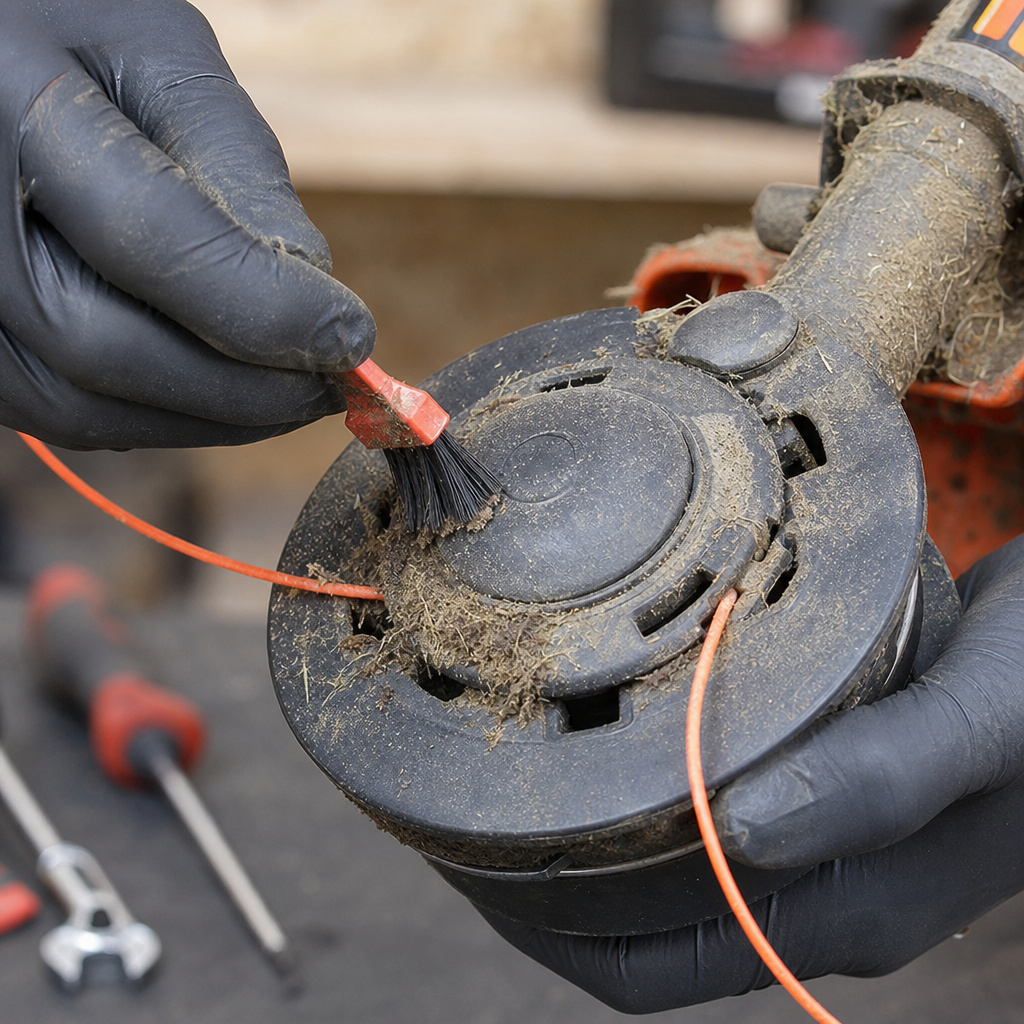
A string trimmer is a simple machine, but neglect the basics and it will fail at the worst possible moment. Maintenance isn’t about making it last forever; it’s about preventing the five most common failures that leave you with a useless tool and a half-finished job.
Before you start any maintenance: Disconnect the spark plug wire on gas models or remove the battery on cordless models. That spinning head can engage with a accidental bump, and the plastic blades are sharp enough to cause serious injury.
- Clean the Air Filter (Gas Models). A clogged air filter starves the engine of oxygen, causing it to run rich, bog down, and foul the spark plug. For a foam filter, wash it in warm soapy water, squeeze it dry, and apply a few drops of two-cycle oil before reinserting. Paper filters should be tapped clean or replaced. Do this every 10 hours of use or at season’s end. Skip it, and you’ll be cleaning the carburetor next.
- Use Fresh Fuel Mix. Two-cycle fuel goes stale in about 30 days. Old fuel forms varnish that clogs the carburetor’s tiny jets. The engine will either not start or will start and then die under load. Use a fuel stabilizer if you must store gas, or better yet, buy pre-mixed canned fuel like TruFuel. It’s more expensive per gallon, but it’s ethanol-free and lasts for years. I learned this after having to completely disassemble and clean the carburetor on a Stihl FS 56 RC-E, a two-hour job for a five-minute prevention.
- Inspect and Clean the Cutting Head. After every use, knock off caked-on grass and dirt. Every few months, remove the spool, clean out any wound-up grass, and check for wear on the bump-feed mechanism. Grass and mud act as grinding paste, wearing down plastic parts. A clean head feeds line smoothly.
- Check the Drive Shaft Lubrication. Many straight-shaft trimmers have a grease fitting near the gear head. A couple of pumps with a grease gun once a season keeps the gears turning smoothly. A dry gear head will whine, get hot, and eventually strip the nylon gears. You’ll know it’s happening by the high-pitched grinding noise and the smell of hot plastic.
- Store It Properly. For gas trimmers, run the engine until it stalls to empty the carburetor bowl, or add fuel stabilizer. For battery models, remove the battery and store it indoors in a climate-controlled space. Hanging the trimmer by its guard, rather than leaning it on its head, prevents the shaft from bending.
Never store a gas trimmer with fuel in the tank over the winter, especially with ethanol-blended gas. The ethanol attracts moisture, which separates in the tank and causes corrosion. By spring, you’ll have a gummed-up carburetor and a tank that may need replacement.
Troubleshooting Common Problems
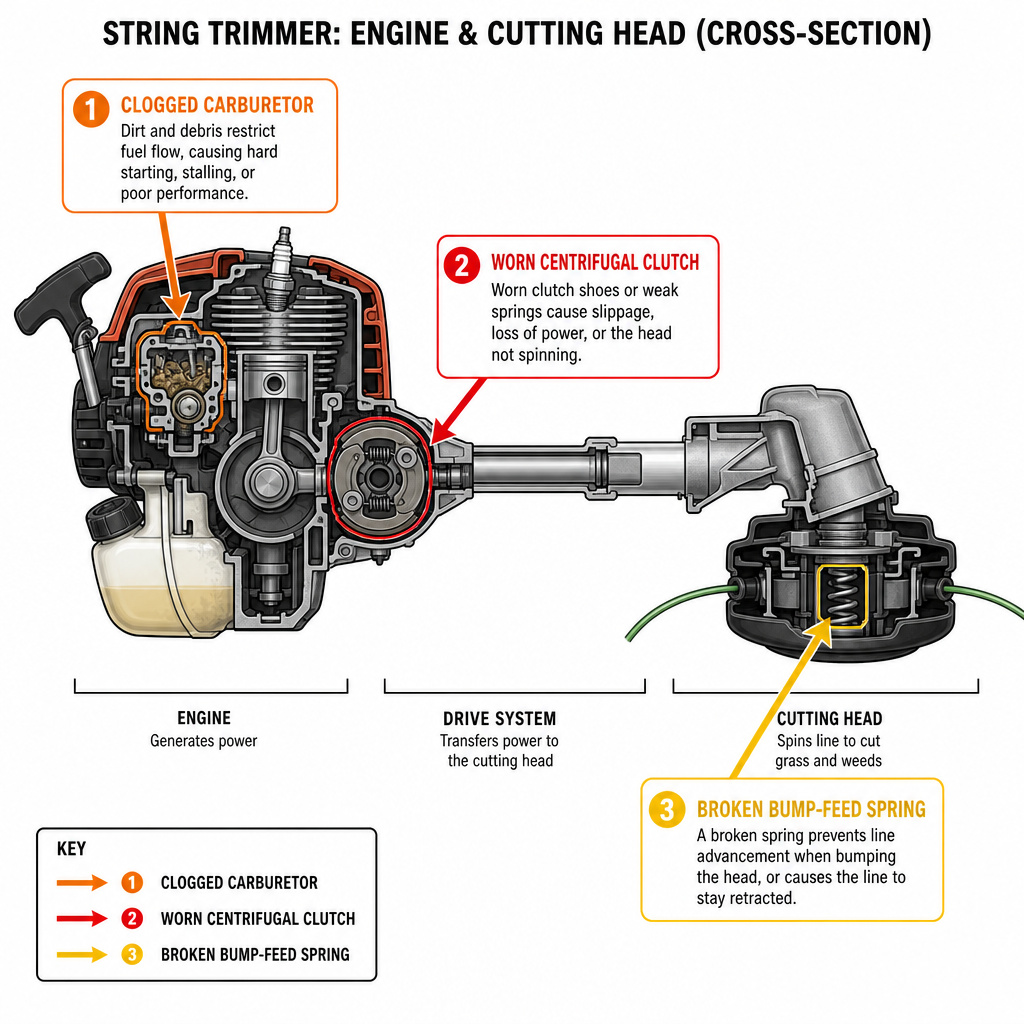
Your trimmer will talk to you. It makes specific sounds, emits specific smells, and behaves in specific ways when something is wrong. Learning this language saves a weekend and a repair bill.
Engine starts but dies when you give it throttle. This is almost always a fuel delivery issue. The carburetor is either clogged with old fuel varnish or the fuel filter inside the tank is blocked. On some models, the fuel line itself can crack and suck air. You’ll need to clean the carburetor, a kit with new gaskets and diaphragms is about $15, or replace the fuel line and filter.
Head spins slowly or not at all, but engine revs high. The centrifugal clutch is likely worn out. The shoes or weights inside no longer grip the drum when centrifugal force acts on them. You’ll hear the engine rev freely without the corresponding load noise from the head. Replacement is straightforward but requires opening the clutch housing.
Line feeds uncontrollably. On a bump-feed head, the spring inside is broken or has lost its tension. It no longer retracts the pawl after a bump, so the spool unwinds freely. On an automatic feed head, the mechanism is jammed with debris or broken. The fix is usually a head replacement. A universal bump-feed head costs about $20 and takes ten minutes to install.
Vibration and shaking. First, check for a bent drive shaft. This can happen if the trimmer is dropped or used to hit something solid. Second, the trimmer head itself might be unbalanced from uneven line wear or a damaged spool. Finally, on gas models, an engine misfire or loose mounting bolts can cause violent shaking. Ignoring vibration leads to fatigue for you and accelerated wear on every bearing in the tool.
A burning electrical smell from a corded or battery model. Stop immediately. This is the motor overheating or the wiring insulation burning. The thermal overload protector has likely failed, or debris has jammed the head, causing the motor to draw excessive current. Continuing will burn out the armature windings, a death sentence for the tool.
Frequently Asked Questions
What’s the difference between a string trimmer and a weed eater?
Nothing. “Weed eater” is a brand name that became generic, like “Kleenex.” Both refer to the same tool, a handheld device that uses a spinning nylon line to cut vegetation.
Can you cut grass with a string trimmer instead of a mower?
Technically, yes. Practically, it’s inefficient and hard on the trimmer. A string trimmer is designed for edges, tight spaces, and light weeds. Using it to cut an entire lawn will take forever, wear out line quickly, and likely overheat a battery-powered model. It’s a tool for finishing touches, not primary mowing.
Why does my trimmer line keep breaking?
Three main reasons: the line is old and brittle (nylon degrades in UV light), you’re using too thin a line for the vegetation, or you’re hitting hard objects like rocks, fences, or concrete. Swap to a fresh spool of the correct diameter and try to keep the cutting swath in grass and soft weeds.
How often should I replace the trimmer line?
Replace the entire spool when it’s about 80% used up or at the start of each season. Old line becomes brittle and snaps more easily, wasting your time. Don’t wait until you’re down to the last few feet mid-job.
Is it worth soaking trimmer line in water before use?
The old trick of soaking trimmer line to make it tougher is largely a myth. Modern nylon lines are formulated for flexibility and impact resistance. Soaking may slightly soften very stiff line, but it won’t prevent breakage from impact. Your effort is better spent choosing the correct line diameter and shape for your task.
My gas trimmer won’t start. What should I check first?
Follow the “fresh fuel, spark, air” rule. First, ensure you have fresh, properly mixed fuel in the tank. Second, check for spark by removing the spark plug, grounding it against the engine body, and pulling the starter rope (you should see a bright blue spark). Third, check that the air filter is clean and not clogged. Ninety percent of no-start issues are solved here.
The Bottom Line
A string trimmer is a simple machine with one job: spin a line fast enough to cut. The complexity comes from how it generates that spin, through a finicky two-cycle engine, a torquey electric motor, or a battery-powered drive, and how it manages the line feeding out. Understanding the centrifugal clutch, the fuel mix, and the bump-feed mechanism turns a mysterious, frustrating tool into a predictable piece of equipment. Keep the air filter clean, use the right line, and listen for the sounds of trouble. That’s the real work. The cutting part is just the reward.
