
Reciprocating vs Rotary Screw Air Compressor: The 4 Key Specs
This post contains affiliate links. As an Amazon Associate, we earn from qualifying purchases.
A reciprocating air compressor uses pistons to compress air in bursts, ideal for intermittent, high-pressure tasks. A rotary screw compressor uses twin helical rotors for a continuous, steady air flow, built for constant, high-volume industrial duty. The choice hinges on your required CFM, pressure, duty cycle, and acceptable noise level.
That piston-versus-rotor distinction is mechanical, but the real-world decision is about flow, runtime, and sound. A shop running one impact wrench needs a different machine than a body shop spraying paint all day.
What follows: a breakdown of the four specs that actually matter, the failure modes each type is prone to, and the specific models that define each category. By the end, you’ll be able to read a spec sheet in ten seconds and know which compressor type fits your air demand.
Key Takeaways
- Match duty cycle to runtime: Reciprocating compressors need rest (50-70% duty cycle); rotary screw units run continuously (100% duty cycle).
- Pressure isn’t the differentiator: Both types easily hit 125-175 PSI. Rotary screws excel at delivering high CFM (cubic feet per minute) steadily.
- Noise dictates placement: A reciprocating compressor hits 85-90 dB(A), ear protection required. A rotary screw runs at 70-75 dB(A), often tolerable in-shop.
- Oil changes are non-negotiable but different: Reciprocating pumps need oil changes every 500 hours; rotary screw air ends die from varnish without annual fluid service.
- Size and cost scale with air demand: For under 20 CFM, a piston compressor wins on price and footprint. Above 30 CFM, the rotary screw’s efficiency and longevity justify its higher initial cost.
The Core Mechanical Difference: Piston vs Rotor
A reciprocating compressor is a pump. A crankshaft drives pistons up and down inside cylinders. On the downstroke, an intake valve opens, pulling in air. On the upstroke, the valve closes and the piston compresses the air against the cylinder head, forcing it out through a discharge valve into a tank. This happens in pulses.
The compression cycle in a reciprocating compressor is intermittent. Each piston stroke delivers a discrete “slug” of compressed air, which is why tank size matters, it smooths out the pulsation for tools. The valves (reed or disc) are the highest-wear component, cycling open and shut with every piston stroke.
A rotary screw compressor is a continuous displacement machine. Two precisely machined, meshing helical rotors, one male, one female, spin in a sealed chamber. As they rotate, air is trapped in the cavities between the rotors and the housing. The cavity volume progressively decreases from the intake to the discharge end, compressing the air in a smooth, uninterrupted flow.
The mechanical gap dictates everything else. Pulsation versus smooth flow. Intermittent duty versus continuous duty. Hundreds of moving parts (pistons, rods, valves) versus two main rotating parts.
The 4 Specs That Actually Decide the Match
Forget brand loyalty. Your shop’s air demand answers the question. These four numbers from the spec sheet tell you which compressor type you need.
1. CFM Delivery: Steady Flow vs Tank-Dependent Burst
CFM (cubic feet per minute) is the volume of air the compressor can deliver at a specific pressure. It’s the most important number for matching tools.
A rotary screw compressor delivers its rated CFM continuously. The Sullair LS160, for example, outputs 985 CFM at 125 PSI as long as it’s running. The air flow doesn’t drop as the tank empties because the air end produces it directly.
A reciprocating compressor has two CFM ratings: pump delivery and usable air. The pump might deliver 24 CFM at 175 PSI (like the Champion RV-30A pump at 570 RPM). But your tools draw from the tank. You get a burst of high CFM until tank pressure drops, then the pump must restart to refill it. For a tool that needs 20 CFM constantly, a 24 CFM piston compressor will cycle on and off relentlessly.
| Your Air Demand | Reciprocating Fit | Rotary Screw Fit |
|---|---|---|
| Intermittent Use (nail gun, impact wrench) | Excellent. Tank supplies burst, pump refills during downtime. | Overkill. You’re paying for continuous flow you don’t use. |
| Constant, Low CFM (sanding, grinding at 10-15 CFM) | Good with large tank. Pump cycles but keeps up. | Very good. Runs smoothly at partial load. |
| Constant, High CFM (blast cabinet, plasma cutter at 30+ CFM) | Poor. Pump will run continuously, overheat, and fail early. | Required. Only a rotary screw can sustain this flow. |
2. Duty Cycle: How Long Can It Run?
Duty cycle is the percentage of time a compressor can run within a 10-minute period without overheating. This spec separates hobbyist gear from industrial equipment.
Where this goes sideways: Assuming a “5 HP” label means the same runtime. A 5 HP reciprocating compressor is typically rated for a 50-70% duty cycle, it must rest 3-5 minutes every 10. A 5 HP rotary screw compressor has a 100% duty cycle, it can run all day, every day.
The Champion RV-Series manual specifies regular cooldown periods. The Atlas Copco maintenance schedule for their CR-Series piston compressors includes an 8-hour daily visual inspection for a reason, these machines generate intense heat at the cylinder head.
A rotary screw like the Kaeser ASD 40 is designed for continuous duty. Its cooling system and oil-flooded compression chamber manage heat efficiently. This makes it the default for an automotive shop with multiple bays operating simultaneously.
3. Maximum Pressure: Both Can Hit High PSI
Pressure capability is not the deciding factor. Both compressor types are capable of high pressures.
- Reciprocating Compressors: Easily achieve 175 PSI for industrial use. The Quincy QR-25 Series is rated up to 175 PSIG. Two-stage piston compressors are particularly efficient at high pressure.
- Rotary Screw Compressors: Commonly deliver 125-150 PSI for plant air. Specialized designs, like the Johnson Controls Frick series for refrigeration, handle much higher pressures.
For most pneumatic tools (90-125 PSI), both types are sufficient. The question is whether you need that pressure at 5 CFM or 50 CFM.
4. Noise Level: The Shop Environment Factor
Sound pressure level, measured in dB(A), determines where you can place the compressor.
- Reciprocating Compressor: 85-90 dB(A). The piston slams, valves clatter, and the motor strains. This is near the volume of a lawn mower. It requires hearing protection for prolonged exposure and often mandates placement in a separate, ventilated room.
- Rotary Screw Compressor: 70-75 dB(A). The primary sound is the whir of the rotors and the rush of air. This is comparable to a vacuum cleaner. It can often be installed on the shop floor without causing communication issues.
The Champion Revolution quiet enclosed reciprocating compressor is an exception, using foam insulation to hit 62 dB(A). But that’s a specialty design. Most standard piston compressors are loud.
Noise, Space, and Upfront Cost
The practical constraints of your shop often make the final decision.
| Factor | Reciprocating Compressor | Rotary Screw Compressor |
|---|---|---|
| Noise | Loud (85-90 dB(A)). Often needs a separate compressor room. | Moderate (70-75 dB(A)). Can be installed in-shop. |
| Footprint | Vertical tanks save floor space. A Champion VRV10-12 (120 gal) is ~42″x34″. | Larger overall. A Sullair LS160 is 118″x76″—it needs a dedicated footprint. |
| Initial Cost | Lower upfront cost per CFM for small-to-medium units. | Higher upfront cost. You pay for continuous-duty engineering and materials. |
| Long-Term Cost | Higher electrical cost if cycling frequently. More frequent maintenance on valves and rings. | Lower electrical cost per CFM at constant load, especially with a VSD. Major maintenance (air end) is expensive but infrequent if serviced. |
For a home garage where runtime is short and budget is tight, the reciprocating compressor’s lower initial cost is decisive. In a production environment, the rotary screw’s quiet, continuous operation pays back its higher price in productivity and energy savings.
Maintenance Realities and Failure Modes
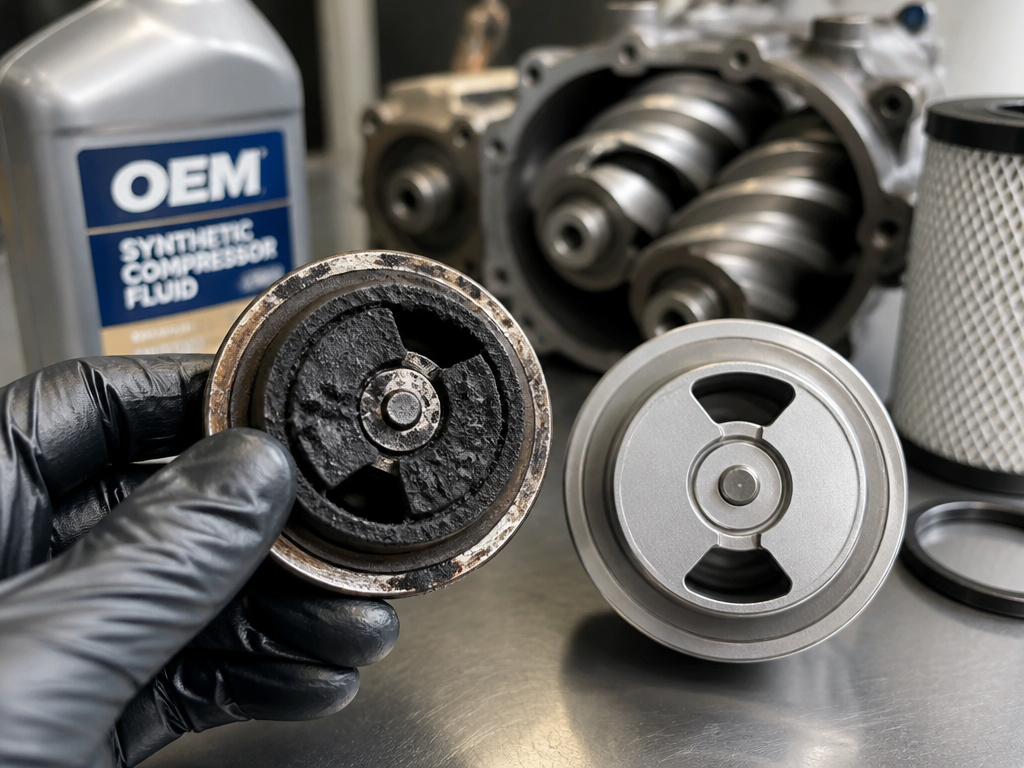
Each type fails in predictable ways. The maintenance schedule is your defense.
Reciprocating Compressor Maintenance (from Atlas Copco CR-Series manual):
- Daily: Check oil level, drain tank.
- Weekly: Clean intake filter.
- Every 500 hours (or 3 months): Change compressor oil. Use ISO 68 or ISO 100 weight as per ambient temperature.
- Every 1000 hours: Inspect compressor valves for carbon buildup and leakage.
Common mistake: Using automotive motor oil in a piston compressor. Detergents foam and cause carbon sludge that gums up the valves. Use a non-detergent, anti-wear compressor-specific oil like FS-Curtis FSC-Max.
Rotary Screw Compressor Maintenance:
- Daily/Weekly: Check fluid level, drain condensate from separators.
- Annually (or per hour meter): Change compressor fluid, oil separator, and air filter. This is critical.
The part nobody mentions: Varnish formation. As rotary screw fluid breaks down, it leaves a hard, lacquer-like coating on the rotors and internal passages. Sullair identifies this as “the leading cause of air end failure.” The fix is a complete teardown and cleaning, a four- or five-figure repair. Using the OEM-recommended synthetic fluid (like Sullube) and strict annual changes prevents it.
The maintenance intensity is different. A piston compressor needs more frequent, hands-on tinkering (valve inspections, ring checks). A rotary screw demands less frequent but more costly and disciplined fluid system service.
Which Compressor Type Wins for Your Job?

The answer is never “always one.” It’s a match between the machine’s capability and your air profile.
Choose a Reciprocating Air Compressor if:
- Your air demand is intermittent (e.g., tire changes, framing nailer).
- You need high pressure (over 150 PSI) for a specific tool.
- Your budget is limited and your required CFM is under 20.
- You have space for a separate, ventilated room to contain the noise.
- You don’t mind performing regular, hands-on maintenance.
The workhorse here is the Champion RV-Series. The RV-30A pump is a cast-iron beast used in countless industrial packages. For a quiet option, the Champion Revolution enclosed model is a clever design.
Choose a Rotary Screw Air Compressor if:
- You have constant, high-CFM demand (e.g., sandblasting, multiple tools running).
- You need 100% duty cycle for production work.
- Shop noise is a concern and you want the compressor on the floor.
- Your electrical cost is high and a Variable Speed Drive (VSD) model would save energy.
- You prefer less frequent, but scheduled, professional maintenance.
The baseline here is the Kaeser ASD 40 series, reliable, simple, and widely serviced. For larger demands, the Sullair LS Series with its next-gen air end is a top-tier industrial choice.
For the majority of home shops running an impact wrench and a few other tools, a quality two-stage reciprocating compressor like a Champion or Quincy on an 80-gallon tank is the correct, cost-effective answer. Step up to a rotary screw only when your air consumption bill justifies it.
Frequently Asked Questions
Can a reciprocating compressor run all day?
No. Most industrial-grade reciprocating compressors have a 50-70% duty cycle. They must rest for 3-5 minutes every 10 minutes of runtime to manage heat. Running one continuously will overheat the pump, cook the oil, and cause rapid valve failure.
Are rotary screw compressors more efficient?
At constant, high load, yes. A rotary screw’s mechanical action is inherently efficient for steady output. For intermittent, low-load use, a standard fixed-speed rotary screw can be less efficient than a piston compressor because it still uses significant power even at idle. A Variable Speed Drive (VSD) rotary screw solves this by matching motor speed to demand.
Which type lasts longer?
With proper maintenance, both can last decades. However, a rotary screw compressor under constant load will typically outlast a reciprocating compressor under the same load because it has fewer high-impact wearing parts (no pistons slamming, valves slapping). Neglect kills either type faster than design.
Is a “two-stage” reciprocating compressor like a rotary screw?
No. A two-stage compressor simply compresses the air in two steps (cylinders) to achieve higher pressure more efficiently and with less heat than a single-stage piston compressor. It is still a reciprocating, intermittent-duty machine. It does not provide the continuous, smooth flow of a rotary screw.
What size rotary screw replaces a 5 HP piston compressor?
Match CFM, not horsepower. A typical 5 HP, two-stage piston compressor might deliver 18-20 CFM at 175 PSI. You’d look for a rotary screw compressor that delivers at least that CFM at your required pressure, which might be a 3-5 HP rotary screw model. Always compare the actual CFM ratings on the spec sheets.
Before You Go
Stop comparing horsepower. Start comparing CFM at your working pressure and duty cycle. Listen to the noise floor you can live with. Read the real maintenance intervals from the manual, not the sales brochure.
For intermittent shop work, the robust simplicity of a piston compressor is hard to beat. When the air demand becomes a constant hum in your daily operation, the smooth, quiet endurance of a rotary screw pays for itself. Your tools don’t care which one feeds them, as long as the air is clean, dry, and enough.
