
What Color Are Metal Drill Bits? A Guide to Their Coatings
This post contains affiliate links. As an Amazon Associate, we earn from qualifying purchases.
Metal drill bits are most commonly black, gold, or a silver-bright finish. Black usually indicates a black oxide coating on High-Speed Steel (HSS) for corrosion resistance. Gold typically means a Titanium Nitride (TiN) coating on HSS for heat resistance and longer life. A plain silver color often signifies uncoated, precision-ground HSS. Bronze or copper tones usually point to solid cobalt steel (HSS-Co5), a tougher material for hard metals like stainless steel.
The coating or material that creates that color directly changes what the bit can cut and how long it lasts. A black oxide bit will rust if you leave it in a damp toolbox, while a gold TiN bit can handle the heat of drilling stainless steel without softening as quickly.
This isn’t about memorizing a simple chart. You need to know which finish works for your garage projects, why a “gold” bit might still be wrong for stainless steel, and how to spot a cheap bit that’s only colored to look premium. What follows breaks down the four main colors, the specific products behind them, and the one mistake that turns a $5 bit into a smoking, dull stump.
Key Takeaways
- Color signals coating or material, not a universal standard. A gold bit is usually TiN-coated HSS, but a bronze bit is solid cobalt steel, two different things for different jobs.
- Black oxide bits are for general-purpose drilling in soft steel, wood, and plastic. They resist rust but wear faster than coated bits; the Bosch Impact Tough line adds an impact-rated shank.
- Titanium Nitride (TiN) gold coating triples bit life on HSS by resisting heat and friction. It’s excellent for production work in non-ferrous metals like aluminum, but not for hardened steel.
- Cobalt steel bits (bronze color) are a material upgrade, not just a coating. They withstand the high heat of drilling stainless steel and hardened alloys where HSS bits fail.
- Ignore color on no-name bits. Some manufacturers use decorative paint that chips off. Check for laser-etched size markings and buy from reputable brands like IRWIN, Bosch, or DeWalt.
The Core Color Code for Metal Drilling
Forget guessing. The color on a drill bit is a functional label, a direct result of its final manufacturing step. That black, gold, or bronze finish is either a surface treatment applied to the base steel or the natural hue of the alloy itself. This code tells you about heat resistance, lubricity, and the type of metal you should attack.
Black Oxide, Titanium Nitride (TiN), and Cobalt (HSS-Co5) are the primary finishes for metal drilling bits. Black oxide is a conversion coating offering corrosion resistance. TiN is a ceramic coating applied via PVD, increasing surface hardness to ~2300 HV and heat resistance to 1100°F (600°C). Cobalt refers to the steel alloy itself, typically containing 5-8% cobalt for red-hardness.
This system exists because drilling metal generates intense, localized heat. A standard HSS bit will lose its temper, its hardened edge, somewhere around 600°F. A coating or better alloy raises that ceiling, letting you drill longer, faster, and through tougher materials. The wrong color choice means watching your bit glow cherry red and turn to mush.
Black Oxide: The Workhorse Finish
Black oxide isn’t a plating; it’s a magnetite layer chemically grown on the surface of the steel. It provides minimal increase in hardness but excellent corrosion resistance and reduces glare. For the home gamer, this is your go-to for 90% of tasks: drilling mild steel, aluminum, plastic, and wood.
Why it works: The process leaves a porous surface that holds oil, providing a slight lubricity that reduces friction. It’s a cheap, effective way to keep a bit from rusting in your drawer.
Where it falls short: It wears off quickly under abrasive conditions. Drilling cast iron or stainless steel will strip the coating in a handful of holes, after which you’re left with a plain HSS bit.
Common mistake: Using a black oxide bit for stainless steel or cast iron. The coating abrades away within seconds, and the underlying HSS isn’t tough enough for the job. You’ll smell burnt steel before the hole is finished.
For a robust version of this, look at the Bosch Impact Tough Black Oxide Drill Bits. They add an impact-rated hex shank, which is overkill for a drill press but prevents slippage in a high-torque cordless impact driver. It’s a design acknowledging that most DIYers now drive holes with the same tool they drive screws.
Gold Standard: Titanium Nitride (TiN) Coating
The familiar brassy-gold color comes from a micron-thin layer of Titanium Nitride applied by Physical Vapor Deposition. This isn’t paint; it’s a super-hard ceramic coating. According to the Ruko specification sheet, this coating boosts surface hardness to approximately 2300 HV and allows the bit to withstand temperatures up to 1100°F (600°C).
Why it’s a game-changer: The coating drastically reduces friction. Less friction means less heat transferred into the bit, which preserves the HSS underneath. Manufacturer claims of 3x to 6x longer life are real in consistent workshop use. The slick surface also helps chips evacuate the flutes more cleanly.
The catch: TiN is a coating on an HSS core. If you drill something harder than the coating is rated for (like hardened tool steel), you’ll chip or wear through it. Once breached, you’re back to a standard HSS bit. It’s a performance enhancer, not a material transformer.
A prime example is the IRWIN TURBOMAX Titanium series (like set #3018003). These bits combine the TiN coating with a 135° split point that’s supposed to prevent “walking.” For drilling aluminum, bronze, or mild steel in a production setting, they’re exceptional. For a one-off hole in a hardened steel bracket, you’d want cobalt.
Material Over Coat: Cobalt and Plain HSS
Sometimes the color is the material. This is the critical distinction that separates a coated bit from a fundamentally tougher one.
The Bronze Performer: Cobalt Steel (HSS-Co5/Co8)
Bits with a distinctive bronze or copper hue are usually made from cobalt high-speed steel, often designated HSS-Co5 (5% cobalt) or HSS-Co8. The color isn’t a coating; it’s the natural color of the alloy after heat treatment. Cobalt increases the bit’s “red-hardness”, its ability to hold an edge at the red-hot temperatures generated by drilling stainless steel, cast iron, and titanium.
Where this goes sideways: Confusing a gold TiN-coated HSS bit for a cobalt bit. The TiN bit is better for fast, abrasive wear in softer metals. The cobalt bit is better for the extreme pressure and heat of hard alloys. If your gold bit is smoking and dulling on stainless, you likely have a coated HSS bit, not a cobalt one.
When to reach for cobalt: Any project involving stainless steel, hardened steel, or cast iron. The IRWIN 29-Piece Cobalt M42 HSS Set (3018002B) is a classic choice. The M42 grade includes 8% cobalt, and the set’s 135° point angle is optimized for hard metals. You’ll pay more, but you’ll drill the holes instead of burning through a pack of cheaper bits.
Bright Finish: Uncoated High-Speed Steel
A plain, silvery-metal bit is precision-ground High-Speed Steel with no coating. This is often called a “bright finish” or “jobber length” bit in industrial catalogs. They’re the baseline.
The pros: They’re usually the cheapest. You can easily resharp them on a bench grinder. For low-volume work in soft materials where corrosion isn’t a concern, they’re perfectly adequate.
The cons: They offer no corrosion resistance and will dull fastest. In a professional or even serious DIY context, starting with a coated or cobalt bit is almost always more economical in the long run. You spend less time changing bits and resharpening.
Decoding the Drill Bit Aisle: A Decision Table
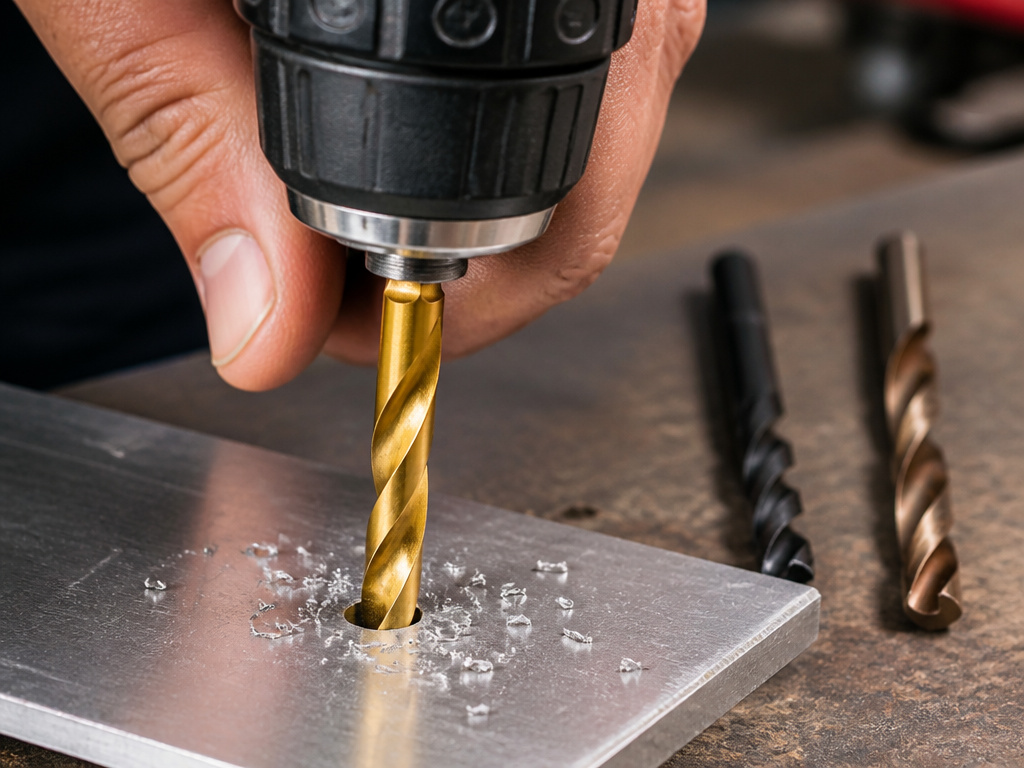
Use this table to cut through the marketing. It matches the visual cue to the underlying tech and the real-world job.
| Color / Finish | What It Usually Is | Best For Drilling… | Lifespan vs. Plain HSS | Top-of-Mind Example |
|---|---|---|---|---|
| Black / Matte Gray | Black Oxide coating on HSS | Mild steel, aluminum, wood, plastic | 1.5–2x longer | Bosch Impact Tough Black Oxide |
| Brassy Gold | Titanium Nitride (TiN) coating on HSS | Aluminum, bronze, mild steel, plastic (high-speed production) | 3–6x longer | IRWIN TURBOMAX Titanium Set |
| Bronze / Copper | Solid Cobalt Steel (HSS-Co5/Co8) | Stainless steel, cast iron, hardened steel, titanium | 5–8x longer on hard metals | IRWIN Cobalt M42 Set |
| Silver / Bright | Uncoated High-Speed Steel (HSS) | Soft steel, wood, plastic (low-volume, general use) | Baseline (1x) | Generic jobber-length HSS bits |
| Black & Gold | Black Oxide with Gold highlights (e.g., NITRO) | Heavy-duty drilling in hard metals (marketing varies) | Manufacturer-specific | NITRO Heavy-Duty HSS Drills |
The bottom line: Need to hang a shelf in mild steel? Black oxide. Building an aluminum patio frame? Gold TiN. Fixing a stainless steel sink? Bronze cobalt. Don’t overthink it, but don’t under-equip yourself either.
Why Color Alone Can Lie: The Imposter Bits
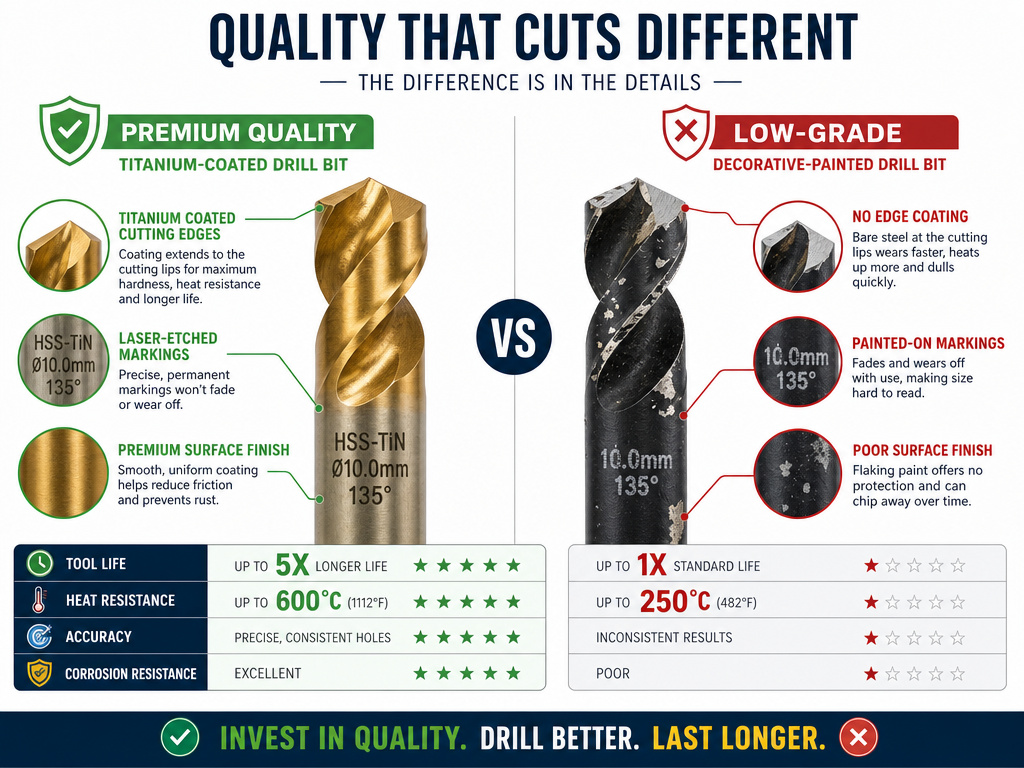
Here’s the part the packaging won’t show you. Color is a useful guide, but it is not a guarantee. The market is flooded with budget bits where the color is purely decorative, a paint or dye applied to cheap, low-grade steel.
How to spot a fake:
- Check the markings. A quality bit will have its size and often the material (e.g., “HSS-Co”) laser-etched or stamped clearly. Faded, painted-on markings rub off.
- Look at the cutting edges. Under a bright light, the cutting lips of a coated bit should still show the coating. On a fake, the color often stops at the flute, and the cutting edge is bare, softer steel.
- Consider the source. A no-name 100-piece set for $20 is almost certainly selling you color, not performance. The steel hasn’t been heat-treated properly and won’t hold an edge.
The failure mode is predictable and quick. The decorative coating flakes off during the first hole. The bit overheats instantly, loses its hardness, and either snaps or simply stops cutting, leaving you with a polished, useless dimple in your workpiece. It’s the single biggest waste of time and money in the drill bit world.
Worth knowing before you start: If a drill bit feels unusually light for its size or has a rough, cast-looking surface instead of a smooth grind, put it back. Good steel has a certain heft and precision to it you learn to recognize.
Frequently Asked Questions
What does a gold drill bit mean?
Gold color almost always means a Titanium Nitride (TiN) coating. This ultra-hard ceramic layer is applied to a High-Speed Steel bit to reduce friction and heat buildup, allowing for faster drilling and a lifespan 3 to 6 times longer than uncoated HSS. It’s excellent for non-ferrous metals like aluminum and for high-volume work in mild steel.
Are black drill bits for metal?
Yes, black drill bits, specifically those with a black oxide finish, are for metal. They are a standard choice for drilling mild steel, aluminum, and other soft metals. The black oxide provides rust resistance and minor lubricity. However, they are not suitable for hardened or stainless steel, where a cobalt bit is required.
What is the difference between cobalt and titanium drill bits?
This is a critical distinction. “Titanium” bits are High-Speed Steel bits with a gold Titanium Nitride coating. “Cobalt” bits are made from a different steel alloy containing 5-8% cobalt throughout the entire bit. Cobalt bits are materially tougher and more heat-resistant, designed for drilling hard metals like stainless steel. The coating on a titanium bit will wear off if used on such materials.
Can I use any drill bit for metal?
No. You must use bits specifically designed for metal, which are made from High-Speed Steel (HSS), cobalt, or carbide. Wood and masonry bits have completely different tip geometries and materials that will fail instantly on metal. Using the wrong bit is a sure way to break it, ruin your workpiece, or cause injury from flying shrapnel.
Why are some drill bits silver?
Bright silver finish means the bit is made of uncoated High-Speed Steel (HSS). It’s the basic, most economical option. These bits work fine for occasional use in soft metals, wood, and plastic but lack the corrosion resistance and enhanced performance of coated or alloyed bits. They are often sold as “jobber length” bits in bulk for industrial settings.
Before You Go
Drill bit color is a shortcut, not scripture. Black oxide is your everyday rust-resistant workhorse. That flashy gold TiN coating is for beating the heat in aluminum and production runs. When the metal turns tough and your drill starts screaming, the bronze hue of solid cobalt steel is what gets the job done.
Ignore the color on bargain-bin bits. Look for the laser etching, feel the heft, and stick with names that have a reputation to uphold. Your next project isn’t about the color you start with, it’s about the clean hole you finish with. Grab the bit that matches the metal, not just the prettiest one in the tray.
