
How to Refill an Air Compressor and Avoid Common Failures
This post contains affiliate links. As an Amazon Associate, we earn from qualifying purchases.
To refill an air compressor, you add the correct type and amount of lubricating oil to the pump’s crankcase, not the air tank. The process requires depressurizing the system, draining old oil if needed, and filling to the midpoint of the sight glass or dipstick. Using the wrong oil or overfilling causes premature pump failure within weeks.
That “correct oil” clause is where most DIY guides stop. They don’t tell you that the oil’s job changes after the first fifty hours of run time. The initial fill flushes manufacturing debris. The second fill is for lubrication alone, and missing that switch-over window is how pumps start knocking.
What follows: the exact oil specs from five OEM manuals, the one tool that makes refilling clean, and the daily habit that prevents the tank from rusting through from the inside. By the end you’ll know which of the three common compressor failures you’re actually preventing with each step.
Key Takeaways
- The first oil change is critical. Rolair mandates a change after the first 50 hours of operation to remove break-in debris; skipping this accelerates wear.
- SAE 30 non-detergent motor oil is the default for most pumps under 90°F, but synthetic compressor oil (like Ingersoll Rand’s) lasts longer and runs cleaner if your system’s seals and hoses are compatible.
- Overfilling the crankcase is as destructive as running dry. Excess oil aerates, loses its cooling ability, and can blow past piston rings into the discharge air.
- Drain the air tank daily, without exception. Humidity condenses inside the steel tank every cycle; stagnant water corrodes the bottom seam until it leaks or, in extreme neglect, ruptures.
- The fill point is always on the pump’s crankcase, marked by a dipstick or a round sight glass. Never add oil to the pressure switch, motor, or air tank.
The Oil Isn’t for the Tank. It’s for the Pump
You refill the crankcase, not the reservoir. The pump’s moving parts, the crankshaft, connecting rods, and piston rings, need a constant oil film to prevent metal-on-metal contact. The air tank stores dry, compressed air. Putting oil in the tank coats your tools in a fine mist and can damage paint sprayers or pneumatic sensors.
The crankcase holds a surprisingly small amount. A 5-horsepower Ingersoll Rand TS4 holds just 40 ounces (1.2 liters). That small volume circulates rapidly, so its condition degrades faster than engine oil in a car. Contaminants like moisture and carbon particles accumulate quickly.
A milky, foamy appearance in the oil sight glass means water has contaminated the lubricant. This sludge accelerates wear on bearings and cylinder walls. In humid environments, consider running the compressor for longer continuous periods to keep the pump hot enough to boil off condensation.
The 50-Hour Rule Every Manual Buried
Manufacturer break-in procedures are not suggestions. Rolair’s owner’s manual for models like the 5715 and 6820K17D states plainly: “Replace the oil after the first 50 hours of operation.”
This initial interval removes microscopic metal shavings from new parts wearing in. Ignoring it lets those particles act as grinding compound. The pump will still run, but you’ll hear a faint tapping noise within another hundred hours. By then, the bearing surfaces are scored.
How to Choose the Right Compressor Oil
The wrong oil voids warranties and kills pumps. The right one depends on your pump type, ambient temperature, and whether you’ve committed to a synthetic blend.
| Oil Type | Best For | Do Not Use If | Common Brand/Standard |
|---|---|---|---|
| SAE 30 Non-Detergent | Standard mineral oil for most reciprocating pumps in temps under 90°F (32°C). | Your manual specifies synthetic, or ambient temps consistently drop below 40°F (4°C). | Conventional motor oil (Mobil, Shell) marked Non-Detergent. |
| Synthetic Compressor Oil | Extended drain intervals (up to 2,000 hours), high-temperature operation, or very cold startups. | Your system has incompatible seals (some older Buna-N rubber) or PVC discharge lines. | Ingersoll Rand Ultra Coolant, Rolair Syn-1. |
| 20W-20 Non-Detergent | Cold climates where standard SAE 30 would be too viscous for easy starting. | General-purpose use in warm workshops; it thins out faster under load. | Less common; check manual for specific weight. |
Synthetic oil is not a universal upgrade. Ingersoll Rand warns that synthetic lubricant requires compatible system materials. If your air hoses, tank coatings, or seal compounds aren’t on their compatibility list, the oil can degrade them.
Stick with the manufacturer’s first recommendation. For a general-purpose home garage compressor, a quality SAE 30 non-detergent is the safe default. The cost difference between synthetic and conventional matters less than the cost of a pump rebuild.
The Step-by-Step Oil Refill (With Pictures)
This process assumes you are changing old oil. For a simple top-up, skip to step 4.
Before you start: The pump and air tank are under pressure. The oil may be hot enough to burn skin. Wear safety glasses and gloves. Work in a well-ventilated area.
- Depressurize the System. Turn the compressor off and unplug it. Pull the pressure release valve ring on the tank until the gauge reads zero. Wait two minutes. Open the tank drain valve briefly to confirm no pressure remains.
- Locate the Drain Plug. Find the crankcase drain plug, usually a hex-head bolt on the pump’s bottom or lower side. Place a drain pan (an old dish tub works) underneath.
- Drain the Old Oil. Remove the drain plug and the oil fill cap to allow air flow. Let it drain completely, this takes a few minutes. Inspect the oil. Metal flakes signal wear; a milky color means water contamination.
- Clean and Reinstall the Drain Plug. Wipe the plug clean, check its sealing washer, and reinstall it snugly. Do not overtighten into the soft crankcase aluminum.
- Add New Oil. Find the fill port on the crankcase side, marked “Oil.” Use a long-neck funnel to avoid spills. Add oil slowly, pausing to check the level via the sight glass or dipstick.
- Check the Level. The correct level is at the center of the sight glass or between the two marks on the dipstick. Do not fill to the top. Replace the fill cap tightly.
- Run a Test Cycle. Plug in the compressor, open the tank valve, and let it cycle to cut-out pressure. Check for leaks around the drain and fill plugs. Listen for unusual knocking, a sign of air in the oil system that should clear after a minute.
Where this goes sideways: Adding oil with the tank pressurized. The positive pressure inside the crankcase can blow oil back out the fill hole, creating a messy geyser and leaving the pump underfilled. Always verify zero pressure first.
Draining the Tank Isn’t Optional
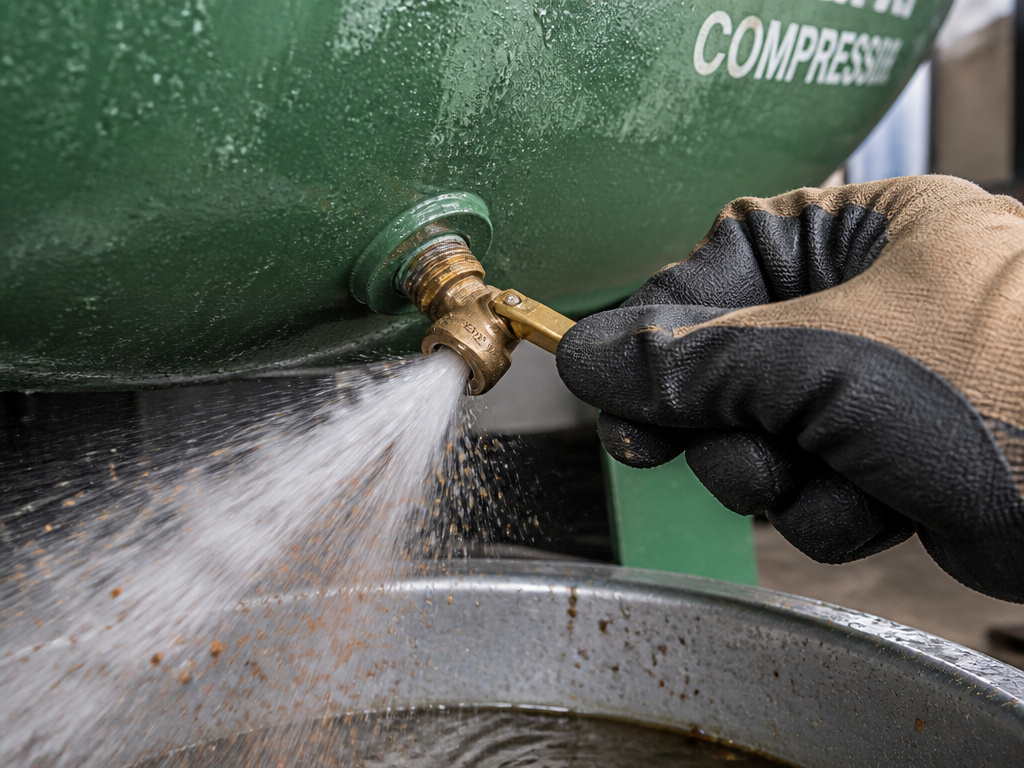 Refilling oil maintains the pump. Draining the tank preserves the entire machine. Compressing air squeezes out water vapor, which condenses on the cool inner walls of the steel tank. That water sits against the metal, starting a rust patch that grows with every cycle.
The ABAC manual states moisture accumulation “will increase as humidity in the air increases.” In a humid climate, a tank can collect a cup of water in a week of light use.
Drain every time you finish using the compressor. The procedure is simple: * Turn off and depressurize the compressor. * Open the manual drain valve at the tank’s lowest point. * Let air and water blast out until only a steady stream of air remains. * Close the valve firmly.
If your drain valve is hard to reach, install an automatic drain valve. It purges moisture on a timer or with each compressor cycle. It’s the single best upgrade for a compressor that lives in a busy garage.
What Most People Get Wrong About Refills
Three mistakes cause almost all preventable compressor failures. They seem minor until the repair bill arrives.
Overfilling the crankcase. The Husky manual cautions: “Overfilling with oil will cause premature air compressor failure.” Excess oil gets whipped into foam by the crankshaft. Foamy oil doesn’t lubricate or cool. It can also force its way past piston rings into the compressed air stream, coating your tools and project surfaces.
Using automotive motor oil. Detergent oils contain additives that suspend contaminants. In a compressor, these additives can foam and create carbon deposits on hot valve surfaces. Always use non-detergent oil unless your manual explicitly approves a detergent type.
Ignoring the air filter. A clogged intake filter makes the pump work harder, raising operating temperature and speeding oil breakdown. Check the foam filter every 25 hours of use. Clean it with mild soap and water, let it dry completely, and re-oil it lightly with the same compressor oil before reinstalling. A clean filter is as important as clean oil for a home shop compressor.
Essential Tools and Accessories for the Job
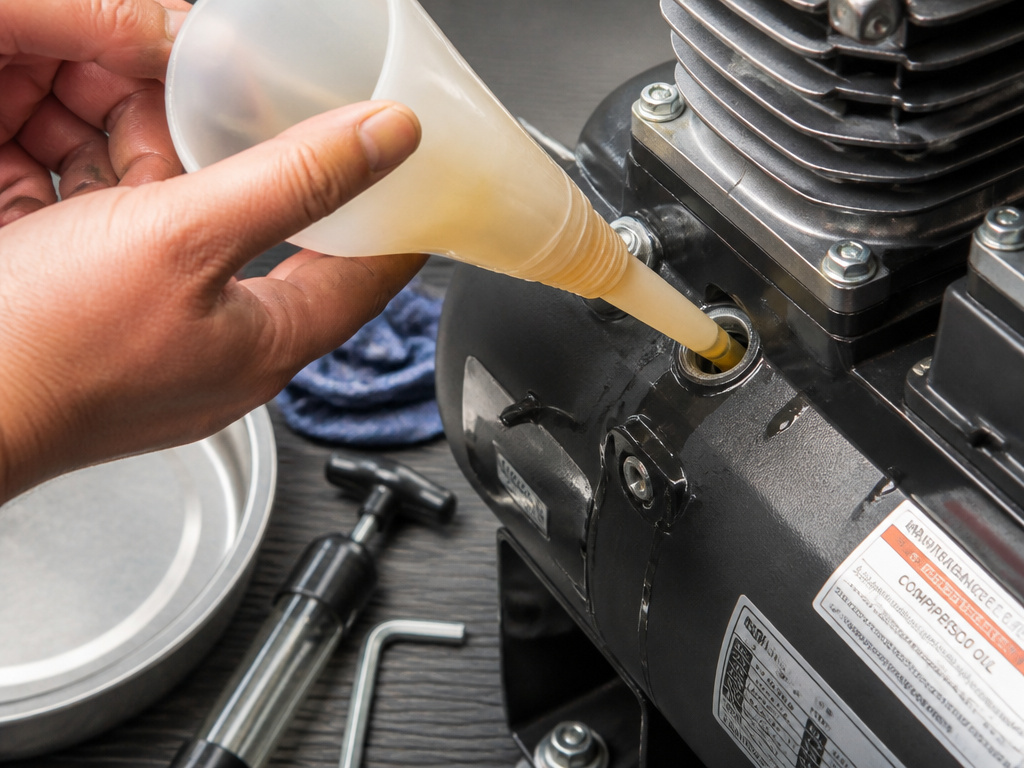 You need more than a jug of oil. This short list saves time and prevents spills.
- Long-Neck Funnel: A must for reaching the fill port on a recessed pump. The plastic ones for automotive oil work perfectly.
- Drain Pan: A shallow, wide pan to catch the old oil. A disposable aluminum baking pan is a cheap, effective option.
- Lint-Free Rags: For wiping the dipstick and cleaning up drips. Paper towels can leave fibers behind.
- Correct Wrench: Usually a 3/8″ or 1/2″ hex key for the drain plug. Use the right size to avoid rounding the bolt head.
- Oil Suction Pump (Optional): For compressors without a drain plug, a fluid extractor lets you pull oil out through the fill tube.
While you’re maintaining the system, check your air hose for cracks and your fittings for leaks. A small investment in a quality air compressor accessory kit keeps everything running smoothly and extends the time between major services.
Frequently Asked Questions
Can I use synthetic blend motor oil in my air compressor?
No. Synthetic blend motor oils still contain detergents and other additives not formulated for the high-temperature, high-moisture environment of a compressor pump. Use only oil labeled as non-detergent or specifically formulated for air compressors. For synthetic benefits, buy a dedicated synthetic compressor oil like Mobil Rarus or Ingersoll Rand’s formula.
How often should I change the oil if I barely use my compressor?
Change it annually, regardless of hours. Oil absorbs moisture from the air over time, even when the compressor sits idle. This leads to acidic sludge and internal corrosion. An annual change is cheap insurance for a compressor for your garage that sees seasonal use.
My oil turns black very quickly. Is that normal?
Yes, for mineral oils. Unlike engine oil, compressor oil doesn’t have detergents to hold carbon in suspension. The carbon from normal combustion (yes, tiny amounts occur even in electric compressors) and heat cycles will darken the oil rapidly. As long as it isn’t milky or filled with metallic glitter, dark color alone isn’t a failure sign. Synthetic oils stay cleaner longer.
What happens if water gets in the oil?
Water causes the oil to emulsify, turning it a creamy tan color. This sludge is a poor lubricant. It leads to increased friction, overheating, and accelerated wear on bearings and cylinder walls. If you see milky oil, drain it immediately. Fix the source of moisture, often a compressor stored in a cold, damp space, before refilling.
Is there an alternative to manual tank draining?
Yes. An automatic tank drain valve is a worthwhile upgrade. It electronically opens for a few seconds at set intervals to expel water. This guarantees drainage even if you forget, drastically reducing the risk of internal tank corrosion. It’s one of the best additions for long-term compressor health.
The Bottom Line
Refilling an air compressor is straightforward once you know the pump takes the oil, not the tank. Follow the 50-hour rule for the first change, use SAE 30 non-detergent as your default, and never overfill the crankcase.
The real secret isn’t in the refill procedure itself. It’s in the daily tank drain. That five-second habit is what stops the rust that kills tanks. Pair that with a quality air compressor oil and a clean filter, and your compressor will outlast the projects you use it for.
