What Material Is Drilled with a Hammer Drill? Top Surfaces
This post contains affiliate links. As an Amazon Associate, we earn from qualifying purchases.
A hammer drill is designed for hammer drilling (percussion drilling) into hard, brittle materials like concrete, brick, and stone. It can also drill without hammering into wood, metal, ceramic, and plastic when you switch it to drill-only mode and use the correct bit. The tool’s function selector and your choice of drill bit decide what you can, and cannot, safely drill.
That distinction between hammer mode and drill mode is the whole game. It’s not a stronger drill; it’s a different tool that toggles between two mechanisms. Get the mode wrong, and you burn out bits, stall the motor, or crack the workpiece.
What follows: the four material categories your hammer drill actually handles, pulled straight from manufacturer manuals. The one setting mistake that destroys tile. And why you’d ever pick a rotary hammer instead.
Key Takeaways
- Use hammer mode only with carbide-tipped masonry bits for concrete, brick, cinder block, and natural stone.
- Switch to drill-only mode for wood, metal, plastic, and ceramic, using hammer action here snaps bits and damages the workpiece.
- Cast iron and brass are the exception: drill them dry, without cutting lubricant, per the DeWalt D25333 manual.
- Never use hammer mode on ceramic tile or glass; the impact energy will crack it. The Powerworks POWDP15640 manual explicitly warns against this.
- For holes larger than 1 inch (25.4 mm) in concrete or frequent heavy-duty work, a rotary hammer or SDS-Plus drill is the right tool, not a standard hammer drill.
The 4 Material Categories a Hammer Drill Is Built For
Your hammer drill’s manual isn’t marketing. It’s a spec sheet that tells you exactly what the motor, clutch, and hammer mechanism are rated to handle. Ignoring it turns a $150 tool into a paperweight in one afternoon.
Technical Snapshot: A hammer drill delivers rapid, short-impact blows (measured in Joules, e.g., 3.5 J for the DeWalt D25333) while the bit rotates. This percussion action fractures brittle materials like concrete, allowing the fluted bit to clear debris. In drill-only mode, the hammer mechanism disengages, providing pure rotation for cutting tasks.
1. Concrete, Brick, and Masonry (Hammer Mode REQUIRED)
This is the job the tool was invented for. The hammering action chips away at the hard, granular surface, while the rotation spirals the dust out. Carbide-tipped masonry bits are non-negotiable here; their hardened tips withstand the pounding that would shatter a standard high-speed steel bit.
The capacity matters. A homeowner-grade model like the Ryobi P2140 is rated for concrete up to 30 mm (about 1-3/16 inch). A more robust tool like the Makita M8103 lists a 13 mm capacity in concrete. Pushing beyond these limits overheats the tool, wears the bearings, and produces ragged, off-center holes.
2. Wood, Plastic, and Composites (Drill Mode ONLY)
The second you switch to hammer mode on wood, you’re asking for trouble. The impacts will splinter the wood, create a rough, oversized hole, and prematurely dull a good wood bit. For clean holes, you need pure rotation.
The Ryobi SDS65 manual is clear: for wood, use “rotation only” action. A standard twist bit or spade bit works perfectly. The hammer drill’s variable speed and high torque make it excellent for driving large lag screws or boring through thick lumber, but only when the hammering is turned off.
3. Metal (Drill Mode ONLY, with a Caveat)
Drilling metal with a hammer drill is fine, in drill mode. You need sharp, high-speed steel twist bits and, for most metals, a cutting lubricant to keep the bit cool and extend its life.
Where this goes sideways: Drilling cast iron or brass. The DeWalt D25333/D25334 manual specifies these as exceptions: they “should be drilled dry.” Adding oil or lubricant can cause the fine metal particles to clump, creating a grinding paste that accelerates wear on the bit.
The hammer mechanism provides zero benefit on metal and a lot of risk. The vibrations can work-harden stainless steel, making it tougher to drill through, and will quickly ruin the precise cutting edges of a metal bit.
4. Ceramic Tile and Glass (Drill Mode ONLY, Extreme Caution)
This is the most common point of failure. The instinct is to reach for hammer mode on tough tile, but that’s exactly what shatters it.
The Powerworks POWDP15640 manual states plainly: “Don’t use the hammer drill function for ceramic tile or other material that cannot withstand impact energy.” You need a diamond-tipped or carbide spear-tip bit designed for glass and tile, running at a slow, consistent speed in pure drill mode. Let the bit’s abrasiveness do the work, not force.
The Right Bit for the Job Is Not a Suggestion
The bit is the translator between your tool’s power and the material. Using the wrong one is like using a screwdriver as a chisel, it might work once, but the failure is built in.
| Material | Bit Type | Critical Setting | What Happens If You Get It Wrong |
|---|---|---|---|
| Concrete, Brick | Carbide-tipped masonry bit | Hammer + Rotation | Bit dulls immediately, hole is slow and messy, motor overheats. |
| Wood | Twist bit, spade bit, hole saw | Rotation Only (Drill) | Wood splinters, hole is oversized, bit binds and can kick back. |
| Metal | High-speed steel (HSS) twist bit | Rotation Only + Lubricant* | Bit overheats and loses temper (goes blue), dulls fast, stalls drill. |
| Tile/Glass | Diamond core or carbide spear tip | Rotation Only, Low Speed | Tile or glass cracks radially from the hole, bit skates and scratches surface. |
| *Except cast iron & brass: drill dry. |
The shank type is the next decision. Most hammer drills use a keyless chuck for standard round-shank bits. For serious masonry work, an SDS-Plus system is far superior. The bit locks in with a positive grip that handles the hammer force better and allows for quicker changes. Trying to use a standard chuck adapter in hammer mode is a shortcut to breaking the adapter and damaging the tool’s spindle.
For a deep dive on selecting bits, our guide on concrete drill bit features breaks down the geometry that makes a masonry bit work.
Hammer Drill vs. Rotary Hammer: When Your Tool Isn’t Enough
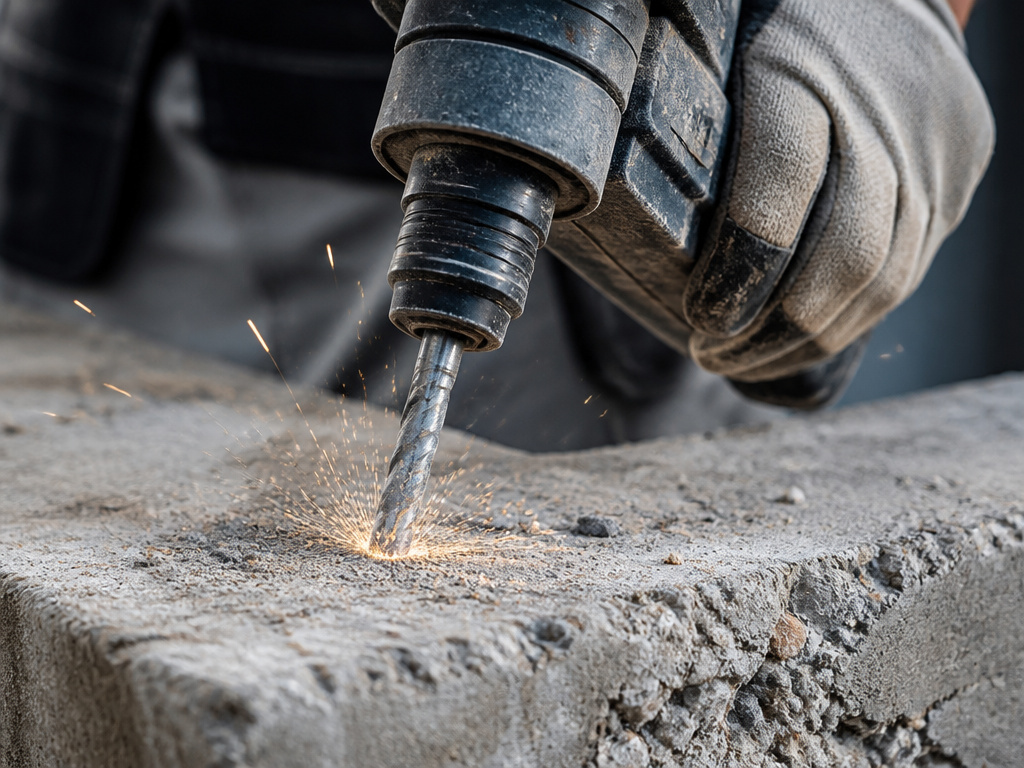 A hammer drill is a jack-of-all-trades. A rotary hammer is a master of one: destroying concrete. The difference is in the mechanism.
Your hammer drill uses a cam or clutch system to generate impacts. It’s effective for drilling anchor holes for a shelf. A rotary hammer uses a pneumatic piston, like a tiny jackhammer, to deliver a much more powerful blow with less vibration transmitted to your hands.
The part nobody mentions: That pneumatic mechanism means a rotary hammer can also do “hammer only” mode for light chipping and demolition, something a standard hammer drill can’t do safely.
So when do you step up? Look at the hole size and frequency. The Ryobi SDS65, an SDS-Plus rotary hammer, is rated for 1-inch (25.4 mm) holes in concrete. If your project involves more than a few holes of that size, or you’re drilling into reinforced concrete (rebar), the hammer drill will struggle, overheat, and burn out. That’s when you need the right tool for the job, which you can explore in our comparison of rotary hammer vs hammer drill.
How to Not Break Your Hammer Drill (Or Yourself)
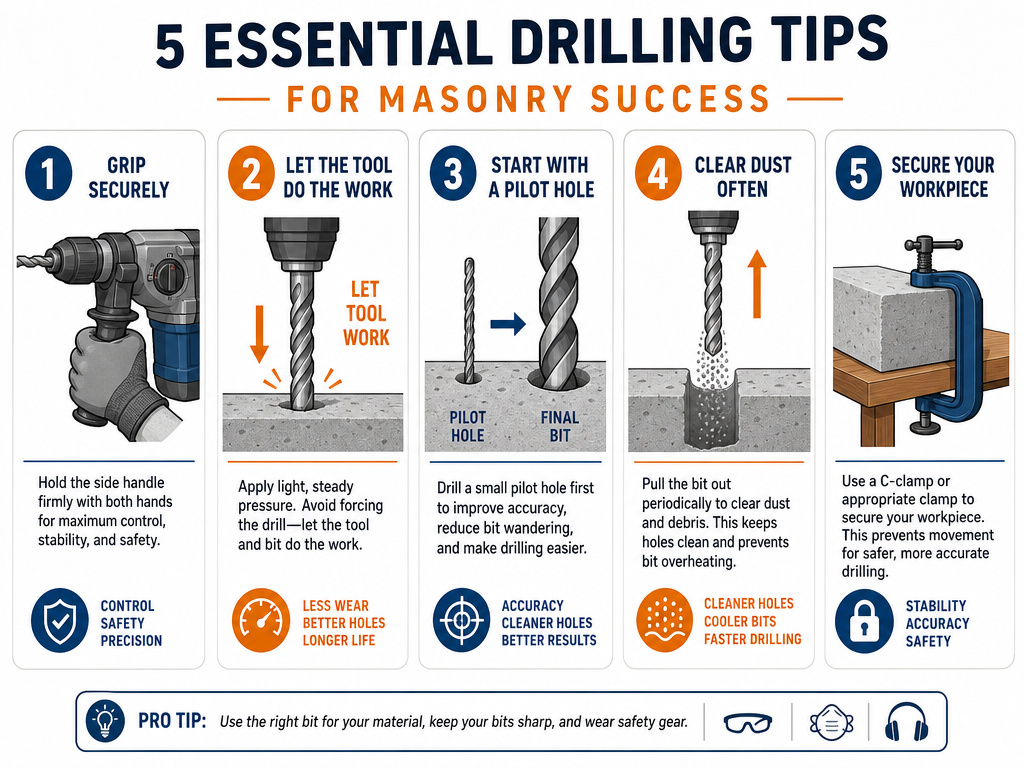 The manuals scream about safety for a reason. This isn’t a gentle tool.
- Always use the side handle. The Makita M8103 manual warns of “tremendous and sudden twisting force” at breakthrough or if you hit rebar. One hand on the trigger, one on the auxiliary handle. Every time.
- Let the tool do the work. Applying excessive pressure doesn’t make it drill faster. It wears out the mechanism, burns out the bit, and increases the kickback risk. In hammer mode, only enough pressure to keep the bit engaged is needed.
- Start with a pilot hole for large diameters. Especially in metal or hardwoods. It guides the larger bit, reduces load, and gives a cleaner finish.
- Clear the debris. In masonry, periodically pull the bit out to clear dust from the hole. A clogged hole creates friction, overheats the bit, and can bind it solid.
- Secure your workpiece. Un-clamped material can spin violently with the bit, turning a drill into a dangerous projectile.
Understanding how a hammer drill works makes these rules obvious, they’re not arbitrary, they’re mechanical necessities.
Frequently Asked Questions
Can you use a hammer drill as a regular drill?
Yes, absolutely. Switch the function selector from the hammer icon to the drill icon. This disengages the percussion mechanism, and the tool operates as a powerful, variable-speed drill driver. This is perfect for using a hammer drill on wood, metal, or driving screws.
What is the difference between a hammer drill and an impact driver?
They are completely different tools. A hammer drill is for drilling holes, combining rotation with a hammering action for masonry. An impact driver is for driving fasteners (screws, bolts), using concussive rotational impacts to deliver high torque. Don’t confuse them.
Can a hammer drill break concrete?
Not for demolition. While it can drill holes, a hammer drill is not designed for breaking or chipping slabs. The “light chiseling” some manuals mention is for small tiles or surface scoring. For breaking, you need a dedicated demolition hammer or a rotary hammer with a chisel bit.
Do I need a special drill bit for concrete with a hammer drill?
Yes. You must use a carbide-tipped masonry bit rated for percussion drilling. A standard black oxide or HSS bit will be destroyed in seconds. The concrete drill bit is built with a hardened tip and a flute design to evacuate concrete dust.
Why is my hammer drill not hammering?
First, check that the function selector is firmly set to the hammer icon. If it is, the internal hammer mechanism (often a pair of toothed clutch plates) may be worn out or jammed with dust. For corded models, this can sometimes be cleared by running the tool at high speed without pressure. If it persists, the tool likely needs professional service.
The Bottom Line
A hammer drill’s capability is defined by a switch and a bit. Flip to the hammering icon for concrete, brick, and stone with a carbide bit. Flip back to the drill icon for everything else. The moment you mix those up is the moment you break something.
For the occasional anchor in a block wall or a hole in a stud, a combi hammer drill is the most versatile tool you can own. But when the job list fills with ½-inch holes in a foundation, rent a rotary hammer. It’s not an upgrade; it’s the right tool. Your wrists, your timeline, and your finished project will thank you.
