What Is a Coring Drill? How Its Diamond Bit Cuts Concrete
This post contains affiliate links. As an Amazon Associate, we earn from qualifying purchases.
A coring drill is a specialized power tool that uses a hollow, rotating bit, typically tipped with diamonds, to cut a precise cylindrical hole and extract a solid core of material like concrete, masonry, or asphalt. It is distinct from a hammer drill, which pulverizes material, and is used for creating clean openings for pipes, conduits, and HVAC systems, or for obtaining intact samples for material testing.
That core extraction is the whole point. It’s not just a different shaped hole; it’s a different physical process. Where a standard drill makes a mess of dust and chips, a coring drill leaves behind a neat, removable plug. The quality of that plug decides whether your pipe fits or your lab test is valid.
What follows: the specific mechanics that make this possible, the three main types you’ll encounter on a job site, and the concrete specs, from RPM to vibration ratings, that separate a pro-grade tool from a rental-yard disappointment. We’ll also cover when you absolutely need a coring drill versus when a hammer drill will do, and the one safety setup that contractors get wrong every time.
Key Takeaways
- A coring drill’s hollow bit extracts a solid cylinder, preserving the material for inspection or creating a clean pass-through. A hammer drill smashes the same hole into rubble.
- Water isn’t optional for most coring jobs. It cools the diamond segments and flushes away abrasive slurry. Dry coring asphalt on a hot day can weld the bit in place within minutes.
- The rated RPM on the tool must match the bit’s maximum speed. Running a 4-inch bit at 1700 RPM burns out the diamonds and glazes the steel shank.
- Hand-held models cap out around 4-6 inches. For anything larger or deeper, you need a rig-mounted drill anchored to the surface, never rely on a vacuum pad for overhead or wall drilling.
- Core drills are for precision and sample integrity. If you just need to make a hole through a wall for a cable, a rotary hammer drill is faster, cheaper, and less messy.
How Does a Coring Drill Actually Work?
A coring drill works by applying high-speed rotary force to a hollow cylinder armed with cutting segments. Imagine a cookie cutter spinning at 740 revolutions per minute, pressed into concrete. The cutting edges, usually diamond-impregnated, grind away the material at the circumference. The core itself remains untouched inside the tube, held in place by a slight friction fit until you extract it.
The physics are simple but unforgiving. The bit must rotate true. Any wobble transfers into the drill’s motor and gearbox as chatter, which you’ll feel as a violent shaking in a hand-held model. That’s why rig-mounted drills have a vertical column and a feed mechanism, to keep everything perfectly aligned.
Technical Overview: A diamond coring machine utilizes a tubular steel barrel with diamond-impregnated segments sintered onto its leading edge. As the barrel rotates under power, these segments abrade a narrow kerf, separating a solid cylinder of the base material. A continuous water flush serves dual purposes: cooling the diamond matrix to prevent thermal degradation and evacuating the abrasive slurry from the cutting face to maintain cutting efficiency and bit life.
Water is the silent partner in this operation. The Hilti DD 110-W manual explicitly lists it as a core drill component. Without it, the friction heat at the cutting face can exceed 500°F. In concrete, that bakes the slurry into a glassy paste that binds the bit. In asphalt, the heat softens the bitumen until it acts like glue. The bit seizes. I’ve seen a 4-inch bit welded into a road patch after two minutes of dry coring on an 80-degree day. The recovery involved a second drill and a cutting torch.
The Critical Role of the Diamond Core Bit
The bit is the consumable heart of the system. It’s not a drill bit in the traditional sense. It’s a steel tube with diamond segments brazed or sintered onto one end. The diamond isn’t a coating; it’s a composite matrix designed to wear slowly, constantly exposing fresh, sharp diamond crystals.
You match the bit to the material. A soft-bond matrix for hard, abrasive concrete. A hard-bond matrix for softer, green concrete or brick. Using the wrong bond glazes the segments, they shine like a mirror, and cutting stops. The tool keeps spinning, but it’s just burning electricity.
Segment height tells you how much life is left. New segments might be 10mm tall. Most contractors will run them down to 3mm before considering replacement. Going further risks the steel core contacting the work, which creates sparks, ruins the bit’s barrel, and can damage the drill’s spindle.
The Core Drill vs. The Hammer Drill: A Mechanical Breakdown
This is the most common point of confusion. Both tools make holes in concrete. Their methods are opposites.
A rotary hammer drill uses a pounding, piston-driven action. A carbide-tipped bit hammers and rotates simultaneously, smashing the brittle concrete into small fragments. It’s fast, effective, and messy. The hole’s walls are rough and fractured. You cannot get a clean sample.
A coring drill uses only rotation. There is no hammering. The diamond segments grind a precise circumference. The result is a hole with smooth, intact walls and a perfect cylinder of material you can lift out. It’s slower, requires more equipment (water, often a rig), but it’s the only way to get that clean, undamaged result.
| Feature | Coring Drill | Rotary Hammer Drill |
|---|---|---|
| Primary Action | Rotation only | Rotation + Percussive hammering |
| Hole Finish | Smooth-walled, precise diameter | Rough, fractured walls |
| Waste Material | A single solid core | Dust and small chips |
| Best For | Clean penetrations for pipes, conduits, material samples | Anchoring, fastening, rough openings where finish doesn’t matter |
| Speed | Slower, methodical | Faster |
| Ancillary Needs | Often requires water supply and rig mounting | Typically standalone, handheld |
The choice comes down to the job’s deliverable. Are you installing a sleeve for a 4-inch PVC pipe through a foundation wall? You need the clean hole a core drill provides. Are you drilling a dozen holes for wedge anchors? A hammer drill is the right tool.
The Three Main Types of Coring Drills
1. Hand-Held Core Drills
These are the most portable and accessible. Models like the U.S.SAWS Core Pro 4 are designed for holes from 1 to 4 inches in diameter. They plug into a standard 110V outlet, weigh around 30 pounds, and spin at a fixed RPM, 1700 for the Core Pro 4.
Where this goes sideways: Assuming a hand-held drill can handle its maximum rated diameter under all conditions. The U.S.SAWS manual for the Core Pro 4 states its 4-inch capacity, but also warns that the tool generates “an enormous amount of force.” Drilling a 4-inch hole in reinforced concrete by hand is a two-person job for control. Trying it alone risks a violent kickback that can break wrists.
They are ideal for electrical boxes, small conduit holes, or light sampling work. Their limit is operator strength and stability. You also need a method to capture the water, which usually means a secondary vacuum unit or a helper with a wet-dry vac.
2. Rig-Mounted or Stand-Mounted Core Drills
For holes larger than 4 inches, deeper holes, or any work requiring precision alignment, you move to a rig. The drill motor, like the DEWALT DCD150, mounts onto a stand like the DEWALT DCPS151. The stand anchors to the floor, often with expansion bolts or a vacuum pad, providing a stable vertical column.
This setup removes the human from the force equation. You turn a handwheel or engage a motorized feed to lower the bit steadily. This gives you a perfectly plumb hole, even at 6-inch diameters or through 24-inch thick foundation walls. The DEWALT DCD150 is part of the company’s POWERSHIFT system and offers a 3-speed gearbox to match RPM to bit size.
Common mistake: Using a vacuum pad to secure a rig on a dirty, dusty, or damp floor. The Power Tool Institute’s safety guide states that for a vacuum pad to be effective, the surface must be clean and free of contaminants to create a seal. If the seal is incomplete, the rig can torque sideways under load. For overhead or wall drilling, vacuum pads are explicitly not recommended.
3. Dedicated Core Drilling Rigs
These are truck-mounted or trailer-mounted units used for professional concrete sawing and coring contractors. They drill holes up to 60 inches in diameter for major infrastructure work. They integrate a high-power motor, a heavy-duty column, and a large-capacity water tank. You won’t buy one for a home project, but you will hire a crew that uses one.
Key Specifications and What They Mean for Your Job
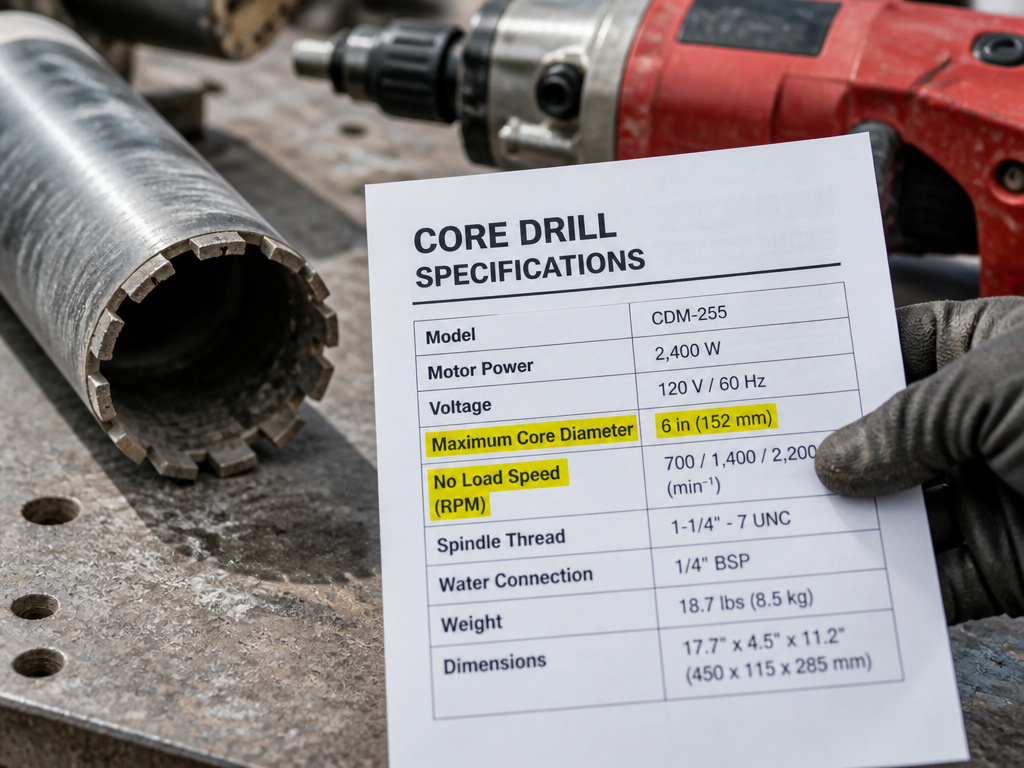
Reading a spec sheet tells you what a coring drill can and cannot do.
- Maximum Core Diameter: This is the absolute limit. The Hilti DD 110-W handles up to 6-3/8 inches. The DEWALT DCD150 matches that. The U.S.SAWS Core Pro 4 stops at 4 inches. Never exceed this. A bit larger than the rated capacity can over-torque the gearbox, shearing a key or stripping gears.
- RPM (Revolutions per Minute): This must be compatible with your bit. Larger diameter bits require lower RPMs to maintain a safe peripheral speed. Running a 6-inch bit at 1580 RPM (the Hilti’s high gear) is a recipe for disaster. Most bit manufacturers provide a maximum RPM chart.
- Power Source: Corded (110V or 220V) or Cordless (60V MAX* like the DEWALT). Corded offers unlimited runtime but requires a generator or outlet. Cordless offers mobility but needs a battery ecosystem, the DCD150 uses two 15Ah FLEXVOLT batteries.
- Weight: Hand-held drill weight matters. A 30-pound tool becomes a 60-pound tool when it’s 18 inches off the ground, biting into concrete. The Hilti DD 110-W is relatively light at 12.6 pounds.
- Vibration Rating: Expressed in m/s², this measures how much hand-arm vibration the tool transmits. The Hilti DD 110-W lists a triaxial vibration value of 4.6 m/s² for wet coring. Lower is better for long-term operator comfort and safety.
When Do You Need a Coring Drill? (And When You Don’t)
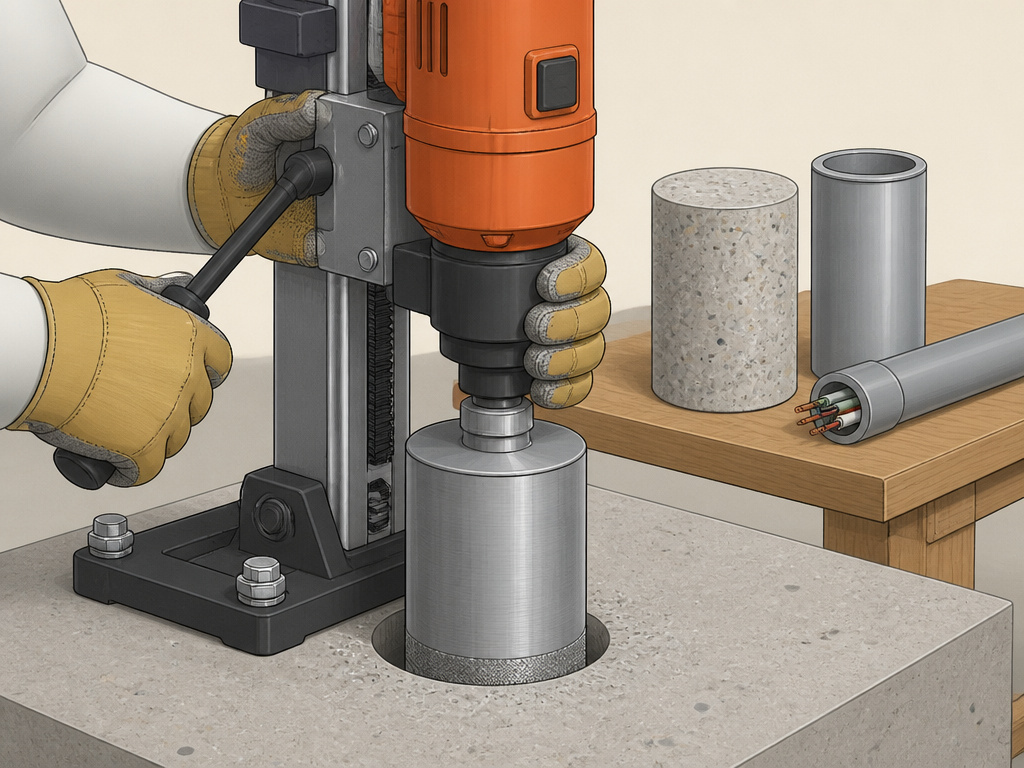
You need a coring drill when the job requires one of three outcomes: 1. A Clean, Undamaged Hole: For installing pipe sleeves, electrical conduits, or HVAC ducts where a smooth wall is necessary. 2. A Structural Sample: For concrete testing labs that need an intact cylinder to test compressive strength, as outlined in procedures like Alberta Transportation’s ATT-5. 3. Precision Placement: When the hole must be perfectly vertical or placed within a tight tolerance.
You do not need a core drill if: * You are installing concrete anchors or screws (use a hammer drill). * You are making a rough opening that will be hidden or patched. * You are drilling into brick or block for a small cable (a standard rotary hammer drill with a carbide bit is sufficient). * You are working with porcelain or ceramic tile; you need a specialized drill bit for concrete or tile, not a coring system.
Safety: The Non-Negotiable Rules
Coring drills generate tremendous torque and can fail in dangerous ways. The manuals from DEWALT, Hilti, and the Power Tool Institute agree on these non-negotiables.
- Secure the Workpiece and the Tool: For hand-held drilling, brace yourself. For rig drilling, anchor the base with mechanical fasteners unless the surface is perfectly clean and flat for a vacuum. Never use a vacuum pad on walls or ceilings.
- Use Water and GFCI Protection: Water and electricity mix here by design, but only with a Ground Fault Circuit Interrupter. Wear insulated gloves and boots.
- Inspect Before Starting: Check that all bolts on the rig column and base are tight. A loose bolt can let the entire assembly shift, binding the bit. The Alberta Transportation procedure warns that a loose drill can slam into a truck bumper when moving between holes.
- Know What’s Behind the Wall: Never core blindly into an existing structure. You could hit post-tensioning cables, rebar, or live electrical conduits. Assume everything is there until proven otherwise.
- Wear the Right PPE: Safety glasses are a minimum. A full face shield is better when water and slurry are spraying. Hearing protection is required, sound levels can exceed 92 dB(A). Wear a respirator when dry coring or if dust control fails.
Essential Accessories and Setup
You cannot run a core drill with just the tool. The system requires supporting parts.
- Core Bits: Diamond bits are the standard. Match the bond to the material. For frequent use, investing in a set of carbide drill bits makes no sense here; this is a diamond-specific application.
- Water Supply: A portable tank with a pump, like the DEWALT DCE6820, or a connection to a spigot with a flow regulator. The Hilti DD 110-W includes a Gardena connector.
- Rig or Stand: For any hole over 4 inches or any depth over a few inches, a stand is mandatory. It provides control and safety.
- Core Extractors: A simple set of pry bars or a dedicated core lifter tool. Trying to dig out a stuck core with a screwdriver can damage the hole’s edge.
- Wrenches: For changing bits on systems without a quick-release. The DEWALT kit includes 36mm and 41mm wrenches for its system.
Frequently Asked Questions
Can I use a coring drill without water?
You can, but only for specific, short-duration tasks in soft materials like aerated concrete block. For concrete, masonry, or asphalt, water is essential for cooling and cutting efficiency. Dry coring will drastically reduce bit life and can lead to dangerous bit seizure.
What’s the biggest hole a core drill can make?
Hand-held drills typically max out at 6-3/8 inches. Rig-mounted drills for construction can handle bits up to 60 inches in diameter, but these are massive, trailer-mounted units operated by specialized contractors.
How long does a diamond core bit last?
Bit life is measured in linear feet cut, not time. A quality bit can cut 100-200 feet of concrete depending on the aggregate hardness and operator technique. Signs of wear include slowing cutting speed, excessive vibration, and visible reduction in the diamond segment height.
Is a core drill the same as a rotary hammer?
No. They are fundamentally different tools. A core drill uses only rotation and a hollow bit to extract a cylinder. A rotary hammer drill uses hammering and rotation to pulverize material. They are not interchangeable for their primary tasks.
Can I rent a coring drill?
Yes, coring drills are commonly available from equipment rental yards. When renting, ensure you get the complete system: drill, correct stand, water tank, hoses, and a selection of bits. Ask for a demonstration of the safety features, like the clutch and switch operation.
What’s better for concrete, a corded or cordless core drill?
corded hammer drill provides consistent, unlimited power, which is crucial for long, deep cores. A cordless model like the DEWALT DCD150 offers excellent mobility and eliminates trip hazards from cords, but requires a significant investment in high-capacity batteries. For most professional contractors doing frequent coring, corded is still the default.
The Bottom Line
A coring drill is a precision instrument for a specific job: removing a perfect cylinder of material. It is not a general-purpose concrete drill. If your work involves installing plumbing, electrical, or HVAC systems through finished walls or slabs, or if you need to test concrete integrity, this is the tool you hire or buy.
For the DIYer tackling a one-time project, renting a hand-held model like the U.S.SAWS Core Pro 4 is the most sensible path. For a pro who encounters coring weekly, investing in a rig-mounted system like the DEWALT DCD150 with its stand and water tank transforms a grueling task into a controlled, repeatable process.
Remember the two rules that matter most: match the tool’s RPM to the bit size, and never, ever skip the water. Everything else flows from getting those right.
