What Titanium Drill Bits Are Used For: Key Uses Explained
This post contains affiliate links. As an Amazon Associate, we earn from qualifying purchases.
Titanium drill bits are High-Speed Steel (HSS) bits coated with a thin layer of titanium nitride (TiN). This gold coating reduces friction and increases surface hardness, making them excellent for fast, clean drilling in wood, plastic, aluminum, brass, and mild steel. They are not for masonry, stainless steel, or hardened steel, where the coating oxidizes and fails above 550°C.
That temperature limit changes everything. It’s not just a spec sheet footnote; it’s the line between a bit that feels like it’s gliding and one that suddenly grinds to a halt, its gold coating burnt off. The coating is a surface treatment, not the core material, and its performance is entirely conditional on managing heat.
What follows is a breakdown of where that coating works, where it fails catastrophically, and the three rules that decide whether a titanium bit is the right tool for your job. We’ll cover the exact materials they can handle, the ones that will destroy them, and how to spot the moment a titanium bit turns back into a plain HSS drill bit.
Key Takeaways
- Titanium bits are HSS cores with a TiN coating; the gold color is a surface treatment, not solid titanium.
- They excel in wood, plastic, and soft metals (aluminum, brass, mild steel) because the coating reduces friction and heat.
- The TiN coating oxidizes and breaks down at sustained temperatures above 550°C, making them a poor choice for stainless steel, hardened steel, or deep, dry holes.
- Never sharpen a titanium bit, you’ll grind off the coating, leaving a standard HSS bit that performs worse than a new coated one.
- For deep holes (3x the bit diameter or more), you must use a “pecking” technique and lubricant to manage heat and prevent chip welding.
The Gold Isn’t Solid Titanium
You pick up a drill bit and it’s a distinctive gold color. That’s the titanium nitride (TiN) coating, a ceramic layer applied to a High-Speed Steel (HSS) core using a Physical Vapor Deposition (PVD) process. The coating is only a few microns thick, about the width of a human hair. Its job is to create a harder, slicker surface on an otherwise ordinary bit.
This matters because the coating dictates the bit’s entire personality. It lowers friction, which means less heat generation and faster chip ejection. It also increases surface hardness, which fights wear. But the moment that thin layer is compromised, the bit reverts to its base HSS identity. All the advertised benefits, the longer life, the smoother cutting, vanish instantly.
A titanium nitride coating will start to oxidize and break down when heat generated by cutting operations exceeds approximately 550°C. Once burnt off, chipped, or damaged, the tool reverts to a standard HSS drill bit.
That’s the non-negotiable ceiling. Drill soft materials with proper technique, and you stay well under it. Push into hard metals or run the drill too fast, and you blow past it. The failure isn’t gradual. It’s a threshold.
What Materials Can You Drill With Titanium Bits?
The rule is simple: titanium bits are for materials softer than the coating’s heat tolerance. They are general-purpose champions, not specialists for extreme conditions.
Wood and Plastic: This is their sweet spot. The low friction prevents melting in plastics and reduces tear-out in wood. A bit like the DEWALT DW1309, with its 135-degree split point, starts cleanly and pulls chips out fast.
Soft Metals (Aluminum, Brass, Copper): The coating’s slickness prevents “galling”, where soft, gummy metals stick to the flute and clog the bit. You get cleaner holes with less effort. Always use a lubricant like cutting oil here; it keeps temperatures down and extends the coating’s life dramatically.
Mild Steel: Yes, but with a caveat. For thin sheet metal or the occasional hole in angle iron, a titanium bit is fine. For production work or thicker sections, the heat builds up and you’re flirting with the 550°C limit. This is where understanding your drill bit materials becomes critical, knowing when a coating is enough and when you need a tougher alloy throughout.
What You Absolutely Should Not Drill:
- Stainless Steel: Stainless work-hardens. As you drill, the material around the hole becomes harder than the original metal. A titanium coating wears off rapidly against this abrasive, hardening surface. You’ll burn through the coating in short order.
- Hardened Steel or Tool Steel: The material itself is too hard and abrasive. The coating offers no meaningful advantage.
- Masonry or Concrete: These materials require a carbide tip. A titanium bit will dull on the first contact.
| Material | Titanium Bit Suitability | Key Reason | Risk If Used |
|---|---|---|---|
| Pine, Plywood, MDF | Excellent | Low friction reduces tear-out; fast chip clearance. | Minimal risk. |
| ABS, PVC Plastic | Excellent | Coating prevents melting and gumming. | None with moderate speed. |
| Aluminum, Brass | Very Good | Prevents galling; provides clean finish. | Overheating without lubricant strips coating. |
| Mild Steel (<1/4″) | Good for occasional use | Faster cutting than plain HSS. | Heat buildup in deep/thick metal oxidizes coating. |
| Stainless Steel | Poor | Work-hardening abrades coating rapidly. | Coating fails quickly; bit performs worse than plain HSS. |
| Hardened Steel | Not Recommended | Material hardness exceeds coating benefit. | Immediate dulling; potential bit breakage. |
| Masonry/Concrete | Not Recommended | Requires carbide tip for abrasion resistance. | Instant blunting of cutting edges. |
The Real Trade-Off: Titanium vs. Cobalt
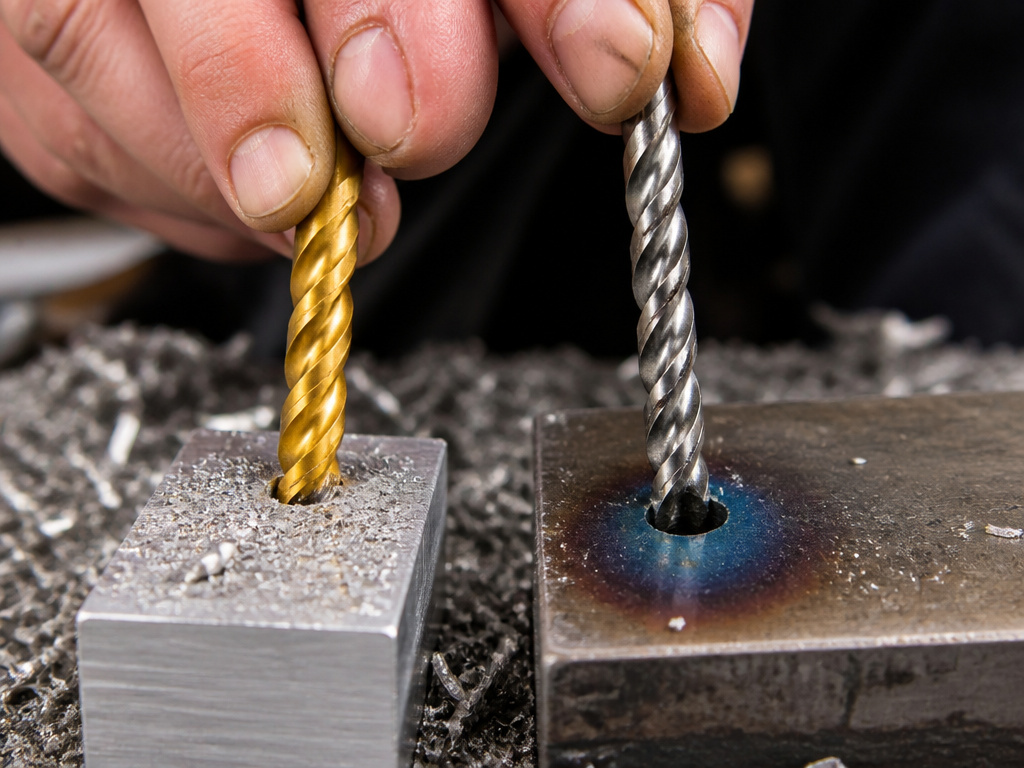
This is the most common cross-shop. People see two bits for metal and wonder which to choose. The difference isn’t subtle; it’s fundamental.
Titanium bits are about a surface advantage. Cobalt drill bits are about bulk material properties. Cobalt bits (like M35 or M42 grades) are HSS alloyed with 5-8% cobalt throughout the steel. This gives them “red hardness”, the ability to retain their hardness and cutting edge at high temperatures. The cobalt is in the steel, not on it.
I keep a set of Bosch Impact Tough bits for general shop work and a set of cobalt bits for metal fab. The titanium set feels faster on aluminum all day. The second I hit stainless or need more than two holes in thick mild steel, I reach for cobalt. The titanium bit will get hot, the chips will turn blue, and the cutting sound changes to a grind. That’s the coating giving up.
The choice hinges on heat and material. If your work generates high, sustained heat, cobalt wins. If you want to avoid heat in soft materials, titanium is great, until the coating fails.
| Factor | Titanium (TiN Coated) | Cobalt (M35/M42 Alloy) |
|---|---|---|
| Construction | HSS core with thin TiN coating. | HSS alloyed with 5-8% cobalt throughout. |
| Heat Resistance | Good up to ~550°C at the surface. Coating then oxidizes. | Excellent “red hardness.” Maintains edge at much higher bulk temperatures. |
| Best For | Wood, plastic, aluminum, brass, occasional mild steel. | Stainless steel, hardened steel, cast iron, high-carbon steel, production metal drilling. |
| Durability | Coating wears; performance drops sharply when coating is gone. | Gradual, predictable wear; can be resharpened multiple times. |
| Feel & Speed | “Slicker” feel, less drag, faster in soft materials. | “Heavier” cut, more torque required, consistent in hard materials. |
| Long-Term Cost | Lower upfront cost; replace when coating wears. | Higher upfront cost; multiple re-sharpenings extend life. |
For a deeper dive into this specific matchup, our guide on the difference between cobalt and titanium breaks down the metallurgy and cost-per-hole math.
How to Use Titanium Drill Bits Correctly (And Make Them Last)
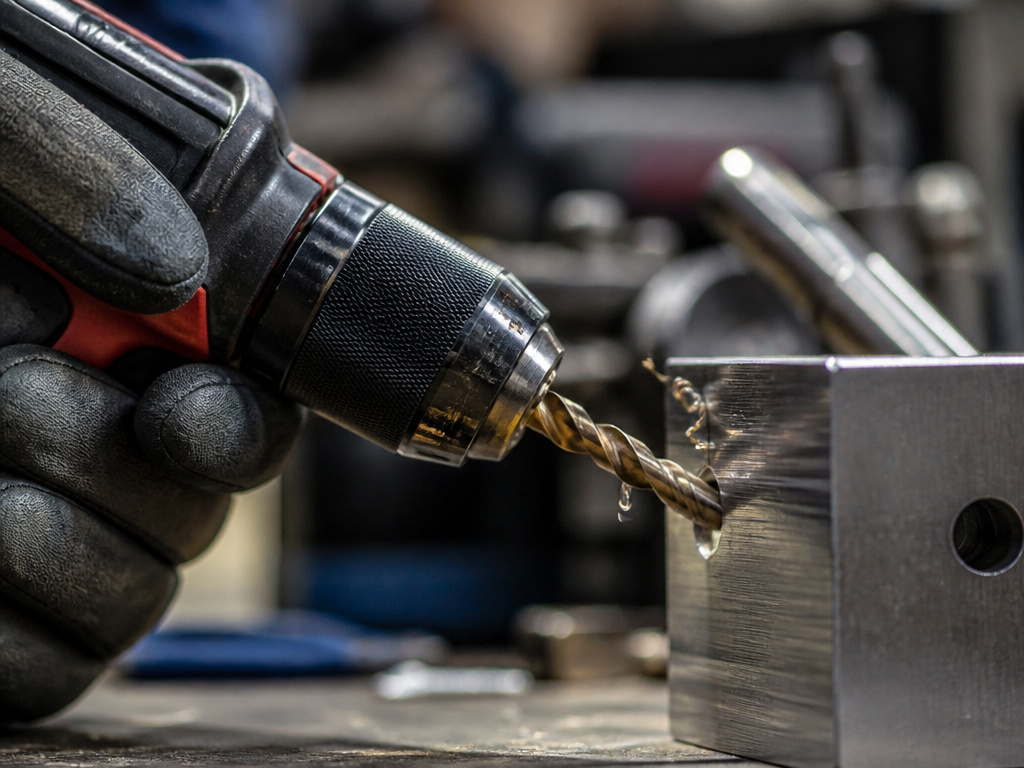
Using a titanium bit isn’t complicated, but ignoring three rules will burn your money.
Rule 1: Manage Speed and Pressure. High RPMs generate heat. In metal, start slow. Let the bit’s split point or pilot point (like on the DEWALT DD5116 Impact Ready bit) engage and establish the cut. Then you can increase speed slightly. Press firmly, but don’t lean on the drill. Let the bit cut. If you see smoke or the chips coming out are discolored (blue or black), you’re going too fast or using too much pressure.
Rule 2: Lubricate Every Metal Cut. This is non-negotiable for anything beyond sheet metal. A drop of cutting oil on the hole and the bit keeps temperatures down and flushes chips. It’s the single easiest way to preserve the coating. For aluminum, a lubricant also prevents material adhesion.
Rule 3: “Peck” for Deep Holes. The official guidance from manufacturer catalogs defines a deep hole as three or more times the drill bit’s diameter. For a 1/4-inch bit, that’s 3/4 of an inch. Beyond that depth, friction and chip evacuation become problems. Use a “pecking” technique: drill a short distance (about one diameter), retract fully to clear chips and let lubricant back in, then drill again. This prevents chips from welding to the flutes and keeps heat manageable.
Common mistake: Drilling a deep hole in one continuous push. The chips pack in, lubrication can’t reach the cutting edge, and friction heat skyrockets. You’ll exceed the 550°C limit inside the hole, and the bit will emerge with a dull, discolored tip.
Maintenance is straightforward, and mostly about what not to do.
- Do clean them. Wipe bits with a dry cloth after use to remove debris and moisture. For gunked-on resin or metal, use a brush and a mild solvent. Our article on cleaning drill bits has safe methods.
- Do store them properly. Keep them in a case or a rack. Loose bits in a drawer bang into each other, chipping the coating.
- Do NOT sharpen them. Sharpening grinds away the TiN coating. What’s left is an HSS bit with an uneven geometry that will perform worse than a new, cheap HSS bit. When a titanium bit is dull, replace it. This is the biggest point of confusion for new users, and why understanding drill bit sharpening limitations is key.
When Should You Choose Titanium Drill Bits?
So, who is the ideal user for this tool? It’s the person who drills a mix of materials and values speed and a clean finish over absolute maximum durability in hardened metal.
Choose titanium bits if:
- Your projects involve wood, plastic, and soft metals 80% of the time.
- You drill into mild steel occasionally, for things like brackets or thin-wall tubing.
- You want a bit that feels faster and smoother in a cordless drill, preserving battery life.
- You prefer the convenience of a general-purpose set and don’t want to swap bits constantly.
Avoid titanium bits if:
- You regularly work with stainless steel, hardened steel, or cast iron.
- You are drilling many deep holes in metal as part of production work.
- You expect to resharpen your bits to save money over time.
For most home workshops and general contractors, a quality titanium set is the default pick. The Bosch TI4148 series or a DEWALT titanium set covers an enormous range of everyday tasks. They sit logically between basic black oxide vs titanium drill bits and the more specialized carbide drill bits.
Frequently Asked Questions
Can you sharpen titanium drill bits?
No. Sharpening removes the titanium nitride coating. Once the coating is gone, you are left with a standard High-Speed Steel bit that lacks the coating’s low-friction and wear-resistant properties. It will perform worse than a new, inexpensive HSS bit. When a titanium bit is dull, replace it.
Why do titanium drill bits break so easily?
They don’t, if used within their limits. Titanium bits are just HSS cores, which are tough but not brittle. Breakage usually comes from lateral force (bending the bit) or using them in a hammer drill setting on metal. The impact action of a hammer drill is for masonry only and will shatter any metal-cutting bit, titanium or cobalt.
Are titanium bits good for stainless steel?
No. Stainless steel work-hardens, meaning it becomes harder as you drill it. The abrasive, hardening surface wears away the thin TiN coating very quickly. Once the coating is gone, the underlying HSS dulls rapidly. For stainless steel, you need the heat resistance of cobalt vs titanium drill bits or carbide.
What’s the difference between gold and black titanium drill bits?
The gold color is the classic titanium nitride (TiN) coating. “Black titanium” usually refers to a titanium carbonitride (TiCN) or titanium aluminum nitride (TiAlN) coating, which is slightly harder and can handle higher temperatures. However, the same fundamental rules apply, it’s still a thin coating on an HSS core with a heat limit.
How long do titanium drill bits last?
It depends entirely on what you drill and how you treat them. Drilling only softwood with proper technique, they can last for years. Drilling dry, deep holes in mild steel, you can burn through the coating in a single job. The lifespan isn’t measured in time, but in the total heat load and abrasion the coating endures before it oxidizes or wears off.
The Bottom Line
Titanium drill bits are a performance upgrade for everyday materials, not a magic solution for every drilling problem. That gold coating is a thin, hard layer that reduces friction and wear on wood, plastic, and soft metals. Its Achilles’ heel is heat, sustained temperatures above 550°C oxidize the coating, turning your premium bit into a mediocre one.
Use them within their lane. Match them to soft materials and the occasional metal job. Manage your speed, use lubricant, and peck-drill deep holes. When you see that coating start to wear or discolor, you’ve hit their limit. For anything harder or hotter, step up to cobalt or carbide.
Your drill bit choice should be as intentional as your tool choice. Knowing what titanium drill bits are used for, and what they’re not, saves you time, money, and the frustration of a bit that quits halfway through a project.
