What Is a Spade Drill Bit Used For? Nail-Embedded Wood Test
This post contains affiliate links. As an Amazon Associate, we earn from qualifying purchases.
A spade drill bit is used to bore large, rough holes quickly in wood, plastic, and soft metals, primarily for construction trades like electrical and plumbing where speed matters more than a clean finish. Its flat, paddle-shaped design removes material fast but leaves a ragged exit hole. Modern versions, like the Bosch EXPERT Self Cut Speed, use a threaded tip to self-feed, while patented designs from Black & Decker can last over 30 times longer in nail-embedded wood.
That last clause, about hitting nails, is where the real cost of a spade bit gets decided. The commodity answer is “drills fast, leaves a rough hole.” The job-site reality is that studs and joists are full of old fasteners. A standard bit dies on the fifth nail. A modern one drills past fifty.
What follows is the breakdown the trades actually use: the core applications, the three modern designs that changed the game, and the head-to-head against Forstner and brad point bits you need before you buy.
Key Takeaways
- Spade bits excel at speed, not precision. Use them for running wire, pipe, or cables through framing where the hole will be hidden.
- Hitting a nail destroys most spade bits in under five holes. Patented designs with hardened cutting edges can last 31x longer in the same test.
- Modern “self-feed” bits like the Bosch EXPERT or Hilti WDB-S use a threaded tip to pull themselves into the wood, making overhead drilling feasible.
- For a clean, finished hole in visible wood, use a brad point or Forstner bit instead. A spade bit will always splinter the exit side.
- The shank matters: a 1/4-inch hex shank works in impact drivers, giving you more torque and options than a simple round shank.
The Core Job: Fast, Rough Holes in Wood
Look at the business end of any spade bit. The flat paddle, the two cutting lips, the pointed tip. This shape isn’t for finesse. It’s a wood-plowing shovel mounted on a drill. The wide surface area scoops out material with every rotation, which is why electricians and plumbers reach for them inside walls.
A spade drill bit’s primary function is the rapid creation of large-diameter (1/4-inch to 1-1/2-inch) holes in soft materials where hole quality is secondary to speed and material removal rate. The design prioritizes fast waste ejection over cutting cleanliness.
You’ll use a spade bit when the hole is a means to an end, not the end itself. Drilling through a wall stud to run a 12/2 Romex cable. Boring through a top plate for a PVC drain line. Notching a deck ledger board. The hole will never be seen again once the drywall goes up or the siding is on. In those minutes, saving thirty seconds per hole across twenty studs adds up to a real coffee break.
The bit works on most sheet goods, plywood, OSB, MDF, and can handle plastics and even soft metals like aluminum in a pinch. But its home is dimensional lumber. The cutting spurs on the sides score the circumference of the hole, while the main lips chisel out the core. This action is violent and efficient. It’s also why the exit side of the workpiece always splinters. The spurs lose purchase just before breakthrough, and the last sliver of wood tears out.
Common mistake: Using a spade bit without a pilot hole on large diameters. The broad, flat tip can “walk” across the wood surface before it bites. Drill a small pilot hole first with a standard drill bit to guide the spade bit’s point. It saves your workpiece and your wrist.
The Modern Spade Bit: Speed & Longevity
For decades, a spade bit was a simple piece of stamped steel. You burned through them. Today, that’s the budget option. The professional tier has split into two branches: bits built for pure speed, and bits built to survive abuse.
The speed branch uses a self-feeding threaded tip. The Bosch EXPERT Self Cut Speed and the Hilti WDB-S are the benchmarks here. That threaded cone at the point acts like a screw. It pulls the bit into the wood with minimal pressure from you. This is a game-changer for drilling overhead or in tight spaces where leverage is poor. Bosch claims 3x faster, Hilti claims up to 10x faster than a conventional spade bit. The mechanism is the same: reduced feed force lets the drill’s motor spend its energy on rotation, not push.
The longevity branch is an answer to a specific, expensive problem: nails. The US Patent 12485494 document from Black & Decker lays it out in a brutal test. They drilled into pine boards with 10d and 16d nails embedded at 1200 RPM under constant force.
| Bit Type | Average Holes Drilled Before Failure | Life Increase vs. Control |
|---|---|---|
| Control (Bosch Nailstrike N51009) | 4.83 holes | 1x (Baseline) |
| Sample Group A (Patented Design) | 69.5 holes | 14x |
| Sample Group D (Patented Design) | 152.4 holes | 31x |
The control bit, a respected brand’s “nail-eating” model, lasted less than five holes. The patented bits used a secondary, harder steel alloy for the cutting edges. They didn’t just last longer; in a separate speed test in clean wood, they cut just as fast. The trade-off of robustness for speed didn’t materialize.
Where this goes sideways: Assuming all “pro” bits are the same. A self-feed bit is for clean wood speed. A hardened-edge bit is for demolition-like conditions. Using the wrong one wastes money. For general framing where you might hit the occasional nail, the hardened-edge design is the real cost saver.
Spade Bit vs. Forstner vs. Brad Point
This is the most common point of confusion in the workshop. All three drill holes in wood. Their purposes are almost opposites.
| Bit Type | Best For | Hole Quality | Speed | Key Limitation |
|---|---|---|---|---|
| Spade Bit | Rough through-holes in framing, plumbing, electrical. | Very poor (splintered exit). | Very Fast. | Ugly holes, poor control in thin stock. |
| Brad Point Bit | Accurate, clean holes for dowels, shelf pins, furniture. | Excellent (clean entry & exit). | Moderate. | Limited to smaller diameters (typically under 1/2″). |
| Forstner Bit | Flat-bottomed, precise holes for hinges, mortises, any visible joinery. | Superior (smooth sides, flat bottom). | Slow. | Requires high torque, can wander without a pilot. |
Think of it as a trade-off between time and finish. A spade bit is for the rough-in. A brad point bit is for the finish carpentry where the hole might be seen. A Forstner bit is for fine woodworking where the hole itself is a functional part of the design.
You would never use a spade bit to drill a hinge mortise. The tear-out would ruin the door edge. You would never use a Forstner bit to drill twenty holes for wiring. It would take all afternoon and burn out the bit. This is why a proper guide to drill bit selection starts with the job, not the tool.
The part nobody mentions: A spade bit’s vibration and grabby cut make it hazardous in thin stock or small workpieces. It can wrench the drill, and your arm, if it catches. Clamp your workpiece. Every time.
How to Use a Spade Drill Bit Correctly
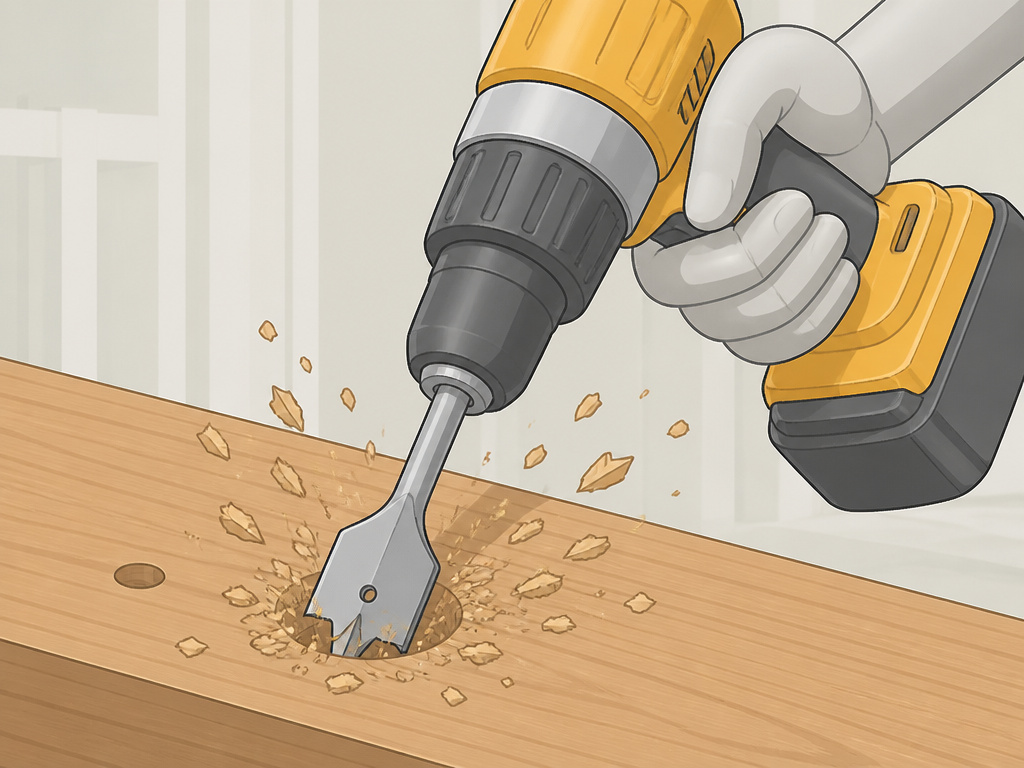
The procedure is simple, but three details decide between a smooth operation and a broken bit.
- Start with a pilot hole. For any bit over 1/2-inch, drill a 1/8-inch pilot hole first. This gives the spade bit’s center point a guide to follow and completely eliminates “walking.”
- Set your drill to high speed, high torque. Spade bits work best at full RPM. If your drill has a clutch, set it to the drill icon (not a number). For corded drills, use the higher speed setting. The goal is to let the cutting lips slice, not scrape.
- Use firm, steady pressure. Let the bit do the work, but don’t let it just spin without biting. With a self-feed bit, the pressure is minimal, the thread does the pulling. With a standard bit, you need to provide consistent forward force.
- Withdraw to clear chips. Every inch or so, pull the bit completely out of the hole to eject the packed-in wood shavings. A clogged bit overheats, binds, and smokes.
- Ease off before breakthrough. As you feel the bit about to exit the back of the workpiece, reduce pressure. This minimizes, but won’t eliminate, the tear-out on the back side.
Before you start: Wear safety glasses. The ejected wood chips are sharp and travel fast. Secure your workpiece with clamps or in a vise; the bit’s aggressive cut can spin a loose board. Be aware of what’s behind your drilling surface, know where your wires and pipes are.
Skipping the pilot hole is the most common error. The bit dances, marring the surface and starting off-center. The hole ends up oval, and you waste time trying to correct it. The second error is not clearing chips. The bit binds, the motor strains, and the cutting edges overheat and lose their temper (literally). A blue-tipped spade bit is a dull spade bit.
Sizes, Shanks, and What to Buy
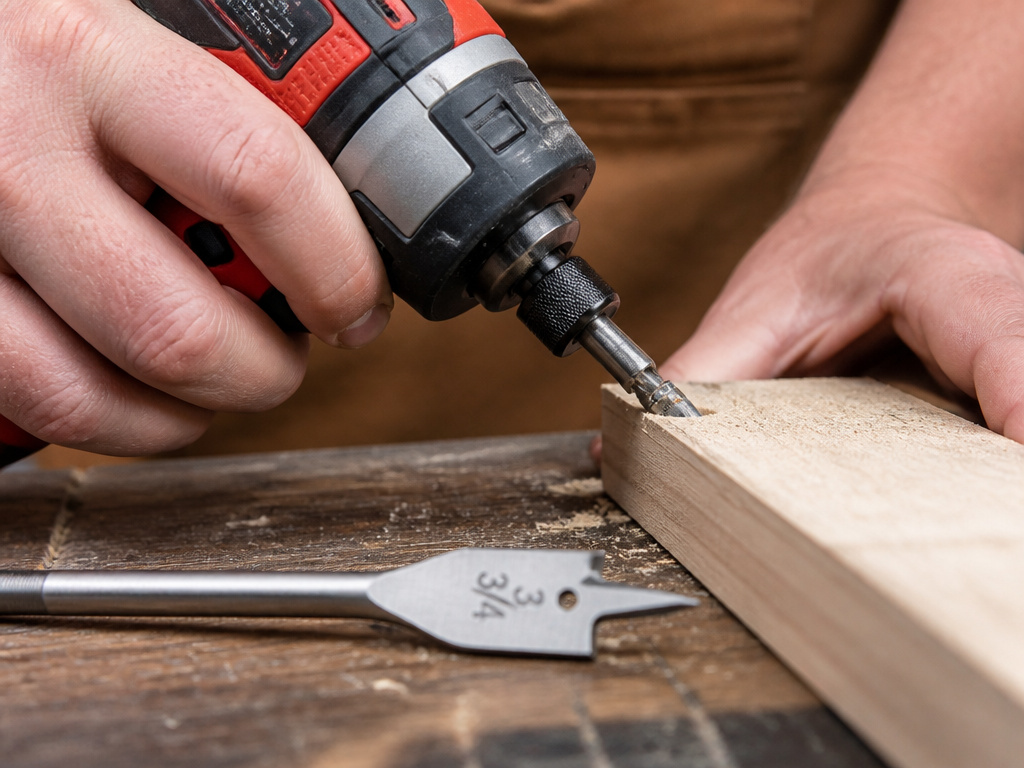
Spade bits come in a tight range of sizes, typically from 1/4-inch to 1-1/2-inch. The size is stamped on the flat of the paddle. Length is the other variable. Standard bits have a shank length of about 6 inches. Extended-length versions, like the Bosch Daredevil series, go out to 16 inches for drilling through deep wall cavities or stacked lumber.
The shank is your connection to the tool. The old standard is a simple round shank that fits a drill chuck. The modern standard for professional use is a 1/4-inch hex shank. This lets you use the bit in an impact driver, which delivers higher torque and is less likely to twist your wrist on a bind. It also allows for faster bit changes.
So what should you actually buy? It depends on your typical job.
- For the occasional DIYer doing simple projects: A standard round-shank set is fine. You won’t hit enough nails to justify the premium.
- For regular home renovation or light trade work: Start with a self-feed bit like the Bosch EXPERT Self Cut Speed in your most-used size (like 3/4-inch for plumbing). The ease of use is worth the step up.
- For pros drilling in existing framing or remodeling: Seek out the hardened-edge technology implied by the patent data. This is where you save real money on consumables.
Your drill bit techniques need to match your hardware. An impact driver with a hex-shank spade bit is a powerful combo, but the hammering action can sometimes crack the plastic housing of cheaper bits. Invest in impact-rated models.
Frequently Asked Questions
Can a spade bit be used on metal?
Only on very soft metals like aluminum or thin sheet metal, and at low speeds. The flat design doesn’t evacuate metal chips well, causing immediate overheating and dulling. For metal, use a proper step drill bit or a twist bit.
Why does my spade bit keep getting stuck?
You’re not clearing chips. The flute-less design packs shavings tightly behind the paddle. Withdraw the bit completely every inch to blow or shake out the debris. Also, ensure you’re using enough RPM, too slow a speed lets the bit rub instead of cut, generating heat and friction.
Can I use a spade bit in an impact driver?
Yes, but only if it has a 1/4-inch hex shank. Many modern professional spade bits, like the Hilti WDB-S, are designed for this. The impact action can help power through knots and reduce binding. Do not use a round-shank spade bit in an impact driver without a proper chuck adapter, it will slip.
What’s the difference between a spade bit and a paddle bit?
There is no difference. “Spade bit” and “paddle bit” are interchangeable terms for the same tool. “Spade” refers to its shape like a shovel spade; “paddle” refers to its flat, oar-like blade.
How do I sharpen a dull spade bit?
You can sharpen the two main cutting lips with a flat file, following the existing angle. The side spurs are trickier and often require a specialized triangular file. However, given the low cost of many spade bits, replacement is often more time-effective than sharpening for non-professionals.
The Bottom Line
A spade drill bit is a demolition artist for wood. It’s the tool you use when you need a big hole gone now, and you don’t care what the back looks like. The innovation isn’t in making cleaner holes, it’s in making the bit itself survive the brutal reality of construction. The data doesn’t lie: a better bit can last thirty times longer when it hits what’s really inside your walls.
For your next wiring or plumbing project, skip the bargain-bin set. Get one good 3/4-inch self-feed bit with a hex shank. You’ll feel the difference on the first overhead joist. And if you’re drilling into anything that might have been nailed before, look for the technology that treats the nail as a feature, not a bug. That’s how you buy a bit once.
