What Are Diamond Saw Blades Used For? Uses, Types & Materials
This post contains affiliate links. As an Amazon Associate, we earn from qualifying purchases.
Diamond saw blades are specialized cutting tools for hard, abrasive materials like concrete, stone, brick, and tile. They cut via abrasive grinding, using industrial diamonds embedded in a metal bond. The correct blade is chosen by matching its bond hardness and segment design to the specific material and cutting method.
Most people think a diamond blade is a diamond blade, that one type cuts everything hard. They grab whatever’s on the shelf, burn through it on a single patio job, and blame the tool. The real mistake is missing the three-way match between material, bond, and cutting method. A blade that glazes over on granite will wear out in minutes on abrasive concrete block.
This guide breaks down exactly what diamond blades cut, how they work, and how to pick the one that won’t waste your money or your afternoon. We’ll cover the core types, the critical difference between wet and dry use, and the safety rules that aren’t just common sense.
Key Takeaways
- Diamond blades grind, they don’t saw. Forcing them overheats the bond, glazes the diamonds, and ruins the blade.
- The blade’s bond hardness must match the material: soft bond for hard, dense materials (granite); hard bond for soft, abrasive materials (cinder block).
- Segmented blades are for fast, rough masonry work. Continuous rim blades are for chip-free tile and glass. Turbo blades split the difference on stone.
- Wet cutting is not optional for tile and long concrete cuts, it controls deadly silica dust and prevents the blade from losing its temper.
- A cheap blade costs half as much but lasts a quarter as long. The rework from a chipped tile or a wandering cut on concrete costs more than the premium blade upfront.
How Does a Diamond Blade Actually Cut?
Forget everything you know about toothed saw blades. A diamond blade doesn’t have teeth that chip out material. It’s a steel disc with industrial diamond crystals locked into a powdered metal alloy along its edge, called the segment or rim.
Diamond blades function through an abrasive grinding action. As the blade rotates at high speed, the exposed diamond crystals on its edge scrape away microscopic particles of the workpiece material. The surrounding metal matrix gradually erodes from friction, shedding dulled diamonds and revealing fresh, sharp crystals beneath. This self-sharpening process continues throughout the blade’s service life.
The metal that holds the diamonds is called the bond. This isn’t glue; it’s a specifically formulated sintered metal powder, often containing cobalt, iron, or bronze. The bond’s hardness is the single most important spec after the diamond quality itself.
Here’s the counterintuitive part that trips up weekend warriors. You need a soft bond for hard materials. Think granite, quartzite, cured high-strength concrete.
These dense materials don’t wear the bond down quickly. If the bond is too hard, the diamonds get rounded off and polish smooth against the stone before the bond erodes to release them. The blade “glazes”, it shines, smokes, and stops cutting. You’ll see a polished, mirror-like band on the segment.
Conversely, you need a hard bond for soft, abrasive materials. This includes concrete blocks, asphalt, and brick. These materials are friable and wear the bond down aggressively. If the bond is too soft, it erodes faster than the diamonds can be fully utilized, shedding sharp diamonds prematurely. The blade wears out in what feels like minutes, leaving a trail of expensive metal dust.
The first time I cut a granite countertop with a blade meant for concrete block, I learned this the expensive way. The blade was a standard Husqvarna segmented model. Two inches into the cut, it started screaming and throwing sparks. A thin, blue-hued smoke came off the rim.
I shut it down and felt the segment, smooth as glass. The bond was too hard for the granite, so the diamonds polished flat against the stone’s surface instead of grinding it. The blade was done. A continuous rim tile blade with a softer bond finished the job without a hitch, but I was already out forty bucks.
What Materials Can You Actually Cut With a Diamond Blade?
The list is long, but it’s not everything. Diamond blades excel on non-ferrous, brittle, and abrasive composites. They struggle with most ferrous metals and gummy plastics.
| Material | Best Blade Type | Critical Consideration | Common Mistake |
|---|---|---|---|
| Reinforced Concrete | Segmented, Turbo | Hard aggregate and rebar require a tough, heat-resistant bond. | Using a dry-cut blade without cooling passes. The rebar heats up, loses temper, and welds microscopic steel to the diamonds, loading the blade. |
| Porcelain / Ceramic Tile | Continuous Rim (Wet) | Extreme hardness and brittleness demand a fine-grit diamond and constant water cooling. | Trying to dry-cut porcelain. It thermally shocks and cracks along the cut line every time. |
| Natural Stone (Granite, Marble) | Continuous Rim or Turbo (Wet) | Softer bond needed. Marble is softer but can clog (load) the blade with stone dust. | Cutting granite dry. The heat can fracture the stone along crystalline boundaries, ruining the slab. |
| Asphalt | Segmented | Very abrasive. Uses a hard bond and large gullets to clear tar-coated debris. | Cutting deep in one pass. The asphalt melts and re-fuses behind the blade, binding it. |
| Brick / Cinder Block | Segmented | Highly abrasive. A hard bond and open segment design last longest. | Assuming all masonry is the same. Fire brick is much harder than standard red clay brick. |
| Glass | Continuous Rim (Specialty) | Diamond grit must be very fine. Always use water and light pressure. | Any side-to-side movement. The blade will catch and shatter the pane instantly. |
| Plastics (PVC, Acrylic) | Continuous Rim (Fine) | Low heat generation is key. Diamond cuts cleanly without melting edges. | High RPMs. Friction melts the plastic, which then coats and ruins the blade’s cutting edge. |
You’ll notice metals aren’t on that core list. You can cut thin-walled stainless steel, aluminum, or copper pipe with a specialty vacuum-brazed diamond blade. These have a single layer of diamonds bonded directly to the steel core.
They work by abrasion with minimal heat input, which is great for preventing work hardening on stainless. But they are a niche tool. For most metal cutting, a carbide-toothed blade or an abrasive cutoff wheel is cheaper and more effective. Trying to cut thick steel with a standard diamond masonry blade is a great way to deposit a layer of molten steel onto your diamonds, rendering them useless.
The 3 Main Diamond Blade Types (And When to Use Each)
Blade design controls cutting speed, finish quality, and cooling. Picking the wrong one is like using a chainsaw to trim a bonsai.
Segmented Blades: The Demolition Workhorse
These blades have gaps, called gullets, between each diamond segment. The gullets allow airflow for cooling and provide space for debris ejection. This design makes them aggressive and fast, but the cut finish is rough.
- Best For: General construction, demolition, and rough cutting. Concrete, brick, block, asphalt, and stone where finish doesn’t matter.
- Cutting Method: Primarily dry-cutting with handheld saws (angle grinders, circular saws). Can be used wet.
- What Happens If You Use It Wrong: Using a segmented blade on tile or granite will chip and shatter the edges. The open segments grab and fracture brittle material.
Continuous Rim Blades: The Precision Artist
This blade has a smooth, uninterrupted edge with no segments. It’s often thinner than a segmented blade and cuts with a much finer, cleaner finish. There are no teeth to chip the material.
- Best For: Delicate, brittle materials where a clean edge is critical. Porcelain tile, ceramic tile, glass, slate, and finished stone countertops.
- Cutting Method: Must be used with water. A dry continuous rim blade will overheat in seconds, losing tension (warping) and destroying the bond.
- What Happens If You Use It Wrong: Trying to cut concrete or brick with a continuous rim blade. The blade will load up with debris immediately, overheat, and the rim will likely separate from the core. It’s a one-cut wonder.
Turbo Rim Blades: The Hybrid Performer
Imagine a continuous rim blade, but with a serrated or wave-like pattern cut into the edge. Sometimes the segments are small and curved. This design increases cutting speed by improving airflow and cooling while maintaining a relatively smooth finish.
- Best For: A balance of speed and finish. Natural stone (granite, marble), concrete pavers, roof tiles, and dense brick. It’s the go-to for masonry where you don’t want a brutally rough edge.
- Cutting Method: Can be used wet or dry, though wet is always better for blade life.
- What Happens If You Use It Wrong: Expecting a turbo blade to cut as fast as a segmented blade on heavy demolition. It will wear faster. Expecting it to finish as smoothly as a continuous rim on porcelain tile. It will still micro-chip the glaze.
I keep a 4.5-inch segmented blade on my angle grinder for quick cuts and a 7-inch continuous rim on my tile saw. Trying to make one blade do both jobs costs more in ruined materials and blades than just owning the two dedicated tools.
Wet Cutting vs. Dry Cutting: It’s a Safety Issue, Not a Preference
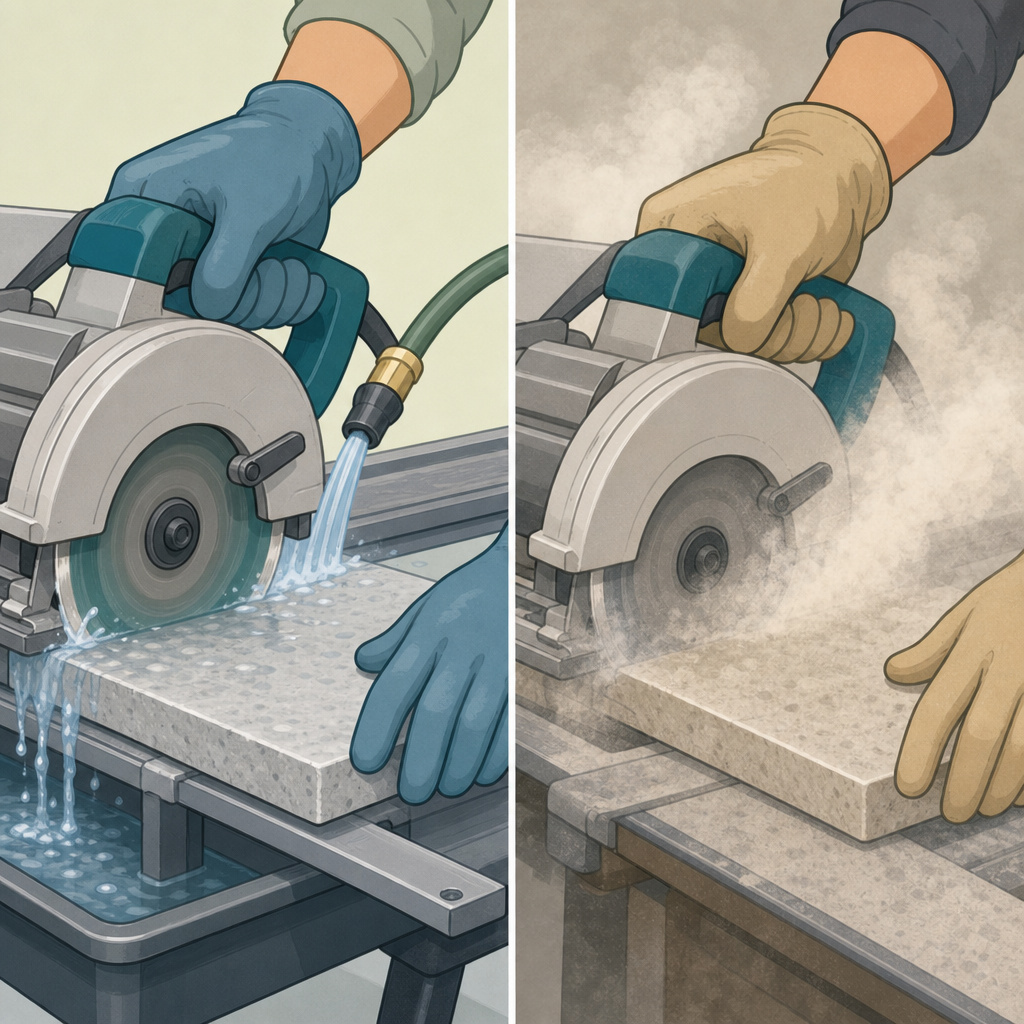
This is where online guides get soft. They say “wet cutting is better for blade life.” That’s true, but it undersells the stakes. For materials like concrete, brick, and tile, dry cutting unleashes respirable crystalline silica dust. Inhaling that dust leads to silicosis, an incurable and fatal lung disease. Water isn’t just a coolant; it’s a dust suppression system.
Before you start any dry cutting operation: Wear a properly fitted NIOSH-approved N95 respirator (or better, a P100), sealed safety goggles, and hearing protection. Do not rely on a disposable dust mask.
-
Wet Cutting uses a continuous water flow over the blade. This does three things:
- Cools the blade and the material, preventing thermal stress and bond failure.
- Suppresses nearly 100% of hazardous silica dust.
- Flushes away swarf (cutting debris), keeping the diamonds clean and cutting efficiently.
Use it for: All tile work, long concrete cuts, countertop fabrication, any indoor cutting.
-
Dry Cutting relies on air cooling and requires a blade specifically designed for it (often with laser-cut expansion slots in the core to prevent warping). You must use a technique called “pass cutting”, making a series of shallow cuts, pulling the blade out to let it spin freely and cool, then cutting deeper.
Use it for: Short, onsite cuts where water is impractical (e.g., cutting a door opening in a block wall, notching a patio slab). Always outdoors with full PPE.
The rule is simple. If you can hook up a hose or a water bottle feed, do it. Your lungs and your blade will thank you. If you must cut dry, invest in a high-quality dry-cut blade and respect the heat. Let the blade cool more than you think it needs to.
How to Choose the Right Diamond Blade: A 4-Step Checklist
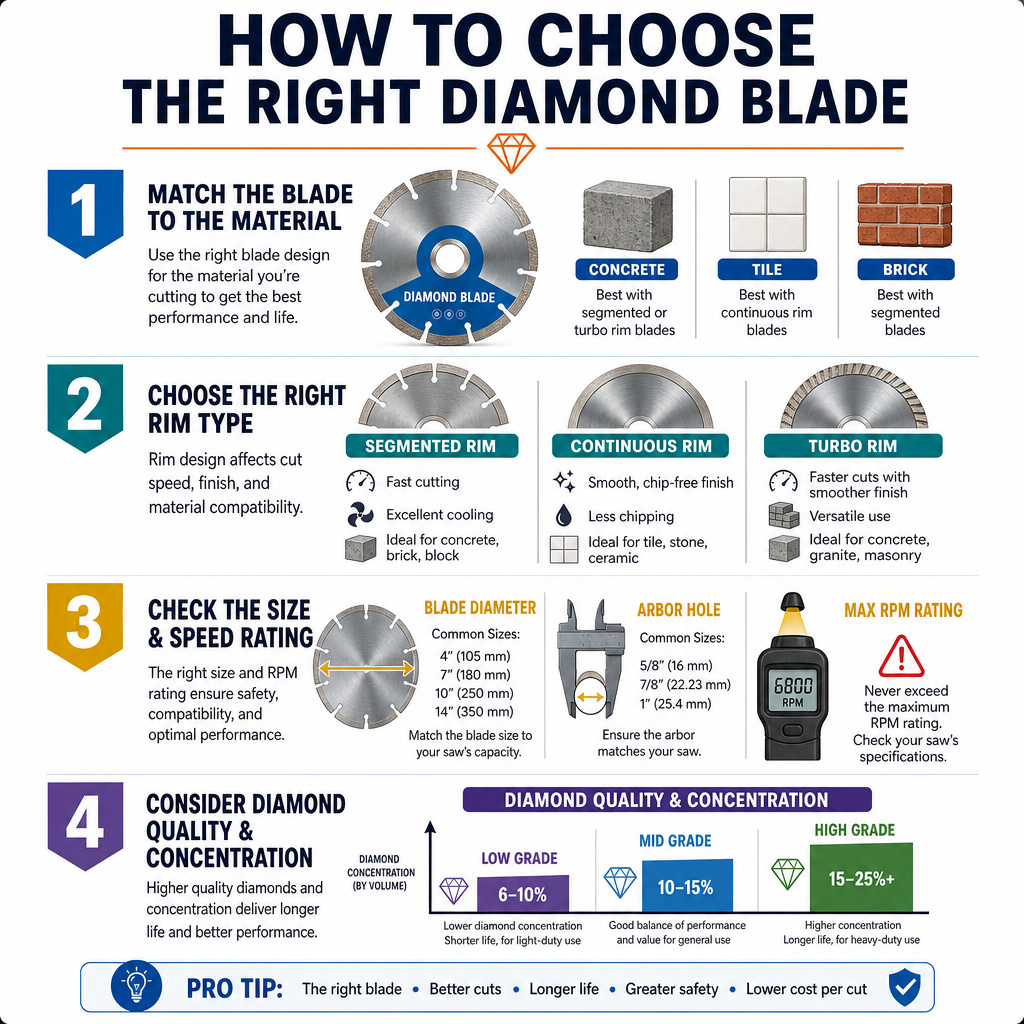
Don’t just grab the package that says “Cuts Concrete.” Follow this sequence.
- Match the Material. This is non-negotiable. Is it concrete or tile? Hard stone or abrasive brick? The material dictates the bond hardness. Check the blade’s packaging or spec sheet, good manufacturers list compatible materials.
- Select the Blade Type. Decide on the needed finish. Rough cut? Segmented. Clean cut? Continuous rim. Compromise? Turbo. This choice also dictates your cutting method (wet vs. dry).
- Verify Tool Compatibility.
- Diameter: Your saw’s guard must clear the blade.
- Arbor Size: The hole in the center must match your saw’s arbor. Never use reducers or washers to make up a size difference; it throws the blade out of balance.
- RPM Rating: The blade’s maximum RPM must be higher than your tool’s no-load speed. If your angle grinder spins at 11,000 RPM, your blade must be rated for at least 12,000 RPM.
- Consider Diamond Quality & Concentration. This is the “you get what you pay for” factor. Higher diamond concentration and stronger, sharper diamond grit (like synthetic VSG diamonds) cost more but cut faster and last exponentially longer. For a one-time DIY project, a mid-grade blade is fine. For a pro or a big project, the premium blade pays for itself in time saved and fewer blade changes.
A note on that RPM warning. I mounted a blade rated for 8,000 RPM on a 10,000 RPM demo saw once, thinking “it’s just for a few cuts.” On the third cut, a loud BANG sounded and the saw kicked violently. A segment had separated from the core due to centrifugal force.
The blade exploded. I was wearing a face shield, which is the only reason I still have my eyes. The rating is there for a reason.
Troubleshooting Common Diamond Blade Problems
Even with the right blade, things go wrong. Here’s what to look for.
| Problem | Likely Cause | Immediate Fix | Long-Term Prevention |
|---|---|---|---|
| Blade Glazes (shiny surface, no cutting) | Bond too hard for material. | Switch to a blade with a softer bond. For an emergency, try cutting a piece of abrasive concrete block or brick to dress the blade. | Always match bond hardness to material. |
| Blade Wears Extremely Fast | Bond too soft for material. Overheating from forced feeding. | Use a harder bond blade. Let the blade cut at its own pace; don’t push. | Use correct bond. Employ wet cutting or pass-cutting for dry work. |
| Excessive Vibration or Wobble | Blade is warped from overheating. Flange nuts not tightened evenly. | The blade is likely ruined. Replace it. Ensure saw arbor is clean and flanges are parallel before tightening. | Never let a blade overheat. Tighten mounting nut securely with the correct wrench. |
| Blade Cuts Slowly or Drifts | Dull diamonds. Blade is loaded with debris. | For loaded blades, clean with a soft brick or dedicated dressing stone. For dullness, replace blade. | Use water to keep blade clean. Don’t cut materials that gum up the blade (e.g., asphalt with a fine blade). |
| Chipping on Tile or Stone Edges | Using a segmented blade. Blade is dull. Too much pressure. | Switch to a continuous rim blade. Use a sharp blade. Use lighter pressure and let the blade do the work. | Use the correct blade type for finish work. Ensure adequate water flow. |
If your blade starts making a high-pitched whining sound and you see a trail of colored sparks (blue or white), stop cutting immediately. That’s the steel core overheating and losing its temper. The blade is permanently compromised and can fracture without warning.
The most common issue I see is glazing from a bond mismatch. Someone uses a general-purpose segmented blade on a granite remnant. After a few inches, it stops cutting.
They push harder, creating more heat, which hardens the bond further. The blade is now a very expensive coaster. Recognizing the shiny, polished segment early can save the blade, stop, let it cool, and switch to a proper blade.
Frequently Asked Questions
Can you use a diamond blade on a wood-cutting miter saw or table saw?
Technically, yes, if the RPM and arbor match. But you should almost never do this. Diamond blades are for abrasives.
Cutting wood loads the segments with pitch and sap, ruining the blade. Wood dust is also highly combustible, and the heat from a diamond blade is a fire risk. Use a carbide-toothed blade for wood. Save the diamond blade for cutting concrete with a circular saw or similar masonry tasks.
How long does a diamond blade last?
There’s no hour meter. Lifespan depends on diamond quality, bond match, and cutting technique. A cheap blade might die on a single 4-inch concrete slab.
high-quality blade used correctly on a wet saw can cut thousands of linear feet of tile. The best metric is performance. When it takes noticeable pressure to cut and the cut speed drops by half, it’s done. For more on this, see our guide on the signs of a dull diamond blade.
What’s the difference between a diamond blade and a carbide-tipped blade?
Carbide-tipped blades have actual teeth with welded-on carbide tips that chip out material like a chisel. They are for cutting wood, plastics, and some metals. Diamond blades have no teeth; they are a solid rim with embedded diamonds that sand away material. They are for stone, concrete, tile, and brick. They are not interchangeable.
Do you need a special saw to use a diamond blade?
You need a saw with the correct RPM and arbor size. For continuous rim (wet) blades, you need a saw designed for wet cutting, like a tile saw or a concrete saw with a water feed. For segmented blades, a standard angle grinder or masonry-grade circular saw works. Always check the tool’s manual first.
Can a diamond blade be sharpened?
Not in the traditional sense. The “sharpening” process is called dressing, which involves cutting a mildly abrasive material (like a fire brick or a dressing stone) to wear away the metal bond and expose fresh diamonds.
This only works if the diamonds themselves are still good. Once the diamond layer is fully worn, the blade is scrap metal. For more on maintaining cutting edges, our article on sharpening circular saw blades covers toothed blades, but the principle of dressing is similar.
The Bottom Line
Diamond saw blades are specialized tools for a specific job: grinding through hard, non-metallic materials. Success isn’t about buying the most expensive blade; it’s about buying the correct blade. Match the bond hardness to your material, choose the segment design for your desired finish, and never treat wet cutting as optional for dust-producing work.
Keep a segmented blade on hand for rough masonry and a continuous rim blade for tile. Let the blade’s speed do the cutting, wear your respirator, and your projects will go from frustrating to flawless. The right blade doesn’t just make the cut, it makes the difference between a professional result and a costly do-over.
