Masonry vs Wood Drill Bit | The 2 Specs That Decide
This post contains affiliate links. As an Amazon Associate, we earn from qualifying purchases.
A masonry drill bit cuts with a crushing action from a carbide tip, while a wood drill bit slices with sharp cutting edges. The masonry bit’s flutes clear pulverized dust; the wood bit’s flutes evacuate curled shavings. Using a wood bit on concrete or brick will round its edges within seconds, and using a masonry bit on fine woodwork will tear the grain and splinter the exit hole.
That distinction is mechanical, not just about buying the right color-coded package. It’s the geometry of the tip and the path of the flutes that decide whether you drill a clean hole or ruin a project and a tool.
What follows: a breakdown of the two tip designs, the four wood bit types that actually matter, and the one mistake that burns out more bits than any other. By the end, you’ll match bit to material in ten seconds flat.
Key Takeaways
- The carbide tip on a masonry bit is a blunt, brazed-on insert designed to crush brittle material; it will splinter wood.
- A brad point or sharp twist bit for wood uses slicing edges that will instantly dull on masonry, rounding over after a few holes.
- Flute design is secondary but critical: masonry flutes are shallow for dust; wood flutes are deep and often helical for chip removal.
- HSS (high-speed steel) is the standard for wood bits; it cannot handle the abrasion of concrete or brick.
- The only hybrid that works is a multi-material bit with a carbide tip ground for slicing, like those from Bosch or Diablo, and even those have limits.
The Core Mechanical Difference
Forget material for a moment. The job dictates the tool’s shape. A drill bit’s primary function is to remove material, but how it removes that material is everything.
A masonry bit employs a carbide tip brazed onto a steel shaft. The carbide insert is not sharp in the traditional sense; its edges are ground to a blunt angle, typically 135 degrees. This tip does not slice. It pulverizes the crystalline structure of concrete, brick, or stone under hammering impact and rotational force. The shallow, straight flutes behind it are designed to channel away fine, abrasive dust.
A wood bit is a cutting tool. Its tip, whether a brad point, a spur on a Forstner, or the chisel edge of an auger, is ground to a sharp point and keen cutting edges. These edges slice through wood fibers cleanly. The flutes are deep and often helical, engineered to lift out long, curled chips without clogging.
Using a wood bit on masonry is like using a chef’s knife to chop rocks. The first contact rounds the delicate cutting edges. The bit spins, heats up, and stops cutting. You’re left with a shiny, polished tip and a lot of frustration. The reverse, using a masonry bit on wood, is like using a hammer to cut bread. The blunt tip crushes and splinters the wood fibers instead of slicing them, blowing out the back of your workpiece every time.
When You Must Use a Masonry Bit
The rule is simple: if the material is mineral-based and you’re using a hammer drill setting, you need a masonry bit. This includes concrete, brick, cinder block, stone, and mortar. The hammer action delivers thousands of tiny impacts per minute, which the carbide tip is designed to withstand and utilize.
The carbide grade matters. Basic bits use a standard carbide insert. For frequent use or harder concrete, look for bits labeled with “4-cutter” or “percussion carbide” geometry, like the Bosch Bulldog series. These have additional cutting faces that stay sharper longer.
Where this goes sideways: Using a masonry bit on tile or glass. The hammer action will shatter those brittle materials. For tile, you need a diamond-grit or spear-tipped bit, run without hammer action.
Drilling into brick or block for anchors is the most common task. Here, the bit diameter must match your anchor sleeve. A 3/16″ bit for a #8 anchor, a 1/4″ bit for a #10, and so on. Using a bit even 1/32″ oversized means the anchor spins and never holds.
If you’re setting a fastener in mortar, know your mortar type. Drilling into Type N mortar (common for general brickwork) is straightforward. Older, harder Type S or Type M mortars will wear a cheap bit faster. The Brick Industry Association technical note details these mortar properties and their typical applications.
| Material | Bit Type Required | Drill Mode | Critical Spec |
|---|---|---|---|
| Poured Concrete | Carbide-tipped masonry | Hammer Drill | Carbide grade (look for “percussion”) |
| Brick / Cinder Block | Carbide-tipped masonry | Hammer Drill | Diameter match to anchor |
| Stone (Granite, Slate) | Carbide-tipped masonry | Hammer Drill | Slow speed, water cooling if possible |
| Mortar Joint | Carbide-tipped masonry | Hammer Drill (light) | Know mortar type (N, S, M) for wear expectation |
The Four Wood Bit Types That Actually Matter
Not all wood bits are the same. Choosing the right one depends on the hole size, depth, and required finish. A basic twist bit is not always the answer.
1. Brad Point Bits
These are the precision choice for dowel holes, shelf pins, and any joinery. The sharp central spur starts the hole exactly where you want it, preventing “walking.” The outer spurs score the circumference of the hole before the cutting edges engage, resulting in a clean, splinter-free entry and exit. The Bosch Professional Brad Point series is the benchmark here.
2. Twist Bits (Standard & Installation)
The general-purpose workhorse. A standard HSS twist bit is fine for quick holes under 1/2″. For deeper holes or drilling through framing where you might hit a nail, an installation bit is the upgrade. These have a tapered flute that prevents jamming in deep, wet, or nail-embedded wood. The Bosch PRO Wood HSS Installation Drill Bit is built for this.
3. Spade Bits & Auger Bits
For large-diameter holes (3/4″ and up), you have two paths. A spade bit is fast and cheap, best for rough electrical and plumbing holes where finish doesn’t matter. It can tear and splinter. An auger bit, with its threaded self-feeding tip and deep, continuous flutes, pulls itself through the wood with less effort and leaves a cleaner wall. It’s the choice for boring through beams or heavy timber.
4. Forstner Bits
When you need a flat-bottomed, perfectly smooth-sided blind hole, only a Forstner bit will do. It’s essential for hinge mortises, inlays, or any cabinetry work. The rim cuts a clean circle, and the flat bottom is machined by radial cutters. They require a drill press for control and a slow, steady feed rate.
| Hole Need | Best Bit Type | Why It Wins | Named Example |
|---|---|---|---|
| Clean, precise dowel hole (1/4″ – 1/2″) | Brad Point | Prevents walking, scores wood fibers for clean exit | Bosch Professional Brad Point |
| Deep hole through a stud (possibly with nails) | Installation Bit | Tapered flute clears chips, HSS survives nail strikes | Bosch PRO Wood HSS Installation |
| 1″ hole for plumbing pipe through a joist | Auger Bit | Self-feeding tip reduces effort, continuous flute clears chips | Irwin Speedbor Max |
| Flat-bottom hinge mortise | Forstner Bit | Cuts a clean, precise blind hole with smooth sides | Freud Forstner Bit Set |
Can You Use a Masonry Bit on Wood? (And Vice Versa)
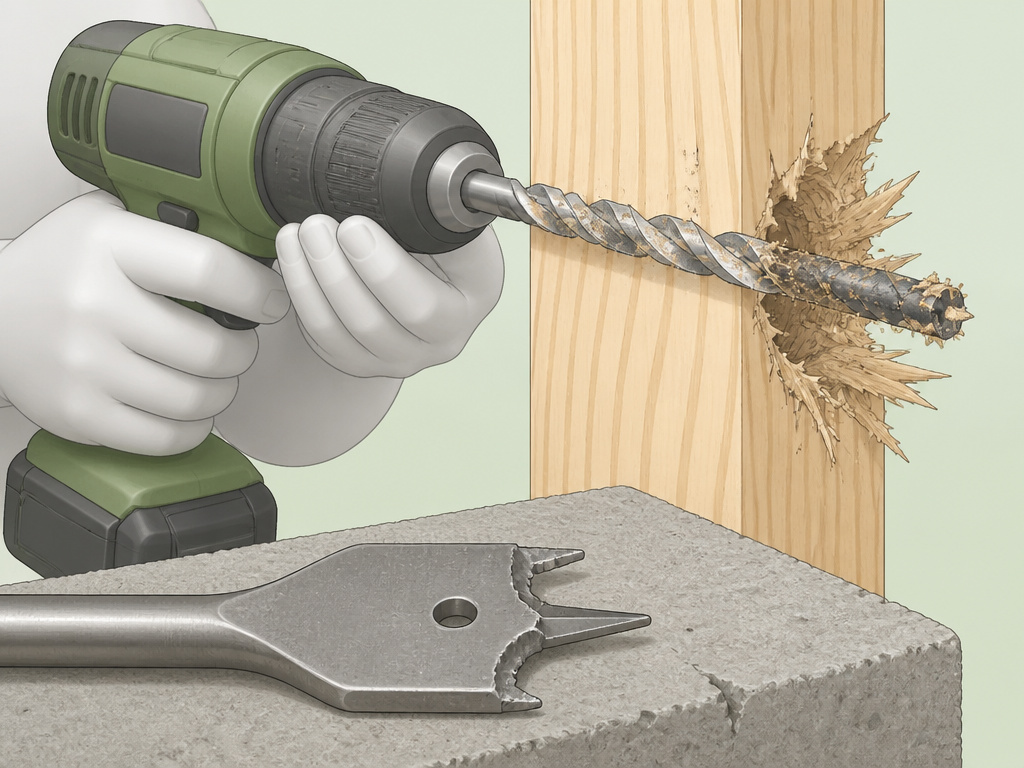
You can physically chuck a masonry bit into a drill and spin it into a piece of pine. The result will be a hole, but it’s a bad idea for three reasons.
First, the cut quality is terrible. The crushing action of the carbide tip will splinter and tear the wood, especially on the exit side. Second, the shallow flutes of a masonry bit are not designed for chip evacuation. In softwood, they can clog with long shavings, causing the bit to bind and overheat. Third, you risk damaging the bit. Wood resin and moisture can gum up the braze joint between the carbide and the steel body.
The opposite, using a wood bit on masonry, is a direct path to a dull bit. A brad point bit will be destroyed in under 30 seconds of contact with concrete. The sharp spurs and edges are made of HSS, which is tough but not abrasion-resistant. Concrete acts like sandpaper, rounding those edges to a useless polish. The bit will stop cutting, smoke, and become a permanent fixture in your “junk drawer of ruined tools.”
Common mistake: Trying to drill a pilot hole for a concrete anchor with a wood bit. The hole will be undersized and rough, the anchor won’t seat, and you’ll have a dull bit. Always use the correct masonry drill bit from the start.
The only exception is the category of multi-material or carbide-tipped twist bits. These look like standard twist bits but have a small, ground carbide tip. Brands like Bosch’s MultiConstruction line or Diablo’s Demon are designed to drill wood, metal, plastic, and sometimes masonry without hammer action. They are a compromise tool, excellent for a handyman who needs one bit for a variety of light tasks, but they are not a replacement for a dedicated masonry bit in a hammer drill for serious concrete work.
How to Choose: A Decision Table
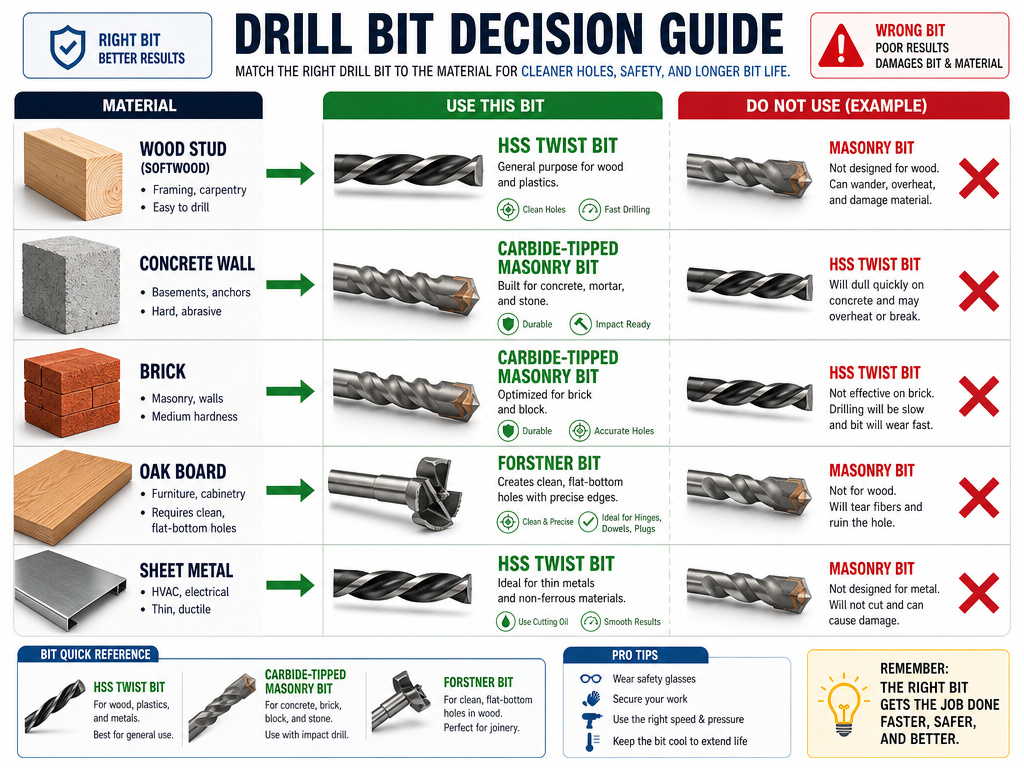
Stop guessing. Match the material you’re drilling to the bit type, and match the bit type to your drill’s capability.
| If You Need To Drill Into… | Then Use This Bit Type: | And Set Your Drill To: | What Happens If You’re Wrong: |
|---|---|---|---|
| A 2×4 wood stud | HSS Twist Bit or Brad Point | Drill Mode (no hammer) | Masonry bit splinters wood; poor grip for screw. |
| A concrete basement wall | Carbide-Tipped Masonry Bit | Hammer Drill Mode | Wood bit dulls immediately; no hole progress. |
| A brick facade for a tapcon | Carbide-Tipped Masonry Bit | Hammer Drill Mode | Wrong bit creates oversized, weak hole. |
| A piece of oak for a cabinet hinge | Forstner Bit | Drill Press (recommended) or low-speed drill | Twist bit tears grain; hole is rough and inaccurate. |
| Sheet metal over a wood backing | HSS Twist Bit (metal) or Step Bit | Drill Mode, slow speed | Masonry bit skates and scars metal; wood bit dulls. |
This table isn’t exhaustive, but it covers 95% of household and workshop scenarios. The process of choosing a drill bit becomes automatic once you internalize the material-bit relationship.
The Role of Bit Material and Coatings
Geometry is king, but the steel and its treatment matter for longevity. For wood bits, High-Speed Steel (HSS) is the standard. It stays hard at the temperatures generated by drilling wood. Some HSS bits have a black oxide or titanium nitride (TiN) coating. These coatings primarily reduce friction and heat, which helps the bit last longer and eject chips more easily. They are not magic, a coated wood bit will still die on concrete.
Masonry bits start with a tough steel shaft, but the tip is always a tungsten carbide insert. Carbide is significantly harder than HSS and resistant to abrasion. The quality of the carbide and the precision of the brazing determine the bit’s life. A poorly brazed tip can snap off under hammer drill stress.
There is no “best” coating for masonry bits. The focus should be on carbide quality and flute design that effectively clears dust. A bit clogged with concrete dust cannot cut, no matter how good the carbide is.
Pro Tips for Longer Bit Life
Bits are consumables, but you can make them last. For wood bits, the enemy is heat and dirt. Drill at the correct speed, faster for small diameters, slower for large ones. Clear the flutes frequently when drilling deep holes. If the bit starts to smoke, you’re going too fast or the flutes are packed.
For masonry bits, the enemy is impact without rotation. Always keep firm pressure and let the hammer action do the work. If the bit is not rotating while the hammer is pounding, you’re just peening the carbide tip and will crack it. Blow out the hole periodically to keep dust from compacting and jamming the bit.
Store them separately. Throwing all your bits in one pouch lets the carbide tips of the masonry bits chip the fine edges of the brad points. Use a dedicated case or a segmented organizer.
Frequently Asked Questions
What does a masonry drill bit look like?
Masonry bit has a distinctive silver or grey carbide tip brazed to a steel shaft. The tip is wider than the shaft and often has a flat, chisel-like profile. The flutes are usually straight or slightly spiraled and are shallower than those on a wood bit. You can learn more about the physical features of masonry bits in our dedicated guide.
Can I use a wood drill bit on concrete?
No. A standard HSS wood drill bit will become dull within seconds on concrete. The abrasive aggregate in concrete will round over the sharp cutting edges, rendering the bit useless. You need a carbide-tipped masonry bit used with a hammer drill.
What is the difference between a masonry bit and a concrete bit?
In common parlance, they are often the same thing. Technically, all bits for concrete are masonry bits, but not all masonry bits are optimized for the hardest concrete. A bit marketed specifically for concrete may have a higher-grade carbide or a more aggressive “4-cutter” tip design for faster penetration. For most DIY tasks, a general-purpose masonry bit works for brick, block, and concrete.
Why does my masonry bit get stuck in the hole?
This is usually caused by two things: failing to clear dust from the hole, or the bit becoming overheated and binding. Concrete dust is abrasive and can compact around the bit. Pull the bit out partially every 10-15 seconds to clear the flutes. Also, ensure you’re using the hammer function, rotation alone is not enough for masonry.
What’s the best all-around drill bit for a homeowner?
If you must have one bit for unexpected tasks, a carbide-tipped multi-material bit (like a Bosch CYL-9 or similar) is the most versatile. It can handle wood, metal, plastic, and light masonry drilling (without hammer action). However, for any dedicated project, you should use the correct specialized bit. It’s like asking for the best all-around vehicle, a pickup truck works, but it’s not ideal for everything.
Before You Go
The split between masonry and wood drill bits isn’t a marketing ploy. It’s engineering. One crushes, the other cuts. Trying to swap them costs you time, ruins your workpiece, and turns a five-dollar bit into trash.
For wood, start with a set of quality HSS twist bits and add a few brad points for fine work. For masonry, buy a small set of carbide-tipped bits that match common anchor sizes. Keep them separate, use them in the correct drill mode, and they’ll each last for years of projects.
When you see a hole that needs drilling, pause for two seconds. Ask: “Is this mineral or organic?” That answer points you straight to the right tool.
