
Methods for How to Make a Hole in Metal Without Using a Drill
This post contains affiliate links. As an Amazon Associate, we earn from qualifying purchases.
You can make a hole in metal without a drill by applying concentrated force with a punch or by using specialized tools like hydraulic punch drivers. For thin sheet metal, a hammer and a center punch will work. For thicker materials or clean holes in pressurized systems, you need a Greenlee hydraulic punch driver or NASA’s inert-gas technique.
The 0.134-inch thickness limit for a Greenlee punch on mild steel isn’t a suggestion. It’s the point where the draw stud snaps or the ram jams. Go thicker, and you’ll hear a sharp crack before the punch stops dead.
What follows: the three proven systems that actually work, the exact specs they’re rated for, and the one field trick NASA published for making holes in live piping without a single metal chip falling inside.
Key Takeaways
- A Greenlee hydraulic punch driver can handle up to 10-gauge (0.134″) mild steel and requires a pilot hole slightly larger than the draw stud.
- NASA’s clean-hole technique uses a blind pilot hole, inert gas pressure, and an end mill to make holes in live systems without contamination.
- For thin sheet metal under 1/16″, a manual center punch and hammer is effective, but accuracy drops fast on thicker stock.
- Hole punch pliers are only for the thinnest sheet metal and aluminum; they will buckle or snap on anything harder.
- Always match the punch type to your material: Slug-Splitter punches for stainless steel, standard punches for mild steel and aluminum.
The Hydraulic Punching Method (Greenlee)
This is for when you need a clean, round hole in sheet metal or conduit, and a drill press isn’t an option. A hydraulic punch driver doesn’t spin—it pushes a sharp, tubular punch through the material with up to 16,000 pounds of force. The slug pops out the other side into a die.
The Greenlee 746 Hydraulic Ram, paired with a 767 Hand Pump, is rated to punch holes from 1/2″ to 5-5/8″ in diameter. Its official capacity for mild steel is a maximum of 10 gauge (0.1344″, 3 mm) when using standard or Slug-Buster punches, dies, and draw studs.
The process hinges on a tight connection. You drill a pilot hole first, thread a draw stud through it, then assemble the die and punch on either side. Hand-tighten everything until it’s snug. If the punch threads aren’t fully engaged on the draw stud, the punch will skew under pressure and tear the metal instead of cutting it.
Here’s the step-by-step, pulled straight from the Greenlee manual:
- Drill the pilot hole. Use a bit slightly larger than the draw stud diameter. This hole is just for alignment, not for cutting.
- Thread the draw stud completely into the ram of the punch driver.
- Slide the die onto the stud, open end facing away from the ram.
- Insert the stud through the pilot hole in your workpiece.
- Thread the punch onto the stud from the other side, cutting edge facing the material. Tighten by hand until the assembly is snug against the metal.
- Pump the handle until the punch shears through. Support the ram’s weight so it doesn’t fall when the slug releases.
Where this goes sideways: Pumping after the ram stops moving. The manual states this will damage the ram internally. You’ll feel the handle get rock-solid. That’s your cue to stop and open the release valve.
For holes larger than your pilot hole, you use step-up punching. Punch a 1/2″ hole first, then switch to a 3/4″ draw stud and a larger die/punch set to enlarge it. This gives the tool a clean edge to bite against and prevents the punch from wandering.
| Material | Punch Type | Maximum Thickness (Mild Steel) | Best For |
|---|---|---|---|
| Mild Steel, Aluminum | Standard Punches | 10 ga (0.134″) | Electrical conduit, HVAC duct |
| Stainless Steel | Slug-Splitter Punches | 10 ga (0.134″) | Food-grade fixtures, chemical tubing |
| Plastic, Fiberglass | Standard Punches | Varies by hardness | Enclosures, panels |
The real limit is the punch and die set, not the hydraulic driver. Always check the manual for the specific punch capacity. For heavy-duty drilling through metal on thicker stock, this isn’t the tool.
The NASA Clean-Hole Technique
Sometimes, the hole isn’t the hard part. Keeping the inside of the pipe clean is. In 1972, NASA published a technique for making “clean holes in metallic piping and components” without disassembling the system or letting contamination inside. They tested it on Inconel, stainless steel, and black steel.
The core problem: drilling a hole from the outside in sends metal chips and debris into the pipe. For fuel lines, hydraulic systems, or oxygen lines, that’s a failure. NASA’s solution uses inert gas pressure to block debris entry.
Before you start: This technique requires you to pressurize the system. You must be certain the pipe or vessel can safely hold 3 to 5 inches of water column pressure. Never attempt this on a system containing flammable or toxic media.
The method has three stages, and it’s all about controlling the breakthrough.
First, drill a blind pilot hole. You drill from the outside, but you stop short. NASA’s specs say to drill to within 0.050 to 0.060 inch of the inner wall. The goal is to leave a thin membrane of metal intact. They used a 0.95 cm (3/8 inch) two-fluted end mill for this because it doesn’t chatter in a hand drill and holds its edge.
Second, pressurize the system with inert gas. Hook up an argon or nitrogen bottle and bring the internal pressure up to 5 to 13 cm (2 to 5 inches) of water. This slight positive pressure will blow outward when you finally pierce the membrane, preventing any chips from falling in.
Third, pierce and finish the hole. Now you carefully drill or punch through the remaining thin wall. The gas flow carries the last bits of debris out. You can then use a ball-type rotary file to countersink or enlarge the hole to a final diameter of up to 0.250 inch.
This is a niche but brilliant solution for making holes in metal doors for new hardware without filling the hollow core with metal dust, or for adding a port to a sealed tank. It turns a contamination risk into a controlled event.
Manual Punching & Cutting
When your metal is thin and your tolerance for imperfection is higher, your hands and some basic tools can do the job. This is the realm of sheet metal, aluminum flashing, and thin gauge steel.
The Center Punch and Hammer is the most direct method. You don’t drill; you displace. Place the sharp tip of the punch on your mark, hold it vertical, and strike it firmly with a ball-peen hammer. The punch dents and then pierces the metal. It’s loud, it’s crude, but for a small hole in material under 1/16″ thick, it works.
The hole won’t be perfectly round. The metal will deform around the edges, creating a raised burr on the exit side. You’ll need to file that down. This method fails on anything thicker because the punch simply mushrooms the metal instead of shearing through.
Hole Punch Pliers are essentially heavy-duty, scissor-style pliers with a punch and die built into the jaws. You align the mark between the jaws and squeeze. They’re fantastic for thin aluminum or soft sheet metal for crafts. Try them on even mild steel, though, and you’ll either bend the metal or snap the pin mechanism. They are not for drilling soft alloys like pot metal; the leverage isn’t enough.
The Hacksaw or Jeweler’s Saw is for making holes that aren’t round. Need a square hole for a valve body or a slot? You can saw it out. Drill a small starter hole inside your marked shape, detach the saw blade, feed it through, reattach it to the frame, and saw out the perimeter. The limitation is the saw frame’s depth; you can only cut so far from the edge of the sheet.
| Tool | Max Material Thickness | Hole Quality | Primary Risk |
|---|---|---|---|
| Center Punch & Hammer | ~18 ga (0.048″) steel | Poor, burred edges | Punch slips, damaging workpiece or hand |
| Hole Punch Pliers | 22 ga (0.030″) aluminum | Good, clean cut | Tool failure on hardened materials |
| Hacksaw | Limited by blade length | Good, any shape | Blade snap, inaccurate cuts |
For a clean, large-diameter hole in thicker sheet metal, these manual methods hit a wall. That’s when you look at using a hole saw mounted in a hand brace or even a creating a square hole in metal with a dedicated square hole punch.
Choosing Your Method: A Decision Guide
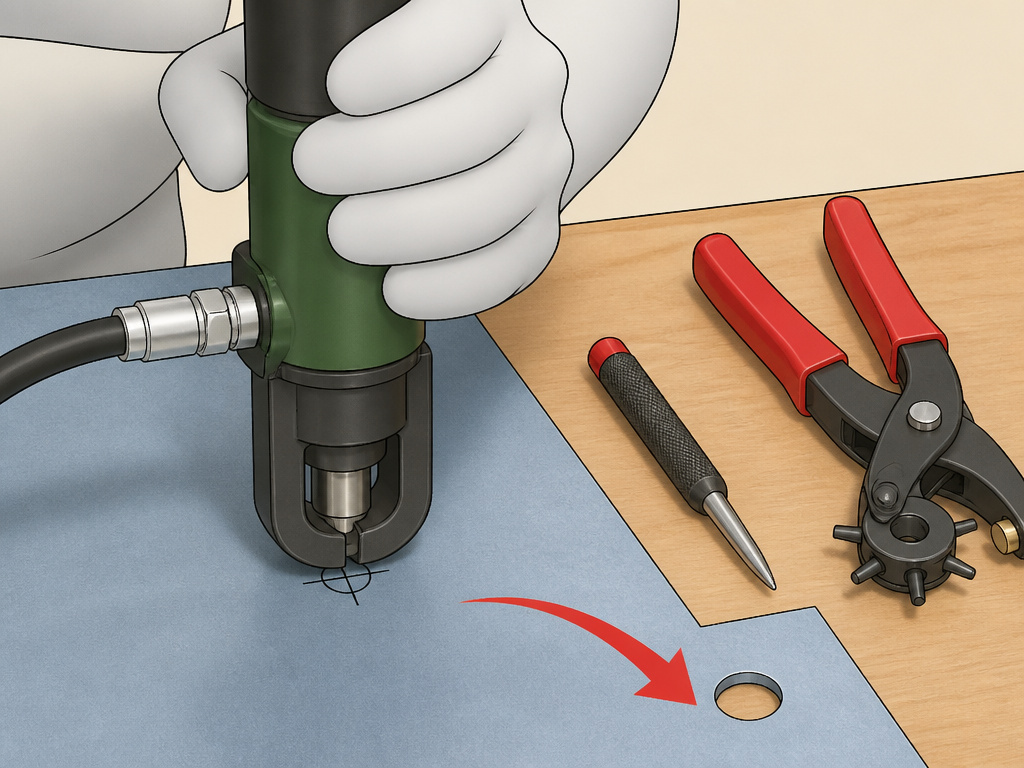
Your metal’s thickness and the hole’s purpose decide everything. Picking the wrong approach wastes time and ruins workpieces.
For holes up to 1/4″ in thin sheet metal (under 1/16″): A center punch is fastest. A hole punch plier is cleanest. If you need a non-round shape, the jeweler’s saw wins. These are all methods for drilling without a power drill that rely on muscle.
For clean, round holes 1/2″ to 4″ in sheet metal up to 10 gauge: The Greenlee hydraulic punch is the professional answer. It’s the only manual method that gives a drill-press-quality hole in this range. It’s also the only one rated for stainless steel with the right Slug-Splitter dies. Understanding drill bit differences is irrelevant here; this system doesn’t use bits.
For adding ports to sealed or pressurized systems: The NASA clean-hole technique is the only safe choice. It’s a specific solution for a specific contamination problem. All other methods will introduce debris.
For anything thicker than 10 gauge mild steel: You’ve mostly exited the “without a drill” realm. At this point, you’re looking at plasma cutting, oxy-fuel cutting, or drilling with a powerful drill and a proper drill bit for hardened metal. A hydraulic punch will stall or break.
Think about your next step, too. A punched hole often needs deburring. A hole made with the NASA method might need tapping for threads. The method you choose sets up the rest of the job.
Safety & Setup: Non-Negotiables
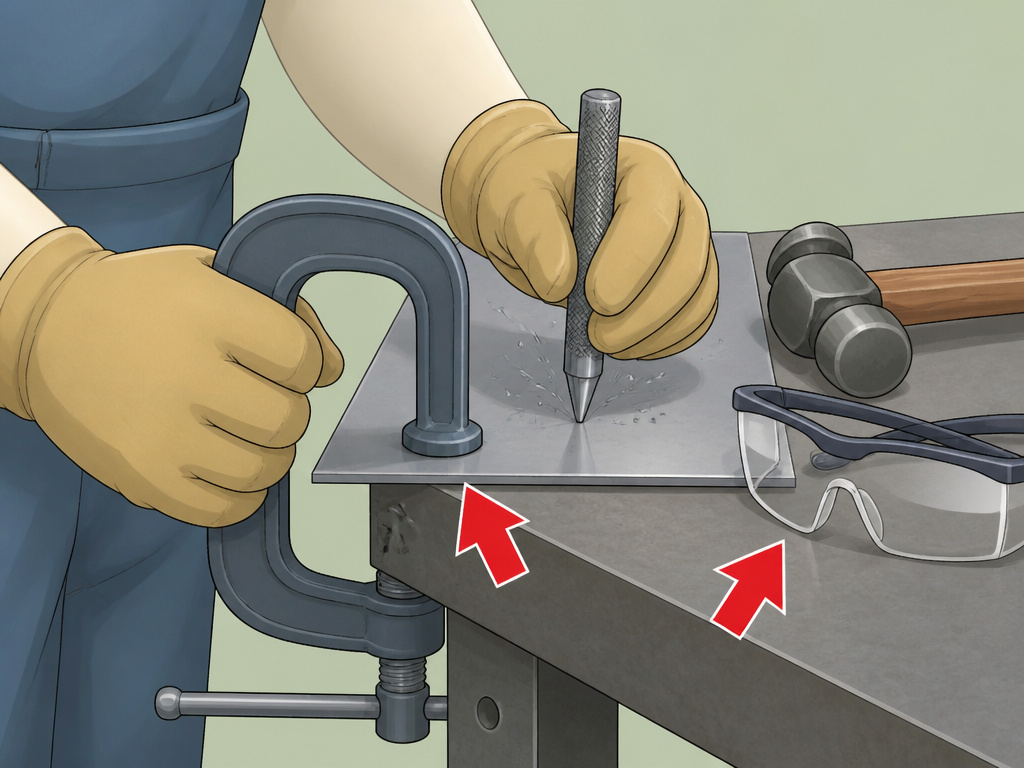
Working with metal and high force demands respect. The shortcuts here lead directly to broken tools or injury.
Eye protection is mandatory. When a punch shears through metal, the slug can eject. When you hammer a center punch, metal flakes can fly. Wear safety glasses every single time.
Secure your workpiece. Use clamps or a vise. Never hold thin sheet metal in your hand while punching or hammering—the recoil can drive the sharp edge into your palm. For hydraulic punching, the manual explicitly says to support the ram’s weight to prevent it from falling when the punch completes.
Know your tool’s limits. The Greenlee 10-gauge limit is a maximum driver rating. Exceed it, and you risk stripping the draw stud threads, cracking the die, or bursting a hydraulic seal. If the ram stops moving, stop pumping. That’s the limit.
Check for hidden hazards. Before using the NASA technique, ensure the system is inert and can hold low pressure. Before punching into any wall or door, know what’s behind it. You’re creating a hole; make sure it’s only going through the intended layer.
The right setup prevents 90% of failures. A wobbly workpiece, a misaligned punch, or a pilot hole that’s too small will turn a simple job into a frustrating mess.
Frequently Asked Questions
Can you really punch a hole in metal by hand?
Yes, but only in very thin sheet metal. Using a hammer and a sharp center punch, you can dent and eventually pierce material up to about 1/16″ thick. The hole will be irregular and require deburring. For anything thicker or any need for precision, you need a leveraged tool like hole punch pliers or a hydraulic system.
What’s the thickest metal you can punch without a drill?
The common professional limit is 10-gauge mild steel, which is 0.1344 inches thick. This is the rated capacity of tools like the Greenlee hydraulic punch driver with standard punches. Specialized industrial machines can go thicker, but for workshop purposes, beyond 10 gauge requires cutting or drilling.
How do you make a hole in metal without shavings?
The only reliable way is NASA’s clean-hole technique. It involves drilling a blind pilot hole, pressurizing the vessel with inert gas, and then piercing the final thin layer. The outward gas flow carries all debris out with it. All mechanical punching or cutting methods will produce some chips or slugs.
What can I use if I don’t have a metal punch?
For thin metal, a sharp nail set or a hardened steel nail can work as a crude center punch. A sharp chisel and hammer can be used to carve out a small, rough hole. For a larger hole, you can drill a ring of small holes and then knock out the center, then file smooth. It’s labor-intensive and imprecise.
Is a hydraulic punch better than drilling?
It depends. For thin sheet metal, a hydraulic punch is faster and produces a cleaner, burr-free hole in one shot, with no spinning bit to catch and deform the material. For thicker plate steel, drilling is the only option. A punch is also superior for manual hole drilling in tight spaces where a drill can’t fit.
Can you use a wood punch on metal?
No. Punches designed for wood are not hardened to the same degree as metal punches. Striking a wood punch against metal will mushroom and ruin its tip instantly. Always use a punch specifically designed and hardened for metalworking.
Before You Go
Making a hole in metal without a drill isn’t about one magic trick. It’s about matching three things: your metal’s thickness, the hole size you need, and the tools that can bridge that gap.
For the DIYer with thin sheet, the center punch is your friend. For the electrician or HVAC tech running conduit, the Greenlee hydraulic punch is a time-saving staple. For the technician working on sealed systems, NASA’s 50-year-old technique is still the gold standard.
Skip the gimmicks. A hole punch plier won’t touch steel. A hammer and nail will just bend. Go with the method that has a verified capacity for your job, and you’ll get a usable hole every time.
