
How to Drill a 4 Inch Hole in Concrete | The 1700 RPM Rule
This post contains affiliate links. As an Amazon Associate, we earn from qualifying purchases.
To drill a 4-inch hole in concrete, you need a core drill and a diamond core bit. A hammer drill or rotary hammer will not work, its hammering action shatters the aggregate and jams bits over 1-1/8 inches. A core drill rotates a hollow diamond bit at a steady speed, grinding a perfect cylinder. The U.S.SAWS Core Pro-4 hand-held model runs at 1700 RPM, and choosing the slowest gear for a 4-inch bit prevents stalling and motor burnout.
That 1700 RPM spec is the anchor. Go faster on a large bit, and the motor bogs down against the concrete’s aggregate. The bit spins without cutting, the gearbox overheats, and you’re left with a glazed hole and a tool that needs a $200 service visit.
What follows: the three tool categories that actually work, the five-step core drill process, and the specific failures, like hitting rebar or drilling upward, that stop a pro job cold. By the end, you’ll know which rental to ask for and the one mistake that voids the warranty on day one.
Key Takeaways
- A core drill is the only tool rated for a 4-inch hole. Rotary hammers max out around 1-1/8 inches.
- Diamond core bits require water cooling. Dry drilling destroys the diamond segments in under a minute.
- Match the drill’s gear to the bit size. The U.S.SAWS manual states to use the slowest speed for large diameters to prevent stalling.
- Vertical upward drilling needs a water basin. Without it, coolant runs back into the motor and ruins it.
- Bit runout over 1 mm will cause wobble, an uneven cut, and can crack the core slug inside the bit.
The Right Tool for a 4-Inch Hole
This is not a negotiation. The physics of cutting a 4-inch cylinder through reinforced concrete demands a specific tool. Using the wrong one doesn’t just slow you down, it breaks equipment.
A rotary hammer or SDS Plus drill is built for impact. It pounds a solid bit into the material, fracturing it. This works for holes up to about 1-1/8 inches. Beyond that, the surface area of the bit is too large. The hammering action cannot effectively transmit energy through the entire bit face. The bit jams, the drill overheats, and you risk snapping the shank.
Technical Spec: The U.S.SAWS CORE PRO-4 HAND-HELD Core Drill has a fixed rotational speed of 1700 RPM and is designed for hole diameters from 1” to 4”. Its oil-bath gear system provides the constant torque needed to grind rather than hammer through aggregate.
A core drill works on the principle of abrasion. A hollow diamond core bit is mounted on a drill that provides pure rotation, often with multiple gear settings. The diamond-encrusted edge grinds away the concrete, leaving a clean, round hole and a solid core slug inside the bit. There is no hammering action.
For a one-time project, rent a hand-held core drill like the U.S.SAWS Core Pro-4 or a similar model from a tool rental yard. For more than a few holes or for precise, deep holes, a stand-mounted core rig is worth the setup time. It anchors to the surface, ensuring perfect perpendicular holes with no operator strain.
Diamond Core Bits: Your Only Real Option
The bit is what does the cutting. For concrete, that means a diamond core bit. Carbide-tipped hole saws and masonry bits will not touch a 4-inch hole in structural concrete.
Diamond bits are categorized by bond hardness and whether they are designed for wet or dry use. For concrete, you need a soft-bond, wet-cut diamond bit. The soft bond allows worn diamonds to fall away, revealing fresh, sharp ones underneath. The water does three jobs: it cools the bit, suppresses deadly silica dust, and flushes cuttings from the cut.
| Bit Type | Best For | What Happens If You Use It Dry |
|---|---|---|
| Wet-Cut Diamond Core | Concrete, reinforced concrete, brick. | Diamonds overheat and glaze over in seconds. The steel barrel warps. Bit is destroyed. |
| Dry-Cut Diamond Core | Asphalt, soft masonry. | In concrete, it loads up with dust, overheats, and the segments de-bond. |
| Carbide-Tipped Hole Saw | Wood, thin metal, plastic. | The carbide teeth dull immediately, then snap off. The saw seizes in the hole. |
The bit must also have the correct arbor to fit your specific core drill. Most hand-held core drills use a proprietary threaded arbor system. Do not force an adapter. Vibration from a mismatched connection will amplify runout and crack the bit.
Bit runout is the amount the cutting head wobbles when spinning. The U.S.SAWS manual specifies it should not exceed 1 mm. Check this before you start. Excessive runout creates an oval, oversized hole and puts tremendous stress on the drill’s spindle.
Step-by-Step: Core Drilling a Clean 4-Inch Hole
The process is methodical, not fast. Rushing any step guarantees a problem.
1. Mark and Scout the Location.
Use a pencil or chalk to mark the exact center. Then, use a stud finder or a professional-grade multi-scanner to detect rebar, post-tension cables, and conduit within a 5-inch radius of your mark. A 4-inch bit removes a cylinder, but the vibration affects a larger area. Hitting steel reinforcement is the most common showstopper.
2. Set Up for Water and Dust Control.
Connect your water hose to the drill’s inlet port. Use a pump sprayer if no tap is available. Place a water collection basin if drilling vertically upward or on a ceiling. This basin catches coolant runoff before it can flow back into the motor housing. The manual is explicit: water contacting the motor or switch box voids the warranty and kills the tool.
Common mistake: Drilling without water to avoid a mess. The diamond segments glaze over in under 30 seconds. After that, the bit spins frictionlessly on a hardened glass-like surface, and you must start a new hole elsewhere.
3. Start the Pilot and Establish the Cut.
Many core bits have a separate pilot drill or guide. If yours does, use it. Some pros prefer to drill a separate 3/8-inch pilot hole first. This gives the large, heavy core bit a guide to follow, preventing “walking” on the uneven concrete surface. Start the drill at its slowest gear setting. Apply light, steady pressure, let the diamonds do the work.
4. Maintain Steady Progress and Clear Debris.
Keep the drill perpendicular. Do not force it. If progress stops, you’ve likely hit rebar or very hard aggregate. Withdraw the bit partially to allow water to flush the cut. Every 30 seconds, pull the bit completely out to clear the core slug of debris. A packed bit overheats and binds.
5. Withdraw the Core and Clean the Hole.
Once you’ve reached depth, switch off the drill while it is still in the hole. With the bit stationary, gently rock it to break any remaining connection at the base of the core. Withdraw the bit with the core slug inside. Tap the slug out with a drift pin. Use a wire brush or compressed air to clean the new hole of any remaining grit.
What Stops a Core Drill Cold (And How to Fix It)
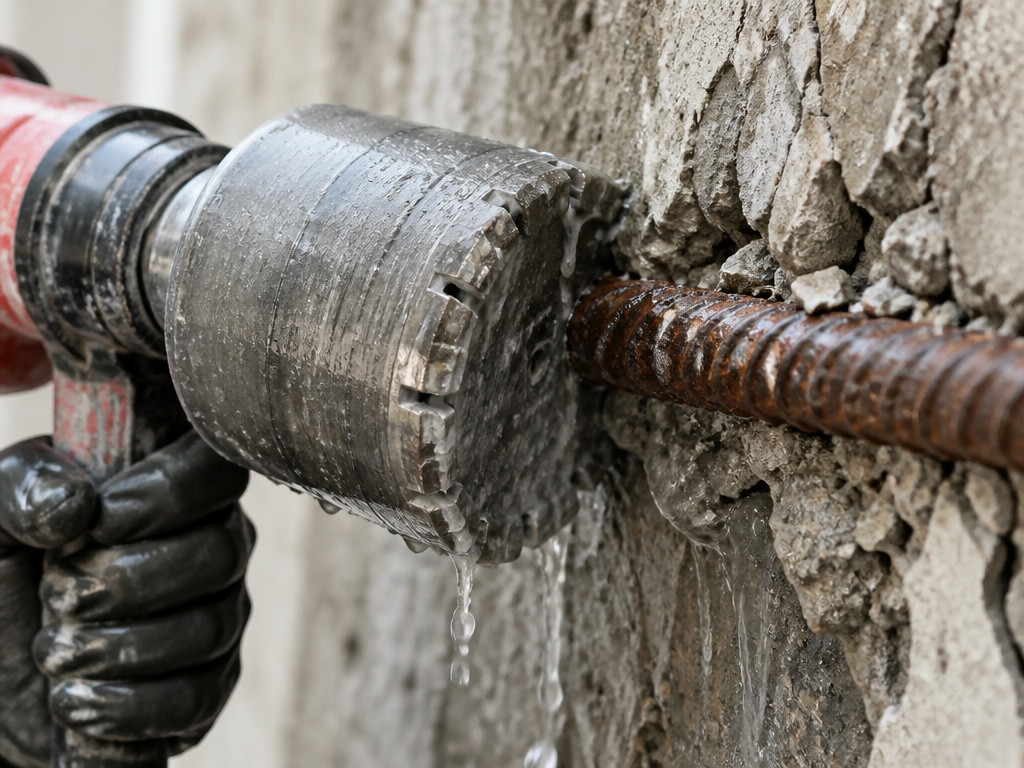 You will hit obstacles. Here’s what they feel like and what to do.
| Symptom | Likely Cause | Immediate Action |
|---|---|---|
| Drill stalls, motor hums. | Bit is too large for gear selection, or hit dense rebar. | Stop. Switch to a lower gear. If already in low gear, you are over capacity. |
| Bit spins freely, no cutting. | Concrete surface is glazed, or diamonds are gone. | Withdraw bit. Inspect segments. Restart with firmer pressure on a fresh spot. |
| Water leaks from drill housing. | Rotary shaft seal failure. | Stop immediately. Do not restart. This requires a specialist workshop repair. |
| Excessive vibration, oval hole. | Bit runout >1mm, or bit is damaged. | Check bit and arbor connection. Replace damaged bit. |
| Oil leaking from gear housing. | Gear oil seal failure. | Stop immediately. Continuing runs the gearbox dry, destroying it. |
Where this goes sideways: Hitting rebar. The bit will not cut through steel rebar. Progress stops instantly. Forcing it chips or de-bonds diamond segments. The fix is to relocate your hole at least 2 inches away, or use a dedicated rebar-cutting bit first, a separate, expensive tool.
A glazed surface happens when a bit spins without cutting, friction-heating the concrete into a glass-hard layer. The fix is physical: you must break that glaze. Sometimes applying more pressure with a fresh bit works. Other times, you need to use a small masonry chisel to break up the glazed spot before restarting.
Gear, Speed, and the 300-Hour Service Cliff
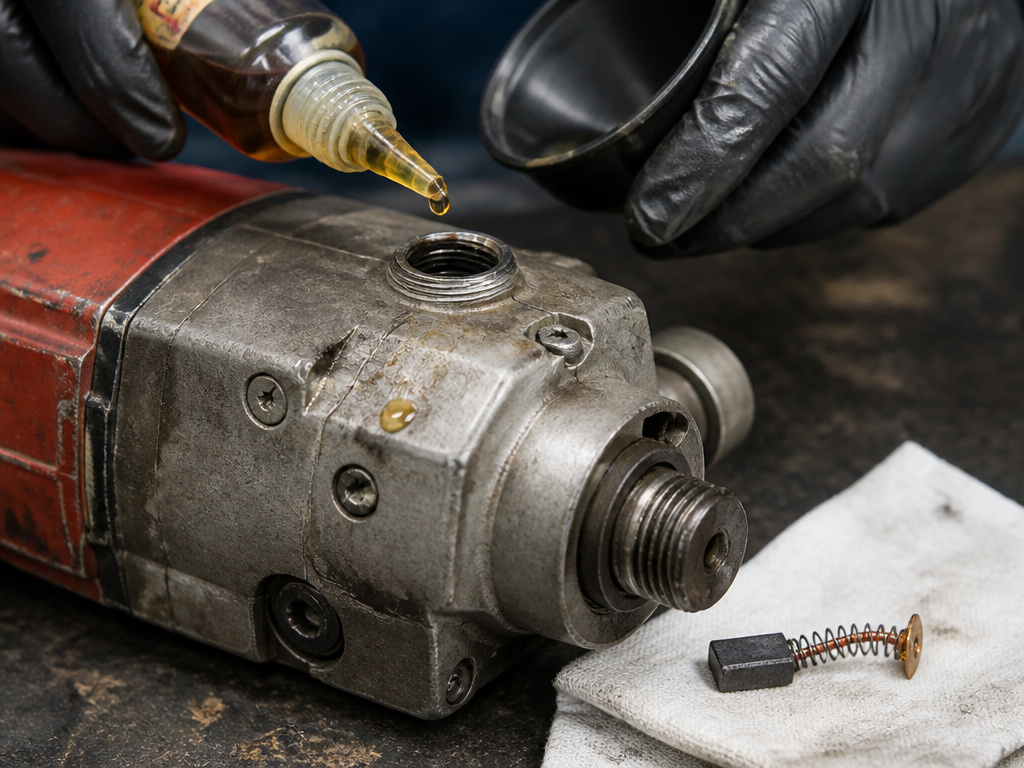 A core drill is a geared machine, not a simple motor. How you use it dictates its lifespan.
The slowest gear provides the highest torque. Always start with this for a 4-inch bit. If the drill labors or stalls, you are asking it to do something beyond its design, either the concrete is too hard, the bit is dull, or you’ve hit metal. Do not switch to a higher gear to power through; you will burn out the motor.
Manufacturers build in maintenance cliffs. The U.S.SAWS manual specifies two: – Gear Oil Change: After the first 300 hours of operation. The filling quantity is 300–310ml of original oil. Ignoring this turns the oil into abrasive slurry that wears down gears. – Carbon Brush Inspection: Also at about 300 hours. Worn brushes cause power loss, arcing, and can eventually damage the motor commutator.
These are not suggestions. They are the line between a tool that lasts for years and one that seizes up on the next job. The one-year warranty does not cover failure due to lack of maintenance.
Safety: This Isn’t a Hand Drill
The forces involved are of a different magnitude.
Before you start: Wear ANSI-rated safety glasses, a silicone-dust respirator, hearing protection, and gloves. Secure loose clothing and tie back long hair. The core can bind and spin the entire drill with enough force to break a wrist. Have a firm, braced stance.
Kickback is the main danger. If the bit binds in the hole, the drill can twist violently. Always use the side handle and grip with both hands. Never stand directly behind the drill; stand to the side.
Silica dust from concrete causes permanent lung damage. Water suppression is your primary control. If you cannot use water, you must use a drill with a vacuum dust extraction shroud connected to a HEPA-filtered vacuum.
Electrical safety is critical. Use a GFCI-protected outlet. The cord must be in good condition. Water and electricity are present; a fault can be fatal.
Frequently Asked Questions
Can I use a hammer drill to drill a 4-inch hole?
No. A hammer drill or rotary hammer is designed for holes typically up to 1-1/8 inches. The hammering mechanism cannot effectively drive a bit with that much surface area. It will stall, overheat, and likely damage the tool. For a 4-inch hole, you must use a core drill.
What is the best diamond core bit for concrete?
For general concrete drilling, a segmented, soft-bond, wet-cut diamond core bit is the standard. The segments allow for debris clearance and cooling. The soft bond ensures the diamond matrix wears at the right pace to keep the edge sharp. Always match the bit specification to the material, bits for asphalt or brick will fail quickly in concrete.
How do I drill a 4-inch hole in concrete vertically upward?
You must use a water collection basin taped or sealed around the drilling area to catch all coolant runoff. The U.S.SAWS manual explicitly warns that water must never be allowed to enter the motor. Drilling upward without this basin guarantees water will run down the drill and into the electrical components, causing immediate failure and voiding the warranty.
Why does my core drill keep stalling?
Three likely causes: you are in too high a gear, the diamond bit is worn out and glazed over, or you have encountered rebar. First, shift to the slowest gear. If it still stalls, remove the bit and inspect the diamond segments. If they look smooth and shiny, the bit is done. If you see metal shavings in the debris, you’ve hit rebar and need to relocate.
How deep can a hand-held core drill go?
Depth is limited by the length of the core bit barrel, commonly 12 to 18 inches for rentals. The drill motor itself can typically handle this full depth in concrete, provided you use water, the correct gear, and clear debris frequently. For deeper holes, you need a stand-mounted drill and extension rods.
The Bottom Line
Drilling a 4-inch hole in concrete is a core drill job. Full stop. Rent a U.S.SAWS Core Pro-4 or equivalent, pair it with a wet-cut diamond bit, and feed it water. Start in low gear, clear the cuttings, and watch for rebar.
The tool’s manual isn’t paperwork. It’s the 1700 RPM limit, the 300-hour oil change, and the warning about vertical drilling that keeps a $1,500 tool from becoming a paperweight. Skip the water to save five minutes on cleanup, and you’ll pay for a new bit in the first hour.
For one clean hole, the process is straightforward. For a career’s worth of them, it’s about respecting the machine’s limits, and the concrete’s stubborn reality.
