
How Many Watts Does an Air Compressor Use | The 70% Rule
This post contains affiliate links. As an Amazon Associate, we earn from qualifying purchases.
An air compressor’s wattage ranges from about 1,000 watts for a small 120V portable unit to over 15,000 watts for a large 3-phase industrial compressor. For common home models, you can expect 1,500 to 2,500 watts. The exact number is found by multiplying the voltage (V) by the amperage (A) listed on the motor’s nameplate, then adjusting for a typical power factor of 0.85 to 0.95.
That voltage-times-amps formula gives you the apparent power in volt-amps (VA). The real power draw in watts is lower because of a lag between voltage and current called power factor. Ignoring it leads to a 5-15% overestimate on your energy bill.
What follows is the conversion from horsepower, the real cost drivers, and a walkthrough of three common compressors, the Husky 20-gallon, the Makita MAC5200, and a 60-gallon belt-drive unit. You’ll leave knowing how to read any spec sheet and calculate your own operating costs without guessing.
Key Takeaways
- Energy is the real cost. Industry data shows electricity can make up over 70% of a compressor’s total lifetime expense, dwarfing the purchase price.
- Find watts on the nameplate. Multiply the motor’s voltage by its amperage (V x A), then multiply by a power factor of 0.85 to 0.95 for the true wattage. A 15A, 120V motor pulls about 1,530 watts, not 1,800.
- Circuit capacity is non-negotiable. A 15-amp household circuit can only handle about 1,440 running watts continuously. Starting a compressor with a 1,500-watt running load on that circuit will trip the breaker every time.
- Bigger tank ≠ more watts. Wattage is determined by the motor and pump, not the tank size. A 60-gallon tank might use the same motor as a 30-gallon model; it just runs less often.
- Control type saves money. A variable speed drive (VSD) compressor can cut energy use by 30-50% compared to a standard on/off unit when air demand fluctuates.
The Basic Math: From HP to Watts
You see horsepower (HP) on every compressor tag. It’s a legacy rating, not an electrical measurement. One mechanical horsepower equals 746 watts, but motor inefficiency means it needs more electrical input to produce that output.
A “1.5 HP” motor doesn’t draw 1,119 watts (1.5 x 746). It draws more, typically 1,500 to 1,800 watts, because of losses in the windings, bearings, and fan. The nameplate amperage is your anchor to reality.
Volts (V) x Amps (A) = Volt-Amps (VA). Volt-Amps x Power Factor (PF) = Watts (W). For most single-phase compressor motors, the power factor falls between 0.85 and 0.95. Assume 0.9 if the spec sheet doesn’t list it.
Take a common 120V, 15-amp compressor motor. 120V x 15A = 1,800 VA. Multiply by a 0.85 power factor: 1,800 VA x 0.85 = 1,530 watts. That’s the real power doing work and generating heat. The remaining 270 VA is reactive power, which the utility must supply but doesn’t register on a basic kilowatt-hour meter.
Skipping the power factor adjustment gives you a number that’s too high. Your actual energy bill is based on watts, not volt-amps.
Why Horsepower Ratings Are Misleading
Motor “horsepower” in the consumer tool world is often a marketing peak, not a continuous rating. You’ll see “Peak HP” or “Running HP.” The running horsepower is the sustainable figure. That Husky 20-gallon silent compressor manual lists a 1.5 HP running motor drawing 11 amps. Using our formula: 120V x 11A = 1,320 VA. Apply a 0.9 PF: 1,188 watts. That’s the true continuous draw.
A “3 HP” compressor on a 120V circuit is physically impossible on a standard 15A breaker. True 3 HP requires about 2,238 watts (3 x 746). At 120V with a 0.9 PF, that would need over 20 amps. They don’t exist for 120V plugs. When you see that claim, check the amperage. It’s likely a “developed” or “peak” rating that the motor can only sustain for seconds before overheating.
From Small Garage to Big Shop: Real Model Wattages
Let’s apply the math to three real-world categories. Tank size tells you how much air is stored, not how hard the motor works. Wattage defines your electrical needs and operating cost.
| Compressor Type & Example | Voltage & Amperage | Apparent Power (VA) | Estimated True Wattage (W) | Primary Use Case |
|---|---|---|---|---|
| Small Portable (e.g., 6-gallon pancake) | 120V, 10-12A | 1,200 – 1,440 VA | 1,080 – 1,300 W | Inflating tires, small brad nailers, blow guns. |
| Mid-Size Garage (Husky 20-Gallon) | 120V, 11A (per manual) | 1,320 VA | ~1,188 W | Framing nailers, impact wrenches, occasional spray painting. |
| Large Stationary (Makita MAC5200 / 5-Gallon) | 120V, 13.8A (per spec) | 1,656 VA | ~1,490 W | Continuous tool use, sandblasting, running two tools at once. |
| Belt-Drive Shop (Northern Tool 60-Gallon) | 230V, 15A | 3,450 VA | ~3,105 W | Industrial air tools, auto body shops, high-demand workshops. |
The Makita MAC5200 is a fascinating case. Its spec sheet lists 3 HP, 13.8 amps at 120V, and a minimum circuit requirement of 15 amps. Our math shows it’s riding the absolute limit of a standard household circuit. 120V x 13.8A = 1,656 VA. True wattage is around 1,490W (using 0.9 PF). A 15-amp circuit can only deliver 1,440 watts continuously (15A x 120V x 0.8 safety factor). This compressor will work, but it will trip a breaker if the circuit is shared with lights or other tools. It’s designed for a dedicated 20-amp line.
Where this goes sideways: Plugging a 13.8-amp compressor into a 15-amp circuit that already has a shop light on it. The compressor starts, the inrush current spikes, the light dims, and the breaker trips on the third cycle. You need a dedicated outlet.
For a home workshop, a best home air compressor like the popular California Air Tools models often uses a lower-amp, oil-free pump. A 120V, 8.5-amp model runs on about 920 true watts, leaving plenty of headroom on a 15-amp circuit. That’s a key spec for garage users sharing a circuit with a freezer.
The 70% Rule: Why Watts Matter More Than Price
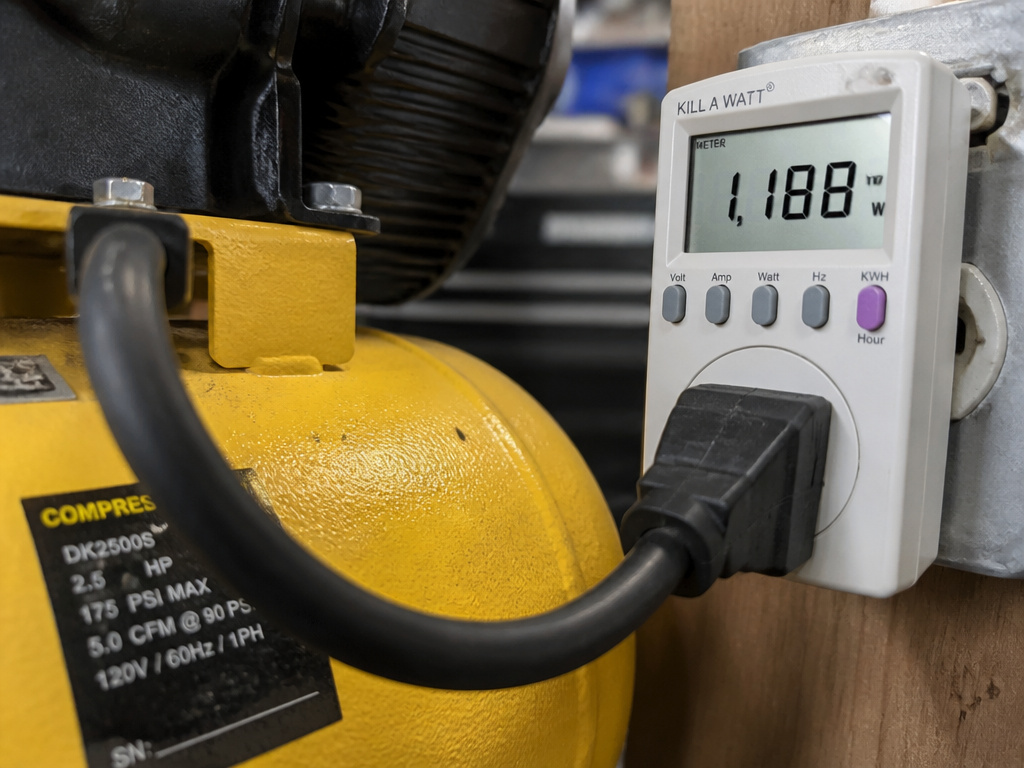 The purchase price is the smallest part of the story. An IU energy consumption modeling study and industry analyses consistently show that over 70% of a compressor’s total lifetime cost is electricity. For a unit that runs 500 hours a year, the energy bill can eclipse the tool’s price in under two years.
This makes efficiency critical. A compressor drawing 1,500 watts that runs 30% of the time costs more than twice as much to operate annually as a 1,000-watt unit with the same duty cycle. The math is simple but often missed.
Annual Energy Cost = (Watts / 1000) x Running Hours x Electricity Rate.
Example: Your 1,188-watt Husky runs 150 hours a year in your garage. Your electricity rate is $0.15 per kWh. (1188 / 1000) = 1.188 kW. 1.188 kW x 150 hours = 178.2 kWh. 178.2 kWh x $0.15 = $26.73 per year.
Now double the runtime or the wattage, and the cost doubles. Run a 3,105-watt shop compressor for 500 hours a year, and you’re looking at over $230 annually. That’s where the 70% figure comes from.
How Control Systems Slash the Bill
The compressor’s control system dictates how it meets demand, and this is the biggest lever for efficiency. A standard on/off (reciprocating) compressor runs at full speed until the tank is full, then shuts off. It’s simple but wasteful if demand is low.
A variable speed drive (VSD) compressor adjusts the motor speed to match air demand exactly. If you’re only using a little air, the motor slows down, drawing far fewer watts. Industry data shows VSD units can reduce energy consumption by 30-50% in applications with variable demand. They’re more expensive upfront, but for a busy shop, the payback period can be under two years.
For home users, the lesson is to size correctly. Buying a two-stage air compressor for occasional tire inflation is like using a sledgehammer to hang a picture. The oversized motor will cycle on and off rapidly, wasting power on each startup surge. Match the compressor to your actual air compressor requirements for tools.
Calculating Your Compressor’s Actual Consumption
 You need two numbers: true running wattage and actual runtime. The wattage comes from the nameplate calculation. Runtime is trickier, it’s not just how long the tool is on.
A compressor’s duty cycle determines how many minutes per hour it can run without overheating. A 50% duty cycle means it can run for 30 minutes, then must cool for 30. Most home reciprocating compressors have a 50-70% duty cycle. The pump runs only when the tank pressure drops below the “cut-in” setting.
Easy to miss: Compressor runtime is rarely linear. It might run for 90 seconds to fill the tank, then sit idle for 4 minutes while you use a nailer. Over an hour of project time, it may only run 15 minutes total.
To estimate, track how often the motor kicks on during a typical project. Time the length of one cycle. Let’s say it runs for 2 minutes every 10 minutes. That’s a 20% runtime. For a 2-hour project, the compressor runs 24 minutes (0.4 hours).
If your compressor’s true wattage is 1,490W (1.49 kW), consumption is: 1.49 kW x 0.4 hours = 0.596 kWh. At $0.15/kWh, that project cost about nine cents in compressor electricity.
This precision matters when comparing a small air compressor to a larger one. The small unit might run 40% of the time to keep up, while the larger one runs 15%. Even with a higher wattage, the larger model could use less total energy because it starts less frequently, each startup has a high inrush current.
Power Quality and Your Electrical System
Watts tell only part of the power story. The inrush current, the surge when the motor starts, can be 3 to 6 times the running amperage. For a 15-amp compressor, that’s a 45 to 90-amp spike for a fraction of a second. It’s why lights dim.
This surge stresses household wiring and breakers. An old outlet with loose connections will heat up at that moment. Repeated over years, this can degrade the connection, increasing resistance and fire risk. This is why installing an air compressor on a dedicated circuit with a properly rated outlet isn’t just best practice; it’s a safety move.
Extension cords are a related hazard. That Husky manual includes a chart specifying wire gauge for cord length. For an 11-amp compressor, a 50-foot extension cord must be 14-gauge minimum. A 16-gauge cord will overheat, cause a voltage drop, and make the motor work harder, drawing more amps. You’ll smell the insulation before you see the smoke.
Before you start: Check your circuit breaker. A 15-amp breaker can only support about 1,440 running watts continuously. Know the amperage of your compressor. If it’s within 2 amps of the breaker rating, it needs a dedicated circuit. Never use an undersized extension cord.
If you’re setting up a compressor for home shops, plan the electrical first. A 230V circuit for a large home shop air compressor is more efficient and puts less strain on your panel than trying to pull 20 amps at 120V. The higher voltage halves the amperage for the same power, reducing line loss and heat.
Frequently Asked Questions
How many watts does a 6-gallon air compressor use?
Typical 6-gallon, 120-volt air compressor uses between 1,000 and 1,300 watts. Check the nameplate: if it draws 10 amps, it uses about 1,080 watts (10A x 120V x 0.9 PF). These units are designed for light duty and will trip a 15-amp circuit if other loads are present.
Can I run a 1500-watt air compressor on a 15-amp circuit?
Technically yes, but it’s at the limit and will likely trip if anything else is on the circuit. A 15-amp circuit can provide 1,440 watts continuously (15A x 120V x 0.8 safety factor). A 1,500-watt compressor exceeds this. It may work on a dedicated, otherwise-empty circuit, but a 20-amp circuit is the safe recommendation.
Does a bigger tank use more electricity?
Not directly. The tank size determines how long the compressor can run before the motor must refill it. A larger tank means the motor cycles on less frequently. However, a larger tank is often paired with a more powerful motor (more watts) to fill it in a reasonable time. The motor’s wattage is the energy cost, not the tank.
What is the most energy-efficient type of air compressor?
For variable air demand, a rotary screw compressor with a variable speed drive (VSD) is the most efficient, potentially cutting energy use by half. For steady, high demand, a two-stage reciprocating compressor is efficient. For typical home use with intermittent demand, a standard reciprocating compressor sized correctly for your tools is the most cost-effective choice.
How do I reduce my air compressor’s energy bill?
First, fix leaks. A single 1/8-inch leak can cost over $100 annually. Second, lower your system pressure if possible; each 2 PSI reduction saves about 1% in energy. Third, ensure proper maintenance, clean intake filters and change oil. Fourth, use a secondary tank near a high-demand tool to avoid raising the main system pressure. Finally, consider a compressor for air tools that matches your CFM needs without being oversized.
The Bottom Line
Stop looking at horsepower. Find the amperage on the motor’s nameplate, multiply by your voltage, and then by 0.9. That’s your wattage. For a garage air compressor, 1,200 to 1,500 watts is the common range, and it demands a dedicated 15- or 20-amp circuit.
Remember the 70% rule: the electricity to run it will cost more than the tool itself. That makes an efficient, correctly sized unit the only smart buy. For most DIYers, a quality air compressor for home like a 20-30 gallon unit from a reliable brand strikes the best balance between power and practicality. It will handle 98% of projects without straining your electrical system or your wallet every month.
Match the tool to the job. Your wallet and your breaker panel will thank you.
