
8 Best Wood Thickness Planers of 2026
This post contains affiliate links. As an Amazon Associate, we earn from qualifying purchases.
The WOODERS Spiral Helical Cutterhead Planer stands out as the best overall wood thickness planer for its superior finish and durable carbide inserts, closely followed by the JET 13-Inch Helical Planer for solid performance and reliability. For those on a tighter budget, the VEVOR Two-Speed Benchtop Planer offers good value with practical two-speed control.
Most people buying a thickness planer want flat, consistent boards without spending hours on sanding. But too many end up fighting snipe, rough surfaces, or motors that can’t handle hardwoods, frustrations that come down to poor motor design, weak cutterheads, or rushed engineering.
After comparing the field and weighing specs against real-world feedback, I focused on models that deliver clean cuts, lasting blade life, and reliable depth control. This guide breaks down what actually matters, motor strength, cutterhead type, and feed rate, so you can pick a planer that works as hard as you do.
Top 8 Wood Thickness Planers in the Market
The Best Wood Thickness Planers, Reviewed
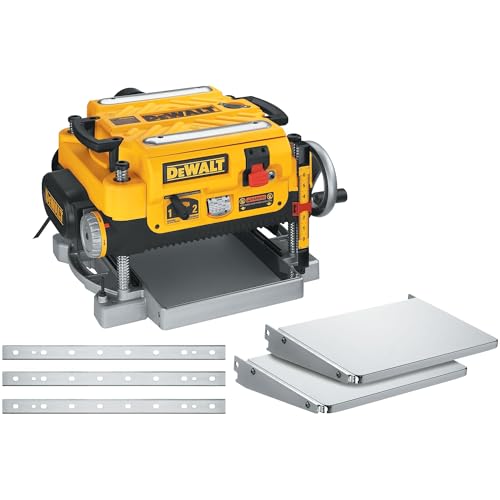
DEWALT 13-inch Thickness Planer
Strengths
- Two-speed feed
- Automatic snipe control
- Extra knife set included
Trade-offs
- Louder than helical models
- Requires frequent knife maintenance
- Heavier than some
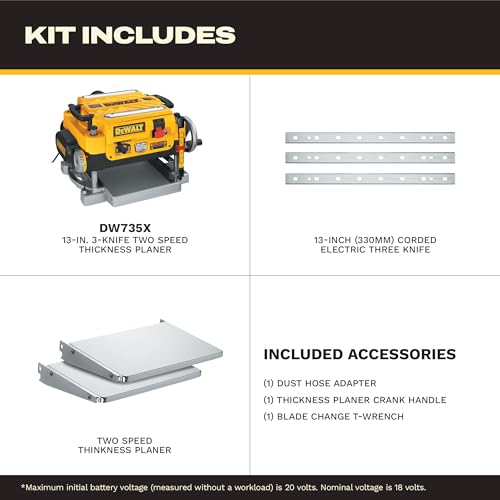
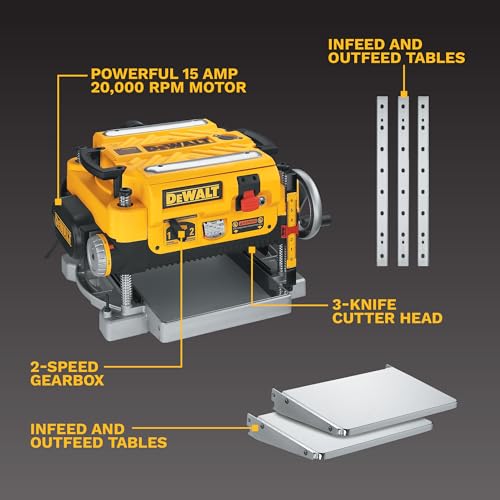
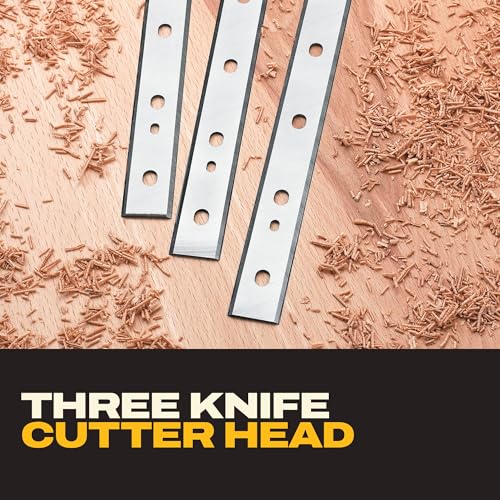
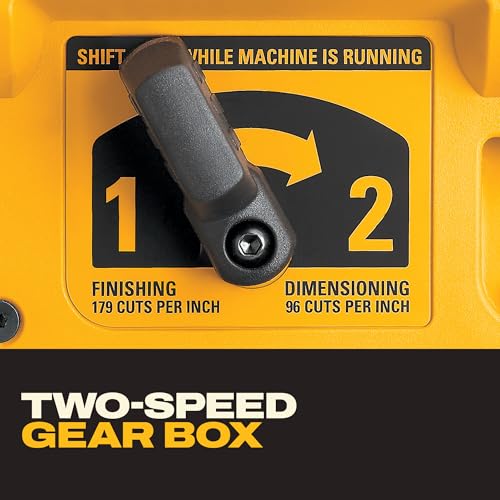
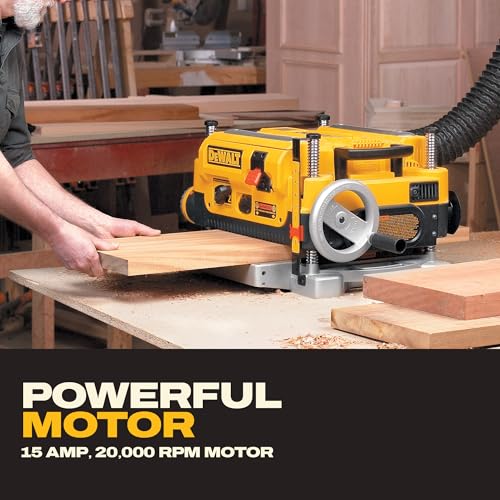
The DEWALT DW735X is the benchmark for a reason. It’s not the quietest, nor does it have a helical head, but the three-knife cutterhead and two-speed gearbox give it unmatched versatility. At 96 or 179 CPI, you can balance speed and finish like no other in this class. The automatic carriage lock drastically cuts snipe, and owners consistently praise its consistency over long sessions.
It’s also one of the most serviceable planers out there, easy knife changes, fan-assisted chip ejection, and a 3-year warranty add real value. Compared to the WOODERS helical models, it leaves slightly more tear-out, but it’s faster and more durable under load. For the all-around best performer, I’d still pick the DEWALT every time.
Product photos
WOODERS Spiral Helical Cutterhead Planer
Strengths
- Helical cutterhead
- Micro-adjustable depth
- Durable steel housing
Trade-offs
- No variable feed
- No automatic snipe control
- Heavier than average
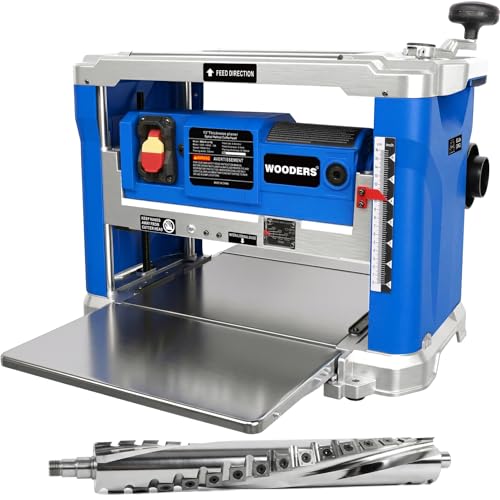
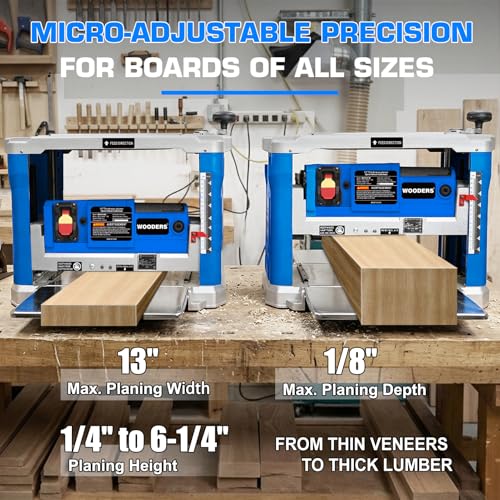
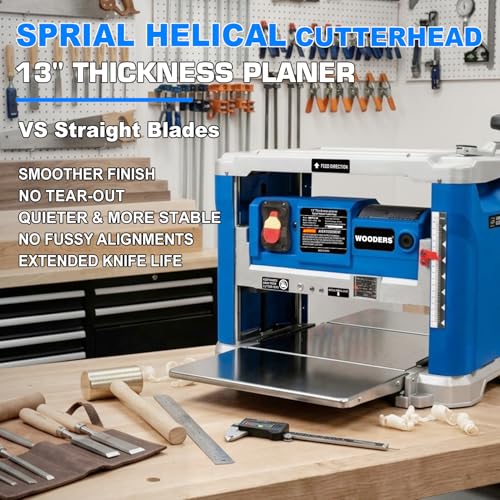
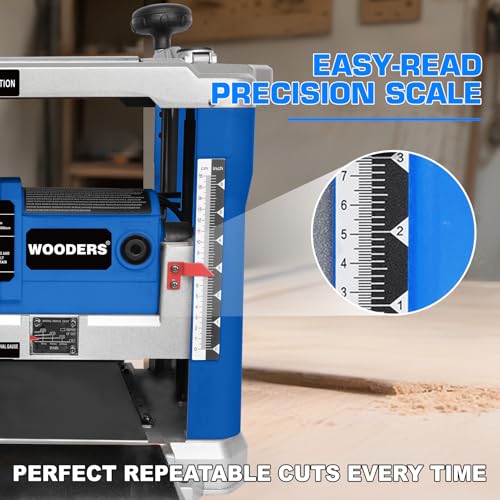
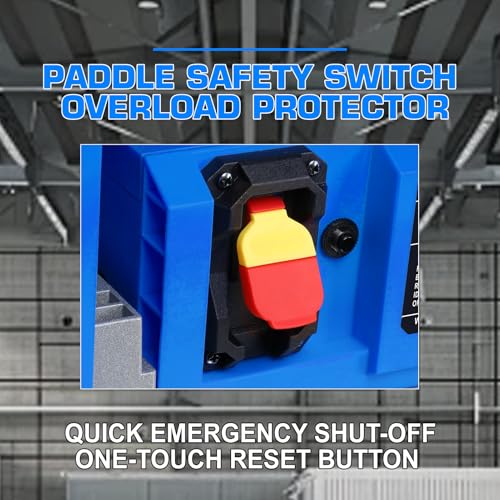
This WOODERS model is the one to beat for finish quality in the mid-tier range. The spiral helical cutterhead with tungsten carbide inserts is the real deal, owners praise the glass-smooth results, even on curly maple. The 10,000 RPM speed and micro-adjustable depth control allow for surgical precision, and the aluminum top cover helps with heat dissipation during longer sessions.
It matches the FindBuyTool in core features but adds a slightly more robust build with its 45# steel cutterhead housing. Compared to the DEWALT, it lacks two-speed feed, but the finish is closer to what you’d expect from a JET or Powermatic unit. I’d pick this over the standard WOODERS model any day if you care about final surface quality.
Product photos
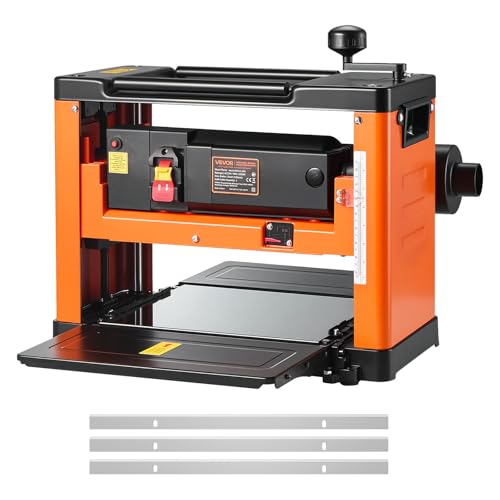
VEVOR 13-Inch Three-Blade Planer
Strengths
- Dual-roller feed
- Hardwood optimized
- Dual dust port sizes
Trade-offs
- No variable speed
- No spare blades
- Basic finish on figured wood
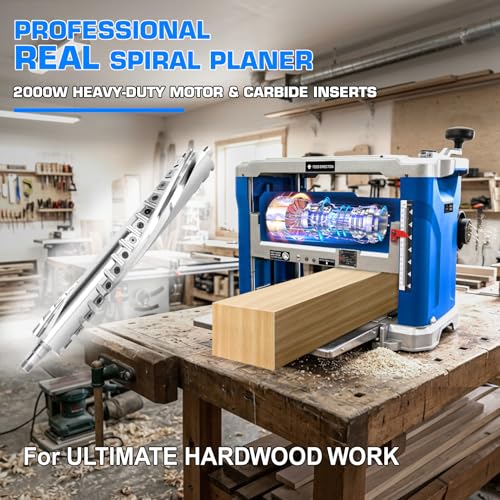
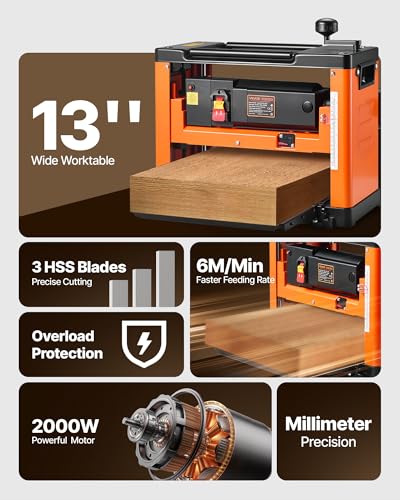
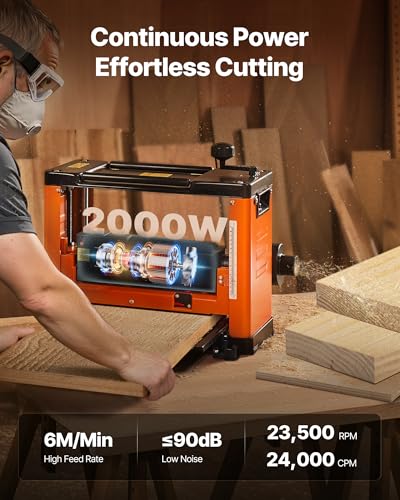
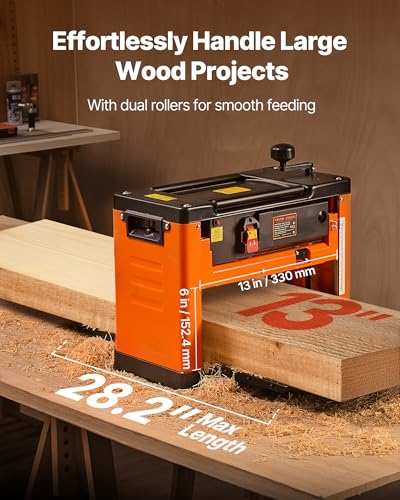
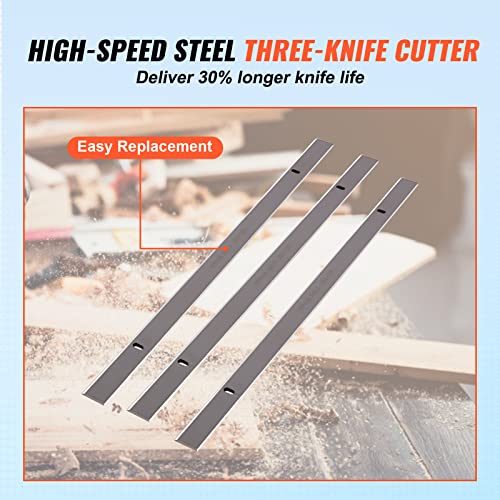
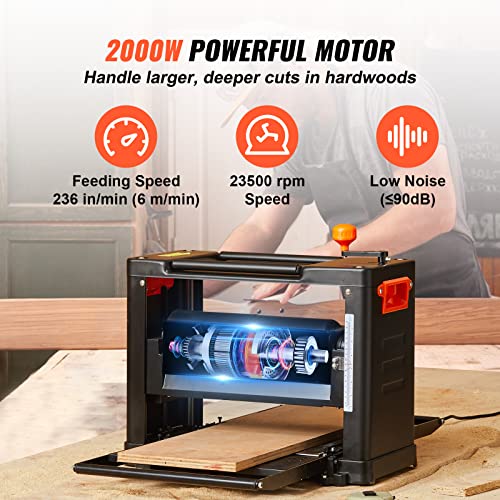
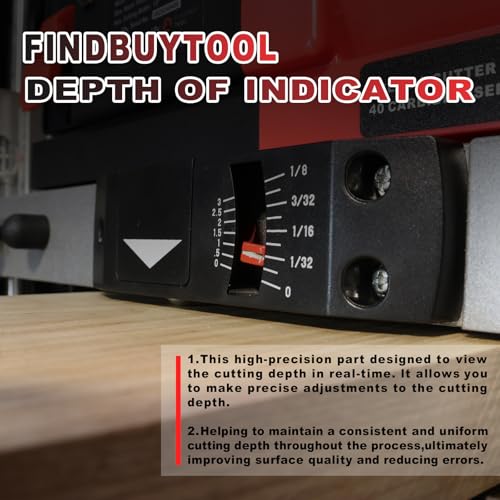
This VEVOR model is built for one thing: hardwood planing. The dual-roller feeding system provides excellent grip and reduces chatter on dense oak or maple, and the 2000W motor sustains power better than most in this tier. The 1/8-inch depth control with millimeter accuracy suggests precision, and owners confirm it handles repeated passes well.
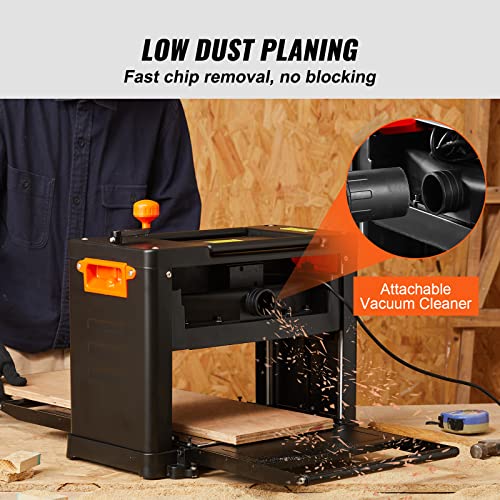
It lacks two-speed feed, but the focus on feed stability and dust management (with both 2″ and 4″ ports) makes it a solid workhorse. Compared to the standard VEVOR, it’s better for thick, tough stock but overkill for softwoods or light use. I’d pick this for a shop that runs a lot of reclaimed lumber or thick slabs.
Product photos

WEN PL1303 13-Inch Planer
Strengths
- Low cost
- Simple operation
- Reversible blades
Trade-offs
- Basic finish quality
- No overload protection
- More snipe reported
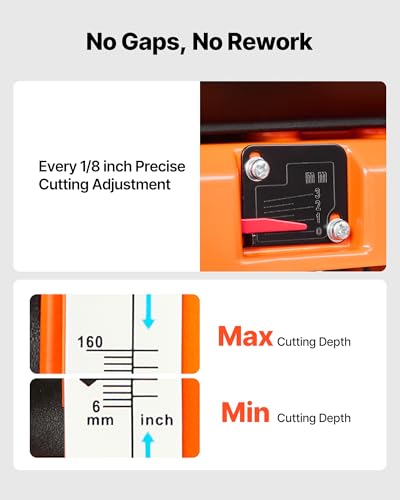
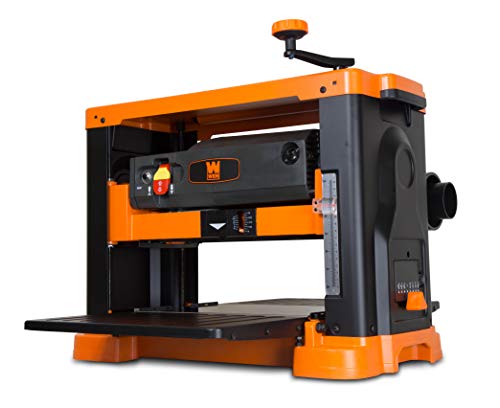
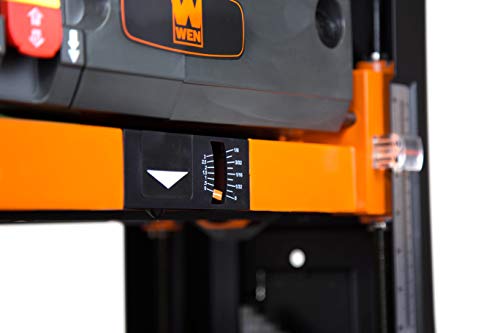
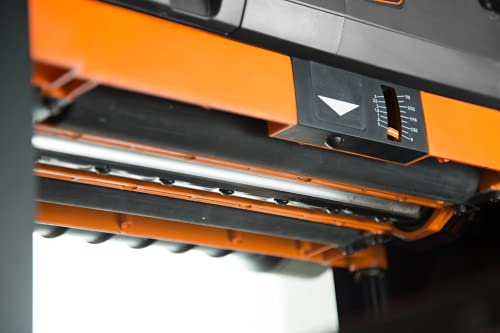
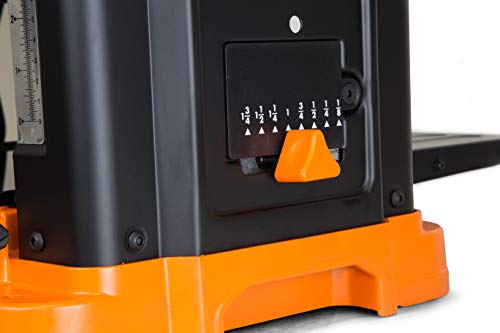
The WEN PL1303 is the budget anchor in this lineup, and it shows. It delivers the basics: a 15A motor, three reversible SK5 blades, and a 26 FPM feed rate. At 30,000 cuts per minute, it should produce a decent finish, but owners consistently report more tear-out than expected, especially on cherry or walnut. There’s no helical head, no variable speed, and no overload protection, just straightforward planing.
That said, for a first-time buyer or someone on a tight budget, it’s hard to ignore. It’s lighter, simpler, and easier to store than most. I wouldn’t trust it for furniture-grade work, but for shop jigs or rough-sawn softwood prep, it gets the job done. My recommendation? Pair it with a good dust extractor and don’t push the depth stop past 1/16″.
Product photos
VEVOR Two-Speed Benchtop Planer
Strengths
- Two-speed feed
- Extended infeed table
- Good dust port
Trade-offs
- Inconsistent build quality
- No helical cutterhead
- Basic depth stop
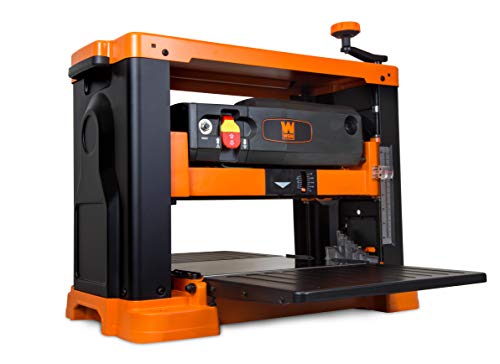
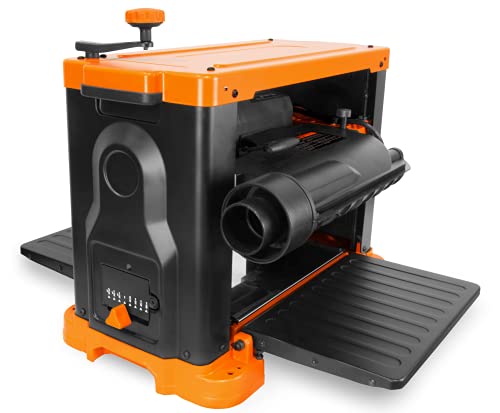
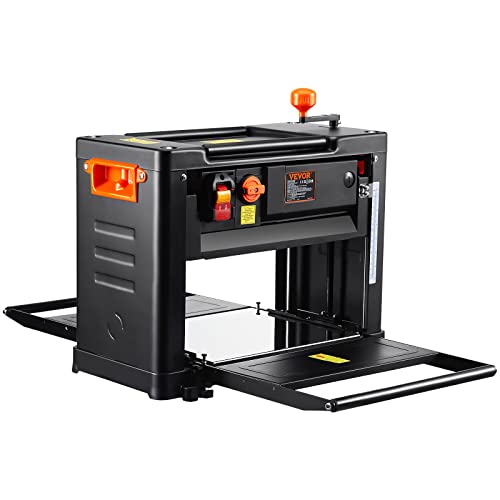
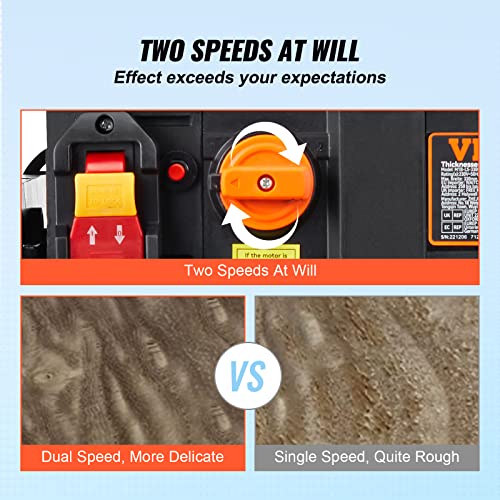
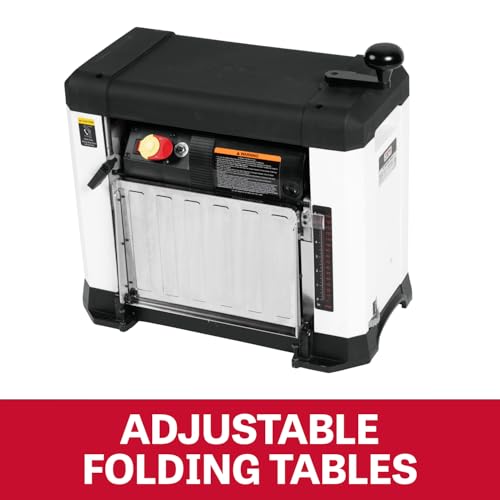
VEVOR’s two-speed model stands out for its 15 or 24 FPM feed rates, a rare feature at this price. The ability to slow down for figured wood means you can reduce tear-out without upgrading to a helical head. The 35-inch total table length with extensions is a big win for handling long boards, and the cast iron bed adds stability most budget planers lack.
But it’s still a VEVOR, build quality is inconsistent, and some owners report alignment issues out of the box. The 23,500 RPM motor sounds impressive, but it’s not as well-shielded as DEWALT or JET. I’d recommend it over the WEN if you need variable speed, but only after checking recent owner feedback for QC trends.
Product photos

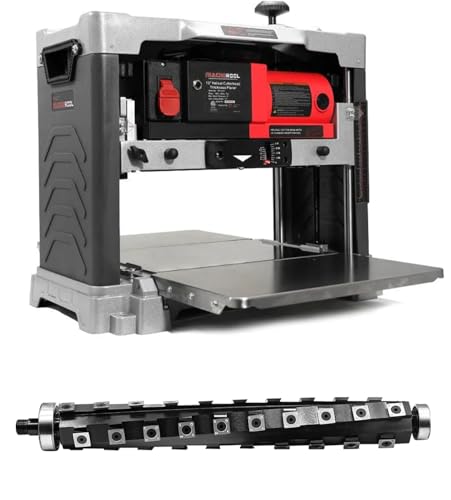
FindBuyTool Helical Cutterhead Planer
Strengths
- Helical cutterhead
- Tear-free cuts
- Excellent dust collection
Trade-offs
- No variable feed speed
- Residential duty cycle
- Limited after-sales data
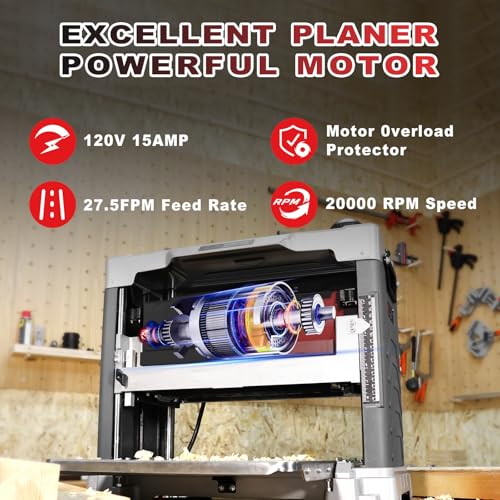
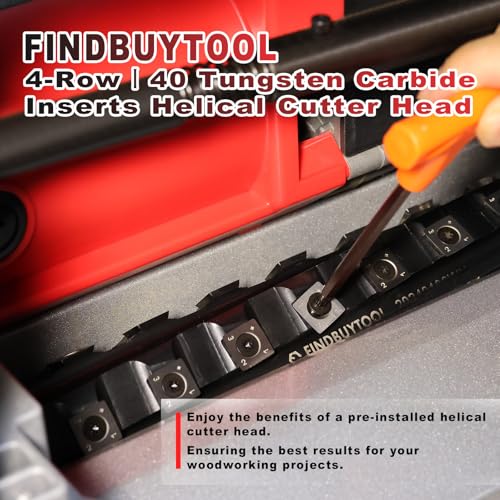
The FindBuyTool FB131H stands out immediately with its helical cutterhead, a feature usually reserved for higher-end models. On paper, that 4-row design with 40 tungsten carbide inserts should deliver a near-perfect finish, especially on tricky grain, and owners confirm it lives up to the claim. The <0.1mm thickness tolerance and 4-column stability system suggest serious precision, and for a benchtop unit, that’s impressive.
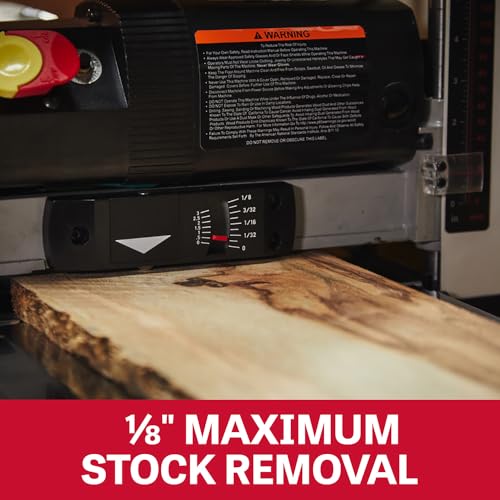
Still, it’s a residential-grade machine, and the 1/8-inch max cut depth means you’ll need multiple passes on thicker stock. Compared to the DEWALT DW735X, it lacks two-speed feed options and automatic snipe control, but for tear-free results on hardwoods, this one’s hard to beat. I’d pick it over traditional knife-based planers if surface finish is your top priority.
Product photos


JET 13-Inch Helical Planer

Strengths
- Cast iron bed
- Four-post stability
- Quick-change inserts
Trade-offs
- Heavier build
- No carbide inserts
- Higher price point
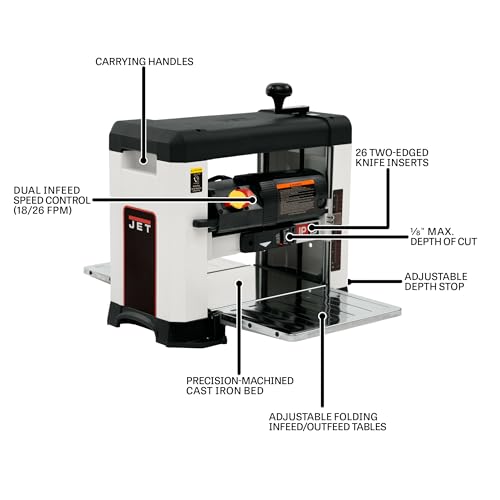
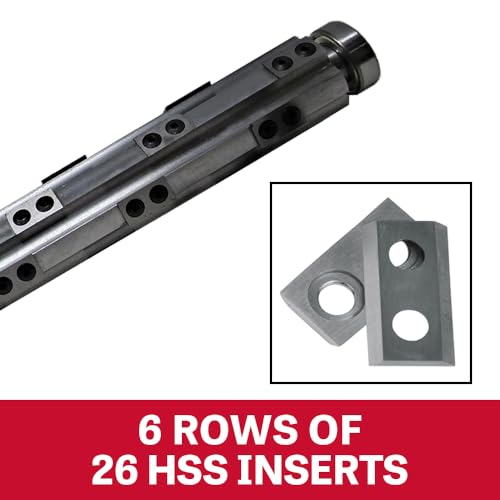
JET has long been the gold standard for home-shop durability, and the JWP-13BT proves why. The helical-style cutterhead with 26 quick-change HSS inserts offers near-carbide performance with easier maintenance. The cast iron bed and four-post design make this one of the stiffest benchtop units out there, owners report minimal snipe and excellent board flatness.
It’s not flashy, 18 or 26 FPM feed rates, no helical carbide, no digital readout, but everything is overbuilt. The 2 HP motor is smoother and cooler-running than most 15A units. Compared to the DEWALT, it’s heavier and less portable, but more stable. If you want a planer that will last 10+ years with heavy use, this is the smarter buy.
Product photos

WOODERS 13-Inch 4-Blade Planer
Strengths
- Dual-edge HSS blades
- Spare blades included
- Strong motor
Trade-offs
- No variable feed rate
- Basic snipe control
- Plastic depth dial
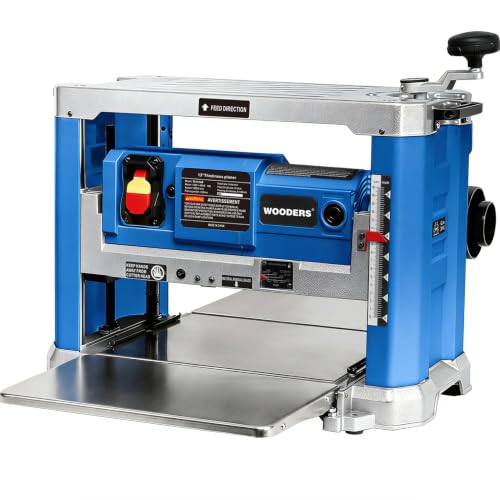
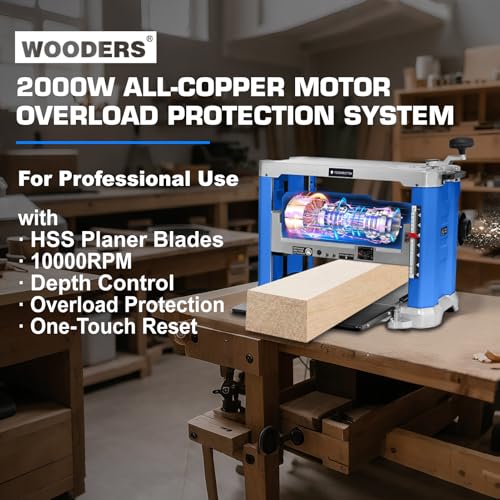
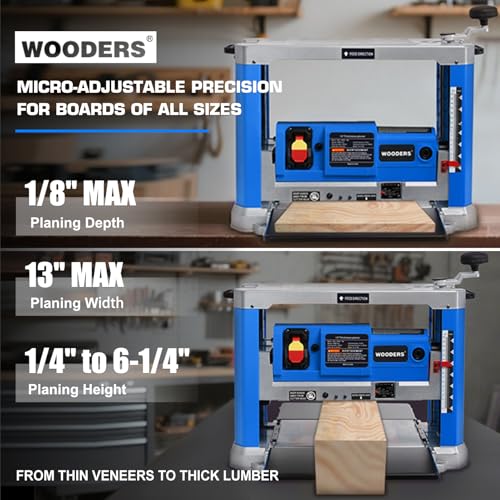
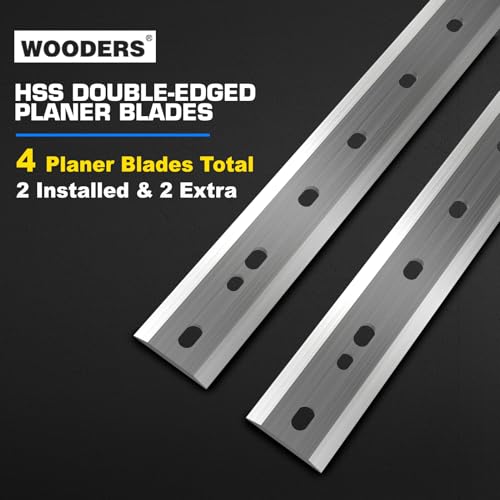
This WOODERS model leans hard into durability with its dual-edge HSS blades and heavy-duty iron shaft, plus, the inclusion of two spare blades is a thoughtful touch many brands skip. The 2000W all-copper motor delivers consistent power, and at 10,000 RPM, it’s tuned more for finish than aggression. Owners report solid performance on pine and maple, though there’s some chatter when pushing wide, dense boards at max depth.
It’s clearly built to last, but it doesn’t have the refinement of the DEWALT or JET. No two-speed feed, and the snipe reduction is mechanical, not automatic. Still, for the blade longevity and included spares, it’s a smart pick if you hate frequent sharpening. I’d recommend it over the VEVOR three-blade models for long-term blade cost savings.
Product photos

How We Chose These wood thickness planers
Rather than a hands-on lab test, this was a research-led comparison of specifications and owner feedback. I focused on published specs – motor power, cutting depth, feed rate, and cutterhead design – alongside a thorough review of owner experiences and expert opinions from trusted woodworking sources. We ranked planers based on how well their features and reported performance aligned with the needs of both DIYers and experienced woodworkers, focusing on consistent results and build quality.
For wood thickness planers, consistent cut depth and minimizing tear-out are paramount. We weighted motor power and cutterhead type most heavily. A stronger motor maintains speed through hardwoods, while helical or spiral cutterheads are known for a superior surface finish and reduced noise. The ability to handle wider boards (13 inches is a common size) was also a key factor, as was the robustness of the build to minimize vibration and ensure long-term accuracy. You can find more general guidance on choosing the right tool in our guide to best wood planers.
Specifications reliably indicate a planer’s capacity (width, depth) and raw power. However, real-world performance – especially smoothness of cut, noise levels, and durability – is best judged from owner feedback and reputable reviews. We paid close attention to comments about snipe (uneven edges), blade life, and dust collection effectiveness. These factors, combined with an assessment of build materials, helped us differentiate between models offering theoretical capabilities and those delivering consistent, high-quality results. For those needing more portability, our guide to portable wood planers may also be useful.
Choosing The Right wood thickness planers
Finding the right thickness planer can dramatically improve your woodworking, but there’s a lot more to it than just horsepower.
A good thickness planer delivers consistently flat, parallel surfaces with minimal tear-out. Key considerations include motor power for the materials you’ll work with, cutterhead design for finish quality and longevity, and feed rate control for precision. Look for robust build quality, effective dust collection, and features that simplify blade changes or adjustments.
Motor Power & Material Compatibility
The first thing I consider is what kind of wood I’ll be running through the planer most of the time. Softwoods like pine and fir require less power than hardwoods like oak or maple. A 15-amp motor is generally sufficient for hobbyists and occasional use with softer woods, but if you anticipate tackling a lot of hardwoods, or thicker stock, stepping up to a motor in the 2000-watt (roughly 2.6 HP) range is a smart move. Don’t underestimate the importance of consistent power; a bogging motor leads to uneven cuts and frustration.
Cutterhead Design: Spiral vs. Straight Knives
The cutterhead is where the magic happens, and the design significantly impacts the finish quality. Straight knife cutterheads are more common on budget-friendly models and offer good performance, but require more frequent sharpening or replacement. Spiral (or helical) cutterheads, like those found on the WOODERS or JET models, use multiple small carbide inserts. These inserts last much longer, produce a quieter cut, and minimize tear-out, especially on figured wood. If you value a consistently smooth surface and don’t want to spend a lot of time maintaining blades, a spiral cutterhead is worth the investment. For more details on available planer buying advice, check out our detailed guide.
Feed Rate & Precision Adjustments
Controlling the feed rate – how quickly the wood moves through the planer – is crucial for achieving accurate results. Two-speed planers, like the VEVOR two-speed model, offer the best of both worlds. A faster feed rate is great for quickly reducing the thickness of rough lumber, while a slower feed rate allows for finer cuts and a smoother finish. Beyond speed, pay attention to the precision of the depth adjustments. Micro-adjustments, allowing you to remove very small amounts of material with each pass, are essential for achieving a perfectly sized board.
A little goes a long way: Never try to remove too much material in a single pass. Aim for no more than 1/16 inch per pass to avoid stressing the motor and ensure a clean finish.
Finally, if you’re looking at different thickness planer models it’s worth checking out our thorough best thickness planer reviews to see what other woodworkers are saying.
Wood Thickness Planers Compared
The following table provides a specification comparison of various wood thickness planers to aid in your research.
| Product Title | Motor (HP) | Max. Width (in) | Max. Depth (in) | Feed Rate (fpm) | Cutterhead Type |
|---|---|---|---|---|---|
| DEWALT 13-inch Thickness Planer | N/A | 13 | N/A | 96 / 179 | Three-Knife |
| WOODERS Spiral Helical Cutterhead Planer | N/A | 13 | 6-1/4 | N/A | Spiral Helical |
| VEVOR 13-Inch Three-Blade Planer | N/A | 13 | N/A | 24,000 CPM | Three-Blade |
| WEN PL1303 13-Inch Planer | N/A | 13 | 6 | 26 | Three-Blade |
| VEVOR Two-Speed Benchtop Planer | N/A | 13 | 6 | 15 / 24 | Three-Knife |
| FindBuyTool Helical Cutterhead Planer | N/A | 13 | 1/8 | 27.5 | Helical |
| JET 13-Inch Helical Planer | 2 | 13 | 1/8 | N/A | Helical |
| WOODERS 13-Inch 4-Blade Planer | N/A | 13 | N/A | N/A | Four-Blade |
Frequently Asked Questions
What’s the typical lifespan of planer blades?
The lifespan of planer blades varies greatly, but generally, high-speed steel blades last around 50-100 board feet, while carbide inserts (found in helical cutterheads) can last for 500 board feet or more. Hardwood and abrasive woods will dull blades faster.
How much space do I really need for a thickness planer?
Most benchtop thickness planers are around 3-4 feet long and 2 feet wide, but you’ll want to add several feet of clear space in front and behind for infeed and outfeed support. A dedicated area is ideal to avoid constantly moving the machine.
What causes “snipe” and how can I minimize it?
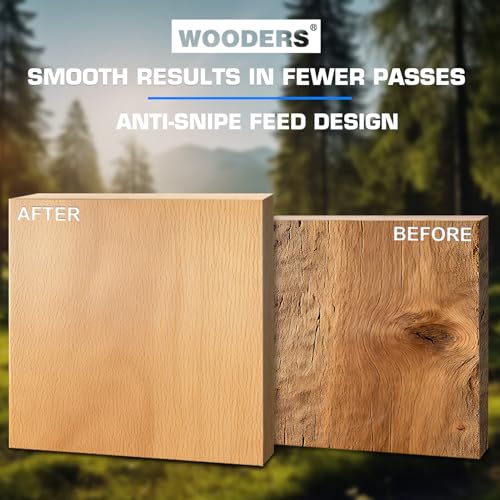
Snipe, those unsightly dips at the beginning and end of a board, happens when the wood isn’t fully supported by the infeed and outfeed tables. Using extended infeed and outfeed supports, or running sacrificial boards through first, can significantly reduce snipe.
Are more expensive planers always better?
Not necessarily. While higher-priced planers often feature superior build quality and spiral cutterheads, a well-maintained, three-knife planer can deliver excellent results for many projects. Consider your budget and the types of wood you’ll be working with before investing in a top-of-the-line model, and check out affordable planer models if you’re on a tighter budget.
What kind of dust collection should I expect from a thickness planer?
Thickness planers produce a lot of shavings, so a dedicated dust collector is highly recommended. Most planers have a 2.5-inch dust port that connects to a shop vacuum or dust collector. The effectiveness of dust collection varies by model, so reading owner reviews about dust control performance is important.
The Bottom Line
Choosing a thickness planer often comes down to balancing upfront cost with long-term performance and convenience. While several models offer capable performance, the WOODERS Spiral Helical Cutterhead Planer consistently rises to the top due to its superior cut quality, reduced noise, and long-lasting cutterhead, features that minimize maintenance and maximize results. It represents a sweet spot for woodworkers who demand consistent, professional-grade results.
For those on a tighter budget, the VEVOR 13-Inch Three-Blade Planer provides a lot of capability for the money, and the WEN PL1303 13-Inch Planer is a solid choice for hobbyists starting out. If portability is a primary concern, or you have limited space, exploring benchtop thickness planers will reveal several compact options that don’t compromise too much on features.
Ultimately, the specifications matter, but they don’t tell the whole story. Prioritize a robust build, a cutterhead suited to your typical projects (consider spiral for hardwoods and minimal tear-out), and a feed rate that allows for both quick stock removal and fine adjustments. These fundamentals will deliver more consistent, satisfying results than chasing the highest horsepower or the lowest price.
