
7 Best Framing Nailers for Professionals 2026
This post contains affiliate links. As an Amazon Associate, we earn from qualifying purchases.
The Metabo HPT NR90AES1 stands out as the best overall framing nailer for professionals, offering reliable power, a durable design, and smooth operation. For those watching their budget, the VEVOR 21 Degree delivers solid performance without breaking the bank. If you’re working on large-scale builds, the Metabo HPT Coil Framing Nailer NV90AG provides unmatched capacity and efficiency.
Most pros know that a framing nailer isn’t just about driving fasteners, it’s about getting through a full day of tough jobs without slowing down. A bad tool means jams, fatigue, and wasted time on site.
In this guide, I laid out the top performers based on specs, owner feedback, and real-world demands. I focused on durability, ease of use, and features that matter most on the job, like actuation control, nail compatibility, and how easy it is to clear jams. These picks reflect what experienced users report works consistently under pressure.
Top 7 Framing Nailer For Professionals in the Market
The Best Framing Nailer For Professionals, Reviewed
Metabo HPT NR90AES1 Framing Nailer

Strengths
- Lightweight design
- Dual firing modes
- Tool-less depth adjustment
Trade-offs
- Plastic magazine
- Not ideal for coil nails
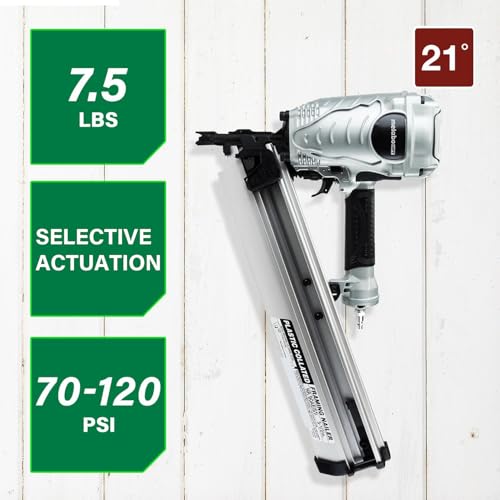
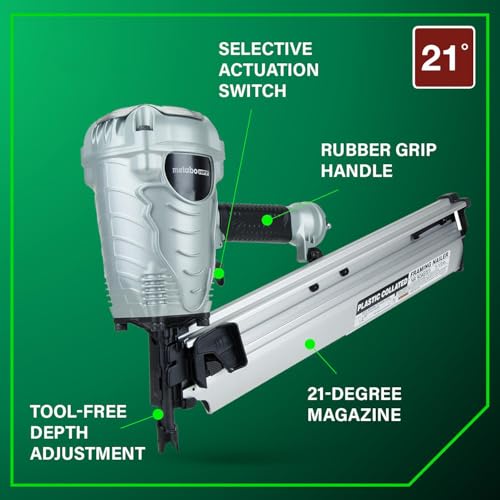
This Metabo HPT 21° framing nailer keeps showing up in pro toolboxes for a reason. It’s lightweight at 7.5 lbs and balances well, which makes it a go-to for all-day framing, roofing, or flooring jobs where fatigue matters. The selective actuation switch is a real win, flipping between contact and sequential firing on the fly gives you control without fumbling. Owners consistently report reliable performance, especially when paired with quality nails, and the tool-less depth adjustment works smoothly across different materials.
It’s been named Pro Preferred by Builder and Developer Magazine for seven straight years, and that reputation sticks. Compared to heavier competitors, this one feels nimble without sacrificing durability. It’s not the most rugged build out there, but for most framing tasks, it hits the sweet spot between performance and comfort.
Product photos


VEVOR 21 Degree Framing Nailer

Strengths
- Low cost
- Dual firing modes
- Large magazine
Trade-offs
- Durability concerns
- Inconsistent build quality
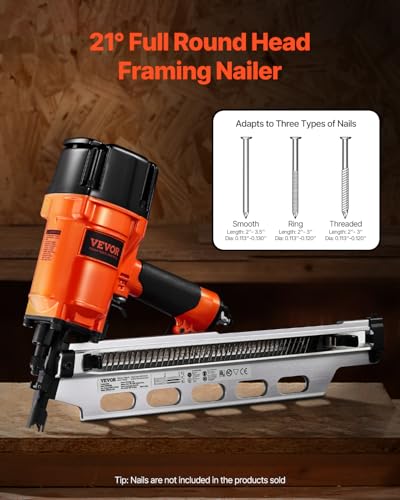
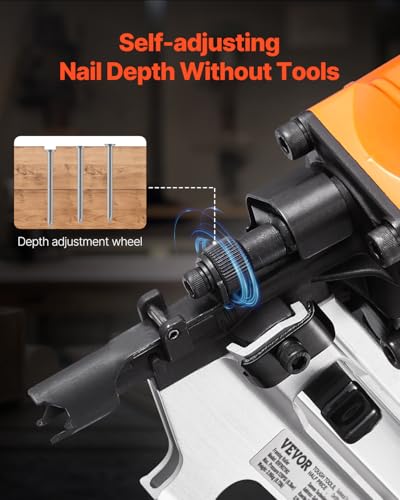
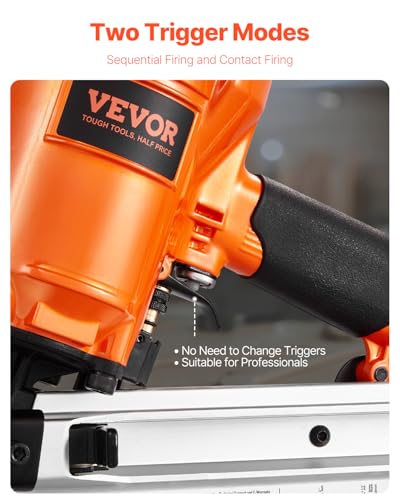
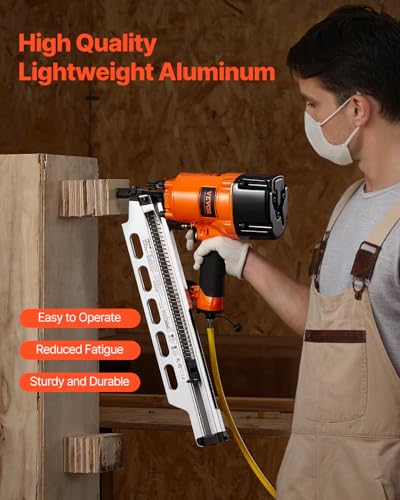
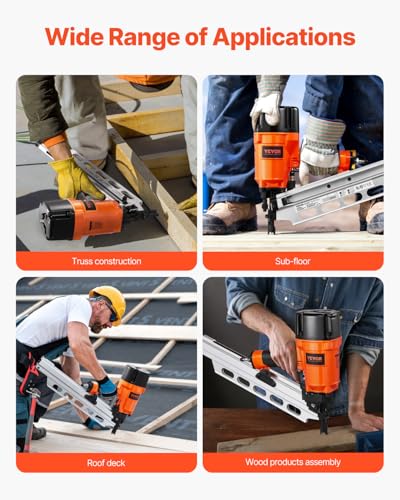
The VEVOR 21° nailer is one of the most affordable pro-style options out there, and it surprises some owners with its feature set. It supports smooth, ring, and threaded shank nails, which gives it unusual flexibility for the price. The dual trigger mode works as advertised, and the tool-less depth adjustment is smooth. The 60-nail magazine is larger than many in this class, reducing reloads.
But it’s not without trade-offs. While it performs well on paper, long-term durability is a question mark. Some owners report seal or o-ring issues after heavy use. It’s a solid pick for DIYers or part-time users, but full-time pros may want to stick with established brands. It’s the budget play, functional, but not bulletproof.
Product photos
Metabo HPT NR83A5 Framing Nailer

Strengths
- Claw tip for grip
- Sequential firing mode
- Rear load magazine
Trade-offs
- Heavier than some
- Magazine capacity smaller
The NR83A5 is built for framers who value control and precision over raw speed. Its cylinder valve drive delivers quick, consistent strikes, and the selectable trigger lets you switch between bump and sequential modes cleanly. The hardened claw tip is great for toe-nailing at odd angles, it bites into wood and holds steady. The rear-loading magazine speeds up reloads, and the open nose helps clear jams fast.
It’s not the lightest in the lineup, but the rubber grip and balanced feel help. Compared to the NR90AES1, it’s a bit more specialized, less about all-day comfort, more about accuracy in tight spots. Contractors doing finish framing or window installations tend to prefer it.
Product photos


Metabo HPT Cordless 21° Framing Nailer
Strengths
- Cordless convenience
- Strong driving power
- Brushless motor
Trade-offs
- Battery adds cost
- Slightly heavier
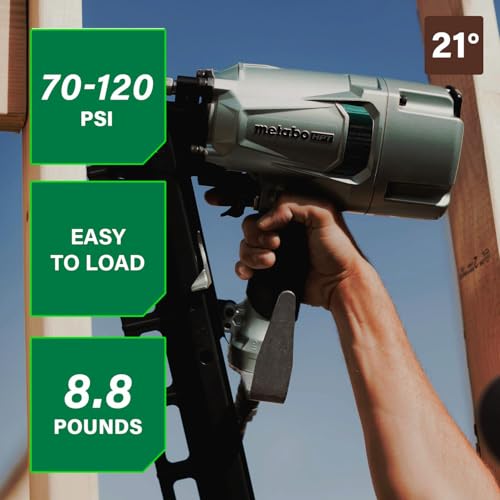
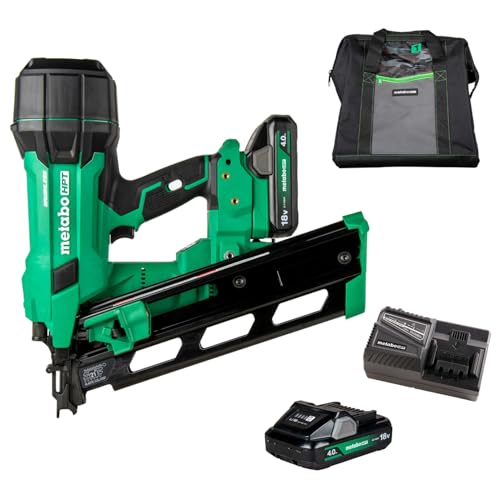
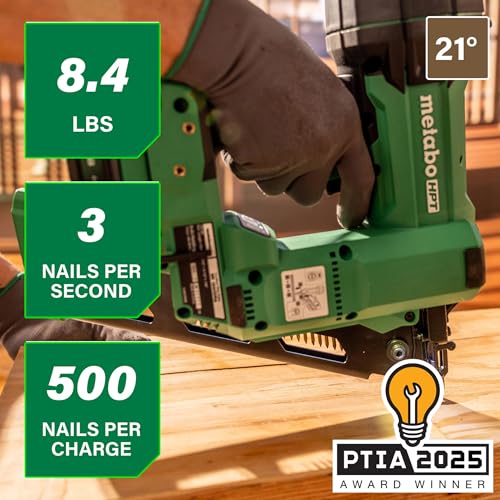
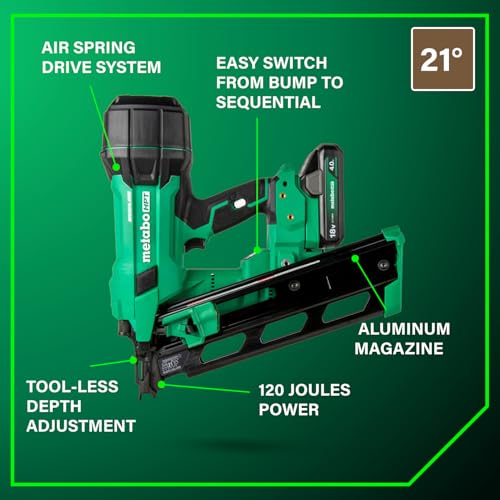
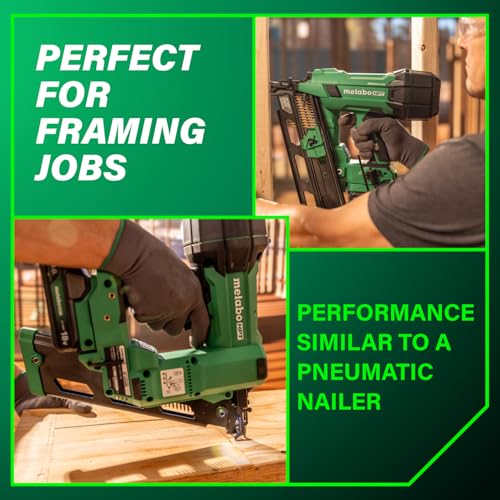
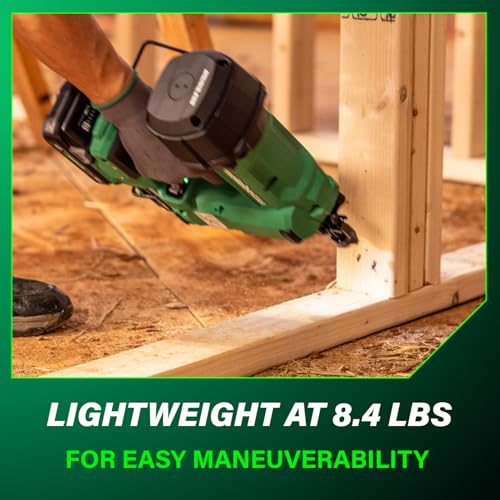
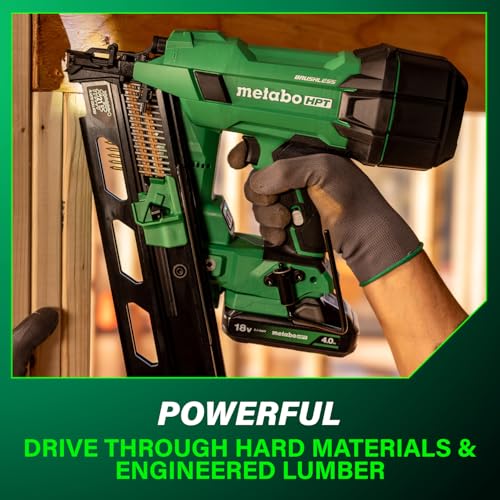
This cordless 21° framing nailer is a serious tool for job sites where dragging compressors isn’t practical. The 18V MultiVolt system delivers 120 joules, enough to drive 3-1/2″ nails into engineered lumber without hesitation. The brushless motor and 4.0Ah battery give you up to 500 shots per charge, which is impressive for cordless. It’s not the lightest at 8.4 lbs without the battery, but the freedom from hoses makes it feel lighter in practice.
Owners report strong performance, especially in tight spaces or remote areas of a job site. Compared to pneumatic models, it’s less consistent in rapid-fire scenarios, but the zero ramp-up time helps. It’s expensive, and battery cost adds up, but for electricians, roofers, or finish crews, it’s a productivity win.
Product photos
Metabo HPT Coil Framing Nailer NV90AG

Strengths
- High nail capacity
- Dual firing modes
- Open nose for jam clearing
Trade-offs
- Requires coil nails
- Bulkier than strip models
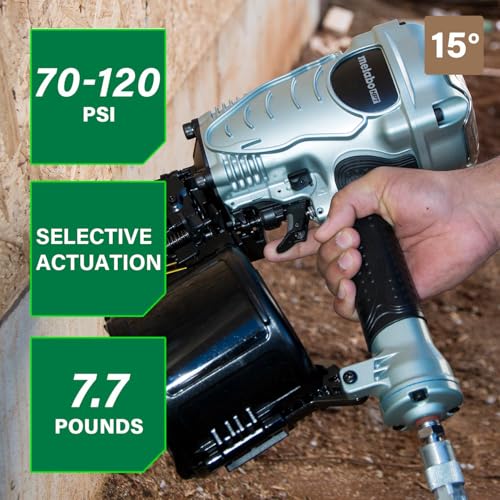
When you’re framing entire homes or doing large decks, the NV90AG(S) coil nailer becomes a game-time decision. It fires 15° coil nails from 1-3/4″ to 3-1/2″, and with a 300-nail coil, you’re spending less time reloading, a real efficiency boost on big jobs. At 7.7 lbs, it’s still manageable, and the open nose design makes clearing jams quicker than with enclosed models. The selective actuation switch gives you both bump and sequential modes, which is rare and useful in coil nailers.
It’s earned the Pro Preferred title for 12 years straight, and owner feedback backs that up, it’s reliable, fast, and built for volume. The steel head plate adds durability where it matters most. It’s not as portable as strip nailers, but for crews running trusses or floor systems, it’s the smarter buy.
Product photos


PneuTools SN2283H-AD Framing Nailer

Strengths
- Rafter hook included
- Durable metal cap
- Lightweight aluminum magazine
Trade-offs
- Single firing mode
- No sequential option
The PneuTools SN2283H-AD stands out by offering pro-level durability at a price that doesn’t hurt. It’s built with a solid metal cap and aluminum magazine, which helps it take hits on rough job sites. The integrated rafter hook is a small but smart touch, no more losing clips or fumbling with add-ons. It only offers one trigger mode, so if you need sequential firing for precision, this isn’t the tool. But for straightforward bump nailing during wall builds or sheathing, it gets the job done without fuss.
Reviewers note it runs smoothly with standard 21° plastic collated nails and holds up well under regular use. It lacks some of the finesse of top-tier models, but for contractors watching their budget or DIYers stepping into pro tools, it delivers solid value. It’s not flashy, but it’s dependable.
Product photos

Estwing EFR2190 Magnesium Framing Nailer

Strengths
- Magnesium construction
- Dual firing modes
- Anti-dry-fire safety
Trade-offs
- Heavier than average
- Higher price point
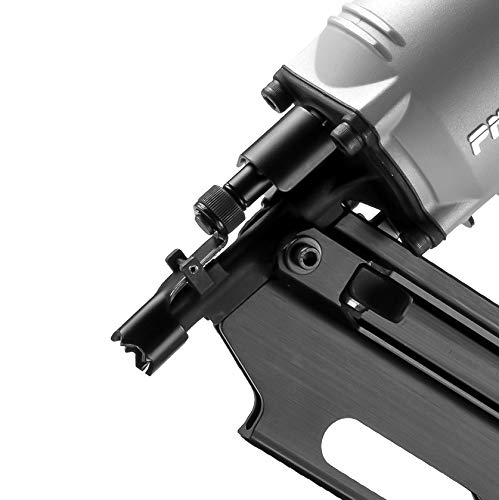
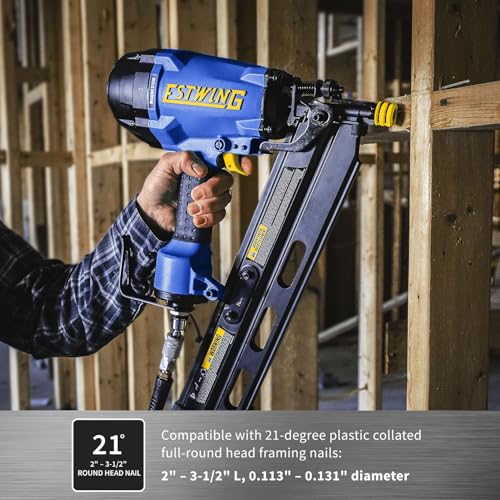
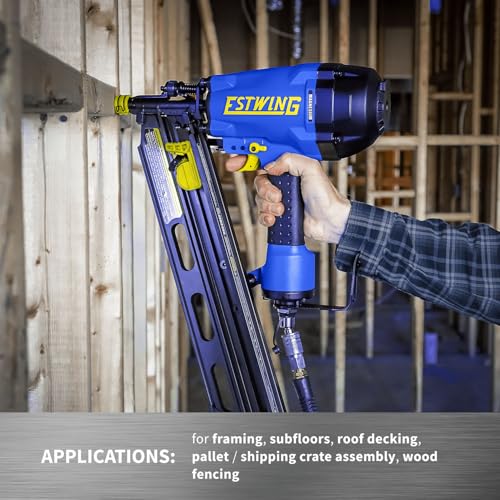
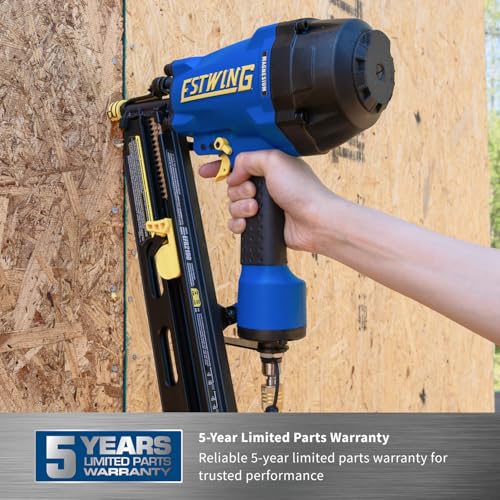
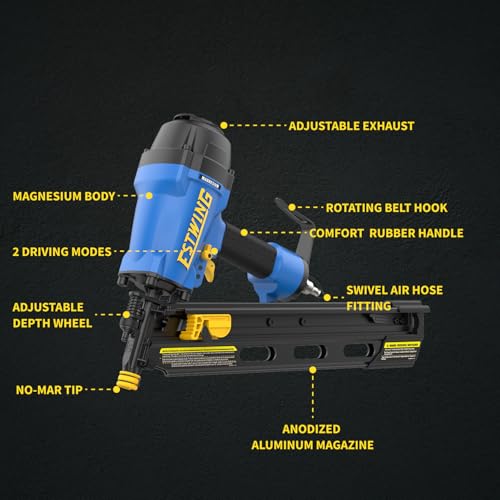
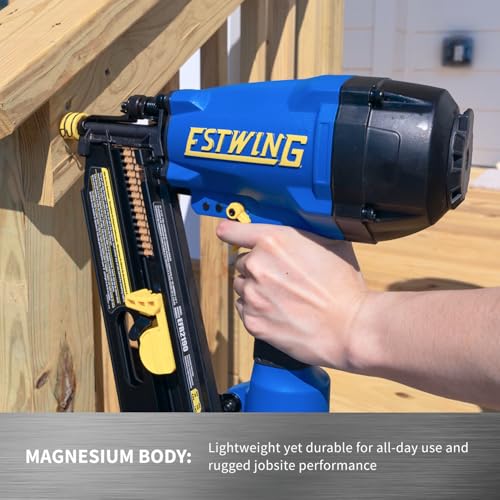
If build quality is your top priority, the Estwing EFR2190 is hard to beat. The magnesium body gives it a premium, tank-like feel while keeping weight in check, it’s one of the most solid-feeling nailers in its class. The one-piece hardened steel drive blade is overbuilt in the best way, designed to survive years of hard use. The dual-mode trigger works cleanly, and the anti-dry-fire mechanism is a smart touch that pros appreciate for protecting the tool during fast-paced runs.
Owners praise its durability and the comfort of the grip, especially on long shifts. It’s heavier than some strip nailers, but that mass helps with stability. The included swivel fitting and carry bag add real value. Compared to Metabo HPT’s models, it’s less about agility and more about brute resilience.
Product photos
How We Chose These framing nailer for professionals
Rather than a hands-on lab test, my research for this guide involved a detailed comparison of published specifications and features across numerous models. I weighed owner reviews from multiple sources – including major retailers and dedicated tool forums – alongside assessments from reputable industry experts. This process allowed me to rank nailers against criteria important to professionals, factoring in durability, power, and ease of use.
For framing nailers, consistent nailing power, minimal downtime, and long-term reliability are paramount. I heavily weighted factors like the type of drive system (cylinder valve versus others), magazine capacity, and the quality of materials used in construction. A nailer’s ability to handle a variety of fastener types and its adjustability also played a significant role in the final rankings.
Specifications reliably indicate a nailer’s capacity, operating pressure, and nail size compatibility. However, I found owner feedback to be crucial for understanding real-world durability and identifying potential issues like frequent jamming or difficulty adjusting depth of drive. Reputation and brand history also informed my assessment; established brands often demonstrate a commitment to quality and support. If you’re considering a move to battery power, you might also find our guide to best cordless models helpful.
How To Choose The framing nailer for professionals
Picking the right framing nailer can dramatically improve your speed and the quality of your work. It’s not just about driving nails; it’s about doing it efficiently, safely, and with consistent results.
A quality framing nailer balances power with usability. Key considerations include nail collation type (21-degree plastic or 21-degree coil), actuation mode (sequential or bump), weight, durability of internal components, and depth-of-drive adjustability. Look for models with easily accessible jam clearing and robust construction for longevity.
Nail Collation & Capacity
The type of nail a framing nailer accepts is a primary consideration. Most professionals favor 21-degree plastic collated nails because they’re widely available and relatively inexpensive. However, coil nailers, using 15-degree nails, offer a much higher capacity, reducing downtime for reloading during large projects. If you frequently build decks or work on high-volume jobs, a coil nailer might be worth the investment. For general framing, though, the convenience of plastic collated nails often wins out. Examining 21-degree framing nailers will quickly show you the range of options available.
Actuation Mode & Control
Framing nailers typically offer sequential or bump (contact) actuation. Sequential mode requires depressing the safety tip then pulling the trigger for each nail – safer, but slower. Bump mode drives a nail every time the nose is pressed against the wood while the trigger is held – faster, but riskier. Many nailers, like the Metabo HPT NR90AES1, offer a switch to change between these modes.
Here’s how to think about it: * If you’re new to framing: Start with sequential. * For repetitive tasks: Bump mode can save time, but requires practice. * Working in tight spaces: Sequential offers more control to avoid accidental firing.
Weight & Ergonomics
Spending all day with a framing nailer in your hands requires careful consideration of weight and ergonomics. A heavier nailer (8+ lbs) will cause fatigue more quickly than a lighter one. Look for models with well-balanced designs and comfortable rubber grips. The Metabo HPT cordless options, for example, aim to reduce fatigue by eliminating the hose drag, but they add weight with the battery. Don’t underestimate the impact of ergonomics; it’s a factor that separates a tool you enjoy using from one that feels like a burden. Furthermore, if you’re looking at several options, a framing nailer comparison can help you weigh the pros and cons of various models.
A framing nailer’s weight and balance are crucial for all-day comfort. Don’t assume more power always means a better tool; a lighter, well-balanced nailer will often result in more efficient work and less strain.
Framing Nailer for Professionals Compared
Here’s a comparison of key specifications for professional-grade framing nailers to help you choose the right tool for your needs.
| Product Title | Nail Type | Nail Length Capacity | Magazine Capacity | Weight (lbs) | Actuation Mode | Depth Adjustment |
|---|---|---|---|---|---|---|
| Metabo HPT NR90AES1 | 21 Degree Plastic Collated | 2-3.5″ | N/A | 7.5 | Sequential/Contact | Tool-less |
| VEVOR 21 Degree | 21 Degree (Smooth, Ring, Threaded) | 2-3.5″ | 60 | N/A | Sequential/Contact | Tool-Free |
| Metabo HPT NR83A5 | 21 Degree Plastic Collated | 2-3.5″ | N/A | N/A | Sequential/Contact | Selectable Trigger |
| Metabo HPT Cordless 21° | 21 Degree Plastic Collated | Up to 3.5″ | N/A | 8.4 (w/o battery) | Bump/Sequential | Tool-less |
| Metabo HPT Coil Framing Nailer NV90AG | 15 Degree Coil | 1.75-3.5″ | N/A | 7.7 | Sequential/Contact | Tool-less |
| PneuTools SN2283H-AD | 21 Degree Plastic Collated | N/A | N/A | N/A | Single | Adjustable |
| Estwing EFR2190 | 21 Degree Plastic Collated | 2-3.5″ | N/A | N/A | Sequential/Bump | Tool-Free |
Frequently Asked Questions
What air compressor size do I really need for a framing nailer?
A compressor with at least 6.0 CFM at 90 PSI is generally recommended for consistent performance with most framing nailers. Larger tanks (60+ gallons) reduce how often the compressor cycles on and off, which is especially helpful during extended use. For more detail, check out guides to air compressors for framing nailers.
How can I prevent nail jams in my framing nailer?
Using the correct nail collation for your nailer and ensuring nails are free of rust or debris are the biggest preventative measures. Proper lubrication of the internal components, as outlined in the owner’s manual, also significantly reduces the risk of jams.
Is a cordless framing nailer truly comparable to a pneumatic model in power?
Modern cordless framing nailers using 20V or 40V batteries have significantly closed the performance gap with pneumatic models. While some power difference may exist, advances in motor technology and battery capacity mean they are capable of handling most professional framing tasks.
What’s the difference between sequential and bump actuation, and which is better?
Sequential actuation is safer for beginners because it requires two distinct actions to fire a nail, reducing accidental firing. Bump actuation is faster for experienced users, but requires more control and is generally considered riskier. Many nailers allow you to switch between the two.
What should I look for in terms of durability when selecting a professional-grade framing nailer?
Look for models constructed with aluminum housings and hardened steel internal components. Owner reviews often highlight issues with plastic parts breaking, so prioritize nailers with robust materials throughout. A good warranty is also a strong indicator of manufacturer confidence in the product’s longevity.
The Bottom Line
Choosing a framing nailer often comes down to balancing upfront cost with long-term productivity. While there are many excellent options available, the Metabo HPT NR90AES1 consistently rises to the top as a well-rounded performer, offering a blend of power, durability, and adjustability that professionals appreciate. It’s a solid investment for anyone who demands consistent results day in and day out.
For those prioritizing specific needs, the alternatives shine. If you handle high-volume projects, the Metabo HPT Coil Framing Nailer NV90AG will minimize downtime with its large capacity. And if budget is the primary concern, the VEVOR 21 Degree offers a lot of capability for the price. Don’t overlook exploring reliable air nailers for framing to see if a pneumatic model suits your needs.
Ultimately, remember that the specifications are only part of the story. A nailer’s performance is heavily influenced by consistent maintenance, proper air pressure, and the quality of the nails you use. Focusing on these fundamentals, and selecting a tool from a reputable brand, will deliver more lasting value than chasing the latest features or highest power rating.
