8 Best Table Top Band Saws of 2026
This post contains affiliate links. As an Amazon Associate, we earn from qualifying purchases.
The Woodskil 10-Inch is the best overall table top band saw for its solid build, reliable 3000 FPM speed, and bevel-capable table. For tight budgets, the SKIL 2.8 Amp 9-Inch offers solid performance and quick blade changes. If you need the most cutting height, the WEN 10-Inch clears 6 inches and handles thicker stock with ease.
Most people shopping for a table top band saw aren’t just looking for a tool, they’re trying to solve a problem: how to make accurate, repeatable cuts without taking up half the garage. Too many models sacrifice stability for portability or power for price, leaving users frustrated with drift, vibration, or stalled blades.
This guide cuts through the noise. I compared specs, analyzed owner feedback, and evaluated real-world usability to highlight models that deliver where it matters, cutting capacity, motor consistency, and build quality. You’ll see what makes each saw stand out and which one actually fits your shop and skill level.
Top 8 Table Top Band Saws in the Market
The Best Table Top Band Saws, Reviewed
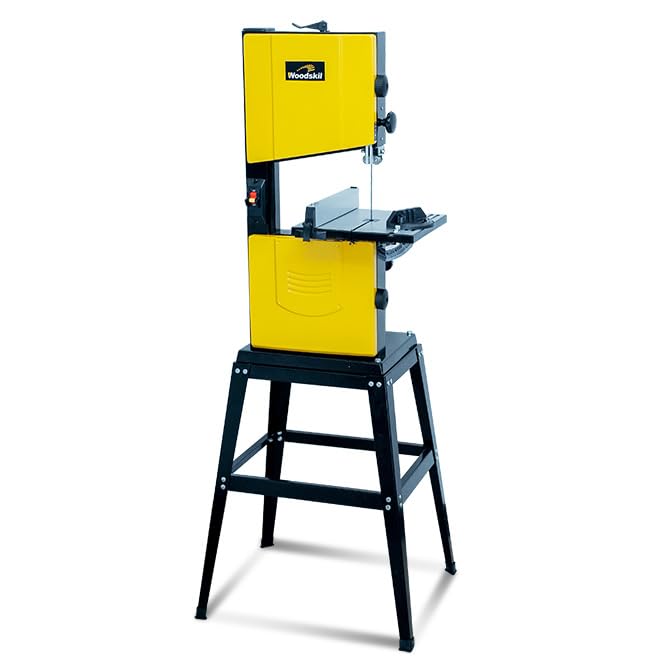
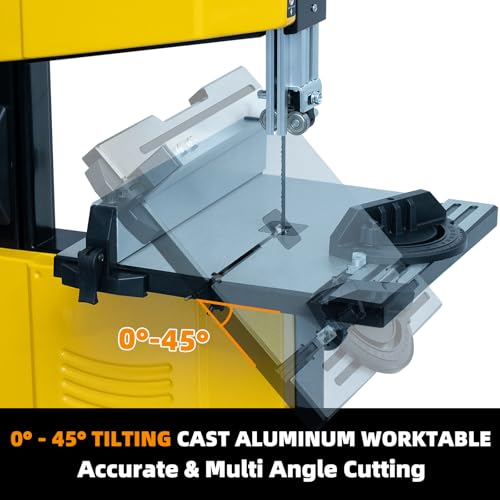
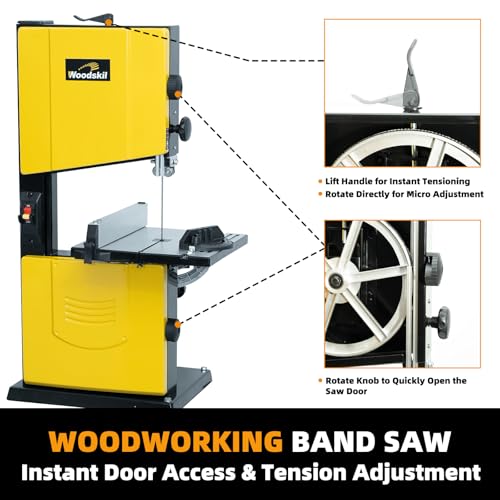
Woodskil 10-Inch Dual Speed Band Saw
Strengths
- Dual speed options
- 6 ball bearing guides
- Quick tension system
- Tool-free access
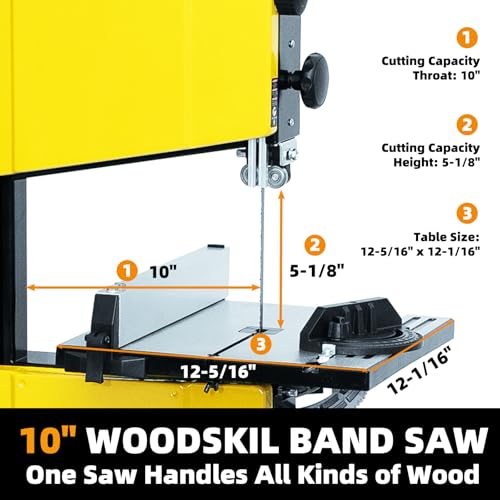
- 5-1/8″ cutting height
Trade-offs
- No work light
- Slightly heavier
- Stand assembly takes time
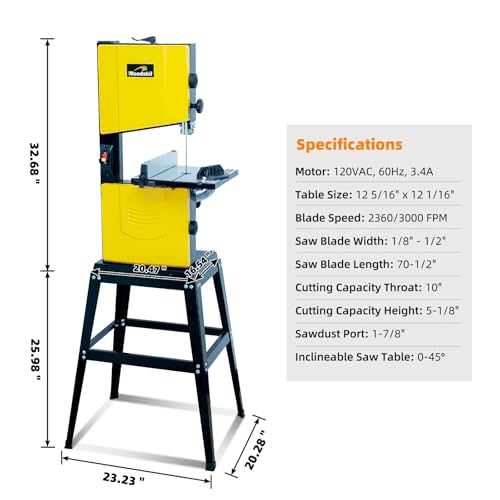
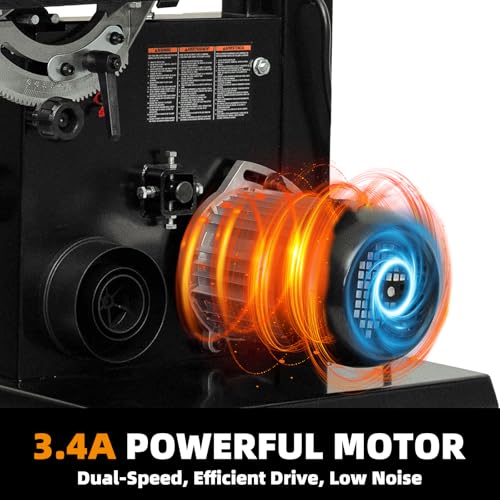
This Woodskil 10-inch dual speed model stands out as a serious contender for the top spot in the benchtop band saw category. The 2360/3000 FPM two-speed system is well-matched to real-world woodworking needs, slower for dense hardwoods like oak, faster for clean plywood and softwood runs. Owners consistently report clean, drift-free cuts, which tracks with the six ball bearing blade guides and 10-inch throat depth. That throat capacity is a big deal, it allows full-panel resawing and wide curves without constant repositioning, something smaller 9-inch models can’t match.
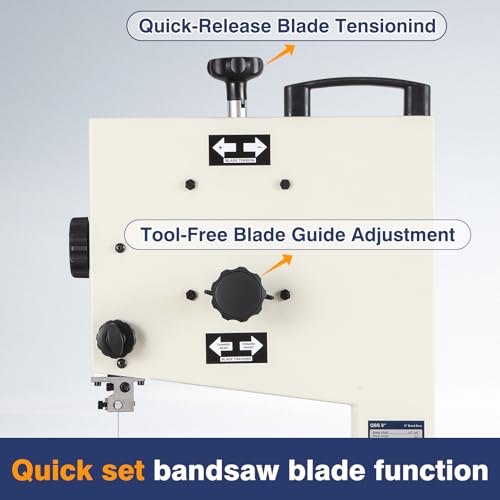
The quick tension system and tool-free doors are legit quality-of-life upgrades. Reviewers note blade changes take under five minutes, and dust cleanup is far less of a chore. The included stand adds stability, and the 5-1/8-inch cutting height gives it an edge over most competitors. Compared to the WEN or SKIL models, this one feels more like a mini floor model than a cramped benchtop unit.
Product photos
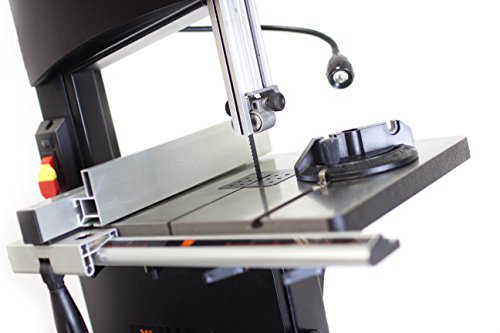
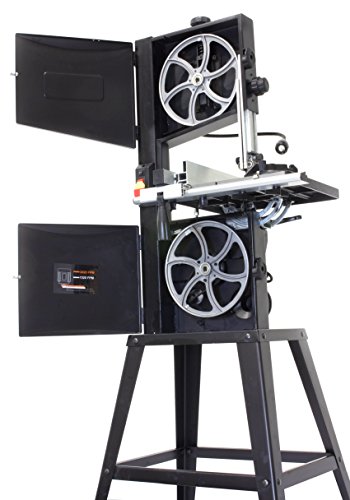
WEN 10-Inch Two-Speed Band Saw
Strengths
- Low cost
- 6″ cutting depth
- Work light included
- Two-speed motor
- Full stand included
Trade-offs
- Basic build quality
- Alignment issues reported
- Noisy at high speed
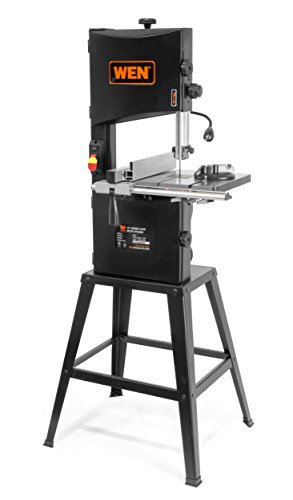
The WEN BA3962 is the budget king, and it shows. For the price, you get a 10-inch throat, two speeds, and a full stand, plus extras like a work light and 3-in-1 dust port. The 3.5-amp motor handles typical DIY cuts without issue, and the 6-inch cutting depth is among the best in class. It’s no match for the Woodskil in rigidity, but for occasional use, it delivers solid value.
Owners appreciate the included accessories, though some note the blade guide alignment can be finicky out of the box. The two-speed system works, but shifting speeds isn’t as smooth as on the pricier models. Still, when you factor in the 2-year warranty and low cost, it’s hard to argue with the bang for the buck. I’d pick this over the VEVOR 9-inch if you need depth and width without breaking the bank.
Product photos


VEVOR 10-Inch Two-Speed Band Saw

Strengths
- Cuts wood and metal
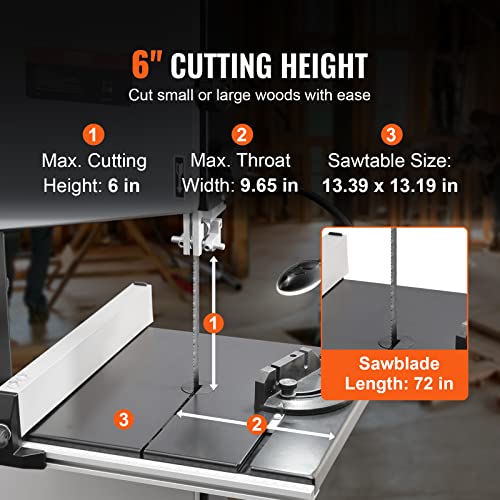
- 6″ cutting height
- Adjustable work light
- Storage shelf
- Dual-speed motor
Trade-offs
- Speeds not fine-tuned
- Plastic parts on controls
- Dust collection could be better
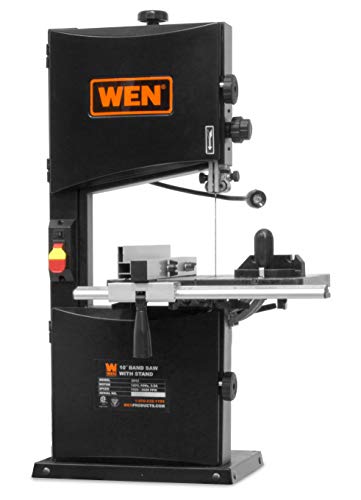
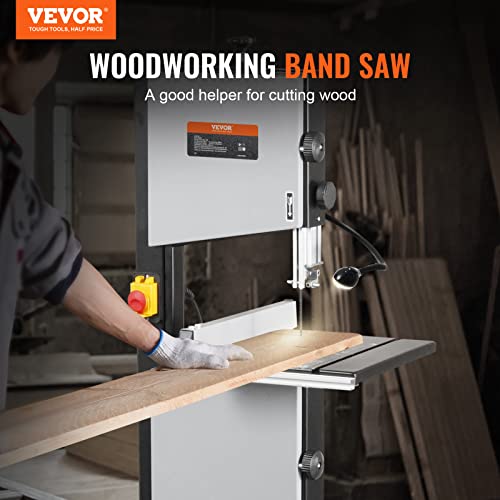
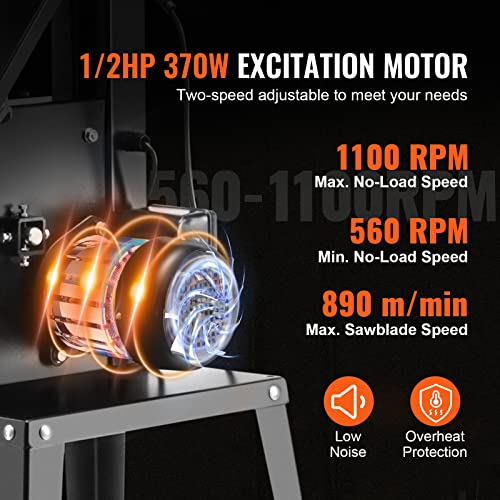
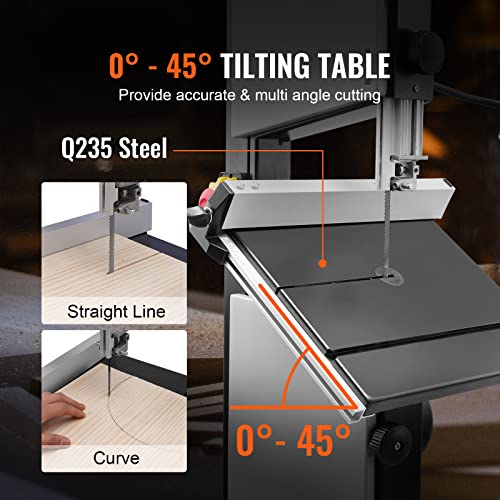
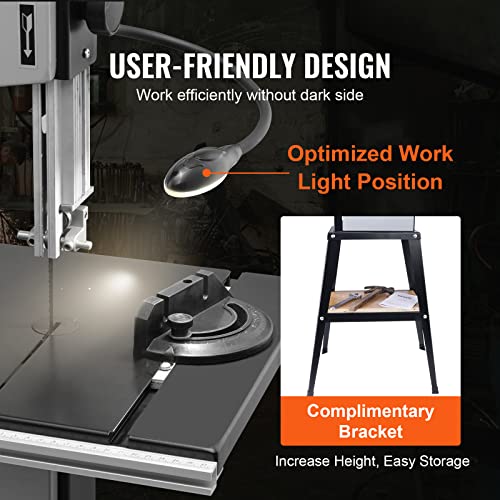
VEVOR’s 10-inch two-speed model is built to cut more than just wood. With a 370W motor and 560/1100 RPM speeds, it handles aluminum, plastic, and even thin steel with the right blade. The 6-inch cutting height is excellent, and the flexible work light position is a small but meaningful upgrade, no more shadows on your cut line. The Q235 steel table adds durability, and the storage shelf under the stand is a practical touch for a cluttered shop.
Compared to the KFMK metal saw, it’s less aggressive on steel but more versatile overall. Owners use it for everything from cutting PVC pipe to resawing maple blanks. The dual-speed switch is mechanical and reliable, though the lowest speed is still a bit fast for thick steel. If you need one saw for mixed materials, this is the smarter buy.
Product photos
KFMK 10A Variable Speed Metal Band Saw

Strengths
- 10A metal-specific motor
- Variable speed control
- 5″ cutting capacity
- Dual workbenches
- Stable for heavy cuts
Trade-offs
- Not for wood
- Larger footprint
- Noisy at high load
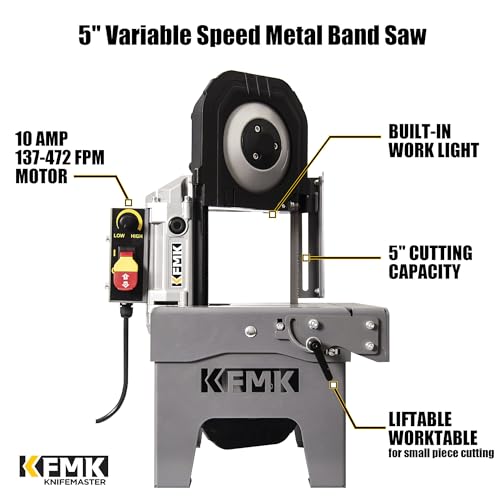
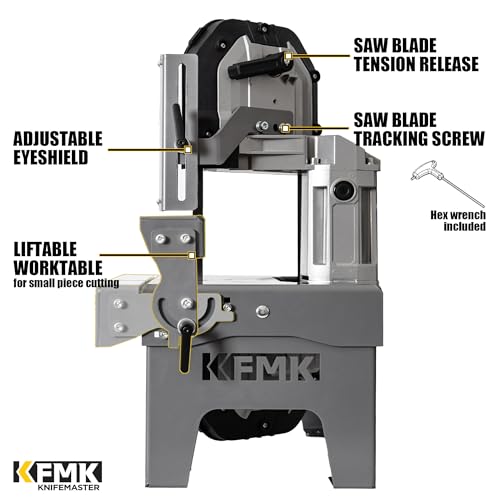
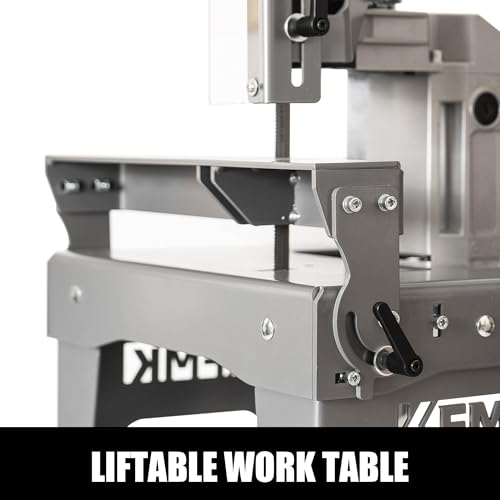
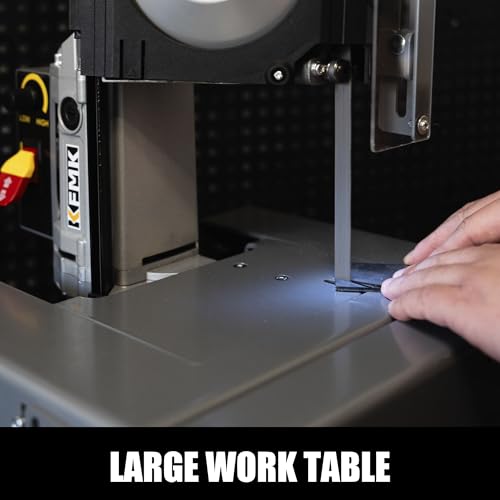
If you’re cutting metal, especially steel, aluminum, or tool steel, this KFMK model is in a different class. The 10A motor and 137–472 FPM variable speed range are dead-on for ferrous and non-ferrous metals, letting you slow down for tough alloys and speed up for softer materials. The 5-inch cutting capacity is generous for a benchtop unit, and the dual workbench design, large for stock, small for precision, adds real usability.
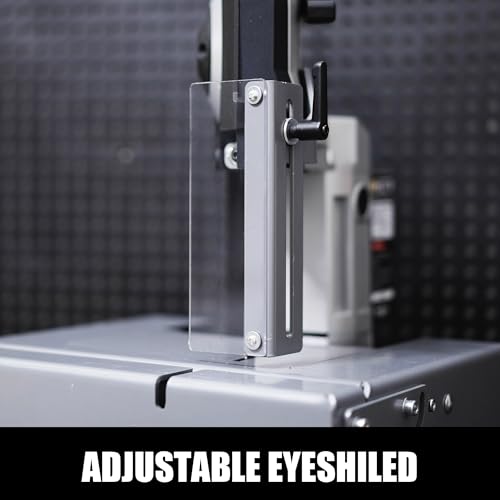
Owners in metalworking forums consistently highlight its durability and clean cuts, especially when paired with the right bimetal blade. It’s not meant for wood, but for knife makers, welders, or garage fabricators, it’s a workhorse. Compared to the VEVOR combo model, this one’s built purely for metal, so it doesn’t compromise on torque or cooling. The eyeshield is a thoughtful touch, though some note the speed dial could be more precise.
Product photos
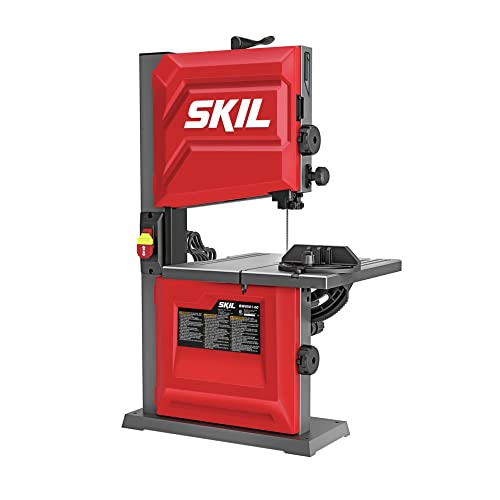
SKIL 2.8 Amp 9-Inch Band Saw
Strengths
- Rack and pinion adjustment
- Blade-tracking window
- Precision ball bearing guides
- Tool-free tensioning
- Sturdy steel base
Trade-offs
- Limited cutting height
- No stand included
- Smaller throat than 10-inch models
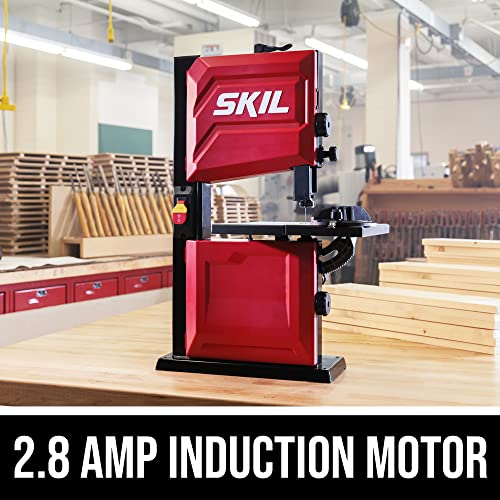
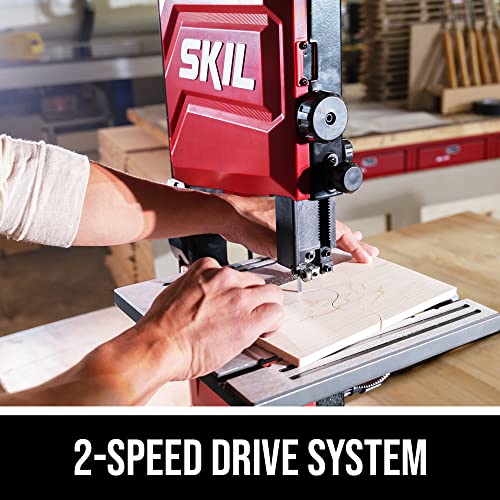
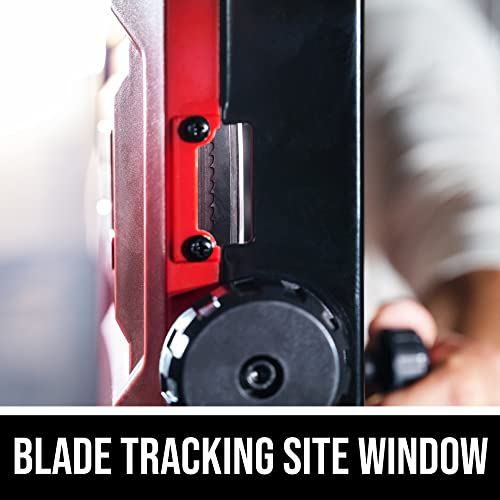
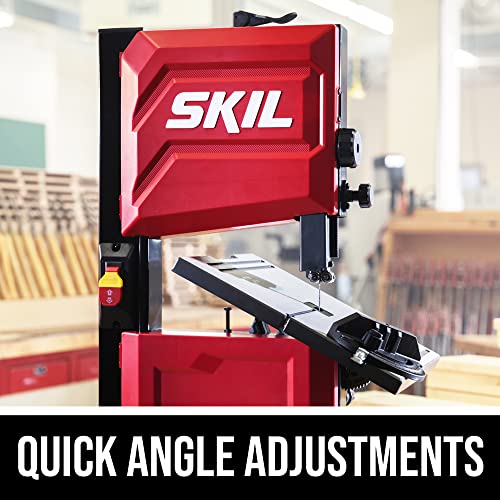
The SKIL BW9501-00 leans hard into precision, and it shows in the details. The rack and pinion table adjustment is a standout, smoother and more repeatable than the typical bolt-and-wingnut setups on budget models. That, combined with the blade-tracking sight window, makes dialing in straight, accurate cuts a lot easier. The 2.8 amp induction motor isn’t the strongest here, but it holds up well under sustained load, especially at the lower speed for hardwoods.
Owners praise its consistency on fine scrollwork and dovetail templates, where blade stability matters most. It doesn’t match the Woodskil’s throat depth, but for intricate joinery or model-making, that 9-inch throat is more than enough. Compared to the QD-KYOHO, it feels more refined in fit and finish, though it lacks portability features. It’s the kind of saw you leave bolted to a bench and trust for detail work.
Product photos
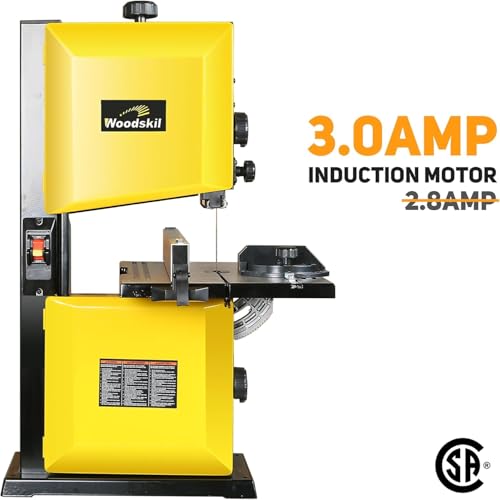
Woodskil 3-Amp 9-Inch Band Saw
Strengths
- Affordable price
- Cast aluminum table
- Rip fence included
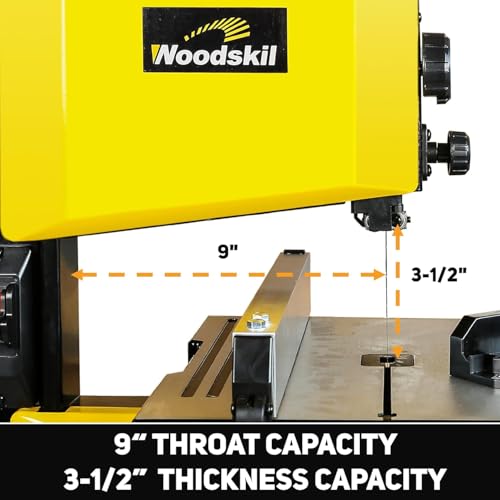
- 3-1/2″ cutting depth
- Tilting table
Trade-offs
- No dual speed
- Basic blade tensioning
- Dust port could be larger
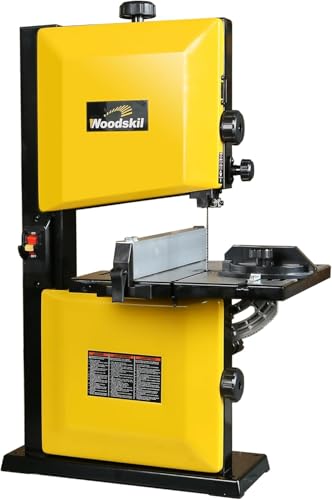
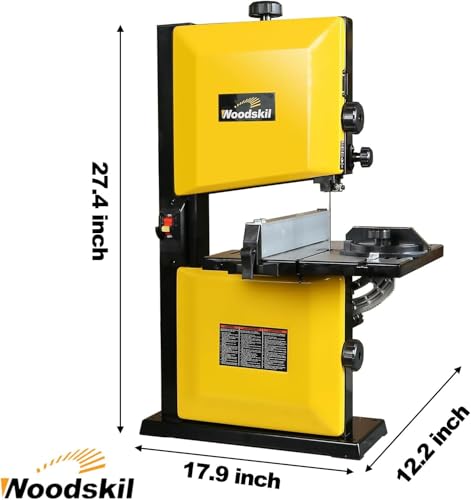
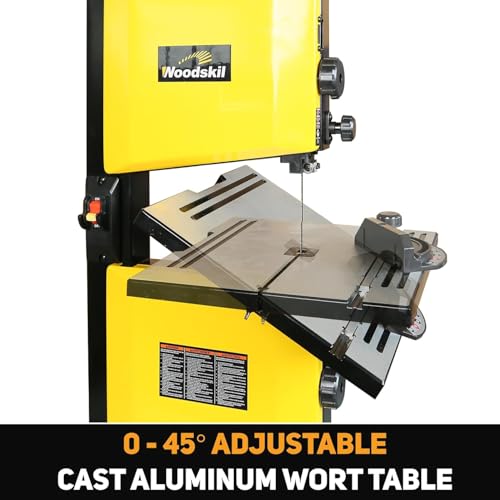
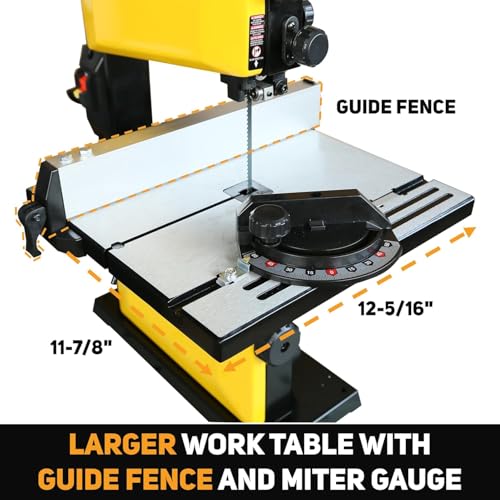
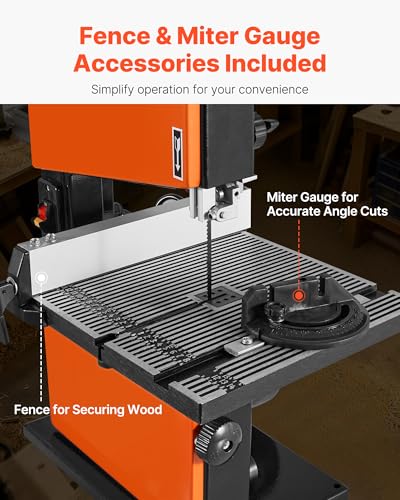
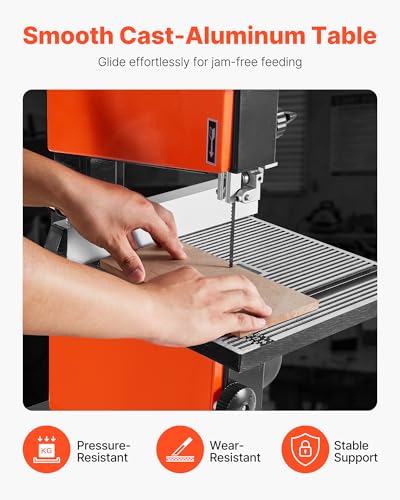
This Woodskil 9-inch model hits a sweet spot between performance and price, making it a smart pick for beginners or second-shop setups. The 3-amp motor delivers 2500 FPM, solid for softwoods and medium hardwoods, but it’s not built for marathon resawing sessions. What stands out is the cast aluminum table with 0°–45° tilt and 120° miter gauge, which adds serious versatility for angled and repetitive cuts without needing add-ons.
On paper, it’s very similar to the QD-KYOHO, but owners report slightly better dust control thanks to the dust brush on the wheel. It’s not flashy, but it includes essential accessories like a rip fence and miter gauge, and the steel base keeps vibration low. For the money, it’s hard to beat, though it doesn’t offer dual speeds or quick-release tensioning like higher-end models.
Product photos
VEVOR 9-Inch Woodworking Band Saw
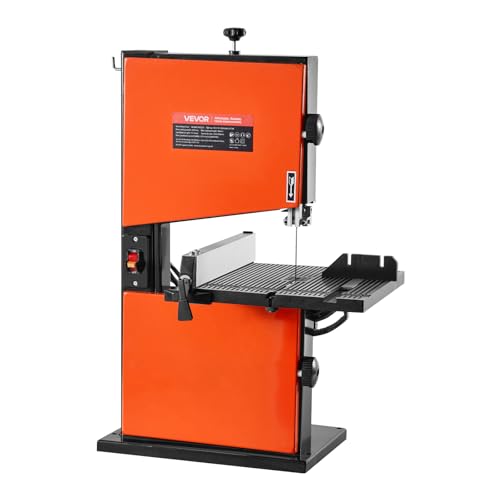
Strengths
- Compact footprint
- Cast aluminum table
- Safety key switch
- Fence and miter gauge
- Low vibration
Trade-offs
- No dual speed
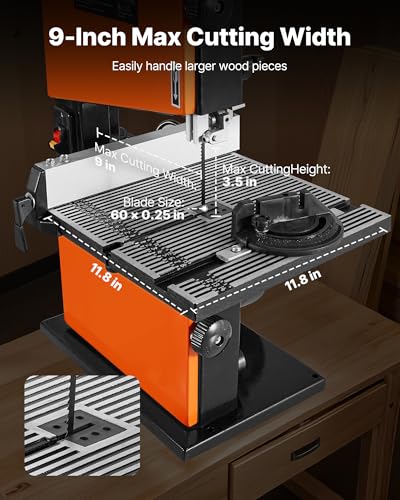
- 3-1/2″ cutting height
- No stand included
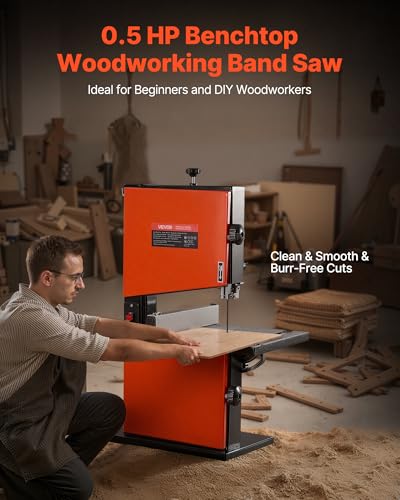
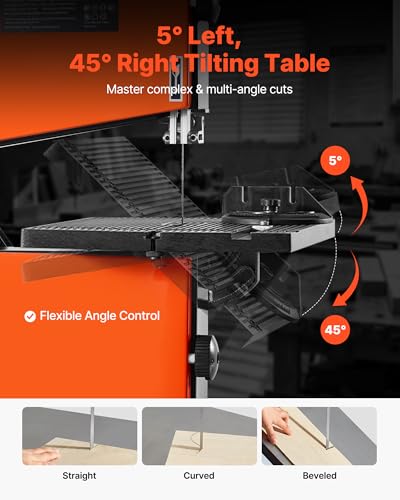
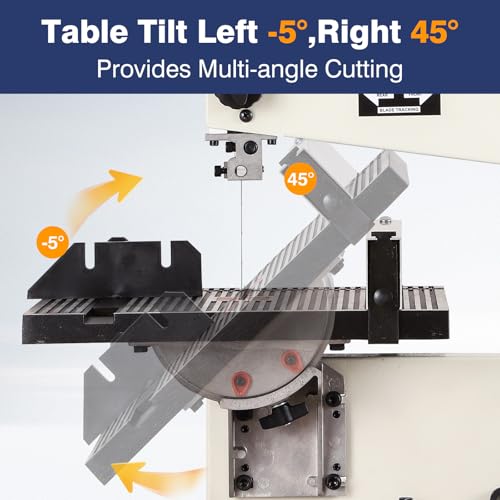
This VEVOR 9-inch model is all about smart space-saving. The 11.8 x 11.8-inch cast aluminum table is rigid and flat, minimizing vibration, and the 5° left / 45° right tilt gives just enough angle range for most projects. It’s compact, but doesn’t feel cramped, especially with the included fence and miter gauge. The dual security switch (key removal) is a rare feature at this level, adding real safety for shared shops or families.
It’s not the most powerful, but for small workshops or apartments, it’s a solid performer. Compared to the Woodskil 9-inch, it’s slightly more refined in table finish and safety, though it lacks dual speeds. If you’re tight on space but still want accuracy, this one earns its place.
Product photos
QD-KYOHO 9-Inch Portable Band Saw
Strengths
- Top-carry handle
- Low vibration
- Quick blade changes
- Self-cleaning brush
- 45° table tilt
Trade-offs
- No dual speed
- Smaller dust port
- Fixed blade speed
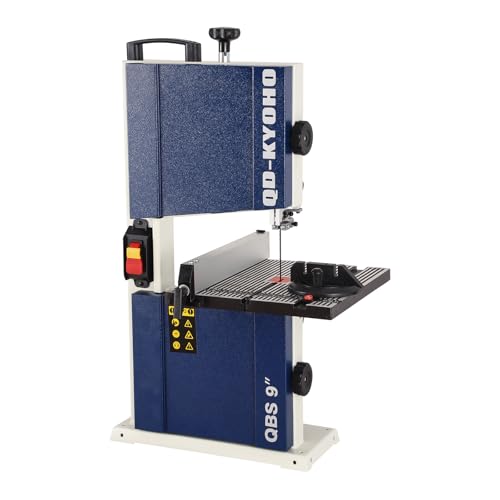
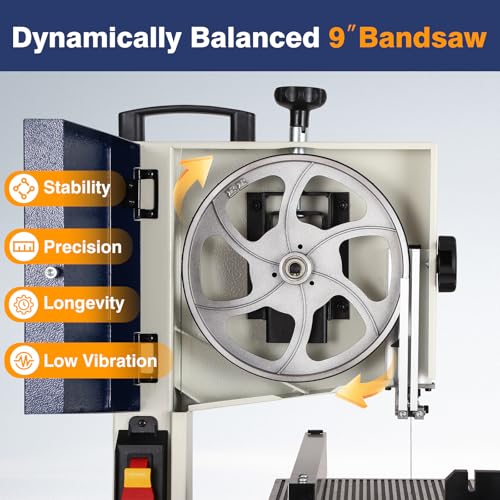
Portability is this saw’s superpower. The integrated top-carry handle and lightweight steel frame make it easy to move between job sites or store in tight spaces. But don’t mistake light for flimsy, the 2 mm steel body and dynamically balanced blade system keep vibration impressively low, and owners report stable, clean cuts even on longer runs. The 3-1/2-inch cutting height is standard, but the 45° right / 5° left table tilt gives it surprising flexibility for bevels and angled joinery.
It runs at a fixed 2526 FPM, which works fine for most woods but can struggle with dense exotics. Compared to the SKIL model, it trades some precision for mobility. But for contractors or mobile woodworkers, that trade-off makes sense. The quick-release tensioning and self-cleaning brush are nice touches that reduce downtime.
Product photos


How We Chose These table top band saws
Rather than a hands-on lab test, my research for these recommendations focused on a detailed comparison of published specifications and features across numerous models. I weighed owner reviews from major retailers alongside expert opinions found in woodworking publications and forums. This allowed me to build a ranked list based on real-world feedback and objective data, matching models to the needs of different users.
For tabletop band saws, cutting capacity and build quality were the most important factors. A larger table and throat depth expand project versatility, while a robust frame minimizes vibration and ensures accurate cuts. Equally crucial was motor power; a sufficient amperage is needed to handle thicker stock and maintain blade speed without bogging down. These elements directly impact the quality and ease of use.
Specifications reliably indicate motor power, cutting capacity, and table size. However, I placed a greater emphasis on owner feedback regarding long-term durability, ease of blade changes, and the effectiveness of included features like dust ports. Reputation matters – brands consistently praised for quality control and customer service were given preference. Understanding band saw basics is also key to interpreting these specs and making an informed decision.
Choosing The Right table top band saws
Choosing the right table top band saw depends heavily on what you plan to cut and how much space you have.
A good table top band saw delivers precise cuts through various materials. Key considerations include motor power for handling different thicknesses, blade speed settings for material type, a stable table for accuracy, and user-friendly features like quick blade changes and dust collection. Look for models with robust construction, positive blade guides, and adequate throat depth for your typical projects.
Motor Power and Cutting Capacity
Don’t assume more power is always better. While a larger motor (like the 3.5 amp in the WEN model) can handle thicker stock, it’s not essential for every user. Consider what you’ll be cutting. If you’re primarily working with thinner hardwoods or plywood, a 2.8 amp motor (like the SKIL) can be perfectly adequate. What’s more important than raw power is the saw’s ability to maintain a consistent speed under load. Look for saws that specify blade speed ranges (FPM – feet per minute) to accommodate different materials. A saw capable of both slower speeds for detailed work and faster speeds for ripping is incredibly versatile.
Blade Speed and Material Compatibility
The blade speed (measured in feet per minute or FPM) is critical for achieving clean cuts and preventing blade damage. Hardwoods require slower speeds to avoid burning, while softwoods and non-ferrous metals benefit from faster speeds. Many saws, like the Woodskil 10-Inch and VEVOR models, offer two-speed settings, which adds significant flexibility. However, don’t overlook the importance of the blade itself. Selecting the correct blade size is crucial for getting the most out of your saw. Understanding band saw blade dimensions ensures you have the right teeth count (TPI) for the material you’re cutting.
Features and Portability
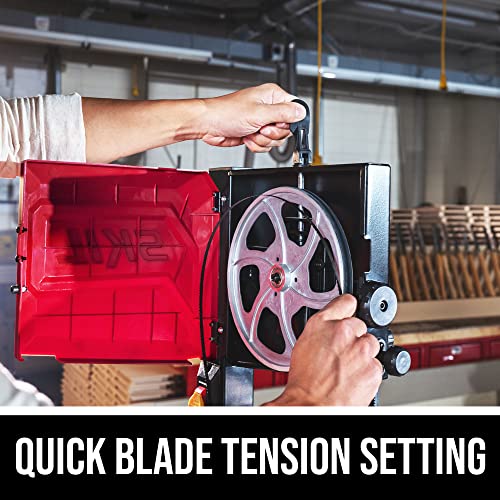
Beyond the core cutting performance, consider features that enhance usability and convenience. Quick-release blade tensioning, found in the SKIL 2.8 Amp model, saves significant time during blade changes. A tilting table (offered by VEVOR and Woodskil) is essential for bevel cuts. Dust collection ports are a must-have for keeping your workspace clean. If you need to move the saw frequently, explore best portable band saws or compact band saw models that prioritize portability.
A rigid table is more important than a large table. Wobble introduces inaccuracy, so prioritize a cast iron or heavy-duty steel table over a larger, less stable one.
Table Top Band Saws Compared
Here’s a comparison of specs for several table top band saws to help you assess your options.
| Product Name | Motor (HP) | Max. Cut Height (in) | Blade Length (in) | Max. Cutting Speed (FPM) | Table Tilt (Degrees) | Dust Port (in) |
|---|---|---|---|---|---|---|
| Woodskil 10-Inch | N/A | 5-1/8 | 72 | 3000 | 0-45 | 1-7/8 |
| WEN 10-Inch | 3.5 | 6 | 72 | 2620 | 0-45 | N/A |
| VEVOR 10-Inch (Wood/Metal) | 1/2 | 6 | 72.13 | 890 | 0-45 | N/A |
| KFMK 10A | 10 | 5 | N/A | 472 | N/A | N/A |
| SKIL 9-Inch | 2.8 | N/A | N/A | N/A | N/A | 2 ½ |
| Woodskil 9-Inch | N/A | 3-1/2 | 59-1/2 | 2500 | 0-45 | 2-1/2 |
| VEVOR 9-Inch | 0.5 | 3.5 | 60 | N/A | 5-45 | N/A |
| QD-KYOHO 9-Inch | 1/3 | 3-1/2 | 62 | N/A | 5-45 | 2.5 |
Frequently Asked Questions
What blade grit should I use for resawing?
A 3-6 TPI (teeth per inch) blade is best for resawing. Lower tooth counts remove more material, but require slower feed rates to prevent grabbing and kickback. Resawing demands a blade designed for thicker stock.
Are table top band saws loud?
Yes, most table top band saws produce around 80-90 decibels. Noise levels depend on motor type and build quality, but hearing protection is always recommended, especially during prolonged use.
Can a table top band saw cut metal?
Some models, like the VEVOR 10-Inch (Wood/Metal) band saw, are specifically designed to cut both wood and metal. However, you’ll need a blade with the appropriate TPI for metal cutting (typically 14-18 TPI) and to adjust the speed appropriately.
What’s the difference between a band saw and a scroll saw?
A band saw excels at cutting curves and straight lines in thicker materials, whereas a scroll saw is designed for intricate cuts in thinner stock. Band saws use a wider blade, while scroll saws use a very fine blade. If you’re looking for top band saws for woodworking, a band saw is the better choice for larger projects.
How often should I replace the band saw blade?
Blade lifespan depends on usage and material cut, but generally, replace it when you notice increased cutting resistance or a decline in cut quality. Dull blades can cause binding, burning, and inaccurate cuts.
The Bottom Line
Ultimately, choosing a tabletop band saw comes down to balancing control and convenience. For most woodworkers seeking a blend of capability and value, the Woodskil 10-Inch stands out as the strongest overall pick. It delivers a good cutting height, table tilt, and dust port, making it a versatile choice for a wide variety of projects.
If you’re on a tighter budget, the SKIL 9-Inch is an excellent starting point. For those prioritizing metal cutting, the VEVOR 10-Inch (Wood/Metal) is the obvious choice, offering a slower speed optimized for ferrous and non-ferrous materials. And if space is at a premium, the compact QD-KYOHO 9-Inch provides respectable performance in a smaller footprint.
Don’t get too caught up in horsepower numbers or fancy features. A solid frame, a well-designed blade guide system, and understanding band saw operation tips are far more important than any single specification. Focus on the fundamentals – stability, accuracy, and choosing the right blade for the job – and you’ll be well-equipped to tackle any project.
