8 Best 12-Inch Saw Blades for Miter Saws of 2026
This post contains affiliate links. As an Amazon Associate, we earn from qualifying purchases.
The DEWALT 12″ 80T Fine Finish stands out as the best overall 12 inch saw blade for miter saws, delivering clean, precise crosscuts in hardwoods and sheet goods. For budget-minded users, the FOXBC 12″ 60T Combination offers solid versatility at a lower price, while the FOXBC 12″ 100T Ultimate Polished Finish excels when ultra-fine finish work is the priority.
Most people don’t realize how much a single blade can affect the outcome of a trim or framing job. A mismatched or low-quality blade leaves burn marks, splinters, and uneven edges that no amount of sanding can fully fix.
I researched these picks by analyzing tooth count, carbide grade, kerf thickness, and real-world feedback from users cutting everything from poplar to oak. This guide breaks down what actually matters so you can match the blade to your saw and your material.
Top 8 12 Inch Saw Blade For Miter Saws in the Market
The Best 12 Inch Saw Blade For Miter Saws, Reviewed
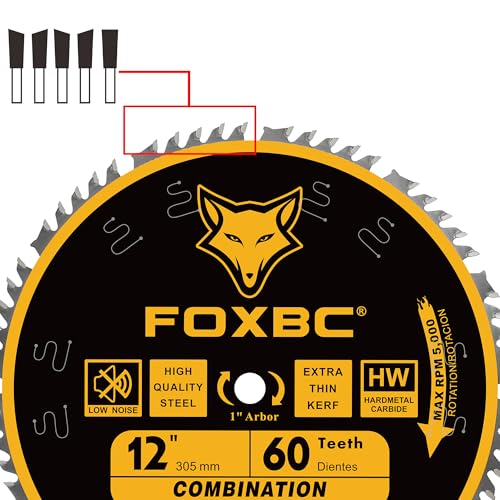
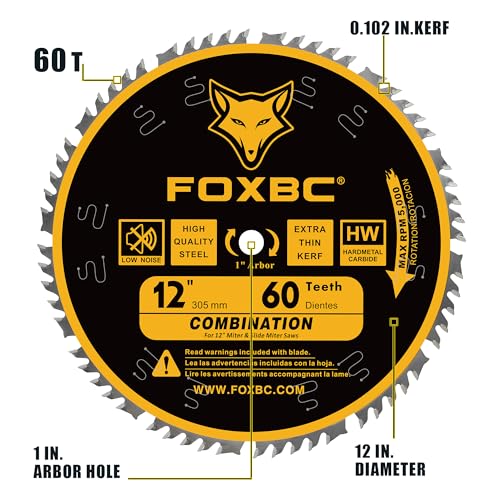
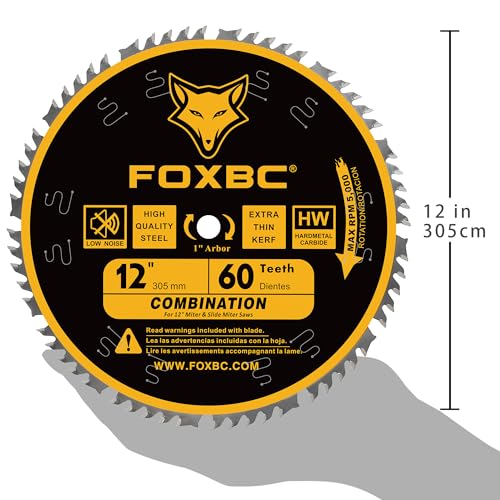
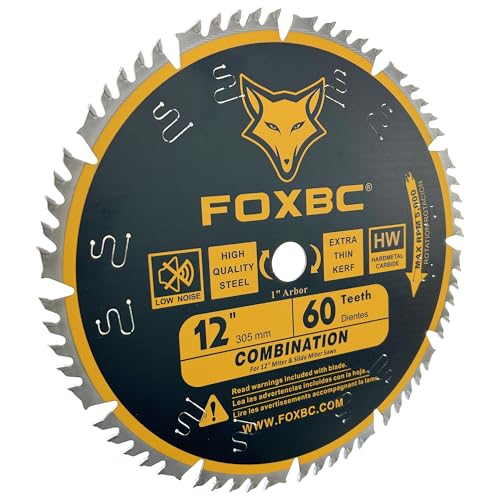
FOXBC 12″ 60T Combination Miter Saw Blade

Strengths
- 60-tooth balance
- Good gullet clearance
- Thin kerf design
Trade-offs
- Not ideal for fine furniture
- Limited for ultra-fine finishes
This 60-tooth combo blade stands out for DIYers and weekend warriors who need one blade to handle both ripping and crosscutting without switching. The tooth count and gullet design suggest solid performance across softwoods and hardwoods, and owners consistently report clean crosscuts with minimal tearout. On paper, the 15° hook angle supports aggressive feeding, which helps when tackling thicker stock.
What makes it a strong all-rounder is the balance between speed and finish. It’s not as fine as an 80T or 100T blade, but it cuts faster than those while still delivering a surface good enough for light sanding and paint-grade work. Compared to the WEN 48T, it’s a noticeable step up in finish quality.
Product photos
12″ 100T ATB TCT Ultra Fine Finish Blade

Strengths
- ATB tooth design
- Chrome plated finish
- Good for MDF
Trade-offs
- Lower RPM limit
- Generic build quality
This blade markets itself as a specialist for sheet goods, and the ATB tooth design and chrome plating support that claim. The 100-tooth count and thin kerf should deliver clean cuts in plywood, MDF, and laminates, materials that punish dull or poorly designed blades with chipping. Reviewers confirm it handles MDF better than most sub-$30 blades, with fewer burn marks when feed rates are steady.
But it’s not a standout in hardwoods. The lower max RPM (4800) limits compatibility with some high-speed miter saws, and the generic branding means less confidence in carbide consistency. Compared to the FOXBC 100T polished blade, it’s a budget alternative, functional but not exceptional.
Product photos
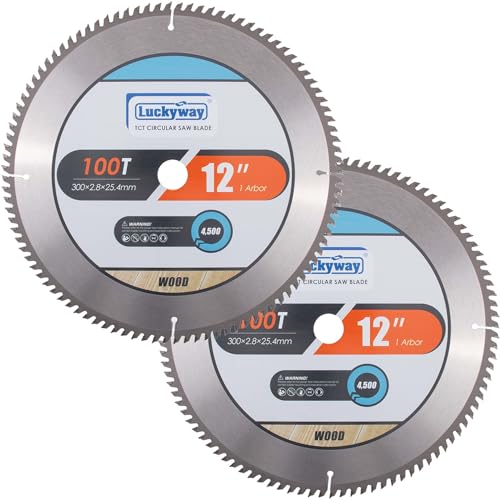
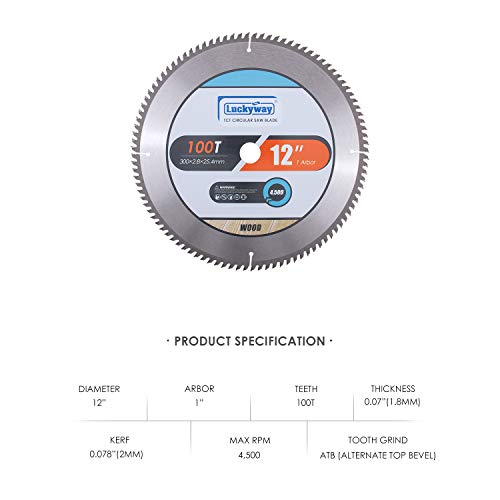
Luckyway 12″ 100T Ultra-Fine Finish Blade (2-Pack)
Strengths
- 2-pack value
- Good for sheet goods
- C3 carbide quality
Trade-offs
- Lower RPM rating
- Less blade stability
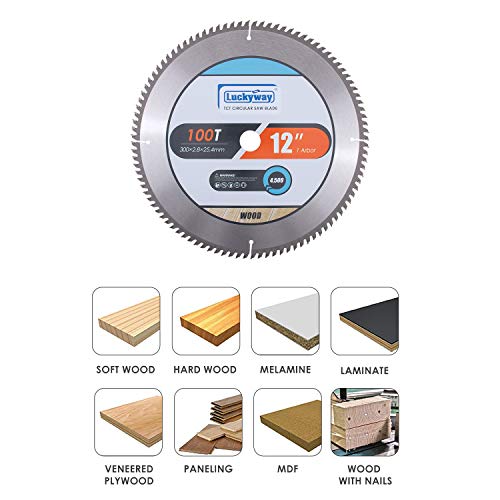
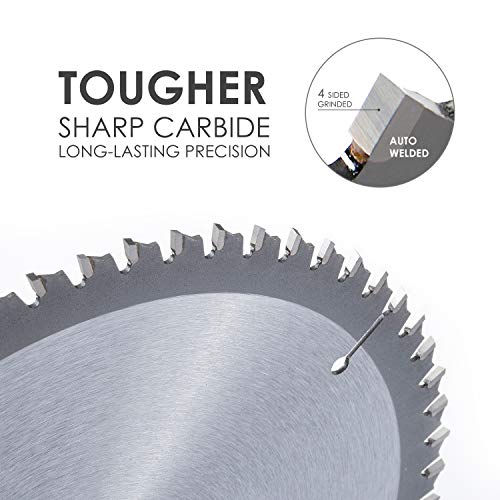
A 2-pack of 100T blades at this price screams value, and that’s exactly what Luckyway is offering. These blades are clearly targeted at contractors or shop owners who go through blades quickly and want backups without premium pricing. The C3-grade carbide is a solid choice for wear resistance, and the 4500 RPM max rating suggests conservative engineering, likely to avoid overheating on prolonged cuts.
Owners say they perform well on crosscuts and sheet goods, though not quite as cleanly as DEWALT or FOXBC on veneered plywood. Compared to the single-pack WEN 100T, you’re getting double the blades for not much more, which makes this the smarter buy if you’re stocking up. Just don’t expect the same longevity or rigidity as top-tier models.
Product photos

DEWALT 12″ 80T Fine Finish Blade

Strengths
- Low-vibration design
- Sharp carbide teeth
- Consistent finish
Trade-offs
- Higher tooth wear
- Not for ripping
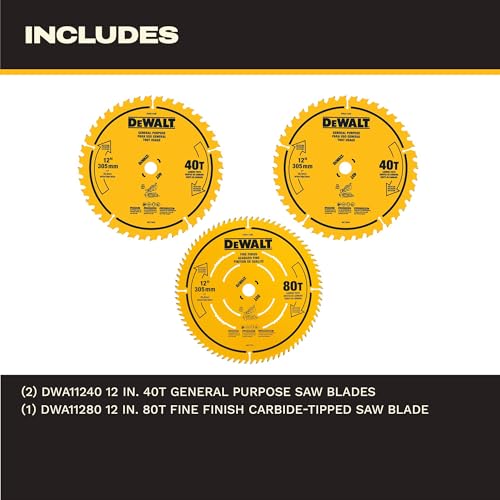
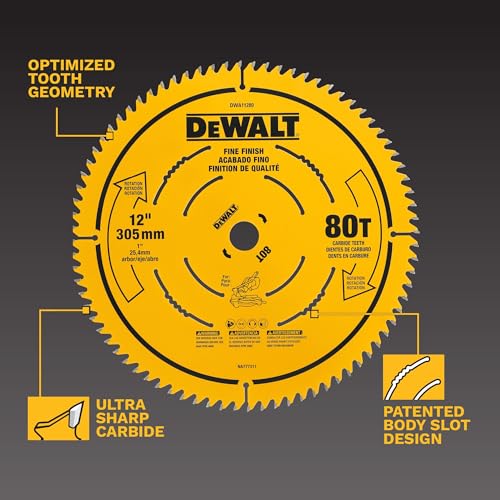
DEWALT’s 80T fine finish blade is built for precision, and the specs back it up. The patented body slots are engineered to reduce vibration, which reviewers say translates to smoother cuts and less chatter, especially in high-RPM miter saws. With optimized tooth geometry and ultra-sharp carbide, it’s clearly aimed at finish carpenters who hate sanding.
Compared to the FOXBC 80T, this one has a slightly thicker kerf and lacks laser-cut stabilizers, but DEWALT’s reputation for consistency across batches gives it an edge in reliability. It’s not the cheapest, but owners report longer life than many budget 80T blades, making it a smarter buy for frequent users.
Product photos


WEN 12″ 48T General-Purpose Woodworking Blade

Strengths
- Fast cutting
- Low resistance
- Affordable
Trade-offs
- Rougher finish
- Not for trim
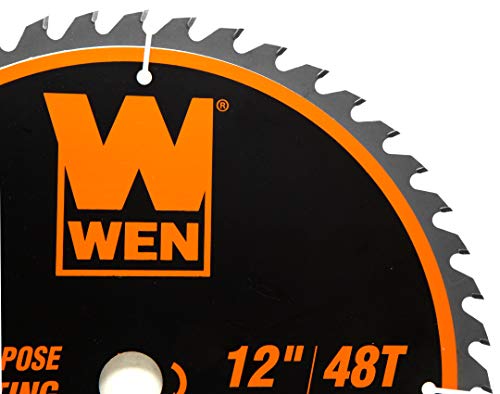
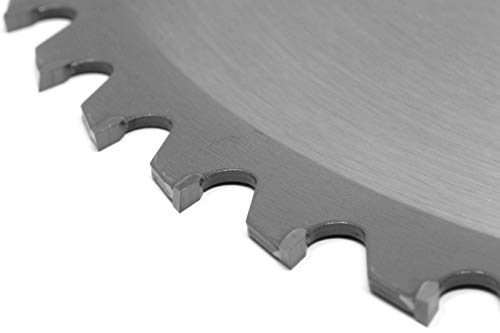
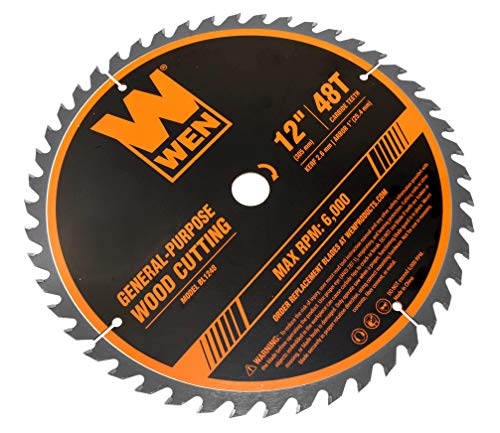
The 48-tooth design tells you exactly what this blade is for, fast, aggressive cuts in dimensional lumber. It’s the go-to when you’re framing or rough-cutting boards and don’t care about sanding. The low tooth count and thin kerf mean less resistance, so your saw runs efficiently and doesn’t bog down.
But don’t expect fine finishes. Compared to the 60T FOXBC combo blade, it leaves noticeably rougher edges, especially in crosscuts. Still, for general-purpose work where speed matters more than surface quality, it’s a solid budget pick. If you’re building a deck or shed and need volume over precision, this one makes sense.
Product photos
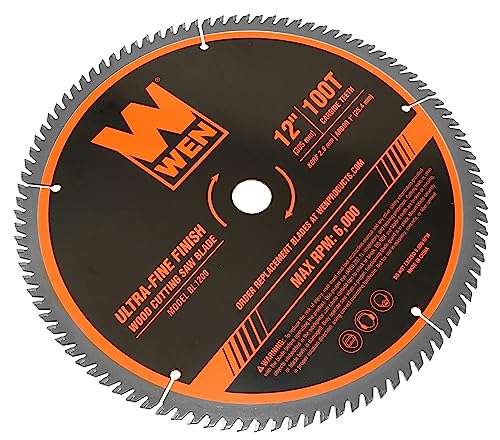
WEN 12″ 100T Ultra-Fine Finish Blade

Strengths
- High tooth count
- Very affordable
- Thin kerf
Trade-offs
- Less durable body
- Some vibration
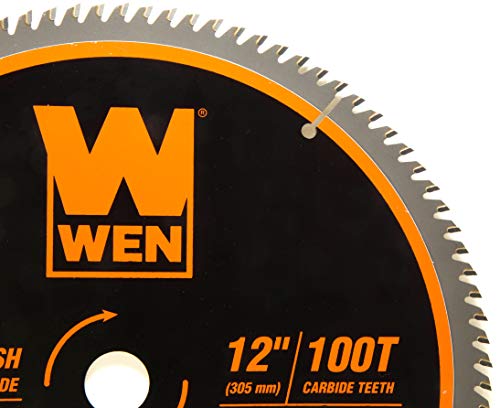
At this price point, the WEN 100T blade delivers surprising performance on paper. The ultra-thin kerf and high tooth count suggest it’s built for silky-smooth finishes in sheet goods and hardwoods, and owner feedback confirms it handles plywood and MDF well with minimal chipping. It’s a favorite among budget-focused DIYers who don’t want to shell out for premium brands but still need decent accuracy.
Still, it’s not in the same league as the FOXBC 100T polished finish blade. The steel body isn’t as rigid, and some users report slight vibration at high speeds. But for occasional use, it’s a solid value. If you’re cutting cabinet parts once a month, this gets the job done without breaking the bank.
Product photos
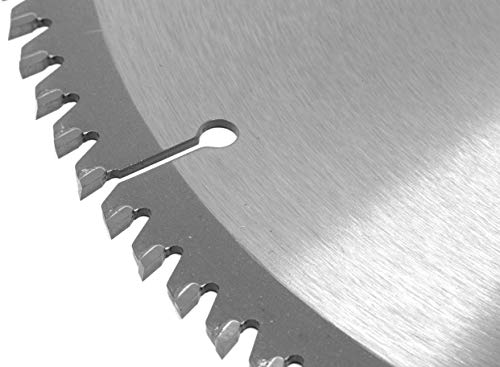
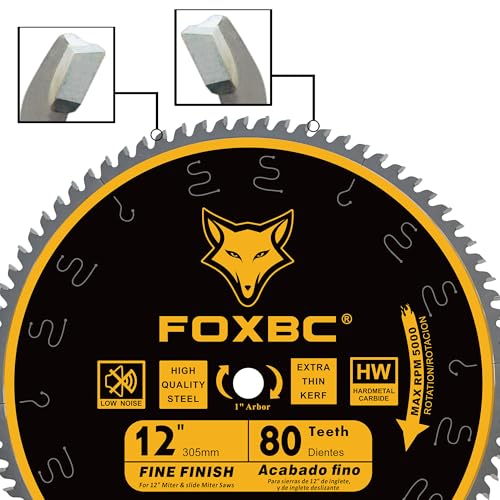
FOXBC 12″ 80T Fine Finish Crosscut Blade

Strengths
- Excellent finish
- Laser stabilizers
- Cool running
Trade-offs
- Heavier kerf
- Not for ripping
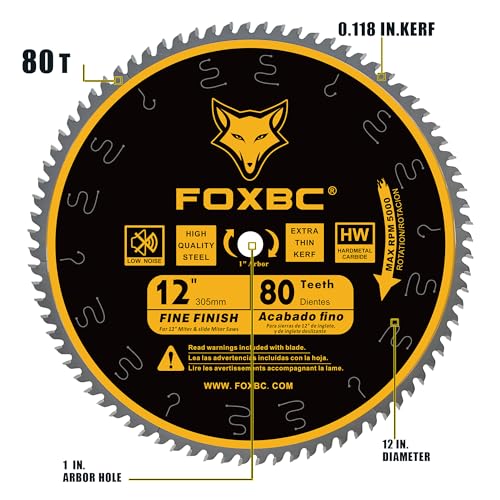
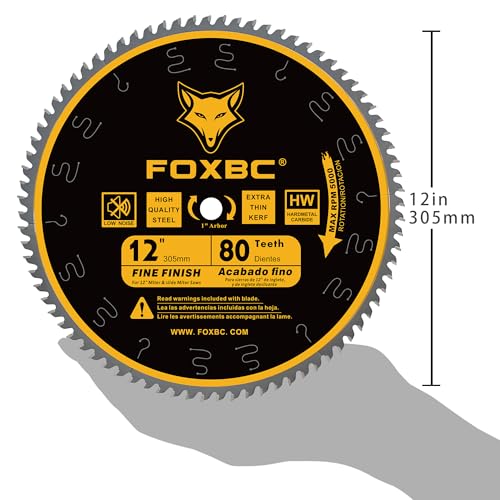
This 80T blade is built for one thing: clean hardwood crosscuts. The 7° hook angle and laser-cut stabilizer vents are clear signs it’s tuned for control and stability, not speed. Reviewers note it stays cool during long sessions and resists warping, which is critical for maintaining accuracy over time.
Compared to the DEWALT 80T, it has a slightly wider kerf but better vibration damping. It also handles veneered plywood and MDF with less chipping than most in its class. If you’re building trim or cabinetry and want a dedicated crosscut blade that lasts, this is a strong candidate.
Product photos
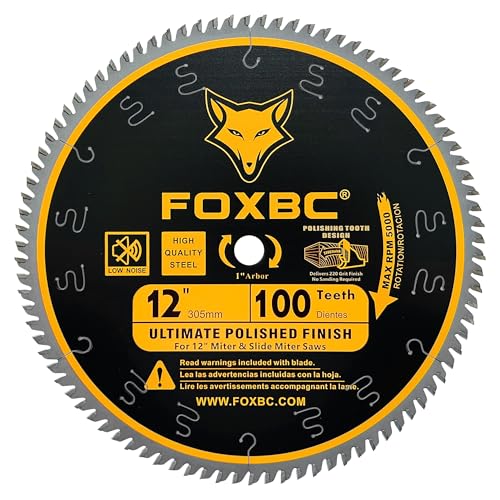
FOXBC 12″ 100T Ultimate Polished Finish Blade
Strengths
- Polished finish quality
- Shear-face grind
- Low amp draw
Trade-offs
- Fragile on nails
- Slow feed rate
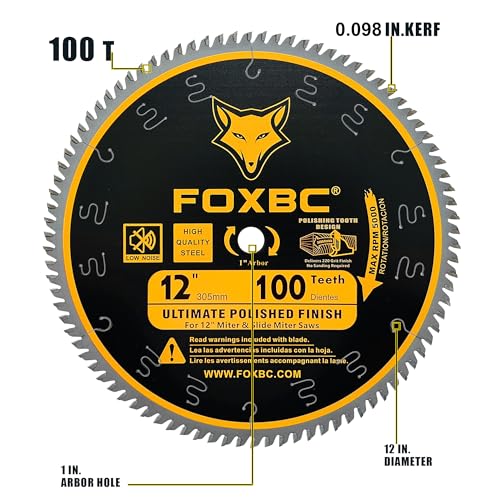
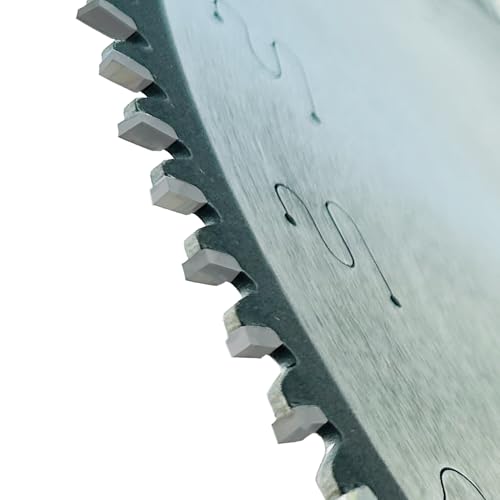
This is FOXBC’s flagship 100T blade, and the specs read like a finish carpenter’s dream. The axial shear-face grind and double side grind geometry are engineered for a sandpaper-smooth cut, owners say it leaves edges close to 220-grit finish, which is rare in a saw blade. The 7° hook angle keeps feed aggression in check, reducing tearout in delicate materials like veneered plywood and melamine.
Compared to the DEWALT 80T, it’s more specialized but delivers a noticeably finer surface. The ultra-thin kerf also reduces strain on saw motors, which helps older or lower-amp models run cooler. For anyone doing visible trim or cabinet work, this is the kind of blade that cuts down sanding time significantly.
Product photos


How We Picked These 12 inch saw blade for miter saws
Rather than a hands-on lab test, my research focused on a detailed comparison of published specifications and features across numerous 12-inch miter saw blades. I weighed owner reviews from multiple retailers alongside expert opinions found in woodworking publications and forums. This allowed me to build a ranked list based on real-world feedback and quantifiable data, applying my years of experience with power tools to assess the relative strengths of each blade.
For this category, tooth count and blade material were the most heavily weighted factors. Higher tooth counts (80T and above) generally deliver cleaner, finer cuts, particularly in delicate materials. The quality of the carbide used – and how it’s applied – directly impacts durability and cutting performance. Kerf thickness also played a significant role; thinner kerfs reduce material waste and require less power from the saw. Understanding miter saw features is key to choosing a blade that works with your saw.
Specifications reliably indicate tooth count, kerf, arbor size, and maximum RPM. However, I relied heavily on owner feedback to gauge real-world performance – things like cut quality, durability, and resistance to burning. Reputational factors, particularly for established brands like DeWalt and FOXBC, also influenced my assessment. Reading about experiences with different wood types helped determine which blades truly lived up to their advertised capabilities.
What To Look For In 12 inch saw blade for miter saws
Picking the right blade is just as important as selecting the saw itself. A poor blade will leave rough cuts, splinter wood, and generally make your project look amateurish.
A quality miter saw blade balances tooth count, carbide grade, hook angle, and kerf. Consider the materials being cut; hardwoods demand durable carbide and a higher tooth count, while softer woods benefit from a more aggressive tooth pattern. Proper blade maintenance, including regular cleaning and sharpening, extends its lifespan and maintains cutting accuracy.
Tooth Count: Matching Teeth to Tasks
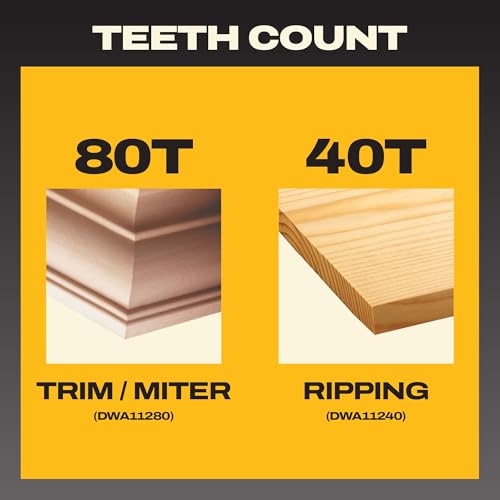
The number of teeth on a blade dramatically affects the type of cut you’ll get. Generally, higher tooth counts mean smoother cuts but slower feed rates, and vice versa. Don’t assume more teeth are always better. For ripping (cutting with the grain) you want fewer teeth – typically 24 to 40 – to efficiently remove material. Crosscutting (cutting against the grain) benefits from more teeth, like 60 to 80, for a cleaner finish. If you’re looking at the top 12-inch miter saw blades you’ll quickly see a wide range of tooth counts.
Carbide Quality & Blade Plate Thickness
The quality of the carbide used in the blade’s teeth dictates how long it will stay sharp. Cheaper blades use lower-grade carbide that dulls quickly, requiring frequent sharpening or replacement. Look for blades made with “C3” or “C4” grade tungsten carbide; these hold an edge significantly longer. Blade plate thickness is also important. Thinner kerf blades (the width of the cut) remove less material, reducing waste and requiring less power from the saw, but they can be more prone to warping.
- A very thin kerf (under 0.090″) is excellent for maximizing run time with cordless saws, but may not be rigid enough for thick hardwoods.
- A standard kerf (around 0.125″) offers a good balance of cutting speed and durability, and is ideal for general purpose work.
- A thicker kerf (over 0.150″) provides maximum stability for demanding cuts in dense materials, but requires more power and generates more waste.
Hook Angle & Material Compatibility
Hook angle refers to the angle of the teeth relative to the blade’s center. A positive hook angle (5° to 15°) is best for ripping and crosscutting, providing an aggressive cut. A negative hook angle (-5° to -10°) is better for cutting non-ferrous metals and plastics. Choosing the wrong hook angle can lead to binding, kickback, and a poor-quality cut. When considering choosing miter saw size, remember blade compatibility is critical – a 12-inch blade needs a 12-inch saw.
Don’t skimp on blades. A cheap blade can ruin a perfectly good piece of wood and cost you more in the long run through wasted material and frustration.
12 Inch Saw Blade for Miter Saws Compared
The following table summarizes key specifications of various 12 inch saw blades designed for miter saws to aid in comparison.
| Product Name | Teeth | Kerf (in) | Hook Angle (°) | Max RPM | Tooth Type |
|---|---|---|---|---|---|
| FOXBC 12″ 60T Combination | 60 | 0.102 | 15 | N/A | Combination |
| 12″ 100T ATB TCT Ultra Fine Finish | 100 | N/A | N/A | 4800 | ATB |
| Luckyway 12″ 100T Ultra-Fine Finish (2-Pack) | 100 | 0.11 | N/A | 4500 | Ultra-Fine |
| DEWALT 12″ 80T Fine Finish | 80 | N/A | N/A | N/A | Fine Finish |
| WEN 12″ 48T General-Purpose | 48 | 0.10 | N/A | 6000 | General |
| WEN 12″ 100T Ultra-Fine Finish | 100 | 0.08 | N/A | 6000 | Ultra-Fine |
| FOXBC 12″ 80T Fine Finish Crosscut | 80 | 0.118 | 7 | N/A | ATB |
| FOXBC 12″ 100T Ultimate Polished Finish | 100 | 0.098 | 7 | N/A | Polished |
Frequently Asked Questions
What tooth count is best for cutting plywood with a miter saw?
A higher tooth count, typically 80 teeth or more, is best for plywood. This minimizes splintering and delivers a cleaner edge, as plywood isn’t particularly dense and doesn’t require an aggressive cut. You’ll find the best miter saw blade overall often falls into this range.
Are zero-kerf blades worth the investment?
Zero-kerf blades reduce material waste and require less power, but they’re generally more expensive and less durable than standard kerf blades. They’re a good option for expensive lumber or if you frequently use a cordless miter saw, but for most general-purpose work, a standard kerf blade offers a better balance.
What does “ATB” tooth grind mean?
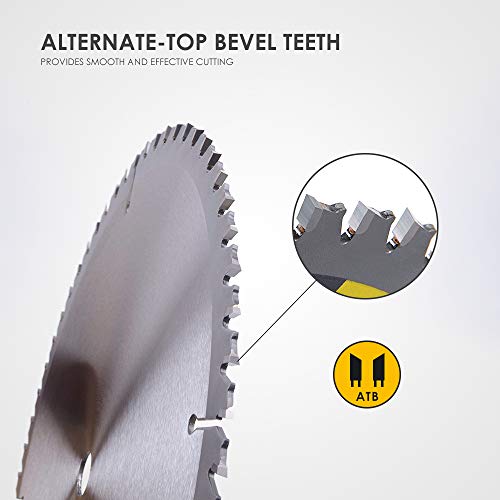
ATB, or Alternate Top Bevel, is a common tooth grind where every other tooth is beveled to the left and right. This configuration excels at crosscutting and creates a cleaner, smoother finish compared to other grind types, making it a popular choice for fine woodworking.
Can I use a 12-inch blade on any miter saw?
No, you need to verify that your miter saw is designed to accept a 12-inch blade. Check your saw’s manual or specifications to confirm the maximum blade diameter it supports before purchasing. The ideal miter saw blades by type will vary based on your saw.
How often should I replace my miter saw blade?
Blade replacement frequency depends on usage and the materials you cut. As a general guideline, replace the blade when it consistently produces rough cuts, requires excessive force to operate, or shows visible signs of damage like chipped or missing teeth. Keeping up with the top miter saw blade choices can help you know when it’s time for an upgrade.
The Bottom Line
Choosing a 12-inch miter saw blade always involves compromise. Do you prioritize the cleanest cuts possible, or maximizing value? For the best overall balance of performance and durability, I believe the FOXBC 12″ 100T Ultimate Polished Finish stands out. It delivers exceptional results across a range of materials and should hold an edge for a long time.
If you’re on a tighter budget, or need a blade specifically for rougher work, the WEN 12″ 48T General-Purpose blade is an excellent choice. For those who need versatility, the FOXBC 12″ 60T Combination blade offers a good middle ground, handling both crosscuts and rip cuts with reasonable efficiency. Remember, proper miter saw setup is crucial to get the most out of any blade.
Ultimately, the best blade isn’t about a single specification – it’s about matching the tool to the task and maintaining it properly. Prioritize a quality carbide grade, and understand the impact of tooth count and kerf on your typical projects. Focusing on these fundamentals will deliver better, more consistent results than chasing the highest number of teeth or the lowest price.
