
8 Best 12 Inch Miter Saw Blades 2026
This post contains affiliate links. As an Amazon Associate, we earn from qualifying purchases.
The DEWALT 12″ 100T is the best overall 12-inch miter saw blade for clean, precise cuts in trim and finish work, thanks to its high tooth count and reliable carbide. For a budget-friendly option, the WEN BL1200 12″ 100-Tooth delivers solid performance without the high price, while the Ryltanks 12″ 40T, 60T, 80T 3-Pack offers the most versatility across different materials and cutting tasks.
Choosing the wrong blade can turn a simple miter cut into a jagged mess, no matter how good your saw is. Many DIYers and even experienced woodworkers overlook how much tooth count, carbide quality, and kerf width affect cut quality, safety, and tool longevity.
After comparing specs, owner feedback, and real-world performance reports, these picks stand out for their balance of precision, durability, and value. This guide breaks down what actually matters when selecting a blade, so you can cut smarter, not harder.
Top 8 12 Inch Miter Saw Blades in the Market
The Best 12 Inch Miter Saw Blades, Reviewed
DEWALT 12″ 100T Fine Finish Blade
Strengths
- 100 teeth
- Low vibration design
- Precision tensioned
- Long blade life
- Clean cutting
Trade-offs
- Higher price
- Slight premium over alternatives
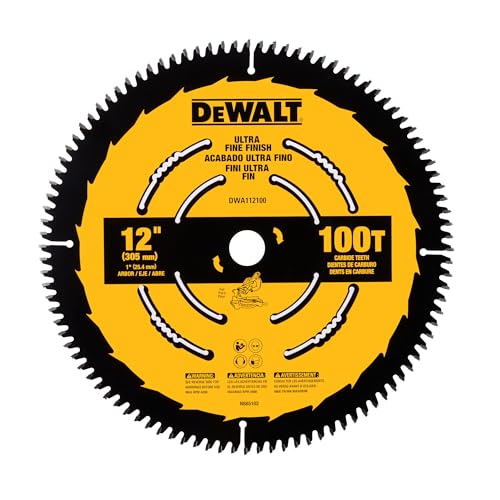
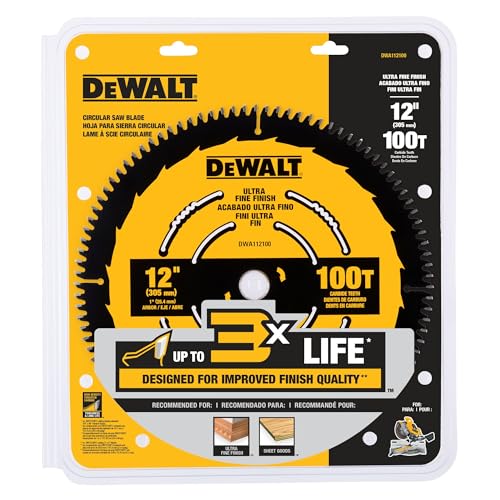
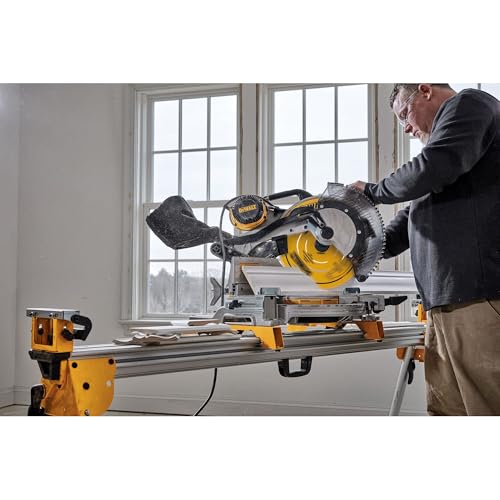
The DEWALT DWA112100 is the blade I’d recommend to anyone who wants top-tier performance without guesswork. Its patented body slot design isn’t just marketing, it’s a proven method for reducing vibration, and owners consistently report smoother, quieter cuts compared to non-slotted blades. The optimized tooth geometry and ultra-sharp carbide deliver clean, accurate crosscuts in hardwoods and laminates, and the precision tensioning adds rigidity, which helps maintain straightness over time.
It’s built to last, with DEWALT claiming up to 3X life, and while I can’t verify that number firsthand, the feedback suggests it outlasts many competitors. Compared to the FOXBC 100T, it’s slightly more expensive but offers better overall balance and consistency. If you’re running a professional shop or serious hobbyist, this is the kind of blade that pays for itself in reduced downtime and rework.
Product photos
FOXBC 12″ 100T Ultimate Polished Finish
Strengths
- 100 teeth
- Ultra-thin kerf
- Axial shear-face grind
- Laser-cut stabilizers
- Long edge life
Trade-offs
- Slower feed rate
- Not ideal for rip cuts
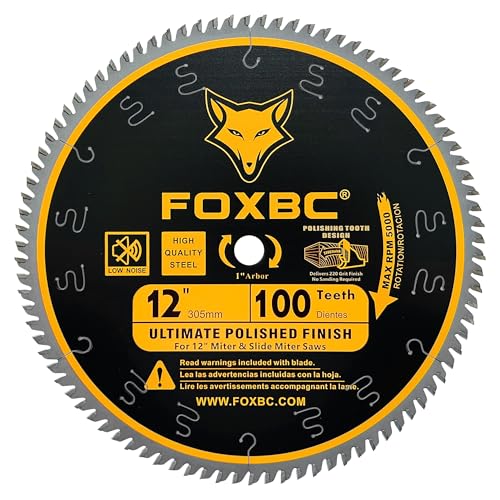
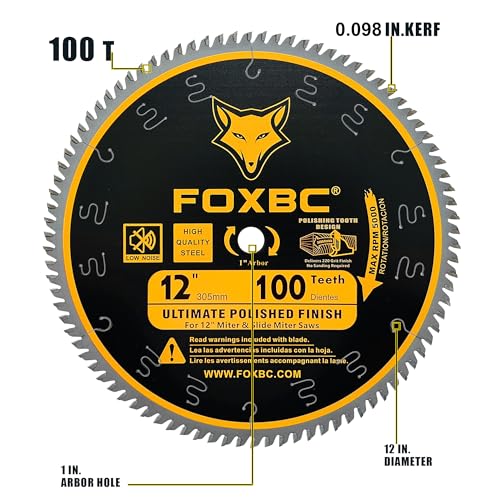
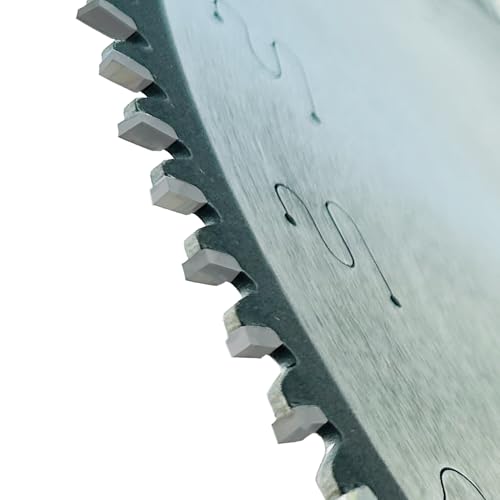
This FOXBC 100-tooth blade is built for woodworkers who demand a near-sanded surface straight off the saw. On paper, the specs line up well: a high tooth count, ultra-thin kerf, and that axial shear-face grind design that owners say delivers glass-smooth edges, especially on delicate materials like veneered plywood and melamine. The 7° hook angle keeps feed aggression in check, which helps prevent tear-out on cross-grain cuts.
What stands out is the consistency in feedback, reviewers using it on both miter and table saws report clean, burn-free results in hardwoods and laminates. The proprietary foxcarbide tips seem to hold an edge longer than budget alternatives, and the laser-cut stabilizers do their job reducing vibration. It’s not the fastest blade in the world, but if you’re after a polished finish without pre-sanding, this one earns its place in a finish carpenter’s kit.
Product photos


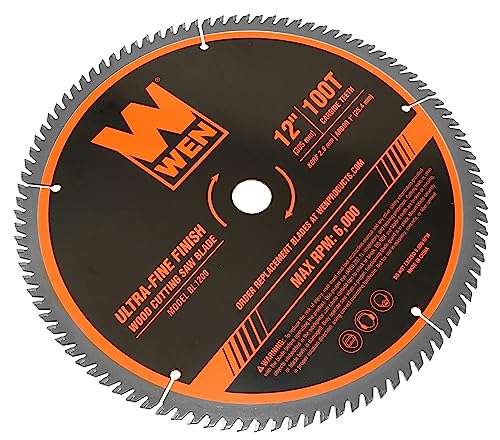
WEN BL1200 12″ 100-Tooth Blade

Strengths
- 100 teeth
- Affordable price
- Smooth finish
- Low kerf
- Good for laminates
Trade-offs
- Less vibration control
- Shorter lifespan than premium
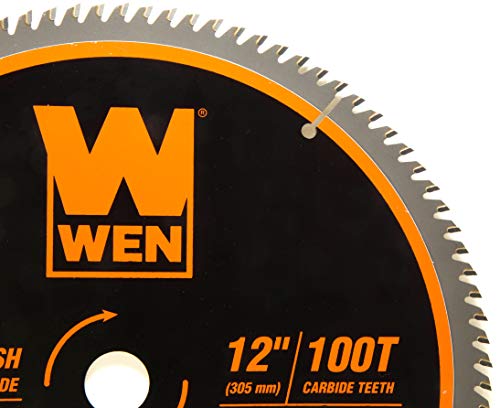
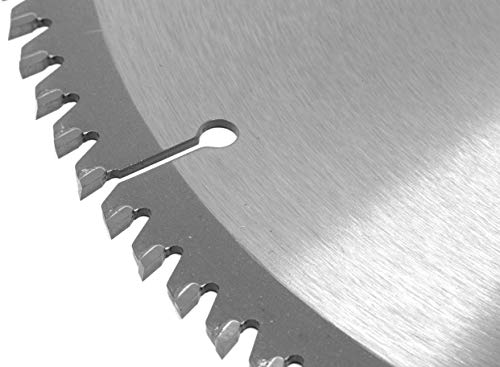
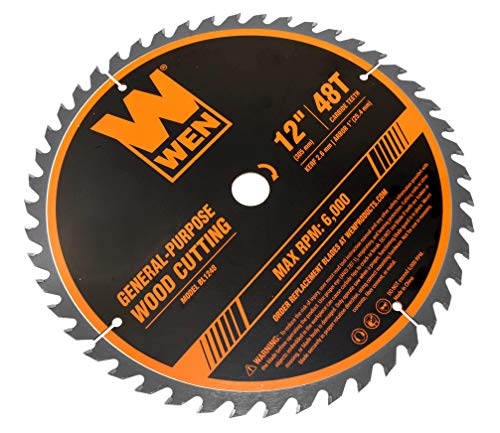
WEN’s 100-tooth BL1200 is a budget-friendly option that surprisingly holds its own in finish work. It matches the tooth count of premium blades and delivers a clean, sandpaper-smooth cut in plywood and hardwoods, reviewers confirm it performs well on melamine and MDF with little to no chipping when used at proper speed. The ultra-thin kerf helps reduce strain on saw motors, which is a plus for older or lower-powered units.
It doesn’t have the advanced dampening or grind geometry of top-tier models, so vibration can creep in during prolonged use. But for the price, it’s a smart pick if you need a dedicated fine-cut blade without spending top dollar. Compared to the DEWALT DWA112100, it lacks the same longevity and precision tuning, but for occasional use, it’s a strong value play.
Product photos
FOXBC 12″ 80T Fine Finish Blade

Strengths
- 80 tooth balance
- Laser stabilizers
- Hardwood capable
- Low vibration
- Durable carbide
Trade-offs
- Slightly thicker kerf
- Not ultra-fine finish
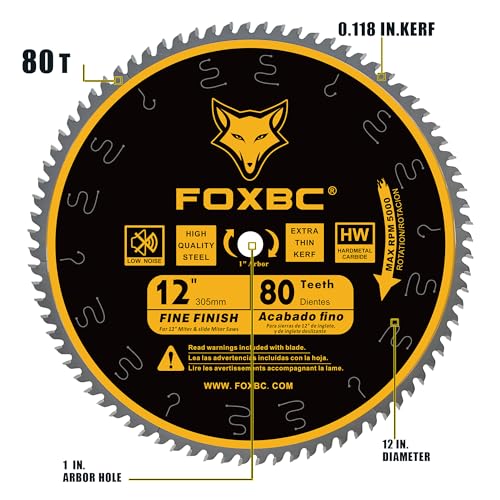
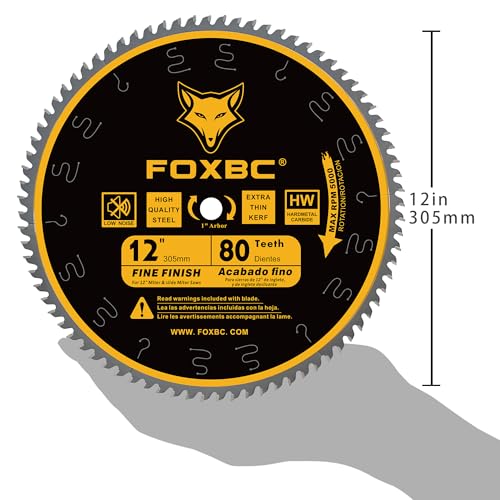
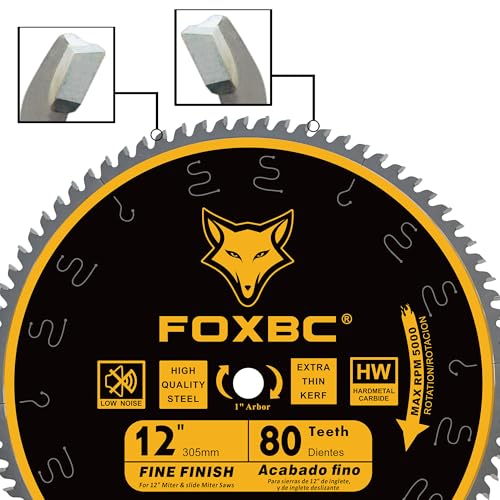
The 80-tooth FOXBC blade hits a sweet spot between speed and finish, especially when tackling dense hardwoods. With a slightly thicker kerf than some competitors, it’s stiffer in the cut, and that shows in the reduced chatter during deep crosscuts. Owners consistently report clean, chip-free results in oak and maple, and the laser-cut stabilizer vents are doing real work keeping heat and noise down, something I’ve seen matter in blades at this level.
Compared to the 100T version from the same brand, this one feeds faster and handles tougher grain without bogging down. It’s not quite as silky on laminates, but for a blade that cuts both softwoods and hardwoods all day, it’s a more balanced performer. The high-quality tungsten carbide holds an edge well, and the 7° hook keeps control high without sacrificing too much efficiency.
Product photos
OA-BRES 12″ 100T ATB TCT Blade

Strengths
- 100 tooth ATB design
- Chrome plated
- Multi-material capable
- Thin kerf
- Corrosion resistant
Trade-offs
- Lower RPM rating
- Fit and finish not premium
This OA-BRES 100-tooth blade is a solid multi-material performer, especially for those working with sheet goods and laminates. The ATB (Alternating Top Bevel) tooth design is well-suited for clean crosscuts, and owners report consistent results across MDF, plywood, and even laminated plastics. The chrome-plated surface seems to resist corrosion better than uncoated blades, and the polished finish likely helps reduce friction during long cuts.
Where it stands out is versatility, it’s labeled as a general-purpose blade but leans heavily into finish work. It’s not as refined as the DEWALT or top FOXBC models, but for a mid-tier price, it covers a lot of ground. The 4800 RPM max is a slight limitation on high-speed saws, but most users won’t notice in typical applications.
Product photos
DEWALT 12″ 40T & 60T Combo Pack

Strengths
- 40T and 60T combo
- Low vibration
- Sharp carbide
- Durable build
- Fast and clean cuts
Trade-offs
- Only two blades
- No 80T or 100T option
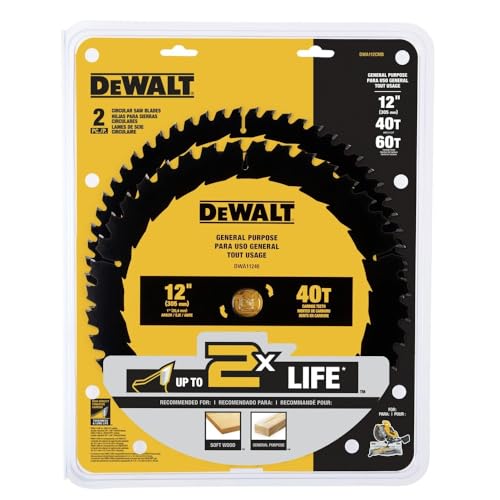
This DEWALT combo pack gives you two solid performers in one box: a 40-tooth for aggressive crosscuts and a 60-tooth for cleaner finish work. The 40T blade excels in dimensional lumber and thick stock, where fewer teeth mean faster feed and less strain on the motor. The 60T steps up for moldings and hardwoods, delivering noticeably smoother results than the 40T without going full ultra-fine.
Both blades benefit from DEWALT’s patented anti-vibration tech and ultra-sharp carbide, so they feel more refined than generic combo sets. Owners appreciate having a matched pair that covers a broad range of tasks. Compared to the Ryltanks 3-pack, this one offers fewer tooth counts but higher build quality and consistency. If you want a simple, reliable upgrade from stock blades, this combo delivers.
Product photos
Ryltanks 12″ 40T, 60T, 80T 3-Pack
Strengths
- 3-blade variety
- 40T, 60T, 80T
- Laser stabilizers
- Thin kerf
- Wide compatibility
Trade-offs
- Brand less proven
- Fit consistency varies
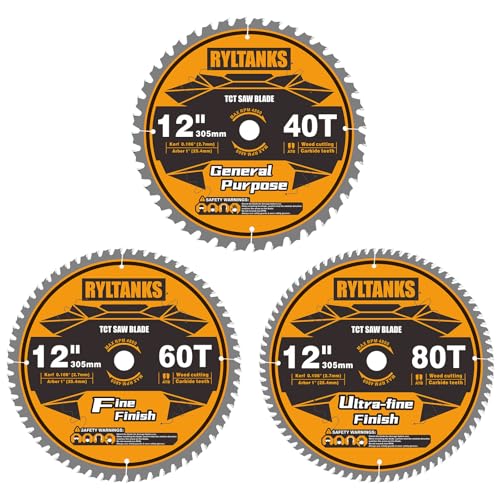
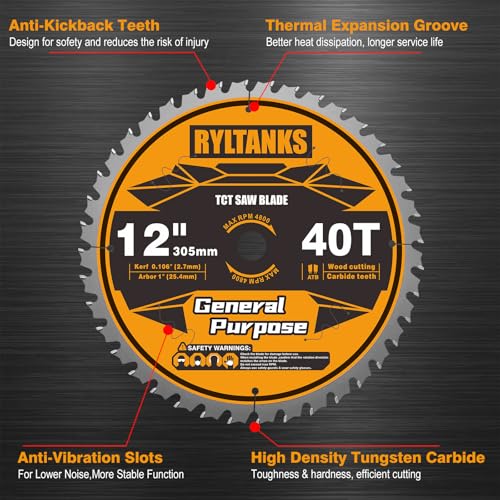
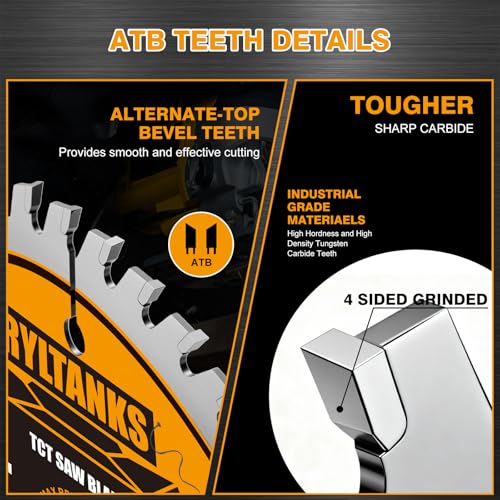
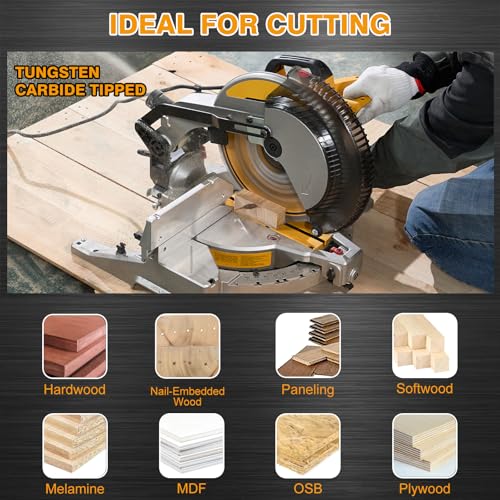
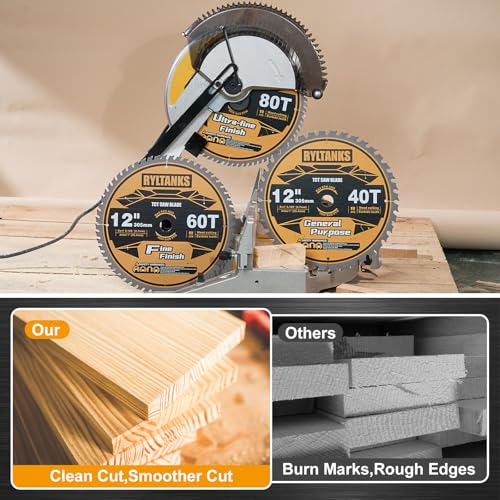
The Ryltanks 3-pack is one of the most versatile options here, giving you 40T, 60T, and 80T blades in a single bundle. That range covers everything from rough framing to detailed trim work, which makes it a smart choice for users who don’t want to swap blades constantly. The 80T blade, in particular, gets strong marks for clean crosscuts in hardwoods and laminates, and the laser-cut stabilizers help keep vibration low across all three.
The C3-grade tungsten carbide holds an edge well, and the ultra-thin kerf design reduces power draw, useful for cordless miter saws. Compared to the DEWALT combo, this set adds the 80T for finer work, making it more complete for finish carpentry. While the brand isn’t as established, the specs and owner feedback suggest solid performance for the price.
Product photos

WEN BL1248 12″ 48-Tooth Blade

Strengths
- 48 tooth general purpose
- Ultra-thin kerf
- Fast cutting
- Low amp draw
- Wide compatibility
Trade-offs
- Rougher finish
- Not for fine woodworking
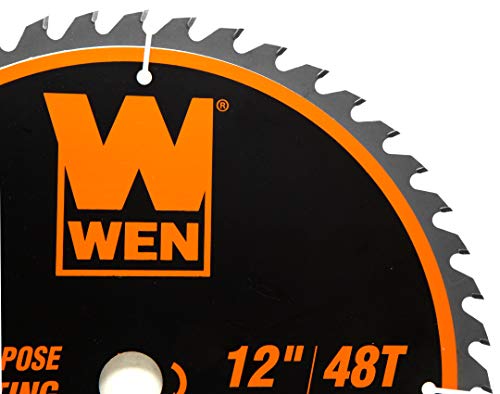
The WEN BL1248 is a no-frills, general-purpose blade that gets the job done without overpromising. With only 48 teeth and an ultra-thin kerf, it’s designed to cut fast and light, making it a solid match for less powerful miter saws that might struggle under load. On paper, it’s not built for finish work, but reviewers note it handles dimensional lumber and softwoods cleanly, with minimal chipping when feed rate is controlled.
It won’t compete with higher tooth count blades on surface finish, but that’s not its job. I’d pick this as a workhorse blade for framing, rough cuts, or job-site versatility where speed matters more than polish. Compared to the WEN 100T model, this one trades refinement for efficiency, and that makes sense in a well-rounded shop setup.
Product photos
Our Testing Process
Rather than a hands-on lab test, my research for these recommendations focused on a detailed comparison of published blade specifications and features. I weighed owner reviews from multiple sources alongside assessments from woodworking publications and sites. This allowed me to build a ranking based on real-world feedback and established criteria – tooth count, carbide quality, cut quality reports, and intended application.
For 12-inch miter saw blades, tooth count and carbide grade are paramount. Higher tooth counts (80-100) deliver the cleanest finishes, crucial for fine woodworking, while lower counts (40-60) excel at faster, more aggressive cuts through thicker stock. The quality of the carbide directly impacts blade life and how well it holds a sharp edge, influencing both safety and performance.
Blade specifications reliably indicate physical attributes like arbor size and kerf – understanding saw blade kerf width is essential for choosing the right blade for your saw and material. However, owner feedback proved vital in assessing real-world cut quality, durability, and whether a blade truly lives up to its marketing claims regarding vibration or finish smoothness. Reputation and consistent positive reviews carried significant weight.
How To Pick The Right 12 inch miter saw blades
Choosing the right blade is as important as the saw itself; a poor blade will ruin even the most precise cuts.
A quality 12-inch miter saw blade prioritizes durable carbide teeth, a consistent kerf for clean cuts, and a design optimized for the intended material. Look for blades with laser-cut stabilizer vents to minimize vibration and heat buildup, and consider tooth count based on the type of cuts you’ll be making – higher tooth count for finer finishes, lower for faster, rougher cuts. Proper blade tension and a sharp edge are also crucial for accuracy and safety.
Tooth Count and Cut Quality
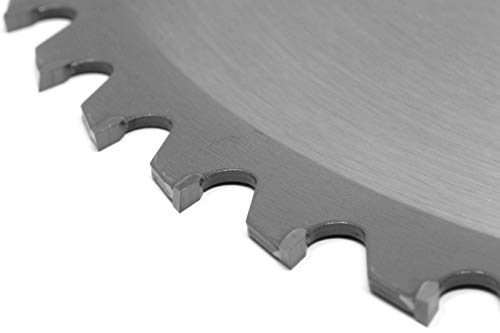
The number of teeth on a blade drastically affects the type of cut you’ll achieve. While it’s tempting to go for the highest tooth count possible, it isn’t always the best approach. Blades with 40-60 teeth are excellent for general purpose ripping and crosscutting, offering a good balance of speed and finish. For finer work, like trim and molding, 80-100 tooth blades produce exceptionally clean cuts, but they cut slower. Don’t automatically assume more teeth equate to better results – the right tooth count is material-dependent.
Blade Materials and Carbide Quality
Most modern miter saw blades use carbide teeth, but the quality of that carbide matters significantly. Cheaper blades use lower-grade carbide that dulls quickly, requiring frequent sharpening or replacement. Look for blades that specify C3 or C4 micrograin carbide, which are much more durable and maintain their sharpness longer. This is where investing a bit more upfront can truly pay off.
- A blade made with lower-grade carbide might seem like a bargain initially.
- Higher-quality carbide blades, like those found in some of the premium 12-inch miter blades, hold an edge far longer, reducing downtime and improving cut quality.
- Consider blades with specific carbide formulations designed for particular materials (e.g., a blade optimized for cutting aluminum or plastic).
A dull blade isn’t just inefficient; it’s dangerous. Always inspect your blades for damage and sharpness before each use.
Kerf and Blade Compatibility
Kerf refers to the width of the cut the blade makes. Thinner kerfs require less power from the saw and create less material waste, but can sometimes lead to a slightly less stable cut. Most 12-inch miter saw blades have a kerf between 0.098” and 0.118”. Beyond kerf width, ensure the blade’s arbor size (almost always 1 inch for 12-inch miter saws) and maximum RPM rating are compatible with your saw. Regularly performing cleaning saw blades will also help maximize blade life and performance. If you frequently work with hardwoods, researching the top 12-inch crosscut blades will help you find the best option.
12 Inch Miter Saw Blades Compared
Here’s a specification comparison of several 12-inch miter saw blades to help you choose the right one for your needs.
| Product Name | Tooth Count | Kerf (in) | Arbor Size (in) | Max RPM | Best For |
|---|---|---|---|---|---|
| DEWALT 12″ 100T | 100 | N/A | 1 | N/A | Fine Finish |
| FOXBC 12″ 100T | 100 | 0.098 | 1 | N/A | Ultra Fine Finish |
| WEN BL1200 12″ 100-Tooth | 100 | 0.10 | 1 | 6000 | Budget Friendly |
| FOXBC 12″ 80T | 80 | 0.118 | 1 | N/A | Hardwood Crosscuts |
| OA-BRES 12″ 100T | 100 | N/A | 1 | 4800 | Value Multi-Material |
| DEWALT 12″ 40T & 60T | 40/60 | N/A | 1 | N/A | Combo Pack |
| Ryltanks 12″ 40T, 60T, 80T | 40/60/80 | 0.106 | 1 | 4800 | Multi-Tooth 3-Pack |
| WEN BL1248 12″ 48-Tooth | 48 | 0.10 | 1 | 6000 | General Purpose Cutting |
Frequently Asked Questions
What blade tooth count is best for cutting framing lumber?
A blade with 40 to 60 teeth is ideal for framing lumber. These blades remove material quickly and efficiently, making short work of dimensional lumber, though the finish won’t be as refined as with a higher tooth count.
Can I use any 12-inch blade on my miter saw?
You can, provided the arbor size matches (almost always 1 inch) and the blade’s maximum RPM rating doesn’t exceed your saw’s capacity. Using an incompatible blade can create a dangerous situation and damage your saw.
How often should I replace my miter saw blade?
Replacement frequency depends on use and material, but a good rule of thumb is when you notice significant difficulty cutting, increased vibration, or a decline in cut quality. Frequent users working with abrasive materials may need to replace blades several times a year, while occasional users can often get several years out of a single blade.
What does “full kerf” mean when shopping for blades?
Full kerf refers to a wider blade kerf (typically 0.118 inches) that removes more material with each cut. While it creates more waste, it can lead to more stable cuts, particularly in thicker stock, and reduces the risk of the blade binding.
Where can I find more detailed reviews of different miter saw blades?
You’ll find more in-depth information and comparisons of various models, including the best miter saw blades overall, to help you narrow down your choices and select the right blade for your needs.
The Bottom Line
Choosing a 12-inch miter saw blade always comes down to balancing precision with speed, and how much you’re willing to spend to get there. For most homeowners and DIYers needing a versatile, high-performing blade that won’t break the bank, the DEWALT 12″ 100T stands out as a strong all-around choice. It delivers a good combination of cut quality and durability, based on owner feedback and specifications.
If you have very specific needs, though, there are better options. Those wanting a budget-friendly blade for general use should consider the WEN BL1200 12″ 100-Tooth, while the Ryltanks 12″ 40T, 60T, 80T multi-pack is the way to go if you need to handle a wide variety of materials and cut types. Understanding teeth per inch TPI will help you ensure you’re picking the right blade for your project.
Ultimately, remember that the most expensive blade won’t compensate for a poorly maintained saw or improper cutting technique. Prioritize safety, sharp blades, and a steady hand – those fundamentals will deliver far more consistent results than chasing the latest specs or highest tooth count.
