
Reciprocating Saw vs Sawzall: What’s the Real Difference?
This post contains affiliate links. As an Amazon Associate, we earn from qualifying purchases.
A Sawzall is a specific brand of reciprocating saw made by Milwaukee Tool. The name ‘Sawzall’ has become a genericized trademark, like Kleenex or Band-Aid, leading people to use it for any reciprocating saw. Functionally, all reciprocating saws, whether labeled Sawzall, DeWalt, Makita, or Ryobi, operate on the same back-and-forth cutting principle.
The confusion starts at the hardware store. You ask for a reciprocating saw, and the clerk points you to the Sawzall aisle. You search online for a blade, and half the results say “for Sawzall.” This doesn’t mean the tools are different. It means one brand was so dominant its name became the default for the entire category.
This guide cuts through the branding noise. We’ll cover the history that created the confusion, break down the specs that actually matter for your projects, and give you a clear framework for choosing the right tool, whether it wears a red Milwaukee badge or not.
Key Takeaways
- “Sawzall” is Milwaukee’s trademark, not a separate tool type. All Sawzalls are reciprocating saws.
- The real differences are in features, not the basic function. Look for blade-change systems, vibration control, and power sources.
- Blade selection is more critical than the brand on the tool. Using a wood blade on metal will ruin your day and the blade.
- For heavy, continuous demolition, a 13-15 amp corded model is still king. For convenience and most DIY, modern brushless cordless saws are more than capable.
- If you’re already invested in a cordless tool battery platform (like DeWalt 20V or Milwaukee M18), buying the reciprocating saw from that brand is almost always the smartest move.
What Is a Reciprocating Saw?
A reciprocating saw is a handheld power tool with a blade that moves forward and backward in a straight, linear motion. This push-pull action, powered by an electric or battery motor, allows it to chew through materials in tight spaces where a circular saw can’t reach. Think of it as a motorized, heavy-duty version of a hand saw.
The reciprocating saw mechanism converts the rotary motion of the motor into a linear, back-and-forth motion via an eccentric gear or a scotch yoke assembly. The blade is clamped at one end in a chuck, and the motor drives the opposing end in a straight line, with stroke length, the distance the blade travels, typically ranging from 1 to 1-1/4 inches.
Its primary domain is demolition and rough cutting. You’ll use it to cut through walls (watch for pipes and wires), prune tree limbs, slice through PVC and metal pipe, or dismantle old decks. It’s not a precision instrument.
The blade flexes, the cut wanders, and the finish is rough. That’s by design. You reach for it when you need to remove material quickly, not when you’re building fine furniture.
The tool’s anatomy is simple: a motor housing, a handle with a trigger, a pivoting shoe (or foot) that rests against the work surface to stabilize the cut, and a blade clamp. That clamp is where a lot of innovation happens. The old-school method required an Allen key to tighten a setscrew. That gets old fast when you’re switching between a wood blade and a metal blade every few minutes.
Where Did the Name “Sawzall” Come From?
Milwaukee Electric Tool Corporation introduced the first portable reciprocating saw in 1951. They didn’t just invent a new tool; they invented a memorable name for it: the Sawzall. The marketing was blunt, this saw would cut through “all” materials you’d encounter in construction and demolition. The name stuck.
It stuck so well that it followed the path of other iconic trademarks. Just as people ask for a Kleenex when they need any facial tissue, contractors and DIYers started asking for a Sawzall when they needed any reciprocating saw. This is the legal definition of a genericized trademark. It’s a mark of massive market success, but it dilutes the brand’s distinctiveness over time.
Milwaukee still fiercely protects the Sawzall trademark. You’ll see it stamped on their tools and in their advertising. Other manufacturers like DeWalt, Makita, and Bosch have to call their versions “reciprocating saws” or use other branded names like DeWalt’s “Sawzall” (a clear play on the generic term). This legal distinction is why you see both terms used interchangeably, even on store shelves.
Sawzall vs. Reciprocating Saw: A Feature Comparison
So if the core tool is the same, why choose a Milwaukee Sawzall over another brand’s reciprocating saw? The answer lies in the specific features and engineering tweaks Milwaukee (and other brands) build into their models. It’s the difference between a generic sedan and a specific model with a turbocharged engine and a premium sound system.
| Feature | Milwaukee Sawzall (Typical) | Generic Reciprocating Saw (Typical) | Why It Matters |
|---|---|---|---|
| Blade Clamp | QUIK-LOK keyless system | Often requires an Allen key or hex wrench | A tool-free clamp lets you change blades in under 5 seconds mid-job. The Allen-key type adds frustration and lost tools. |
| Vibration Control | Counterbalance mechanism & rubber overmold | Basic design with minimal damping | Vibration is the main cause of user fatigue. Reduced vibration means you can cut longer without your hands going numb. |
| Orbital Action | Selectable on most models (0-4 settings) | Often fixed straight reciprocating or not offered | Orbital action adds a slight elliptical path to the blade stroke, making it dig in more aggressively. It cuts wood up to 50% faster but can tear up metal or plastic. |
| Shoe Design | Pivoting, adjustable shoe | Often fixed or non-adjustable | The shoe supports the tool. A pivoting shoe lets you always press against a fresh, sharp section of the blade as the tip wears down, extending usable life. |
| Power Platform | Deep integration with M18/M12 Fuel systems | Varies by brand; may be corded-only or use proprietary batteries | If you own Milwaukee batteries, the Sawzall is a seamless addition. If not, you’re buying into a new, expensive battery ecosystem. |
This table isn’t to say Milwaukee always wins. A high-end DeWalt, Makita, or Metabo HPT reciprocating saw will have comparable premium features. The point is to look past the name “Sawzall” on the box and examine these specific attributes. A budget “Sawzall” might have a basic keyed chuck, while a top-tier DeWalt might have a brilliant tool-free system. Judge the tool, not the nickname.
Key Features to Look For When Buying
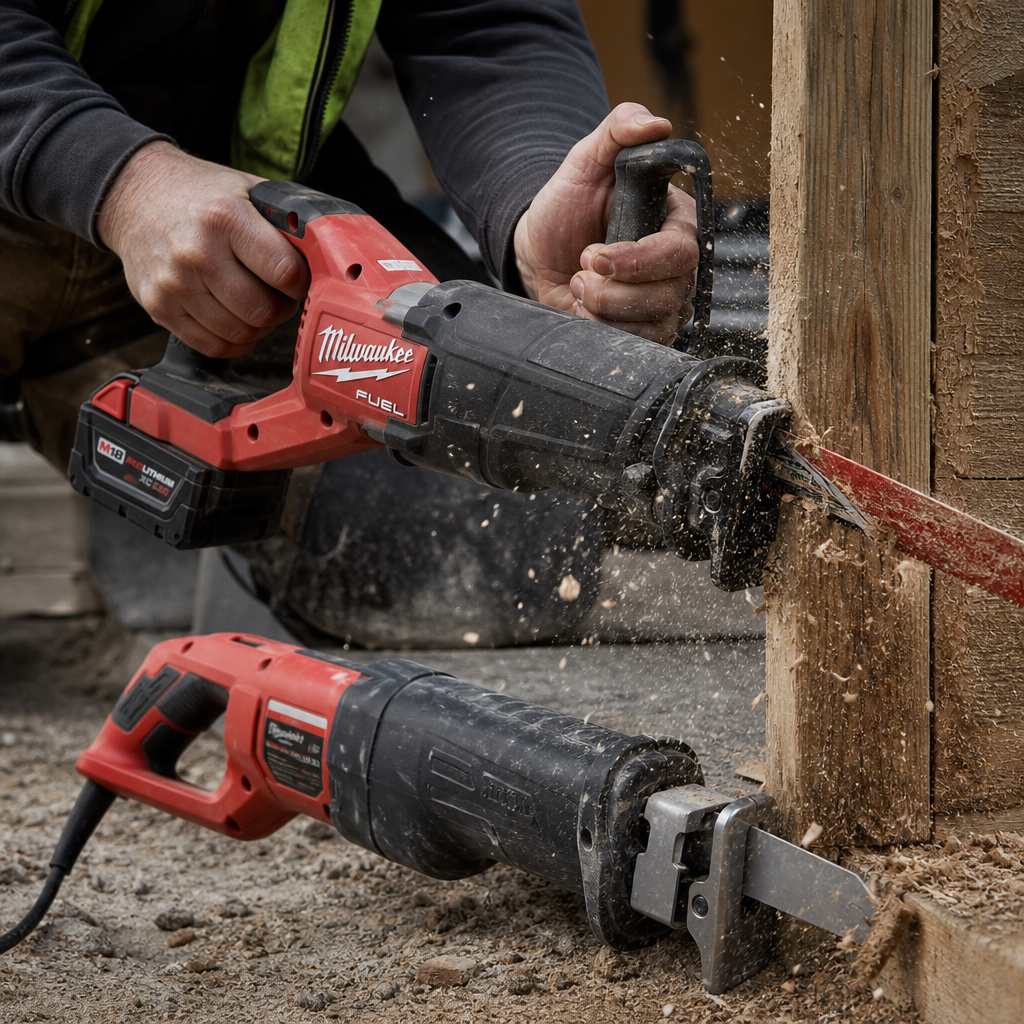
Forget the label on the side for a minute. These are the tangible specs and features that determine whether a saw will be a powerhouse or a paperweight for your specific jobs.
Stroke Length and Speed (SPM): Stroke length is how far the blade travels back and forth. Longer strokes (1-1/4 inch) remove more material per cycle, cutting faster in thick wood. Speed, measured in Strokes Per Minute (SPM), is how many of those cycles happen. A range of 0-3,000 SPM is common. You want variable speed controlled by the trigger, press lightly for slow, controlled cuts in metal; squeeze hard for full-speed demolition.
Orbital Action: This is a game-changer for wood cutting. When engaged, the blade moves in a slight oval or elliptical path in addition to its back-and-forth motion. On the forward (cutting) stroke, the blade arcs into the material, taking a bigger bite. On the return stroke, it pulls back slightly to clear debris. The result is a much faster, more aggressive cut in wood and PVC. Turn it off for metal, as it can cause chatter and wear the blade prematurely.
Power Source: Corded vs. Cordless
- Corded: Delivers unlimited runtime and consistent, maximum power. Look for a 12-15 amp motor for heavy work. The cord is a hassle, but for a full day of cutting concrete block or dense lumber, it’s the reliable choice. You’ll never wait for a battery to charge.
- Cordless: Offers complete freedom from outlets. Modern brushless motors and high-capacity lithium-ion batteries (18V/20V Max and higher) provide shocking power. Runtime is the trade-off. For a full day of work, you’ll need 2-3 batteries rotating on the charger. The convenience for plumbing, electrical, pruning, and most DIY is unbeatable.
I bought a premium cordless model for a deck demolition, lured by the promise of no cords. Two batteries died in an hour. I spent more time waiting for charges than cutting. For the next project, ripping out an old plaster wall. I used a 15-amp corded saw. It was heavier and the cord snagged, but it ran for three hours straight without a whisper of complaint. Now I own both: cordless for quick jobs and overhead work, corded for the heavy, continuous stuff.
Vibration and Ergonomics: This is a feel-in-the-hands spec you must test if possible. All reciprocating saws vibrate. Better models have counter-rotating weights or other mechanisms to cancel out the worst of it. A rubberized overmold on the main and auxiliary handles also helps. If you’re only making a few cuts a year, it’s less critical. For prolonged use, it’s the difference between finishing the job and having tingling hands for hours afterward.
Blade Change System: This is non-negotiable in my book. Insist on a tool-free blade clamp. The common systems are a lever you twist (like Milwaukee’s QUIK-LOK) or a collar you pull back. Needing to find a hex key every time you break or switch a blade is a workflow killer, especially when you’re on a ladder or in a crawl space.
How to Choose the Right Blade
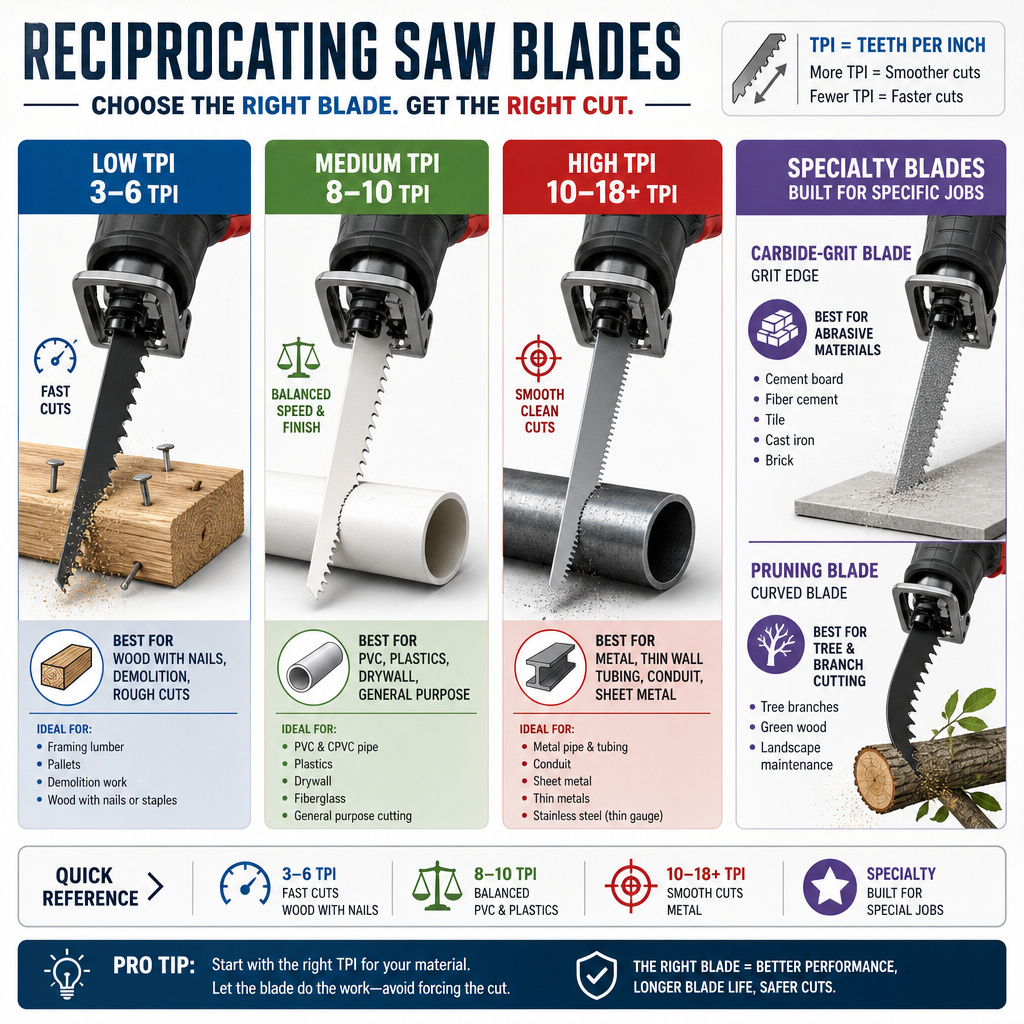
The saw is just the motor. The blade is the tool. Putting the wrong blade on a $300 Sawzall is like putting bicycle tires on a pickup truck, it’s not going to work.
The most important specification is TPI. Teeth Per Inch.
* Low TPI (3-6): Big, aggressive teeth spaced far apart. This is for fast, rough cuts in wood, particle board, and demolition work (nails and all). The large gullets clear sawdust quickly.
* Medium TPI (8-10): A general-purpose range for thicker plastics, PVC pipe, and wood with fewer knots.
* High TPI (10-18+): Many small, closely spaced teeth. This is for cutting metal, pipe, conduit, sheet metal, and bolts. The higher the TPI, the smoother and slower the cut in metal.
* Specialty Blades: Carbide-grit blades for cutting fiber cement, brick, or tile; pruning blades with large, hooked teeth for green wood; long, flexible blades for flush-cutting against a surface.
Blade material matters, too. Bi-metal blades are the standard. They have a flexible high-speed steel (HSS) tooth edge welded to a spring steel body, making them durable and good for mixed material. Carbide-tipped blades are more expensive but last exponentially longer in abrasive materials like fiberglass or composite decking.
Before you start: Always wear safety glasses, a broken blade or metal shard travels fast. Wear gloves to protect against sharp work edges and vibration. Secure your workpiece; a reciprocating saw’s action can grab and shake loose material violently. Before cutting into any wall or floor, use a stud finder or know what’s behind it. Cutting a live electrical line or a pressurized water pipe is a life-altering mistake.
Frequently Asked Questions
Can a reciprocating saw cut straight lines?
It can, but it’s not designed for precision. With a steady hand, a sharp blade, and a guide clamped to your workpiece, you can manage reasonably straight cuts in sheet material. For truly straight, clean cuts, you need a circular saw or a table saw.
What’s the difference between a reciprocating saw and a jigsaw?
jigsaw has a short, thin blade that moves up and down, and it’s designed for making curved or intricate cuts in thinner material. A reciprocating saw is more powerful, uses a sturdier blade, and is built for brute-force demolition. Think of a jigsaw for cutting a sink hole in a countertop, and a reciprocating saw for cutting the countertop in half to remove it.
Is it worth buying a cordless reciprocating saw?
Absolutely, for most users. The freedom from a cord is transformative for many tasks. Just be realistic about runtime. For a full day of heavy cutting, plan for multiple high-capacity batteries (5.0Ah or larger). For lighter, intermittent use, a standard battery is fine.
How do I reduce vibration fatigue?
Choose a saw with built-in anti-vibration technology. While cutting, use both hands, one on the main trigger handle and one on the front auxiliary handle. Let the tool’s weight and the sharp blade do the work; don’t lean on it. Take frequent short breaks to let your hands recover.
My blade keeps getting stuck or bending. What am I doing wrong?
You’re likely forcing the cut or using a dull blade. Let the saw oscillate at its own pace. Apply gentle forward pressure, but if the motor bogs down, ease off. A bent blade often means you twisted the tool sideways during the cut or hit an unexpected nail or knot. Always use a sharp blade; a dull one requires more force, leading to binding.
The Bottom Line
Stop worrying about the name Sawzall. It’s just a very successful brand of reciprocating saw. Your focus should be on the tool in your hands, not the label on its side.
Match the tool to your actual work. Need maximum power for weekend-long projects? Get a 15-amp corded model.
Value portability for plumbing and odd jobs? A brushless cordless saw from your existing battery family is the answer. Then, invest in a good set of blades, bi-metal for general use, carbide for tough stuff, and learn the TPI rule.
The right reciprocating saw is a portal to faster, easier demolition and renovation. Choose based on features and fit, not folklore, and you’ll have a trusted partner for decades of projects.
