
Sawzall Saw Explained: What It Is, Uses & Key Features
This post contains affiliate links. As an Amazon Associate, we earn from qualifying purchases.
A Sawzall is a reciprocating saw, a handheld power tool that cuts materials with a rapid back-and-forth (reciprocating) motion of its blade. While “Sawzall” is a registered trademark of Milwaukee Tool for their specific reciprocating saws, the name is commonly used generically to describe any reciprocating saw. The tool is designed for aggressive, rough cutting and demolition work on a wide range of materials, including wood, metal, plastic, and pipe.
Most people hear “Sawzall” and think it’s a unique type of saw. That’s wrong. It’s just a brand name that stuck, like calling all tissues Kleenex. The confusion leads beginners to buy the wrong blade or use the tool for jobs it’s terrible at, like trying to trim luxury vinyl plank flooring, a move so clumsy it belongs in a comedy sketch.
This guide strips away the brand-name fog. You’ll get the real definition, the tool’s actual capabilities and limits, how to pick the right blade, and the safety rules that keep your fingers attached.
Key Takeaways
- A Sawzall is a reciprocating saw. “Sawzall” is Milwaukee’s brand name, but the term is used generically for any reciprocating saw.
- It’s a demolition and rough-cutting tool. It excels at tearing out walls, cutting pipes, and pruning branches, but it’s not for precision work like a circular saw or miter saw.
- Blade selection is everything. The wrong blade will snap, wear out instantly, or produce a dangerous, ragged cut. Match the Teeth Per Inch (TPI) and blade material to your project.
- Safety gear is mandatory, not optional. Hearing protection is critical, the tool screams at 100+ decibels. Loose gloves can get caught; use snug, cut-resistant ones.
- Let the tool do the work. Forcing the blade causes pinching, kickback, and premature wear. Press the shoe against the material and use a steady, controlled pace.
What is a Sawzall Saw?
The term “Sawzall” originates from Milwaukee Tool‘s trademark for their reciprocating saws, introduced in the 1950s. Engineers Jerome Schnettler and Edward Ristow developed it, but its high initial price slowed adoption until contractors realized its demolition speed justified the cost. The name became genericized due to Milwaukee’s market dominance and the tool’s distinctive, all-purpose reputation.
If you’re holding a tool that vibrates like a jackhammer and has a long, thin blade shooting back and forth, you’ve got a reciprocating saw. The Sawzall is just Milwaukee’s version of that. The blade’s reciprocating motion, some models add an elliptical “orbital” action for faster cutting in soft materials, is what defines the tool. It’s not a gentle saw. It’s built to eat through stuff.
The shoe, that metal plate at the base of the blade, is your control point. You press it against the work surface to stabilize the cut and use different sections of the blade as it wears. Forget the shoe, and the blade hops and dances, turning a simple cut into a chaotic mess.
Sawzall vs. Other Saws: When to Use One
You don’t reach for a Sawzall when you need a clean, straight line on a board. That’s a circular saw job. You don’t use it for intricate curves in plywood. That’s a jigsaw’s domain. The Sawzall is your go-to for destruction and rough shaping.
Think demolition: cutting through wall studs laden with nails, slicing metal pipe during a plumbing retrofit, or opening up a window frame. It’s also surprisingly effective for pruning thick branches, provided you use a low-TPI wood blade. The Reddit thread about cutting luxury vinyl plank with a Sawzall summed it up perfectly: “Using a sawzall is like trying to write a grocery list on horseback.” It’s the wrong tool for precision.
| Saw Type | Best For | Where a Sawzall Fails |
|---|---|---|
| Circular Saw | Straight, precise cuts in wood & sheet goods | Aggressive, uncontrolled demolition |
| Jigsaw | Curved cuts, intricate shapes | Cutting through dense, nail-embedded material |
| Miter Saw | Accurate angle cuts for trim & framing | Portability & cutting in tight, awkward spaces |
| Sawzall | Demolition, pipe cutting, pruning, rough openings | Clean edges, fine detail, precision joinery |
If you need to cut wood with a circular saw for a furniture project, put the Sawzall back in the box. If you’re tearing out a rotten deck ledger board full of rusted screws, the Sawzall is your hero.
Sawzall Blade Types Explained
The blade is the entire personality of the tool. A Sawzall with a metal-cutting blade will barely scratch wood, and a wood blade on a steel pipe will dull in three seconds. The Teeth Per Inch (TPI) is your first filter. Low TPI (3-10) means bigger, aggressive teeth for fast wood cutting. High TPI (14-24) means smaller, closer teeth for smooth metal cuts.
Blade material is the second. Standard bi-metal blades are fine for general use. Carbide-tipped blades, however, are the upgrade for abuse.
They cut through nail-embedded wood, cast iron pipe, and even masonry without immediately turning into a soft noodle. I burned through two bi-metal blades on a single oak stump full of old fence staples. Switched to a carbide grit blade and it finished the job, though the cost is about triple.
Choosing the Right Blade
Here’s a quick reference. Ignore it, and you’ll pay in broken blades and wasted time.
| Material | Recommended TPI | Blade Type | If You Use the Wrong Blade |
|---|---|---|---|
| Wood (Demolition) | 6-10 | Bi-metal or Carbide-tipped | Teeth clog with sap, cut slows, blade overheats & warps |
| Metal (Pipe, Conduit) | 14-18 | Bi-metal | Teeth skip, create jagged edges, snap under vibration |
| Nail-embedded Wood | 6-8 | Carbide-tipped | Standard teeth strip off, blade is useless after 2 feet |
| Plastic/PVC | 10-14 | Bi-metal (Fine) | Melts plastic, creates fused, ragged cut line |
| Pruning (Branches) | 6-10 | Wood (Long) | Pinches in live wood, risks kickback |
The length matters too. A 12-inch blade gives you reach for deep cuts, but it’s more prone to bending. A 3-inch compact blade is stiff and good for tight spaces, but you’ll make a hundred passes to get through a 4×4. For general home demolition, a 6-9 inch blade is the sweet spot.
Key Features & How to Choose a Sawzall
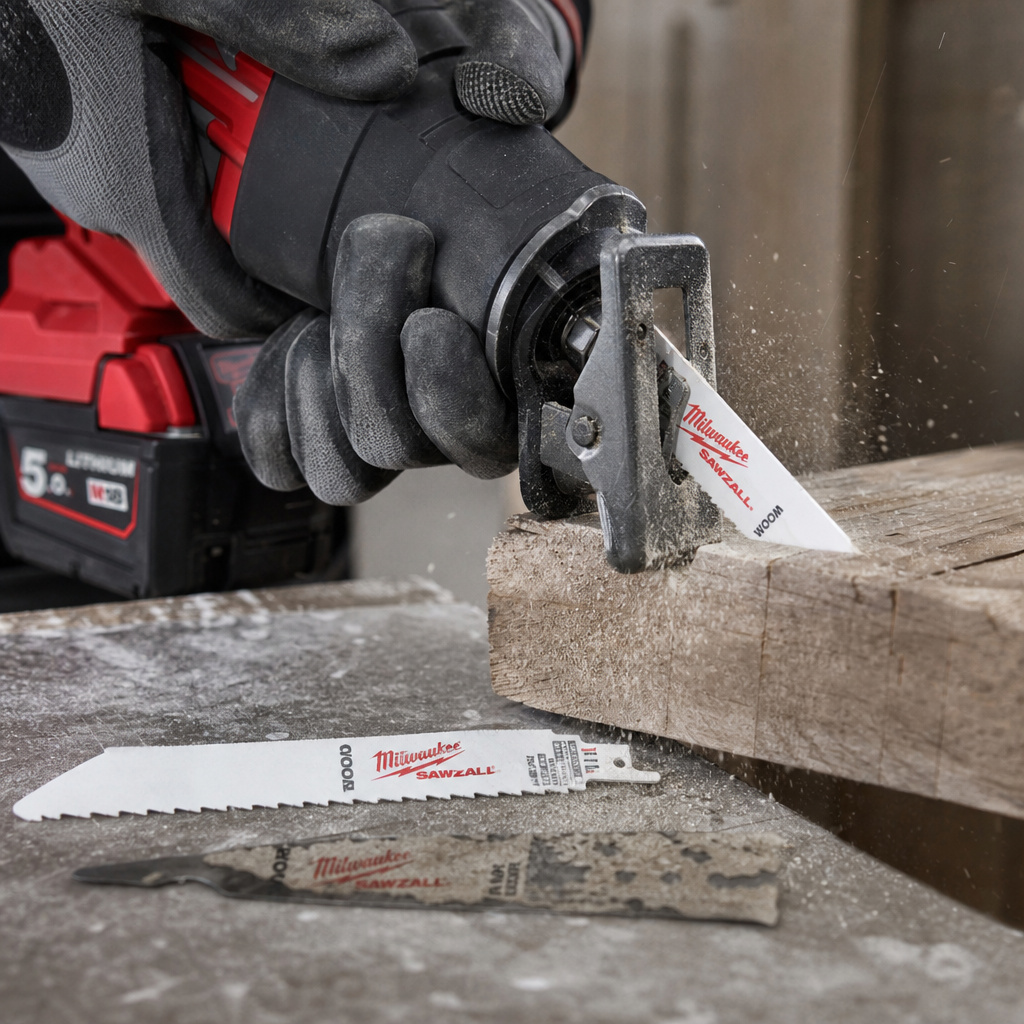
Not all reciprocating saws are equal. The differences decide whether you finish a job sweaty and frustrated or done and satisfied.
Power Source: Corded vs. Cordless
Corded saws give you unlimited run time and often more raw power (measured in amps). They’re lighter than cordless models because there’s no battery. The cord is a nuisance if you’re moving around a lot, like pruning trees around a yard.
Cordless saws offer total portability. Their power is tied to battery voltage, 18V is common for DIY, 36V or higher for pro work. The battery adds weight and cost. I used a corded Sawzall for years in my workshop. Switching to a cordless 18V for outdoor jobs was liberating, but I had to buy two batteries to avoid mid-job downtime.
Performance Specs: SPM, Stroke Length & More
Strokes Per Minute (SPM) is the cutting speed. More SPM (3000+) cuts faster in wood. Less SPM (under 2000) is better for metal to avoid overheating. Variable speed control lets you dial this in.
Stroke length is how far the blade travels each cycle. Longer strokes (1-1.25 inches) cut more aggressively. Short strokes are for finer control. An orbital setting adds an elliptical motion to the stroke, propelling the blade forward slightly for faster wood cutting. It’s brutal on blades in metal, turn it off.
Other features matter:
– Adjustable shoe: Lets you expose fresh blade teeth as the front wears out. A fixed shoe means buying blades more often.
– Tool-free blade change: A lever or knob system. The old hex-key systems are slow and annoying when you need to swap blades mid-cut.
– Brushless motor: Runs cooler, adjusts power output, and extends battery life in cordless models. Worth the premium for frequent use.
– Built-in light: Seems trivial. Cutting in a dark basement or attic, it’s a godsend.
Before you start: Reciprocating saws vibrate intensely and throw debris. Wear safety glasses that seal around your eyes, regular glasses won’t stop sideways chips. Use hearing protection; sustained exposure above 100 dB causes permanent damage. Do not wear loose-fitting gloves, if material catches a glove edge, the reciprocating motion can pull your hand into the blade path faster than you can react. Secure your workpiece with clamps or braces. A kicking saw can break a wrist.
How to Use a Sawzall Safely and Effectively
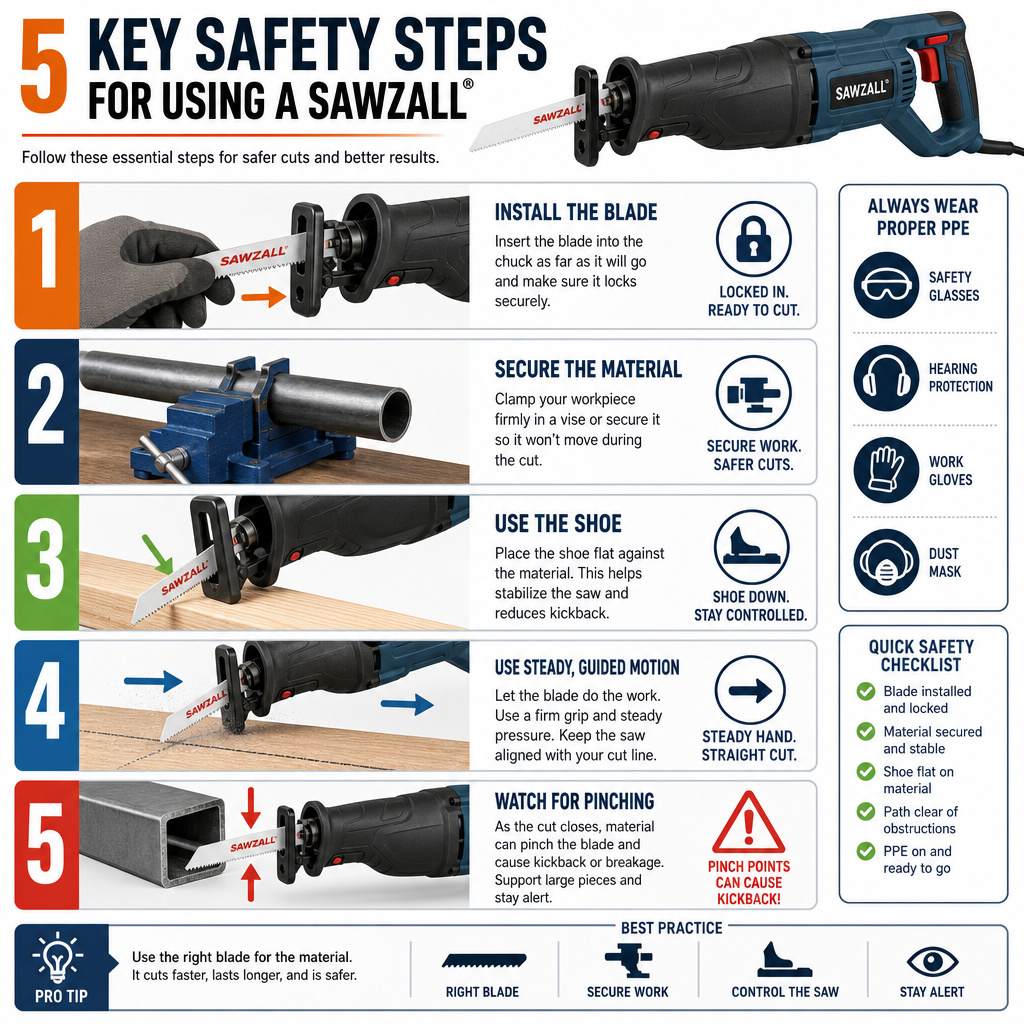
Operating a reciprocating saw isn’t about strength. It’s about setup and control. The tool does the cutting; you just guide it.
- Select and install the blade. Match the TPI and type to your material. Insert it fully into the clamp and lock it securely. A loose blade wobbles and can fly out. If you’re unsure about changing a reciprocating saw blade, practice on a scrap piece first.
- Secure the workpiece. Use clamps, vise, or braces. Cutting a pipe held in your hand is asking for a gashed palm. For wall demolition, make sure the section is stable and not supporting unexpected weight.
- Position the shoe and start the saw. Press the shoe firmly against the material. Start the saw at a low speed if cutting metal to avoid skidding. Let the blade establish a kerf.
- Guide with steady pressure. Don’t force or bend the blade. Let the reciprocating action do the work. If the cut slows, you might need a sharper blade or a higher SPM setting, not more muscle.
- Anticipate pinch points. When cutting through a material like wood, the two sides can close in on the blade as you near the end. Be ready to support the piece or cut from both sides to avoid a violent pinch and kickback.
For more detailed techniques on operating a reciprocating saw for specific tasks like flush cuts or ductwork, there are dedicated guides. The core rule is patience over power.
Common Sawzall Mistakes (And How to Avoid Them)
Everyone makes these errors once. Learning from them saves money and skin.
- Using the wrong blade for the material. This is the top mistake. It results in broken blades, ruined cuts, and a frustrated user. Check the TPI and material rating on the blade package.
- Not wearing hearing protection. The scream of a Sawzall is high-pitched and penetrating. After 30 minutes, your ears ring. After a few years of sporadic use without protection, you have permanent high-frequency loss. I learned that one too late.
- Ignoring the shoe. Letting the shoe float away from the work surface causes the blade to hop, chatter, and produce a ragged cut. It also increases vibration transferred to your hands. Keep it planted.
- Forcing the cut. Pushing and bending the blade stresses the mechanism, can pinch the blade, and leads to premature motor wear. If the cut isn’t progressing, stop. Check the blade sharpness, the SPM setting, or the material density.
- Using it for precision tasks. Trying to make a fine, straight cut in trim wood or laminate flooring with a Sawzall is a fool’s errand. Use a circular saw or jigsaw. The Sawzall’s purpose is rough demolition.
Maintenance and Care for Your Sawzall
These tools are tough, but neglect kills them. A few simple habits keep it running for decades.
- Clean the shoe and blade clamp area. After use, especially in dusty or muddy conditions, wipe off debris. Built-up grime can prevent the blade from seating fully or the shoe from sliding.
- Inspect blades before use. Look for cracked teeth, excessive wear, or bending. A damaged blade is unsafe and inefficient.
- Store it properly. Keep it in a dry place. For cordless models, remove the battery for storage. For corded, don’t wrap the cord tightly around the saw, it stresses the internal wire connections.
- Check the power cord (corded models). Look for fraying or cuts. A damaged cord is an electrical hazard.
- Listen to the motor. If it sounds strained, labored, or makes new grinding noises, stop using it. It might need professional service.
A Sawzall isn’t a delicate instrument, but a yearly check of these points prevents the “it just died mid-cut” surprise.
Frequently Asked Questions
Is a Sawzall the same as a reciprocating saw?
Yes, functionally. A Sawzall is Milwaukee Tool’s brand name for their reciprocating saw. The term is used generically, much like “Kleenex” for tissues. All Sawzalls are reciprocating saws, but not all reciprocating saws are Sawzalls. For a deeper dive on the distinction, see our article on the reciprocating saw vs. Sawzall naming convention.
Can a Sawzall cut metal?
Absolutely. With the correct blade, a high TPI (14-18) bi-metal or carbide blade, a Sawzall cuts through steel pipe, conduit, sheet metal, and even cast iron. Use a slower speed setting (lower SPM) to avoid overheating the blade and creating jagged edges.
What is the best Sawzall blade for cutting wood with nails?
carbide-tipped blade with a low TPI (6-8). The carbide teeth are harder than nails and won’t strip off like standard steel teeth. They’re more expensive, but they last through multiple encounters with embedded hardware.
Is a Sawzall dangerous to use?
It can be, if safety protocols are ignored. The primary risks are flying debris, intense noise, blade kickback if pinched, and vibration. Proper safety gear (eyes, ears, snug gloves), securing the workpiece, and using the correct technique mitigate these risks. It’s less prone to the catastrophic, sudden kickback of a circular saw, but its vibration and aggression demand respect.
Can I use a Sawzall to cut tree branches?
Yes, for pruning thicker branches. Use a long, low-TPI wood blade. Be aware that live wood can pinch the blade, so cut from the outside towards the trunk and support the branch if possible. It’s faster than a hand saw but less precise than a chainsaw for large trees.
How do I change the blade on a Sawzall?
Most modern models have a tool-free system: a lever or collar you twist to release the blade clamp. Older models may require a hex key. Always ensure the saw is unplugged or the battery removed before changing the blade. Insert the new blade fully and lock the mechanism securely. A loose blade is a major hazard.
Before You Go
A Sawzall is a reciprocating saw, a tool born for demolition and rough cutting. Its versatility across wood, metal, and pipe makes it a powerhouse in the workshop, but its aggression means it’s never the tool for precision or fine detail.
Remember three things. First, the blade defines the job, match TPI and material exactly. Second, safety gear is non-negotiable; the tool is loud, violent, and throws chips. Third, let the saw do the work. Your job is to guide it, not force it.
If you’re tearing out old framing, retrofitting plumbing, or clearing thick brush, the Sawzall is your best friend. If you’re trimming molding or cutting laminate flooring, put it away and grab a different saw. Know its purpose, and it will save you hours of labor. Misuse it, and it will waste your time and compromise your work.
