
What Is a 6mm Drill Bit? The Crucial 0.047mm Size Difference
This post contains affiliate links. As an Amazon Associate, we earn from qualifying purchases.
A 6mm drill bit is a standard metric size with a diameter of 0.2362 inches. Its nearest fractional inch equivalent is 15/64″, which is 0.047mm smaller. For general woodworking or clearance holes, that tiny gap usually doesn’t matter. For tapping metric threads or precision metalwork, you must use the exact 6mm bit — the substitute will produce a weak joint.
That 0.047mm difference is the line between a functional assembly and one that fails under load. The confusion doesn’t stop there. A “Size 6” drill bit in some contexts refers to a #6 wire-gauge bit, which is only 5.18mm. This isn’t just academic. Grab the wrong one for an M6 tap and your threads will strip on the first torque.
What follows: the exact conversion math, the three standards that define this common bit, and a simple rule for when you can reach for the 15/64″ and when you must hunt down the real 6mm.
Key Takeaways
- A 6mm drill bit is 0.2362 inches. The closest fractional size is 15/64″ (5.953mm), which is 0.047mm undersized.
- Never confuse a 6mm bit with a #6 drill bit. The #6 size is 0.2040 inches (5.18mm) — a full 0.82mm smaller.
- For metric thread tapping (like an M6x1.0) or press-fit bearings, you must use the exact 6mm bit. Substitution weakens the joint.
- For general-purpose drilling in wood or creating clearance holes for bolts, the 15/64″ substitute is acceptable.
- The standard “jobber length” for a 6mm bit is about 4 inches of flute, defined by ANSI/ASME B94.11M-1993.
The Exact 6mm to Inch Conversion
The math is straightforward: 6 millimeters divided by 25.4 equals 0.2362 inches. That number isn’t a suggestion. It’s the literal diameter stamped on the bit’s shank.
According to the ANSI/ASME B94.11M-1993 standard, a 6mm jobber-length drill bit has a flute length approximately 8-14 times its diameter. For a 6mm bit, that translates to a standard flute length of about 4 inches.
This precise decimal is what your calipers will read. Hardware stores and online charts will list the nearest fractional equivalent as 15/64 of an inch. That fraction converts to 5.953mm.
| Measurement System | Size | Decimal Inch | Difference from 6mm |
|---|---|---|---|
| Metric (Exact) | 6.0 mm | 0.2362 in | 0.000 mm |
| Fractional (Nearest) | 15/64 in | 0.2344 in | -0.047 mm |
| Wire Gauge (#6) | #6 | 0.2040 in | -0.820 mm |
The -0.047 mm gap between 6mm and 15/64″ is small. In a bag of mixed bits, you might not even notice. But that gap has real consequences depending on your project. A clearance hole for a 6mm bolt can be slightly larger, so 15/64″ works. A pilot hole for a 6mm thread cannot be smaller, or the tap will bind and break.
The #6 wire-gauge bit is a different animal entirely. It belongs to the American numbering system, where #1 is large and #80 is tiny. A #6 bit is 5.18mm. Using it where a 6mm is specified leaves a hole almost a millimeter too small. This is the most common point of confusion in mixed workshops.
When a 6mm Bit is Non-Negotiable
Some jobs demand the exact diameter. The tolerance is zero.
Metric Thread Tapping: This is the big one. An M6x1.0 screw requires a 5.0mm pilot hole. If you were tapping an M7x1.0 thread, the required pilot is 6.0mm. Using a 15/64″ bit (5.953mm) for that M7 tap creates a hole 0.047mm undersized. The tap will fight you, generate excessive heat, and likely produce rough, weak threads. For small threads like M3 or M4, even a 0.1mm error can cut thread engagement in half.
Press-Fit and Interference Fits: These assemblies rely on precise diameters for friction. A bearing pressed into a 6mm hole needs that hole to be 6mm, not 5.953mm. The smaller hole increases the interference beyond design limits, risking damage to the bearing or the housing during installation.
CNC Machining and Precision Assemblies: When a digital design calls for 6.00mm, it means 6.00mm. Substituting 15/64″ introduces a dimensional error that can cascade through an assembly, causing misalignment or parts that simply won’t fit. This is why European and Australian workshops standardized on metric drill bits decades ago — it removes the translation error.
Where this goes sideways: Using a 15/64″ bit for an M7 tap. The tap binds halfway in, shears off, and leaves a hardened steel fragment lodged in your part. The repair now requires drilling out the tap with a carbide bit, which often ruins the workpiece.
If your project spec sheet lists millimeters, use millimeter bits. It’s that simple. This is the primary reason to own a set of HSS drill bit metric sizes, even if you work primarily with imperial tools.
When You Can Safely Substitute 15/64″
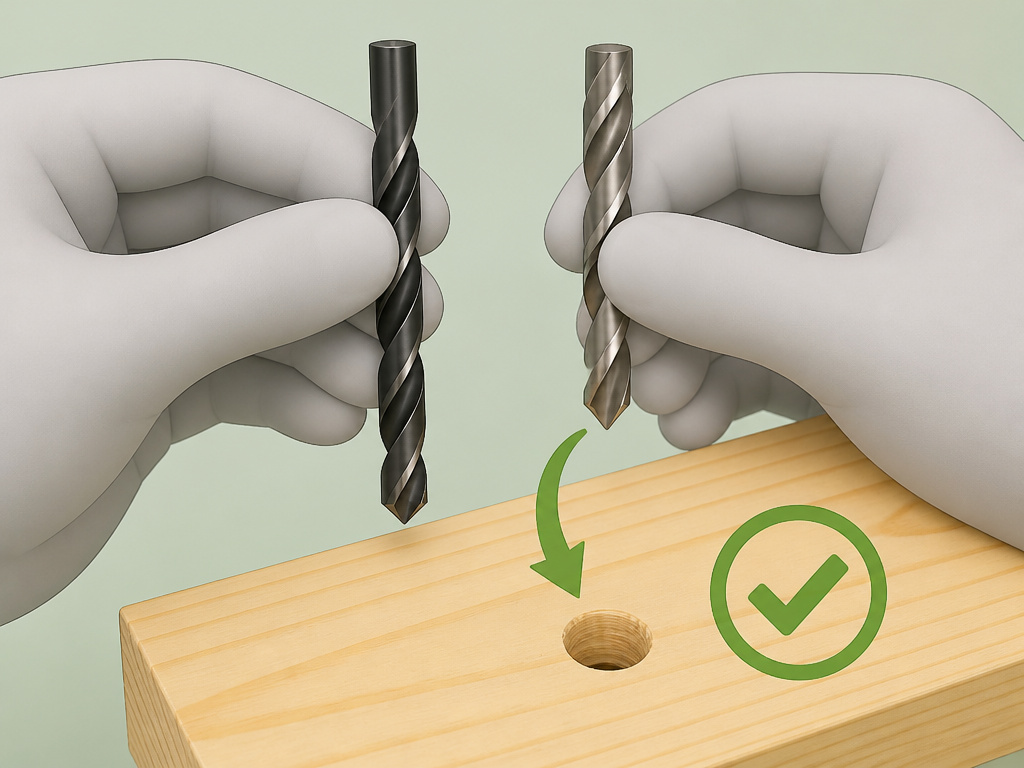
Not every hole needs to be perfect. For many common DIY tasks, the nearest fractional bit is fine.
General Woodworking and Plastic: Drilling a hole for a cable pass-through or a dowel? The 0.047mm difference is negligible. Wood fibers compress and plastic deforms. The visual and functional result will be identical.
Clearance Holes for Bolts: A clearance hole is meant to be slightly larger than the bolt shaft so it can pass through freely. A 6mm bolt has a shaft diameter of 6mm. A 15/64″ (5.953mm) hole is actually slightly smaller, which is not ideal. For a true clearance hole, you’d want a 6.4mm or 1/4″ bit. However, if you’re in a pinch and the material is soft like pine or plastic, you can often force the bolt through the 15/64″ hole.
Rough Construction and On-Site Work: When you’re framing a deck or drilling a hole for a pipe strap, absolute precision is not the goal. Speed and availability are. Grabbing the 15/64″ bit from your standard twist bit set is a perfectly reasonable shortcut.
The rule of thumb: if the hole’s purpose is to remove material rather than to create a precise interface, the substitute is usually safe. When in doubt, drill a test hole in a scrap piece first.
6mm Drill Bit Specifications and Types
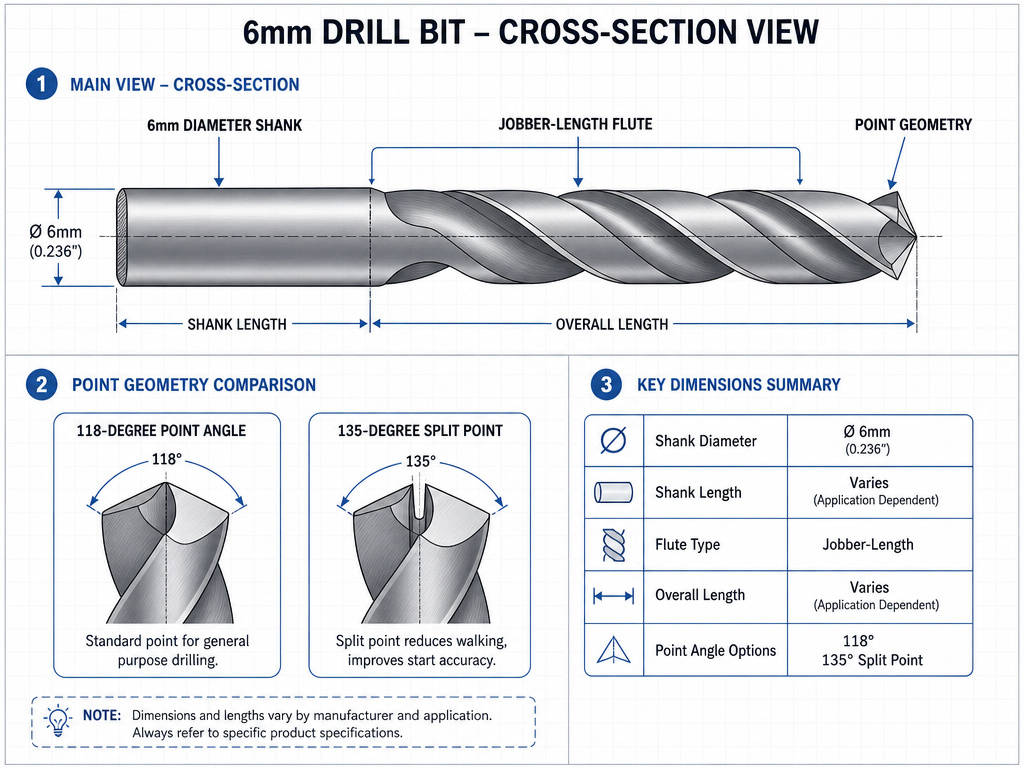
A 6mm bit isn’t just a diameter. It’s a category defined by length, material, and point geometry.
Jobber Length: This is the standard “jobber drill bit” length you find in most retail sets. As per the ANSI standard, a 6mm jobber bit has a flute length of about 4 inches. This provides a good balance of reach and rigidity for most handheld drilling tasks.
Materials:
- HSS (High-Speed Steel): The most common material for general-purpose drilling in wood, plastic, and soft metal. A good HSS drill bit set is a workshop staple.
- Cobalt (HSCO): Contains 5-8% cobalt for drilling harder metals like stainless steel. Stays sharper longer under high heat. The debate between cobalt vs HSS often comes down to the metals you drill most.
- Carbide: Extremely hard and brittle. Used for masonry, tile, and very hard alloys. A masonry drill bit will have a carbide tip brazed onto a steel body.
Point Angles:
- 118° Point: The universal standard. Good for a wide range of materials, from wood to mild steel.
- 135° Point: A flatter angle often called a “split point.” It’s a split point drill bit design that starts cutting immediately with less “walking” on curved metal surfaces. Excellent for hard metals and precision drilling.
| Bit Type | Best For | Why It Matters for 6mm |
|---|---|---|
| HSS Jobber | General DIY, wood, soft metals | Default choice for most home workshops. |
| Cobalt Jobber | Stainless steel, hard alloys | Prevents rapid dulling when drilling metal. |
| Carbide Tipped | Masonry, concrete, tile | The only bit that will last in abrasive stone. |
| Split Point | Precision metalwork, preventing walk | Ensures your 6mm hole starts exactly on mark. |
Choosing the right type is as important as getting the diameter right. Drilling stainless steel with a basic HSS bit will dull it in seconds. Always match the bit to the material.
How to Identify and Select a True 6mm Bit
Don’t trust the label on the plastic sleeve. Inspect the bit itself.
The diameter is almost always stamped or laser-etched on the twist drill bit shank. Look for “6mm” or “6.0”. If it only says “15/64″,” you have the fractional substitute. Some quality bits, especially from European manufacturers, will also list the decimal inch equivalent: “0.2362”.
If you’re buying online or from a bin, use a caliper. Measure the diameter just behind the flutes. A true 6mm bit will measure 6.0mm, or 0.236 inches. A 15/64″ bit will measure 5.95-5.96mm.
For your workshop, it’s worth owning dedicated metric sets. Brands like Bosch, DeWalt, and Makita sell sets labeled “Metric Drill Bits.” This eliminates the guesswork. Keep them separate from your fractional sets to avoid cross-contamination. Knowing the drill bit size by system saves time and prevents errors.
When selecting for a specific job, ask the two-layer question: What is the hole for, and what am I drilling into? The answer dictates both the diameter precision and the bit material. Need a 6mm hole for an M7 tap in aluminum? Use a 6mm HSS bit. Need a 6mm clearance hole in a steel bracket? A 6mm cobalt bit will last longer.
Frequently Asked Questions
Is a 6mm drill bit the same as 15/64 inch?
No, they are close but not identical. A 6mm bit is 0.2362 inches. A 15/64″ bit is 0.2344 inches (5.953mm). The 15/64″ bit is 0.047mm smaller. For many tasks this is fine, but for precision work like tapping threads, you need the exact 6mm bit.
What is a #6 drill bit size?
6 drill bit from the American wire-gauge system is 0.2040 inches in diameter, which is 5.18mm. It is significantly smaller than a 6mm (0.2362 inch) bit. This is a common source of confusion, especially with older instruction manuals.
Can I use a 1/4 inch bit instead of 6mm?
No, a 1/4 inch bit is 6.35mm, which is 0.35mm larger than 6mm. This is too large for a 6mm specification. It would create an oversized hole, making it unsuitable for tapping threads or press fits. For a clearance hole, 1/4″ might be acceptable if a little extra slop is okay.
What is the best drill bit for metal?
For most metals, a split point drill bit made of cobalt (HSCO) is the best choice. The split point design prevents walking on curved surfaces, and the cobalt alloy withstands the high heat generated when drilling steel. For occasional work on mild steel, a quality HSS drill bit with a 135° point is sufficient.
What drill bit do I need for an M6 tap?
For a standard M6x1.0 thread, you need a 5.0mm tapping drill bit. This is not a 6mm bit. The 6mm size would be used for the clearance hole that the M6 bolt passes through, or for tapping a larger M7x1.0 thread.
Before You Go
A 6mm drill bit is 0.2362 inches. Its nearest fractional cousin, 15/64″, is close enough for rough work but will fail you on precision jobs. The #6 wire-gauge bit is a completely different tool.
The takeaway is system discipline. If a plan, part, or tap is metric, use metric bits. Owning a dedicated metric set is cheaper than ruining one precision component. For the home shop, a set of jobber drill bit metric HSS bits covers 90% of needs. For metal, step up to cobalt.
Match the bit to the job’s tolerance, not just its approximate size. That 0.047mm is where good work separates from guesswork.
