What Type of Drill Bit for Hardened Metal | Complete Guide
This post contains affiliate links. As an Amazon Associate, we earn from qualifying purchases.
You need a cobalt high-speed steel (HSS-Co8%) drill bit for hardened metal under 500 Brinell hardness. For anything harder, like Hardox 500 and above, solid carbide is the only option that won’t disintegrate on contact. The choice concerns the material’s Brinell rating and its self-hardening property, which demands a continuous, coolant-flooded cut.
That Brinell number is the gatekeeper. Drill a 550 Brinell plate with a cobalt bit and the edge rounds over in seconds, leaving a polished dimple instead of a hole. The steel wins every time.
What follows is the breakdown no catalog gives you: the exact hardness thresholds from the steel makers themselves, the shortlist of drill models that hit them, and the non-negotiable technique that keeps the hole wall from turning into a glassy, uncuttable barrier. This is the system for getting through.
Key Takeaways
- HSS with 8% cobalt (HSS-Co8%) works up to 500 Brinell. This is the official ceiling from Hardox manufacturer SSAB. Past that, you need carbide.
- Hardox self-hardens with heat. Interrupting a drill stroke lets the hole wall harden around the bit, causing catastrophic wear. Drill each hole in one smooth, non-stop motion.
- Coolant pressure targets 20 bar. Lower pressure means you must drop your speed and feed rates by at least 20% to manage heat.
- For Hardox Extreme, only solid carbide drills apply. Indexable insert and exchangeable-head drills are not rated for this grade.
- Rigidity beats power. A shaky drill press or handheld tool will chip a carbide tip instantly. Secure everything, workpiece, machine, and your stance.
The Hardness Threshold That Changes Everything
Forget generic “hard metal.” The first question is: how hard, exactly? Manufacturer data sheets don’t talk in vague terms; they publish Brinell (HBW) or Rockwell (HRC) numbers. Your drill bit choice lives or dies by them.
SSAB, the maker of Hardox wear plate, draws a bright line at 500 Brinell. Their machining guide states HSS drills are suitable only up to that limit, and only under unstable machine conditions. For stable setups, they recommend solid carbide, exchangeable-head, or indexable insert drills right from the start.
HSS drills are suitable up to 500 Brinell. If the machine conditions are good, you can choose among solid cemented carbide drills, drills with exchangeable heads or indexable insert drills.
Crossing that 500 Brinell line changes the game completely. Hardox 550 has a tensile strength of 1650 N/mm²; Hardox 600 hits 1800 N/mm². At these levels, the steel behaves less like a metal you’re cutting and more like an abrasive block you’re grinding. Only carbide has the wear resistance to last more than one hole.
Why-layer: Carbide’s binder (usually cobalt) holds ultra-hard tungsten carbide particles in a matrix. Under the heat and pressure of cutting hardened steel, HSS softens and loses its edge. The carbide particles stay hard, so they keep scraping away material long after HSS would have dulled. That’s the difference between three holes and thirty.
So your first step is always to identify the grade. If you’re drilling an unknown hardened bolt or plate, try a file test first. A file will skate off material above ~50 HRC without biting. That’s your signal: skip the HSS drawer and go straight for carbide.
Cobalt (HSS-Co8%): The Workhorse Under 500 Brinell
When your material sits under that 500 Brinell ceiling, think AR400 plate, many hardened bolts, or pre-hardened tooling steel, a cobalt drill is the default choice. The “cobalt” here isn’t a coating; it’s 8% cobalt alloyed into the high-speed steel (designated HSS-Co8% or HSS-E), which raises its hot hardness and lets it survive the cutting temperatures.
Brands like Dormer Pramet and Bosch make these bits for a reason. They work in hand drills, drill presses, and CNC machines without needing internal coolant. For most repair shop and serious DIY work, this is the category you’ll use most.
| Dormer Pramet HSS-Co8% Drill Model | DIN Standard | Point Angle | Diameter Range | Best For |
|---|---|---|---|---|
| A117 (Short) | DIN 1897 | 135° | 2.50–13.00 mm | Space-restricted drilling, minimal overhang |
| A777 (Jobber Length) | DIN 338 | 135° | — | General-purpose drilling in drill presses |
| A730 (Morse Taper) | DIN 345 | 118° | 10.00–32.00 mm | Heavy-duty drilling in lathe tailstocks or large radial drills |
The 135-degree point angle on the A117 and A777 is key. A sharper 118-degree angle (common on generic bits) has a thinner web and is more prone to chipping on hard, abrasive surfaces. The 135-degree angle is stronger, sacrificing a little ease of entry for much better edge life.
Common mistake: Using a standard 118-degree HSS bit from the hardware store on hardened steel. The thinner web deforms on contact, the tip rounds, and you’re left holding a spinning, polished shank that does nothing but burnish the surface.
If you’re working without internal coolant, which covers every handheld drill and most home shop drill presses, look at Dormer Pramet’s CDX series (R520, R510). These have a convex cutting edge and a thicker core for extra strength. The R520 follows the short DIN 6539 length; the R510 is the longer DIN 338 version. They’re designed explicitly for machines without internal cooling.
For a deep dive on the properties and uses of these bits, our guide on HSS drill bits covers the specifics.
Solid Carbide: The Only Option for the Hardest Grades
When the Brinell number climbs past 500, you enter carbide territory. For grades like Hardox 550, 600, and especially Hardox Extreme, solid cemented carbide is mandatory. The SSAB guide is blunt: “This is the only type of drill suitable for drilling Hardox® Extreme.”
Carbide drills are brittle. They hate lateral shock, vibration, and runout. Their success hinges on a rigid setup: a firmly clamped workpiece, a short tool overhang, and a machine with minimal spindle play. This is why they’re primarily CNC tools, but shorter-length versions can run in a high-quality drill press.
The model numbers tell the story. Vulcan Steel’s recommendation sheet lists the THUNDER/T80 T80-xx.x solid carbide drill for Hardox HiTuf through Extreme. For Hardox Extreme, they recommend a starting cutting speed (Vc) of 16–26 meters per minute and a feed per revolution (fn) of 0.07–0.12 mm. That’s slow and steady.
Sandvik Coromant’s CoroDrill 860 series (GM and PM variants) in the 3–20 mm diameter range is another industry standard. These are through-coolant drills, meaning they require internal coolant pressure to work as designed.
| Drill Type | Maximum Hardness | Cooling Requirement | Rigidity Demand | Typical Model Example |
|---|---|---|---|---|
| HSS-Co8% | 500 Brinell | Flood coolant preferred | Moderate | Dormer Pramet A777 |
| Solid Carbide | Hardox Extreme (650-700 HBW) | Internal coolant (20 bar ideal) | Very High | Sandvik CoroDrill 860, THUNDER T80 |
| Indexable Insert Drill | Hardox 600 | Internal coolant mandatory | High | Iscar Chamdrill DCM |
The takeaway? Don’t buy a carbide drill for a wobbly benchtop drill press. The first engagement will likely chip the cutting edge. If your machine isn’t solid, you’re better served by a premium cobalt bit and accepting slower progress on the hardest materials. For a comparison of how carbide stacks up against other premium materials, see our analysis of titanium vs carbide drill bits.
The Non-Negotiable Technique: Coolant and the One-Stroke Rule
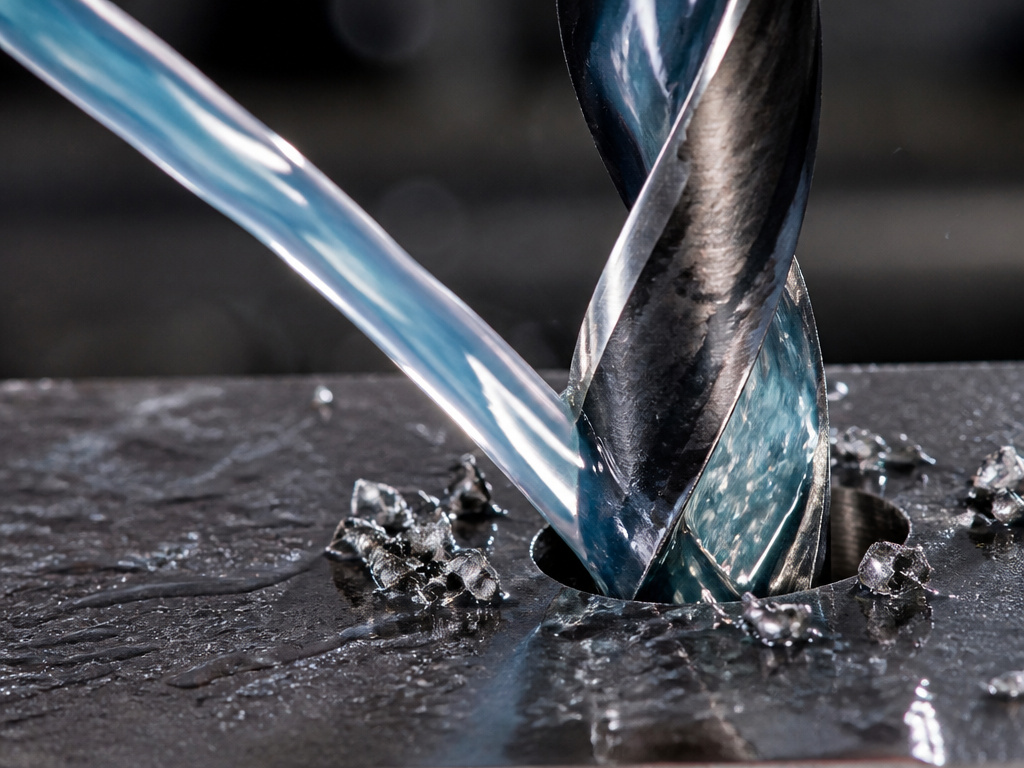 Choosing the right bit is only half the battle. Hardened steel, especially self-hardening grades like Hardox, punishes poor technique instantly. The core mistake is treating it like mild steel.
Coolant isn’t optional; it’s the process. The goal is to manage heat, not just lubricate. Hardox is self-hardening: heat generated during drilling hardens the hole wall around the bit. Dormer Pramet’s advisory is stark: “Restarting a drill in a (partly) hardened hole is disastrous and causes enormous wear.”
Where this goes sideways: Pecking. In mild steel, pecking clears chips. In Hardox, each retraction lets the hot hole wall cool and harden. The next plunge tries to cut glass. The drill skates, wears, or snaps.
The rule is simple: drill each hole to full depth in one smooth, continuous stroke. This requires planning. Use a drill depth stop. Know your exact depth before you start. If you’re drilling through-hole, feed steadily until the bit breaks through.
Coolant pressure matters. The recommendation is about 20 bar of internal coolant pressure. If you’re using external flood coolant (like in a drill press), you must compensate by reducing spindle speed and feed rate by 20% to account for the less efficient heat removal.
For handheld drilling, where flood coolant is messy and often impossible, Bosch notes their HSS bits are designed for quick swarf removal. The trade-off is drastically reduced tool life and the need for even slower speeds. You can feel it when it’s working, a steady, gritty resistance. If the drill starts to sing or smoke, you’re already cooking the bit and hardening the work.
This single-pass, flood-cooled approach is as important as bit selection. It’s the reason a shop with a rigid CNC and through-spindle coolant will run circles around someone with a better bit in a shaky setup. For more on the fundamentals of this process, our guide on how to drill through metal covers speed, pressure, and chip formation.
When the Government Validates Your Drill Bit
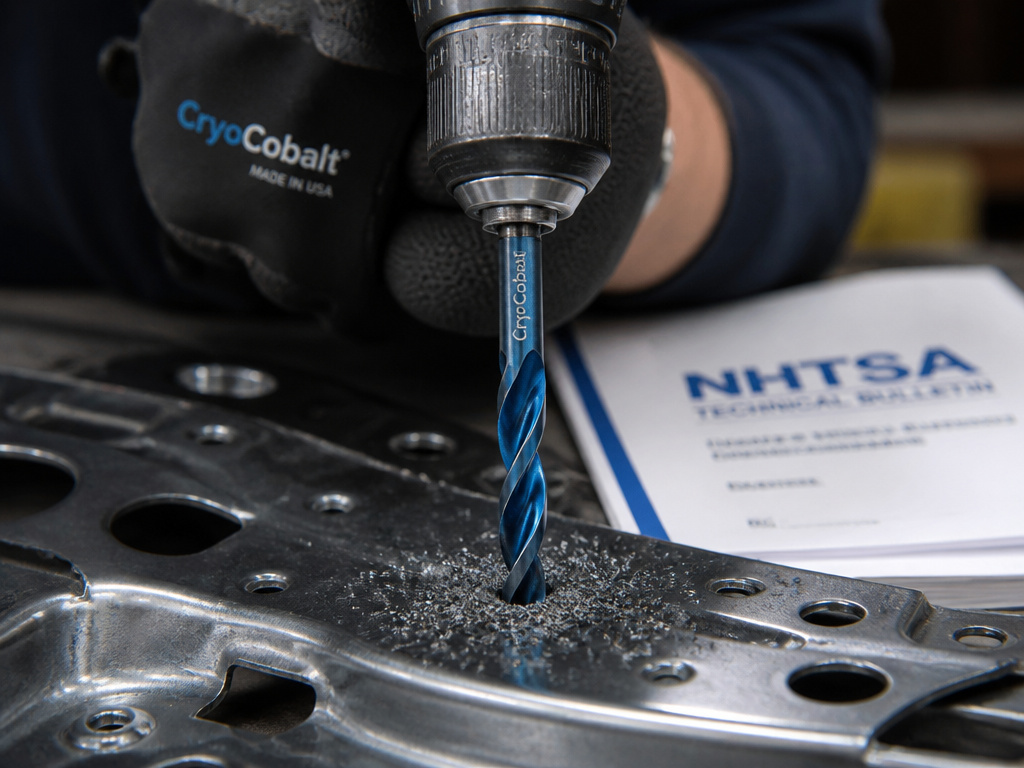 Sometimes the proof of what works comes from unexpected, high-stakes places. In 2014, the National Highway Traffic Safety Administration (NHTSA) published a technical service bulletin (MC-10114260-9999) about drilling ultra-high-strength steel in vehicle collision repair.
The bulletin states that the useful life of standard drills is limited by the hardness of these new steels. It then validates a specific solution: “The General Motors Collision Repair Technology Center has recently validated a *CryoCobalt™ drill bit that has been developed for use with very hard metals.”
The part nobody mentions: When federal vehicle safety regulators and a major automaker’s repair center spend time validating a specific drill bit for hard metals, it tells you the problem is real and the usual hardware-store options have failed. This isn’t marketing.
This NHTSA technical service bulletin highlights a critical point for professionals: on modern vehicles with advanced high-strength steel (AHSS) frames, using the wrong bit isn’t just inefficient, it can compromise a structural repair. The validated CryoCobalt bits (marketed under part numbers like GM801–4–1664 for 1/4″) are essentially a premium cobalt formulation, likely with a specialized heat treatment or coating.
For the rest of us, the lesson is to seek out tools that have been tested and documented against specific, known-hard materials. It’s why the OEM recommendations from SSAB, Dormer Pramet, and Sandvik carry more weight than a generic “for metal” label on a blister pack.
Setting Up for Success (And Not Breaking Bits)
Your drill bit is a component in a system. If the rest of the system is weak, the best bit will fail. The goal is to eliminate all movement except the precise, forced rotation and feed of the drill itself.
- Clamp the workpiece. A vise bolted to the drill press table is the minimum. For sheet or plate, use clamping bars or a fixture plate. Hand-holding is forbidden.
- Minimize overhang. Use the shortest drill bit that can reach the depth. Every millimeter of exposed shank amplifies vibration and deflection. If you’re using a carbide bit, this is the most important step.
- Secure the machine. A benchtop drill press must be bolted down. A handheld drill requires you to brace your body and use an auxiliary handle. No exceptions.
- Start with a center punch. For hardened steel, a sharp, well-struck center punch mark is essential. It gives the drill’s point a divot to sit in, preventing the dreaded “walking” that can instantly chip a corner.
- Set speed slow. For cobalt bits, start at the lowest speed your drill provides. For carbide in a drill press, you may need the middle of the pulley range. The sound should be a low, grinding growl, not a high-pitched whine.
- Apply firm, steady pressure. Let the bit cut. Don’t force it, but don’t let it just spin and polish either. You should see a steady stream of chips, not dust or smoke.
If you’re unsure how to identify the right bit for the job from the start, our primer on how to know what drill bit to use walks through the decision tree.
TL;DR: Rigidity first, speed last. A perfectly set up slow drill will outlast a fast, shaky one by an order of magnitude.
Frequently Asked Questions
Can I use a titanium-coated drill bit on hardened metal?
No. Titanium nitride (TiN) coating is a surface treatment for HSS bits that reduces friction and increases wear resistance in soft to medium steels. Against hardened metal above ~350 Brinell, the thin coating wears through almost immediately, and the underlying HSS substrate quickly fails. It offers no advantage over a plain cobalt (HSS-Co8%) bit and can be worse if the coating process softened the core steel.
What’s the difference between drilling “hardened steel” and “hardened metal”?
For drill bit purposes, they’re the same challenge. “Hardened metal” typically refers to hardened steels (like tool steel, AR plate, Hardox). Non-ferrous metals like hardened aluminum or titanium alloys require different geometries and coatings (like Gühring’s Zenit coating), but the principles of rigidity, low speed, and continuous cutting still apply.
Why did my brand new carbide drill bit snap instantly?
Almost certainly from runout or a poor start. If the drill chuck has play, or if the bit wasn’t seated perfectly straight, the cutting edge on one side takes the full load on entry. Carbide has almost no ductility; it doesn’t bend, it snaps. Check your machine’s spindle runout with a dial indicator. For critical jobs, consider a precision collet chuck instead of a standard keyless chuck.
Is there a special drill bit for stainless steel?
Yes, but it’s different from bits for hardened steel. Stainless steel is tough, not necessarily ultra-hard. It work-hardens rapidly, so you need a bit with a sharp, positive rake angle and a specialized geometry (often a 135-degree split point) to shear the material cleanly before it hardens. Our dedicated guide on drill bits for stainless steel covers the specific models and techniques.
Before You Go
Drilling hardened metal is a filter. It separates tools and techniques that work from those that merely exist. The answer is a material property number (500 Brinell), a tool material (cobalt or carbide), and a brutal adherence to technique (coolant, no pecking).
For the majority of jobs on plates, bolts, and tools under that 500 Brinell line, a quality HSS-Co8% bit like the Dormer Pramet A777, run slow and steady with plenty of cutting oil, will see you through. When you encounter the real heavyweights, the 600 Brinell wear plates or Hardox Extreme, that’s the signal to stop, reassess your equipment, and either invest in solid carbide and a rigid machine or find a shop that has them.
Remember, the metal doesn’t care how strong you think your drill is. It only responds to correct pressure applied by a sufficiently hard, sharp edge. Give it what it demands, and you’ll get your hole. Fight it, and you’ll get a drawer full of shiny, broken stubs.
