What Drill Bit for a #10 Screw | Sizing Rules & Exceptions
This post contains affiliate links. As an Amazon Associate, we earn from qualifying purchases.
The right drill bit for a #10 screw is not a single size. It’s a 0.190-inch major diameter matched to your material, softwood, hardwood, or metal, and your screw’s thread standard (#10-24 UNC or #10-32 UNF). For most wood, start with a 7/64″ or 1/8″ bit. For metal, match the tap drill size for the thread.
That 0.190-inch figure is the screw’s outer thread diameter, the single non-negotiable starting point. Everything else, the pilot hole chart, the thread engagement percentage, even the choice between a twist drill and a precision jobber bit, flows from matching that diameter to the material’s crush resistance. Get it wrong by more than 0.02mm in metal, and the threads strip on installation or the joint fails under load.
What follows: the standard pilot hole chart, the critical split between UNC and UNF thread standards, the specs that turn self-drilling screws from a time-saver into a liability, and the one field test that proves your bit size before you commit to the final assembly.
Key Takeaways
- The #10 screw’s major diameter is 0.190 inches. Your pilot hole must be smaller than this to allow threads to bite.
- #10-24 UNC (coarse) and #10-32 UNF (fine) require different tap drill sizes for metal, #25 (0.1495″) for 10-24, #21 (0.1590″) for 10-32.
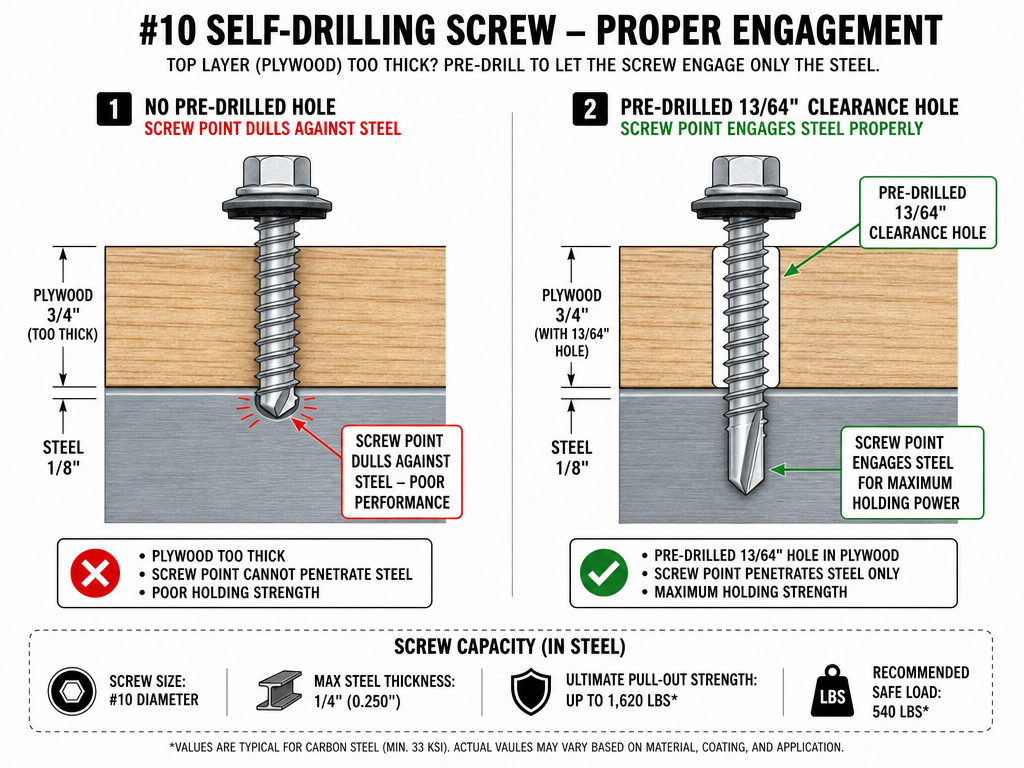
- Self-drilling screws have limits. If the total material thickness exceeds the screw’s rated capacity (e.g., 0.150″ for some #10 screws), you must pre-drill a 13/64″ clearance hole in the top layer.
- Impact drivers can crack case-hardened screws. DeWALT’s testing shows high torque from impacts can induce Hydrogen Assisted Stress Corrosion Cracking (HASCC), leading to sudden failure.
- Always test-fit in scrap material. The screw should drive snugly without binding; if it strips, go up 0.05mm in bit size.
The Standard Answer: Pilot Hole Sizes for #10 Screws
Forget memorizing a single magic number. The correct pilot hole is a moving target set by your material’s hardness and the screw’s job. A #10 screw driving into soft pine needs a different hole than one tapping into steel or one securing a structural joint.
For a #10 wood screw, the pilot hole diameter should be approximately 65-75% of the screw’s major diameter (0.190″), measured at the screw’s core, excluding the threads. This provides optimal thread engagement, enough wood for the threads to grip without splitting the fibers. In softwoods, a 7/64″ (0.109″) bit is typical; in hardwoods, an 1/8″ (0.125″) bit prevents splitting.
Start with this baseline chart. It’s your first filter, not your final answer.
| Material | Recommended Drill Bit | Notes & Rationale |
|---|---|---|
| Softwood (Pine, Cedar) | 7/64″ (0.109″) or #30 (0.1285″) | Smaller hole allows maximum grip in low-density fibers. Use #30 near edges to prevent splits. |
| Hardwood (Oak, Maple) | 1/8″ (0.125″) or #29 (0.1360″) | Prevents splitting under high driving torque. The hole clears the screw’s core, letting threads cut cleanly. |
| Metal (for #10-24 UNC) | #25 (0.1495″) | Standard tap drill size for 75% thread engagement in steel or aluminum. |
| Metal (for #10-32 UNF) | #21 (0.1590″) | Standard tap drill for the finer 10-32 thread. |
| Plastic | #28 (0.1405″) | Prevents cracking and reduces hoop stress. Drill slowly to avoid melting. |
The “why” here is thread engagement. Aim for 65-75% in most applications. That means the threads bite into about two-thirds of the available material depth. Go lower than 60%, and the joint lacks strength. Go above 80%, and you risk high driving torque, screw breakage, or material failure. For structural or vibration-prone joints, like framing or machinery, target the upper end of that range, around 80%.
The part nobody mentions: These chart sizes assume your drill bit is perfectly sharp and you’re drilling perpendicular. A dull bit or an angled hole creates an oversized, ragged opening. The screw will feel tight initially, but the actual thread contact is maybe 50%. The joint feels secure until the first real load, then it strips. That’s why the test fit in scrap is non-negotiable.
The Thread Standard Split: #10-24 UNC vs. #10-32 UNF
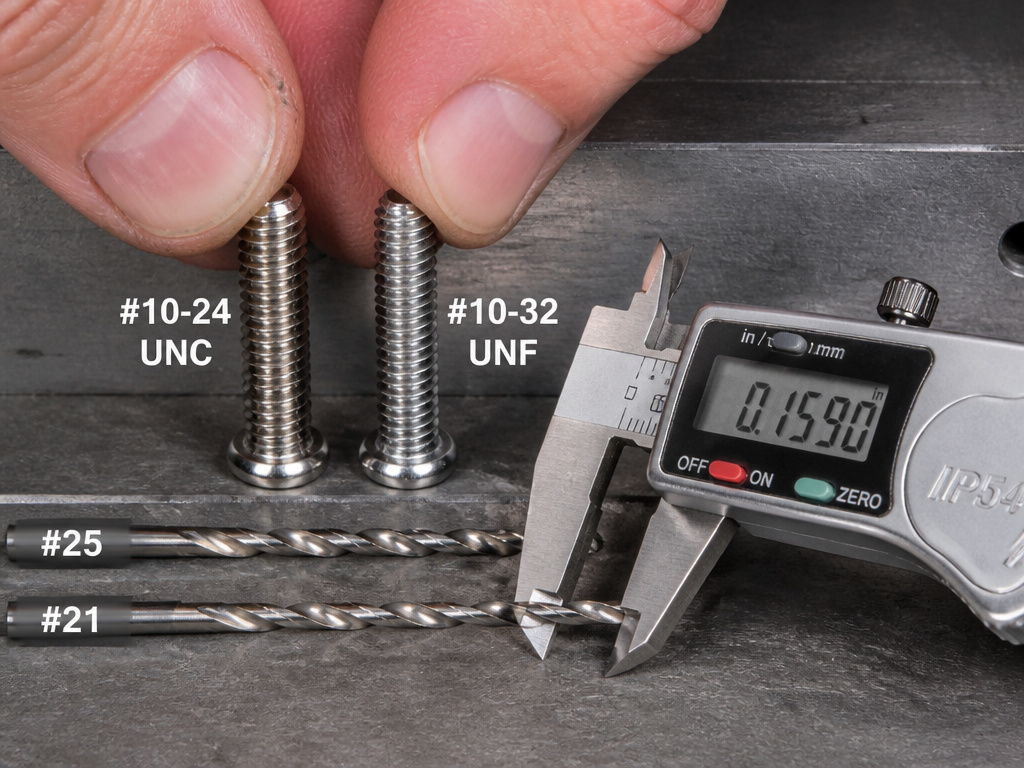
Most guides treat a #10 screw as a single entity. That’s a mistake that leads to stripped holes in metal. The number “10” is the screw gauge; the digits after the hyphen are the threads per inch. This changes everything for metalworking.
A #10-24 UNC screw has 24 coarse threads per inch. A #10-32 UNF screw has 32 fine threads per inch. The coarse thread is stronger in shear and better for brittle materials. The fine thread offers better tension adjustment and is common in precision assemblies. Their different thread geometries demand different pilot holes.
| Thread Standard | Threads Per Inch | Best For | Tap Drill Size (75% Engagement) |
|---|---|---|---|
| #10-24 UNC | 24 | General-purpose, brittle materials, higher shear strength | #25 (0.1495″) |
| #10-32 UNF | 32 | Precision adjustments, finer clamping force, thinner metals | #21 (0.1590″) |
Common mistake: Using a wood screw pilot hole for a machine screw. A 1/8″ hole for a #10-24 machine screw in steel is nearly 0.025″ too small. The screw will either refuse to start, gall the threads, or snap off under high driving torque. Always match the tap drill to the thread standard, not just the screw gauge.
This is where your drill bit selection process must get precise. Numbered drill bits (#21, #25) are essential for metalwork. Trying to use a close fractional size like 5/32″ (0.15625″) for a #21 job leaves the hole too loose for a 10-32 screw, dropping thread engagement below 60%. The connection will vibrate loose.
When “Self-Drilling” Doesn’t Mean “No Drill Bit”
Self-drilling screws, like the Simpson Strong-Tie F10T250BDM or DeWALT Drilit® series, have a built-in drill point. The marketing suggests you can drive them directly into steel. That’s true, but only within strict limits printed on the spec sheet.
Every self-drilling screw has a rated drilling capacity, the maximum thickness of material it can penetrate and tap on its own. For a #10 screw with a #2 point, that might be 0.110″. For a #3 point, it might be 0.175″. If you’re attaching a 1/4″ plywood panel to a 1/8″ steel strap, the total thickness (0.250″ + 0.125″ = 0.375″) far exceeds the screw’s capacity.
Where this goes sideways: Exceeding a self-drilling screw’s capacity. The drill point dulls against the back layer, the motor stalls, and you’re left with a half-seated screw and a burned-up point. The fix is to pre-drill a clearance hole only in the top material, reducing the effective thickness the screw must drill.
DeWALT’s installation guide is explicit: when the total thickness exceeds the screw’s drilling capacity, you must provide a clearance hole in the attached material. For their #10 screws, that hole is 13/64″ (5.2 mm) in diameter. This isn’t a pilot hole; it’s a pass-through hole that removes material, letting the screw’s point engage only the final, thinner layer.
Furthermore, your driving tool matters. DeWALT’s testing shows that using a standard impact driver on case-hardened carbon steel self-drilling screws is risky. The high torque can induce microscopic cracks. Combined with environmental hydrogen and corrosion, this leads to Hydrogen Assisted Stress Corrosion Cracking (HASCC). The screw can fail suddenly, long after installation. Their recommendation is to use a variable-speed screwgun and stay under 2,500 RPM.
Tools, Tolerances, and the Test Fit
Your drill bit choice isn’t just about diameter. The bit type and its inherent tolerance affect the hole quality, especially in metal or precision work.
A standard twist drill from a big-box set might have a tolerance of -0.05mm. That means a nominal 4mm bit could drill a hole as small as 3.95mm. For wood, that’s irrelevant. For a #10-32 UNF tap drill needing a 0.1590″ (4.039mm) hole, that variance can push you out of the optimal engagement range. This is where precision jobber drills manufactured to DIN 338 h7–h8 tolerances come in. They guarantee a hole much closer to the stated size, which is why machinists use them.
Your installation sequence also changes with the material. For drilling into wood, a pilot hole is often enough. For drilling into brick or masonry, you’re not drilling a pilot for a screw; you’re drilling a hole for a plastic anchor, which is a completely different guide to choosing the correct drill bit.
The final, non-negotiable step is the test fit. Drill your chosen pilot hole in an identical piece of scrap material. Drive the screw. It should advance under steady pressure without the driver stalling or the head stripping. If you need excessive force, the hole is too small, increase the bit size by 0.02mm (0.001″) and test again. If the screw spins freely without tightening, the hole is too large. This one-minute test saves hours of repairing stripped holes or disassembling failed joints.
Frequently Asked Questions
Can I use the same drill bit for all #10 screws?
No. You must distinguish between wood screws and machine screws. For wood screws, the bit size varies by wood hardness. For machine screws (#10-24, #10-32), you must use the correct tap drill size (#25 or #21) for threading into metal.
What if my drill bit set doesn’t have numbered sizes?
For metal, you need numbered bits. A fractional set won’t get you the precise 0.1495″ or 0.1590″ required. For wood, you can use the closest fractional size (7/64″ is 0.1094″, very close to an ideal 0.110″ hole for softwood). However, for strength-critical joints in wood, investing in a numbered set is still wise.
How do I drill a pilot hole for a self-drilling screw?
Typically, you don’t. The screw drills its own. The exception is when the total material thickness exceeds the screw’s rated capacity. Then, you pre-drill a clearance hole (e.g., 13/64″ for DeWALT #10 screws) through only the top layer to reduce the effective thickness.
Why did my screw break off while driving it into metal?
Two likely causes. First, the pilot hole was too small for the thread standard, creating extreme driving torque. Second, you may have used an impact driver on a hard, brittle screw (like a case-hardened carbon steel type). The impact’s peak torque can snap it instantly.
Is a countersink necessary for a #10 screw?
It depends on the head style and your finish requirements. A flat or bugle head (like on drywall or deck screws) is designed to sink flush or slightly below the surface. A countersink drill bit creates a conical recess for a flat-head screw to sit flush. For a finished wood project, yes, use a countersink. For framing or structural work, it’s often unnecessary.
Before You Go
The right drill bit for a #10 screw isn’t found in a universal chart. It’s determined by a short checklist: measure the screw’s major diameter (0.190″), identify its thread standard (24 or 32 per inch), assess your material’s hardness, and understand the screw’s purpose, light duty or structural. For metal, match the tap drill size exactly. For wood, err on the side of a slightly larger hole near edges to prevent splits. And for any self-drilling screw, read its capacity rating on the box; if your stack-up is thicker, drill that clearance hole first.
When in doubt, the answer is in the scrap bin. A test fit tells you more than any guide. If the screw drives snug and the joint feels solid, your bit size is correct.
