Rotary Hammer vs Hammer Drill: Key Differences in Power & Chucks
This post contains affiliate links. As an Amazon Associate, we earn from qualifying purchases.
The difference between a rotary hammer and a hammer drill is the mechanism that creates the hammering force. A hammer drill uses a mechanical cam-action system that delivers high-frequency, low-impact blows. A rotary hammer uses an internal pneumatic piston that delivers fewer, much more powerful impacts measured in Joules. The breakpoint is around 3 Joules of impact energy; below that, use a hammer drill for light masonry. Above it, you need a rotary hammer for serious concrete work.
That mechanism gap isn’t academic. It decides which tool you can use for a #5 rebar dowel, which one will burn out its motor on a foundation wall, and which one requires a specialized SDS chuck.
What follows: the specific impact energy numbers that separate the categories, the two chuck systems that lock you into a platform, and the concrete scenarios where picking wrong costs you a day’s work.
Key Takeaways
- The 3-Joule rule: If the job needs more than 3 Joules of impact energy (like drilling holes over 1/2″ in concrete or into reinforced footings), you must use a rotary hammer. A hammer drill physically cannot deliver that force.
- Chuck = commitment: A hammer drill uses a standard 1/2″ keyed or keyless chuck. A rotary hammer uses an SDS-plus or SDS-max system, which requires dedicated, more expensive bits but provides vastly better power transfer and bit retention.
- Rotary hammers chip, hammer drills don’t: A true rotary hammer has a “hammer-only” or “chipping” mode, letting you use flat chisels for demolition. A hammer drill only hammers while the bit is spinning.
- Cordless parity is here: Modern brushless, high-voltage cordless rotary hammers like the DeWalt DCH416B (4.5 J) match the power of mid-range corded models, ending the corded-only rule for pro work.
- Vibration is the hidden cost: Using a hammer drill on a job that needs a rotary hammer transmits punishing vibration to your hands and arms, leading to fatigue and long-term injury risk. Rotary hammers have active vibration control systems for a reason.
The Core Difference: It’s a Mechanism, Not Just Power
Look inside the tool. A hammer drill contains two ribbed metal discs (cams) that click past each other as the motor spins. This cam-action system produces a rapid, rattling vibration, thousands of beats per minute (BPM), but each individual impact is weak. It’s designed to crush soft masonry like brick or cinder block, not solid concrete.
The hammer drill’s cam mechanism generates impacts through direct mechanical collision. The two interlocking cams force the chuck forward and back along the axis of rotation, creating a hammering effect as long as the motor spins.
A rotary hammer uses a completely different drive. An electric motor turns a crank that drives a piston inside a sealed cylinder. The piston compresses air, which then slams a separate striker into the back of the bit. This pneumatic system acts like a miniature jackhammer. It delivers fewer blows per minute (typically 2,000 to 5,000 BPM), but each impact carries multiple Joules of force.
The difference feels immediate in your hands. A hammer drill vibrates intensely. A rotary hammer thuds with a deep, rhythmic punch. That thud is the piston firing.
Why the Mechanism Dictates the Chuck
The cam system in a hammer drill can work through a traditional chuck. The pneumatic piston in a rotary hammer cannot, the force would destroy a standard chuck. This is why rotary hammers use the SDS system (Slotted Drive System). An SDS bit has grooves that slide into the chuck and lock with a ball-bearing mechanism. This allows the bit to slide back and forth freely (“hammer float”) while being locked rotationally, transferring the piston’s full energy directly to the tip.
Using a standard masonry bit in a hammer drill for a rotary hammer job is the fastest path to a shattered bit. The bit cannot move independently of the chuck, so the piston’s energy has nowhere to go but into breaking the carbide tip.
Rotary Hammer vs Hammer Drill: A Specification Showdown
Don’t guess. Match the tool’s rated capacity to your material. This table uses sourced manufacturer specifications to show the stark performance divide.
| Specification | Hammer Drill (e.g., DeWalt DCD1007B) | Rotary Hammer (e.g., Bosch GBH 18V-26) | What It Means for You |
|---|---|---|---|
| Impact Energy | Not rated (cam action) | 2.6 Joules (Bosch spec) | Joules measure work done. 2.6 J can drill a 1/2″ hole in concrete. A hammer drill’s energy is too low to be measured this way. |
| Impact Rate | 0–31,500 BPM (Bosch GSB18V-975C spec) | 0–4,350 BPM (Bosch GBH 18V-26 spec) | High BPM crumbles soft material. Low BPM with high Joules fractures hard material. |
| Typical Chuck | 1/2″ keyed or keyless ratcheting chuck | SDS-plus or SDS-max | The SDS system is non-negotiable for rotary hammers. It’s a dedicated bit platform. |
| Primary Mechanism | Mechanical cam-action | Pneumatic piston | The piston is why a rotary hammer can have a “hammer-only” mode for chiseling. |
| Max Concrete Drill Capacity | 3/8″ (Benchmark 1240-000 manual) | 26mm (over 1″) (Bosch GBH 18V-26 spec) | A hammer drill hits its wall at small holes in poured concrete. A rotary hammer bores anchor holes. |
Where this goes sideways: Using a hammer drill with a “concrete” setting on poured foundation walls. The cam mechanism bounces off the dense aggregate, overheating the motor. You’ll smell the insulation burning before the drill stops.
When to Use a Rotary Hammer (The 3+ Joule Jobs)
Choose a rotary hammer when your task involves high-impact energy drilling or demolition. Its pneumatic mechanism is built for relentless, heavy pounding.
- Drilling holes larger than 1/2″ in concrete, stone, or reinforced masonry. This is the core rotary hammer uses case. The SDS-plus system on a tool like the DeWalt DCH416B, delivering 4.5 Joules, is designed for structural connections and rebar dowels.
- Repetitive drilling for anchors, sleeves, or core holes. The tool’s efficiency and reduced user fatigue make it the only choice for more than a few holes.
- Light to medium demolition work. With the hammer-only mode engaged and a chisel bit, you can chip away tile, break up small concrete sections, or remove mortar. This is a key difference from a demolition hammer vs hammer drill; a demolition hammer is larger and more powerful, but a rotary hammer handles smaller chipping tasks.
- Drilling into hard, dense aggregate or reinforced concrete. The piston-powered blow simply overcomes resistance that would stall a hammer drill.
The rotary hammer drill components, the piston, cylinder, and striker, are built for this abuse. A hammer drill’s cams would wear out or break.
When to Use a Hammer Drill (The “Drill-First” Tasks)
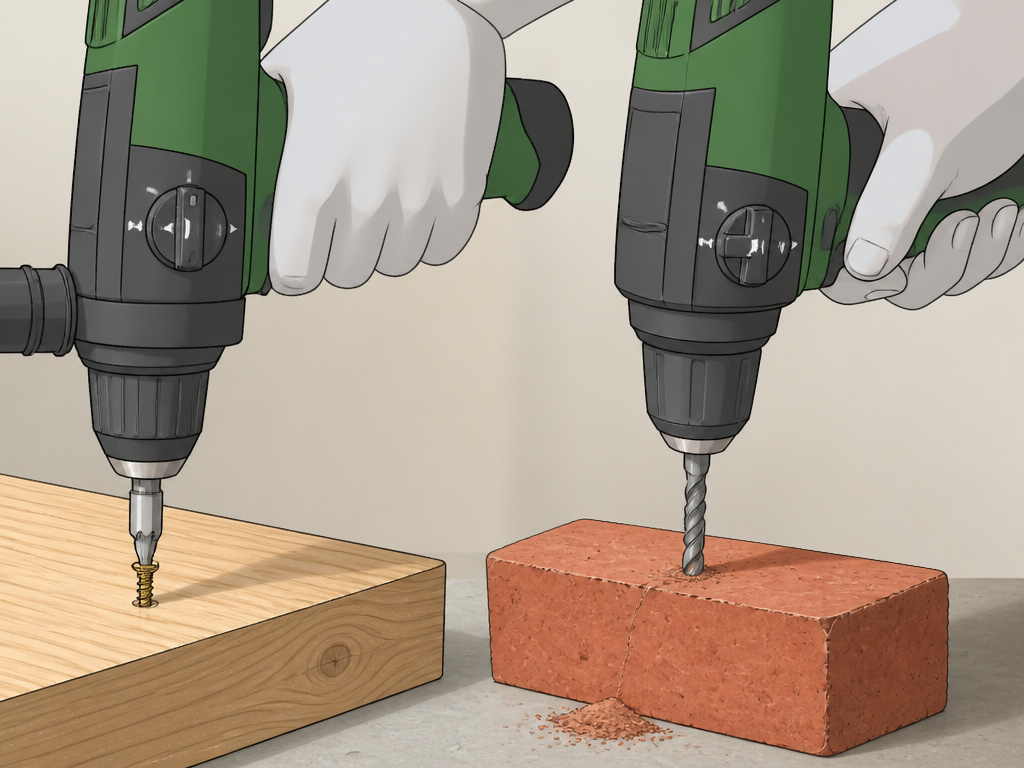 A hammer drill is, first and foremost, a drill. Its hammer function is a secondary feature for occasional light masonry work.
- Driving screws and drilling into wood or metal (90% of its use). Switch the hammer function off. This is its primary role as a versatile driver.
- Drilling small holes (under 3/8″) in brick, block, or soft stone. For mounting a mailbox bracket into a brick wall or installing a tapcon into a cinder block, it’s sufficient.
- Situations where you already own it and need one or two small masonry holes. It avoids buying a specialized tool for a one-off task. For a deeper dive on its capabilities, see our guide on hammer drill uses.
Think of it as a regular drill comparison. A hammer drill vs regular drill adds the cam-action hammer for light masonry, but it doesn’t transform into a concrete breaker.
The Chuck System Divide: SDS vs. Standard
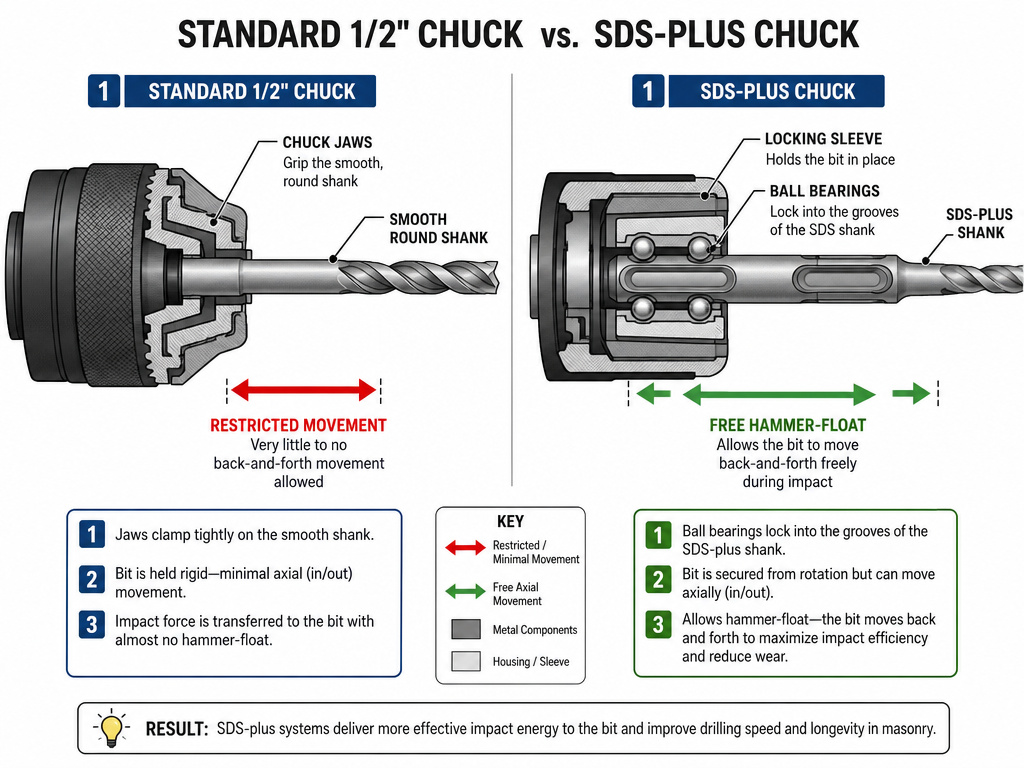 Your bit choice is locked by your tool’s chuck. This isn’t an accessory decision; it’s a platform commitment.
- Standard 1/2″ Chuck: Used by all hammer drill models. It accepts round-shank twist bits, spade bits, and standard masonry bits with a smooth shank. Bits are ubiquitous and cheap. The chuck tightens around the bit, which is why it can’t handle the hammer-float of a rotary mechanism.
- SDS-plus Chuck: The standard for light to mid-duty rotary hammer models. Bits have a shank with grooves and indentations. They slide into the chuck and are held by ball bearings, allowing for that critical back-and-forth movement. SDS-plus bits are more expensive and are a dedicated purchase.
- SDS-max Chuck: For heavy-duty rotary hammers. The shank is larger (18mm) for transferring extreme impact energy (like the 12.5 J from the Bosch GBH 18V-45 C). This is for commercial concrete work and large-diameter coring.
The SDS drill vs hammer drill debate ends here. If you need an SDS chuck, you are buying a rotary hammer. There is no such thing as an SDS chuck on a cam-action hammer drill.
Corded vs. Cordless: The Gap Has Closed
The old rule was simple: corded for power, cordless for convenience. For rotary hammers, that rule is obsolete.
Modern brushless motors and high-voltage battery platforms (like DeWalt’s 60V FLEXVOLT or Bosch’s 18V CORE) deliver corded-level impact energy. The DeWalt DCH416B is a cordless SDS-plus rotary hammer that delivers 4.5 Joules, a figure that matches many corded models from a decade ago. The trade-off is runtime and cost, not peak power.
For a hammer drill, cordless is almost universally the better choice. The high-RPM, lower-torque demands of a cam-action system are perfectly suited to modern battery technology. The convenience of no cord outweighs any minor power deficit for the tasks a hammer drill is meant to perform.
Common mistake: Buying a corded hammer drill for “more power.” The limiting factor isn’t the outlet; it’s the cam mechanism. You won’t drill a larger hole in concrete with a corded hammer drill versus a strong cordless one. The mechanism is the ceiling.
Direct Comparison: Picking Your Tool for Common Scenarios
Should you buy a hammer drill, a rotary hammer, or both? This table answers that with a blunt, scenario-based verdict.
| Scenario | Hammer Drill Verdict | Rotary Hammer Verdict | Reason |
|---|---|---|---|
| Building a deck (drilling wood, driving lag screws) | Yes. This is its home turf. | No. Overkill, clumsy for driving. | A rotary hammer lacks a clutch for driving and is too heavy. |
| Installing a dozen 1/4″ concrete anchors for a shed base | Maybe. It will be slow, hard on the tool, and tiring. | Yes. Faster, easier, and the right tool. | The hammer drill will struggle and vibrate excessively. The rotary hammer will power through. |
| Removing bathroom tile from cement board | No. Hammer function requires spin. | Yes (with chisel). Use hammer-only mode. | This is a chipping task, which only a rotary hammer’s mechanism can perform. |
| General home DIY (assemblies, furniture, drywall) | Yes. Primary use as a drill/driver. | No. | A rotary hammer is a poor impact driver comparison; it’s not for driving screws. |
| Drilling a 1″ hole through a foundation wall for plumbing | No. Will not work. | Yes (SDS-plus with core bit). The only tool for the job. | This requires sustained, high-impact energy that a cam system cannot generate. |
The short version: If your project list includes the word “concrete” more than once, or involves any chiseling, rent or buy a rotary hammer. For everything else, a quality hammer drill is your workhorse. Understanding the hammer drill vs impact driver distinction is also crucial for driving fasteners efficiently.
Frequently Asked Questions
Can I use a hammer drill bit in a rotary hammer?
No. Never. A standard smooth-shank masonry bit will not lock into an SDS chuck. Attempting to use an adapter is dangerous and will damage the tool and the bit. Rotary hammers require SDS-plus or SDS-max bits, which are specifically designed to handle the pneumatic impact and the hammer-float.
My hammer drill has a “hammer-only” setting. Isn’t that the same?
No. On a hammer drill, the “hammer-only” setting typically just disengages the rotation gear. The hammering action still comes from the same two cams, which only work when the motor is spinning. It is ineffective for chiseling. A true rotary hammer mechanism uses a piston that operates independently of rotation, delivering powerful blows whether the bit spins or not.
Is a rotary hammer overkill for a homeowner?
It depends on your home and projects. If you live in a brick house, are building a patio, installing a fence into concrete, or renovating a basement, a rotary hammer is a justified investment. For a homeowner in a wood-frame house doing only occasional small masonry tasks, a hammer drill is sufficient. Consider the primary uses for a rotary hammer on your property before deciding.
What’s the difference between an impact driver, hammer drill, and rotary hammer?
This is a critical three-way split. An impact driver is for driving screws and bolts with rotational impacts. A hammer drill is a drill that adds a vibrating hammer function for light masonry. A rotary hammer is a dedicated concrete drill and light breaker with a pneumatic hammer. They are not interchangeable. See our detailed hammer drill vs impact driver and rotary hammer vs impact drill guides for full breakdowns.
How do I maintain a rotary hammer?
The main task is keeping the chuck clean. Blow out dust from the SDS chuck regularly with compressed air. Apply a thin coat of the manufacturer’s specified grease to the bit shank periodically to ensure smooth movement and prevent seizing. Unlike a hammer drill, the internal piston mechanism is sealed and does not require user maintenance.
Before You Go
The choice between a rotary hammer and a hammer drill is a choice of mechanism. One rattles, the other thuds. One is for drilling that occasionally hits brick, the other is for hitting concrete that occasionally needs a hole.
For the vast majority of drilling and fastening, a robust hammer drill like the Bosch GSB18V-975C or DeWalt DCD805B is the only tool you’ll need. The moment your project involves repeated, large-diameter holes in poured concrete or any amount of chipping, the 3-Joule threshold is crossed. That’s rotary hammer territory, a tool defined by its SDS chuck and piston drive. Rent one for the job, or invest if your property demands it. Your wrists and your timeline will thank you.
