Power Drill vs Power Screwdriver: Which Tool Should You Use?
This post contains affiliate links. As an Amazon Associate, we earn from qualifying purchases.
A power drill makes holes. A power screwdriver drives fasteners. The core difference is in the chuck, the gearing, and the control systems: a drill prioritizes high rotational speed (RPM) and raw torque for boring, while a screwdriver delivers lower, more controlled speed with a precision clutch to stop at a set torque, preventing stripped heads and damaged workpieces. Using a drill as a screwdriver works in a pinch but strips screws and damages driver bits over time.
That distinction between making a hole and setting a fastener seems academic until you strip the head on a cabinet hinge screw or watch a deck board split because the screw was driven too deep. A drill’s high RPM and brute force are perfect for boring but terrible for finesse. A screwdriver’s whole design is finesse.
What follows is a breakdown of the three specs that decide the fight, chuck type, speed, and clutch, plus the specific jobs where picking wrong costs you time and money. By the end, you’ll know exactly which tool to pull from the bag before you touch the first screw or drill bit.
Key Takeaways
- The chuck is the giveaway: A 1/2-inch keyless chuck is for drilling; a 1/4-inch hex quick-release is for screwdriving. Adapters are a compromise that introduces wobble and wear.
- Speed kills driver bits: Drills run at 0–2,100 RPM; precision screwdrivers often max out below 500 RPM. High speed heats and softens bit tips, leading to cam-out.
- The clutch is non-negotiable for screws: A drill’s clutch has 20+ settings for preventing over-tightening. A screwdriver’s clutch is finer, often with a dedicated “soft joint” setting for delicate materials.
- 12V tools blur the line: Compact 12V drills often sacrifice power, making them poor for masonry, while 12V screwdrivers like the Hilti SFD 2-A12 offer professional torque in a tiny package ideal for overhead work.
- Buy for your highest-volume task: If you drill ten holes for every screw, get a drill. If you assemble furniture or install drywall, a dedicated screwdriver pays for itself in saved frustration.
What’s the Physical Difference Between a Drill and a Screwdriver?
Look at the business end of the tool. The mechanism that holds the bit tells you the tool’s primary job before you even pick it up.
Technical Snapshot: A standard power drill, like the Bosch GSB18V-975CB25, uses a 1/2-inch keyless ratcheting chuck designed to grip round-shank drill bits with immense force. A power screwdriver, like the Deprag 342APT-0060, uses a 1/4-inch hex quick-change chuck that accepts screwdriver bits with a magnetic or mechanical lock. The drill chuck transfers high rotational force; the hex chuck enables instant bit swaps and precise axial alignment critical for screw driving.
A 1/2-inch chuck can technically hold a 1/4-inch hex adapter, but that’s where problems start. The adapter adds length, which magnifies any wobble in the chuck jaws. That wobble translates directly to the bit tip, causing it to skate off the screw head or wear unevenly. You’ll feel it as a vague, mushy engagement. A dedicated hex chuck seats the bit solidly, with no play.
The internal gearing is different, too. Drills have a two-speed gearbox: a low-speed, high-torque setting for driving large auger bits, and a high-speed setting for smaller twist bits. Screwdrivers also have multiple gears, but the ratios are tuned for control, not peak RPM. The Hilti SFD 2-A12 offers 400 RPM in first gear for high-torque driving and 1,600 RPM in second gear for faster running, still well below a drill’s top speed.
Chuck Type: The First Decision Point
Your choice here dictates every bit you can use.
| Chuck Type | Holds | Best For | Weakness |
|---|---|---|---|
| 1/2-inch Keyless | Round-shank drill bits, spade bits, hole saws. | Drilling holes of all sizes in wood, metal, masonry. | Poor grip on hex-shank driver bits; slow bit changes. |
| 1/4-inch Hex Quick-Change | Standard hex-shank screwdriver and nut-setter bits. | Driving screws, bolts, and installing fasteners. | Cannot hold round drill bits at all. |
| 3/8-inch Keyless | Smaller drill bits, some hex adapters. | Light-duty drilling and occasional screw driving. | Limited capacity; a compromise in both roles. |
The part nobody mentions: A worn drill chuck will never grip a hex adapter tightly enough for serious screw driving. The jaws develop a polished surface, and the adapter will spin inside them under load, rounding off the adapter’s shank. If your drill is more than a few years old, assume it’s a drill-only tool.
Speed (RPM) and Torque: The Power Split
Torque is the twisting force. RPM is how fast it spins. Drills maximize both; screwdrivers balance them for control.
A high-end drill like the Bosch GSR 18V-90 C delivers 64 Nm (about 566 in-lbs) of torque and 0–2,100 RPM. That’s enough to spin a 1-inch spade bit through a stud or hammer-drill into concrete. A professional screwdriver like the Deprag 342APT-0060 offers a max torque of 6.0 Nm (53 in-lbs) and a top speed of 1,000 RPM. The screwdriver has one-tenth the raw torque but delivers it with far more precision.
Where this goes sideways: Using a drill’s high RPM for screws. At 2,000 RPM, the driver bit tip heats up from friction against the screw head in seconds. Softened metal deforms, the bit cams out, and you ruin the fastener. It happens on the third or fourth screw in a row, every time.
For screw driving, controlled speed is everything. That’s why many dedicated screwdrivers, especially for drywall or electrical work, have very low maximum speeds. The Bosch Professional GTB185-LI drywall screwdriver spins at 4,500 RPM, but that’s a special case for sinking screws quickly into soft material, a niche application.
When a Drill Is the Right Tool (and When It’s Not)
A drill is your go-to for creating holes. Its high RPM clears material efficiently, and its chuck is built to handle the side-load forces a drill bit encounters. The moment your task shifts from making a hole to joining materials, the drill becomes the wrong tool.
The Jobs a Drill Owns
Reach for a drill when you see these tasks on your list: – Boring holes with twist bits, spade bits, or hole saws. This is its home turf. – Hammer drilling into masonry. The hammering action (measured in BPM or IPM) is only found on hammer drills, not screwdrivers. – Mixing paint, thinset, or mud with a paddle mixer. The sustained high torque and speed are needed here. – Driving large-diameter lag bolts or deck screws where sheer clamping force is the goal, and you’re using a socket adapter, not a screwdriver bit.
The Bosch GSB18V-535CN hammer drill, with its 535 in-lbs of torque and 0–28,500 BPM, is built for this world. It has a clutch, but it’s a blunt instrument compared to a screwdriver’s.
Common mistake: Using the drill’s clutch for “precision” screw driving. A drill clutch has 20 or 25 coarse settings meant to prevent motor stall or wrist injury, not to protect the workpiece. It will still overdrive a screw into soft wood or strip a brass fastener.
Why a Drill Fails as a Primary Screwdriver
It’s not just about control. It’s about bit life and consistency.
- Bit Wear: Drill chucks aren’t concentric like a hex collet. The slight run-out causes the driver bit to orbit minutely, grinding the edges of the screw head. You’ll go through bits twice as fast.
- Lack of Feel: The variable speed trigger on a drill is great for starting a hole cleanly. For starting a screw, it’s too sensitive. It’s easy to jump from too slow to too fast, sinking the screw head too deep before you can react.
- Weight and Balance: An 18V drill weighs over 3.4 lbs without a battery. Holding that weight at odd angles to drive a dozen cabinet screws is fatiguing. A dedicated screwdriver like the Bosch GO Gen3 weighs 0.7 lbs.
If you only drive a few screws per project, a drill is fine. If screws are your primary fastener, you need the right tool.
When a Power Screwdriver Is the Right Tool (and When It’s Not)
A power screwdriver is a specialist. It’s for joining things together cleanly, quickly, and without damage. Its design prioritizes operator comfort and bit-changing speed over raw power. It fails when you ask it to do a drill’s job.
The Jobs a Screwdriver Owns
The screwdriver’s domain is any task where the fastener’s integrity and the material’s surface matter. – Furniture assembly. Stripping a bolt in particle board is a one-way ticket to a wobbly bookcase. – Installing electrical outlets, switch plates, and fixtures. Over-tightening cracks plastic covers. – Hanging drywall. This is so specialized that tools like the Bosch GTB185-LI exist just for this, high RPM to sink the screw head consistently without tearing the paper face. – Any production screwing: cabinet installation, deck building (with pre-drilled holes), trim work.
The Hilti SFD 2-A12 exemplifies this. At only 127 mm long and weighing 1.5 lbs, it’s built for all-day use in tight spaces, like inside cabinets or electrical boxes. Its 34 Nm hard-joint torque is more than enough for most fasteners, and its two-speed gearbox gives you control.
The Limits of a Screwdriver
Ask a screwdriver to drill a hole, and you’ll hit a wall, literally.
- No Chuck for Drill Bits: You cannot put a standard drill bit into a 1/4-inch hex chuck. There are hex-shank drill bits, but they are limited in size and type. You won’t find a 1-inch spade bit with a hex shank.
- Insufficient RPM for Clean Holes: Even if you use a hex-shank bit, most screwdrivers lack the RPM to drill a clean hole in wood or metal. The cut will be ragged, and the bit will bind.
- Zero Hammer Function: You will not drill into concrete or masonry with a screwdriver.
The takeaway is simple. A power screwdriver assumes you have already made your holes. Its job begins where the drill’s ends.
The 12V Class: Where the Lines Blur
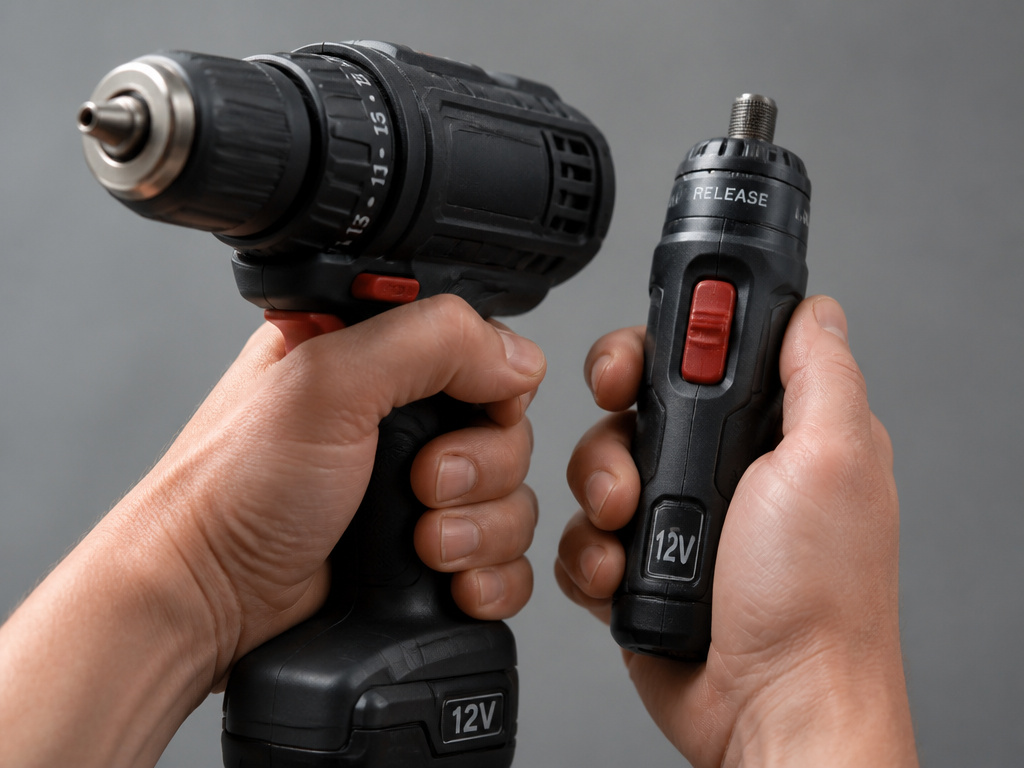 The 12V power tool category is where the distinction between drill and screwdriver gets intentionally fuzzy. Brands design these tools to be compact and versatile, often sacrificing peak power for size. This creates hybrids that are competent at both tasks but masters of neither.
The Compact Drill-Driver
A tool like the Skil PWRCore 12 Brushless Hammer Drill (HD5290A-10) is a prime example. It has a 1/2-inch chuck and a hammer function, so it can technically drill into concrete. Its 350 in-lbs of torque and 0–1,750 RPM are respectable for a 12V tool. In testing, it even outperformed some professional 12V models in drilling speed.
However, it’s heavier and less compact than other 12V options. At nearly 3 lbs with its battery, it’s not the tool you want for driving 100 screws overhead. It’s a capable, small drill that can drive screws when needed, not a dedicated screwdriver.
The Purpose-Built 12V Screwdriver
On the other side, you have tools like the Bosch Professional GSR 12V-32 FC. This is a fascinating beast. It’s first and foremost a screwdriver, part of the FlexiClick system that lets you attach right-angle and offset drives. But its party trick is the optional PRO GFA 12-H rotary hammer attachment, which transforms it into an SDS-plus hammer drill for concrete.
This is the exception that proves the rule. Bosch created a modular screwdriver and added drilling capability via a bulky, specialized attachment. The core tool is still a screwdriver, compact, lightweight, with a precise clutch. It highlights that even when you merge functions, the base tool’s DNA dictates its primary role.
Drill vs Screwdriver: Job-by-Job Breakdown
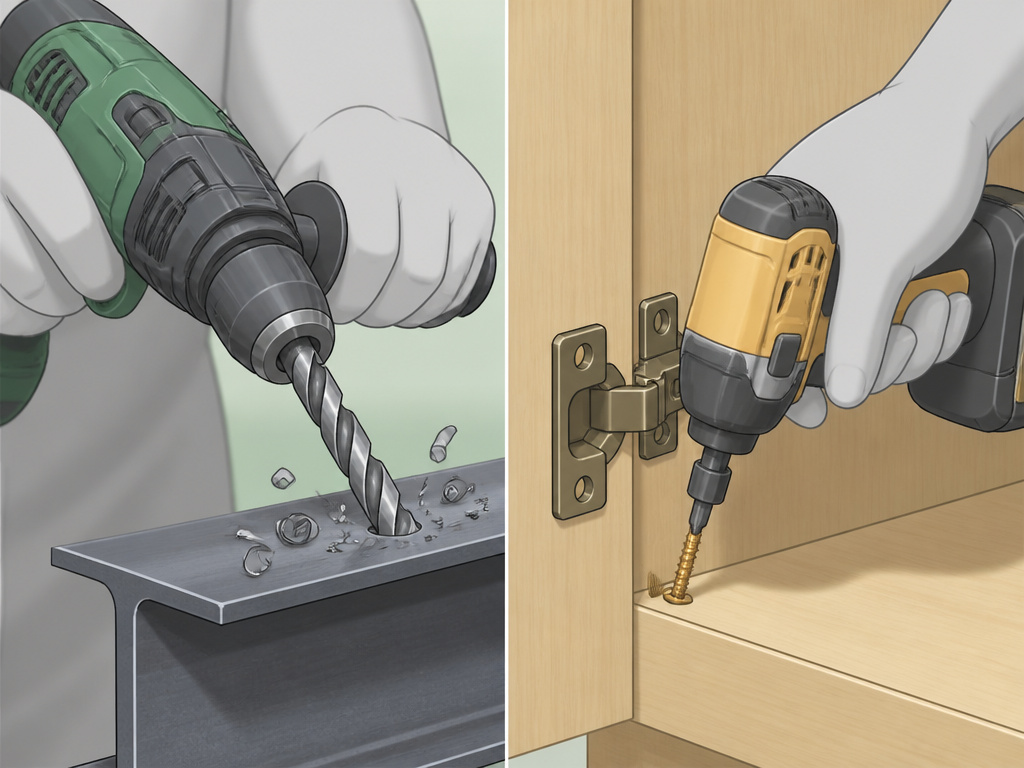 Stop thinking about tools and start thinking about tasks. This table matches the job to the right tool, explaining why the other is a poor fit.
| Task | Best Tool | Why It Wins | Why the Other Fails |
|---|---|---|---|
| Drill a 3/8″ hole in a steel beam | Power Drill (Bosch GSR 18V-90 C) | High, sustained torque (64 Nm) and low-speed setting power through metal without stalling. | Screwdriver lacks chuck for drill bit; insufficient RPM and torque. |
| Install 50 cabinet hinges | Power Screwdriver (Hilti SFD 2-A12) | Precision clutch prevents stripping brass screws; lightweight design reduces fatigue; quick bit changes. | Drill’s high RPM strips screw heads; heavy weight is tiring; clutch is too coarse. |
| Assemble flat-pack furniture | Power Screwdriver (Bosch GO Gen3) | Low speed (306–396 RPM) and mechanical clutch protect soft particle board; one-handed operation. | Drill’s torque cracks MDF; difficult to control at low speeds. |
| Mount a TV bracket to a concrete wall | Hammer Drill (Bosch GSB18V-975CB25) | Hammer action (0–31,500 BPM) breaks up masonry; high torque sets heavy anchors. | Screwdriver cannot drill into concrete; lacks power for anchor setting. |
| Run 200 drywall screws | Drywall Screwdriver (Bosch GTB185-LI) | 4,500 RPM sinks screws fast and consistently; depth stop ensures perfect dimple without tear-out. | Standard drill lacks depth stop, tears paper, sinks screws inconsistently. |
| Drive a few deck screws into pre-drilled holes | Either (Drill on low clutch setting) | For a small number, the drill is adequate if you’re careful. | For a whole deck, the drill’s weight and poor control become major liabilities. |
Bottom line: Volume decides. The more repetitive the fastening task, the more a dedicated screwdriver pays off in speed, quality, and reduced user fatigue.
Making the Choice: What to Buy for Your Work
You don’t need to own both a premium drill and a premium screwdriver. You need to own the right tool for the work you actually do most often. The other tool can be a capable budget option, or you can rent it for the rare project.
For the Occasional DIYer
If your projects are sporadic, hanging a shelf, building a planter box, assembling the occasional piece of furniture, a mid-range cordless drill/driver kit is your best single tool. Look for a model with a good clutch (20+ settings) and practice using the lowest speed setting for screws. The Bosch GSB18V-490B12 offers a solid 490 in-lbs of torque and a 20-setting clutch for a reasonable investment. Accept that you’ll replace driver bits more often and may occasionally mar a project. The trade-off in cost and storage space is worth it.
For the Serious DIYer or Handyman
If you regularly tackle multi-day projects like building a deck, renovating a room, or installing cabinets, you cross the threshold where a dedicated screwdriver earns its keep. Your drill handles the holes. Your screwdriver, like the Bosch Professional GSR 12V-32 FC or a Hilti SFD 2-A12, handles the joinery. The time saved not fighting stripped screws, the professional-looking results, and the reduced arm strain justify the second tool. Your drill can be a heavier, more powerful model since you won’t be holding it all day.
For the Professional
This is no longer a choice. It’s a requirement. A pro needs a high-torque hammer drill (like the Bosch 18V series) for groundwork and a suite of screwdrivers for different trades: a compact model for electrical, a drywall gun for boarding, a high-torque driver for framing. Specialization is how you work faster and waste less material. The Deprag cordless screwdrivers, with their mechanical shut-off clutch and torque accuracy of <3% standard deviation, are built for this world, repeatable, reliable precision, thousands of times a day.
Frequently Asked Questions
Can I use my drill as a screwdriver?
Yes, but with significant caveats. You must use a 1/4-inch hex adapter in the drill’s chuck, set the clutch to a low number, and use the variable speed trigger gently. It will work for a handful of screws. For any volume of work, this method leads to prematurely worn bits, stripped screw heads, and less control over depth. It’s a compromise, not a solution.
What is the main advantage of a power screwdriver?
Control. The primary advantage is the precision clutch that stops the tool at a specific torque. This prevents over-driving and damage to the workpiece and the fastener. Secondary advantages include lighter weight, better balance for all-day use, and faster bit changes with a hex chuck.
Do I need a hammer drill?
Only if you need to drill into masonry, concrete, or brick. The hammering action (measured in Blows Per Minute) is essential for fracturing hard material. For drilling into wood and metal, a standard drill is sufficient. Many hammer drills allow you to turn the hammer function off, making them versatile combo tools.
Is a 12V tool powerful enough for home use?
For 90% of home tasks, yes. A modern 12V brushless drill like the Skil PWRCore 12 can drive 3-inch deck screws and drill 1-inch holes in wood. They struggle with continuous heavy-duty tasks like mixing mortar or drilling large-diameter holes in dense wood. Their compact size is often a bigger advantage than their slight power deficit is a drawback.
What’s better: a quick-change chuck or a keyless chuck?
It depends on the task. For a drill, a keyless chuck provides the strongest, most secure grip on round-shank drill bits, which is essential for safety and performance. For a screwdriver, a quick-change hex chuck is superior because it allows for one-handed bit swaps in seconds, which is critical when you’re constantly switching between screw types.
Can a power screwdriver drill holes?
Only if you use hex-shank drill bits, which are available but limited in type and size. The screwdriver’s lower RPM and lack of a true chuck mean hole quality will be poorer, and the process will be slower than with a drill. It’s a last-resort option for small, shallow holes in soft materials.
The Bottom Line
A power drill and a power screwdriver are not interchangeable. One is a hole-maker, the other a fastener-setter. Picking the wrong tool doesn’t just make the job harder; it leads to broken bits, ruined materials, and a frustrating waste of time.
For most homeowners, a single quality drill/driver covers the bases. Once your projects involve more than a dozen screws at a time, a dedicated screwdriver becomes a wise investment. Look at your last few projects. Did you spend more time drilling holes or driving screws? Your answer is your buying guide. When in doubt, lean towards the tool that matches your highest-volume task, you’ll work faster, cleaner, and with less frustration.
