5 Ways How to Make a Hole Without a Drill (No Power Tools)
This post contains affiliate links. As an Amazon Associate, we earn from qualifying purchases.
You can make a hole without a drill by using a force-based punching method or a manual rotary cutting tool. The five core methods are: a hydraulic punch driver for clean holes in sheet metal, a manual hole saw for larger diameters in pipe, a knockout driver for conduit, a core pin for molding plastics, or a simple hammer and chisel for rough openings in masonry. Each method has a strict material thickness limit, exceed it and the tool jams or breaks.
The 10-gauge steel limit on a standard hydraulic punch is the definitive point where the ram stops moving and the internal seals start to weep. You’ll feel the pump lever go solid, and if you force it, the repair bill arrives before the hole does.
What follows is a breakdown of each method by the material it’s actually rated for, the exact failure you’ll hit if you push past the spec, and the one tool that covers most homeowner scenarios.
Key Takeaways
- A Greenlee hydraulic punch driver punches a clean, burr-free hole in up to 10-gauge mild steel in under a minute, but it jams permanently if you exceed that thickness.
- Manual hole saws require significant arm strength and a steady RPM to cut through pipe; let the saw bog down and the teeth strip in under 10 seconds.
- Knockout drivers are for electrical conduit; using them on stainless steel demands a specific Slug-Splitter punch or the slug won’t release.
- The Victaulic VHCT900 is a dedicated, manual hole-cutting fixture for steel pipe; it is not designed for cast iron, PVC, or HDPE.
- For a single, small hole in thin metal, a hammer and center punch is faster than setting up any dedicated tool, but the edge will need filing.
The 5 Core Methods for Making a Hole Without a Drill
Your choice is determined by the material’s hardness and the hole’s required finish. A punch shears a slug out, leaving a smooth edge.A hole saw grinds a kerf, leaving a rougher cut that often needs deburring. A chisel just fractures the material.
The maximum thickness of material that a punch can penetrate depends on the size and shape of the punch. Refer to the instruction manual supplied with the punch for individual punch capacities. This technical note from Greenlee’s hydraulic punch manual underscores that capacity is not universal, a 1/2″ punch can handle thicker steel than a 4″ punch of the same type.
| Method | Best Material | Hole Quality | Primary Limitation |
|---|---|---|---|
| Hydraulic Punch Driver | Sheet metal (≤10 ga steel) | Clean, no burr | Strict thickness capacity; costly setup |
| Manual Hole Saw | Pipe, tubing, wood | Rough, needs deburring | High physical effort; slow |
| Hydraulic Knockout Driver | Electrical conduit | Very clean | Material-specific punch types required |
| Core Pin | Molten plastic | Molded-in, smooth | Requires a mold; not for post-processing |
| Hammer & Chisel | Brick, soft masonry | Very rough | Inaccurate; generates dust and fragments |
1. Hydraulic Punch Driver: For Clean Holes in Sheet Metal
This is the professional’s choice for electrical panels, HVAC duct, or appliance installation. A Greenlee 1731 Portable C-Frame Punch Driver uses a hand pump to drive a ram and a hardened punch through the material into a die. It doesn’t rotate, it shears.
The C-Frame design eliminates the need for a pilot hole, which is the main time-saver over drilling. You just need to mark the center.
Step-by-Step for a Bump-Feed Head (and Where It Jams)
- Select the punch and die set for your desired hole size (e.g., 3/4″ for conduit).
- Thread the draw stud completely into the ram. If any threads are exposed after assembly, you need a spacer. Missing this strips the threads on the punch.
- Slide the die onto the stud, open end facing away from the ram.
- Position the assembly and hand-tighten the punch onto the stud from the other side.
- Connect the hand pump and support the ram’s weight. Start pumping.
If the ram stops before the hole is complete, stop pumping. Check that the setup is correct and that you have not exceeded the tool’s capacity. This is the direct warning from the manual. The ram stops because the hydraulic pressure has met the material’s resistance. More pumping just strains the seals.
The hole finishes with a clean pop and a slug drops into the die. The edge is smooth, often requiring no further work. For stainless steel, you must use a Greenlee Slug-Splitter punch; a standard punch will gall and seize.
2. Manual Hole Saw: For Larger Holes in Pipe and Wood
A bi-metal hole saw mounted in a hand brace or a hefty tap wrench can cut holes up to 4 1/2 inches. This is how plumbers and electricians made holes before cordless drills. The key is managing speed and pressure entirely by hand.
The Victaulic VHCT900 Hole Cutting Tool is a dedicated manual fixture for this. It’s a frame that clamps to a pipe, with a hand crank to advance a hole saw. The manual is explicit: it is designed only for cutting holes in carbon steel, stainless steel pipe, and copper tubing.
The Physics That Makes or Breaks Your Arms
A hole saw cuts via hundreds of tiny teeth each taking a small chip. Hand-cranking provides the RPM and feed pressure. If you push too hard, the teeth clog and snap. If you go too slow, the work-hardens the metal and the saw stalls.
The VHCT900 manual includes a specific RPM table for different materials. For a 1-inch hole saw in mild steel, the recommended speed is 350 RPM. Try spinning a hand crank at 350 RPM while maintaining steady pressure. It’s a workout.
- Use cutting oil. It reduces heat and triples the saw’s life.
- Clear chips every 10-15 seconds. Back the saw out, brush it clean.
- Reduce pressure before breakthrough. The last millimeter of material can snag and jerk the tool.
Without the fixture, using a hole saw in a plain hand brace is a lesson in frustration. The saw wanders, the pilot bit snaps, and the cut is rarely square. The fixture exists for a reason.
3. Hydraulic Knockout Driver: The Electrician’s Standard
Often called a “KO kit,” this is a cousin to the punch driver but designed specifically for punching holes in electrical panels and load centers for conduit. The principle is identical: a hydraulic ram pushes a punch through a die.
The critical spec from the Greenlee manual is the maximum driver rating: 10 gauge (0.134″, 3mm) for mild steel. This applies to both standard and Slug-Splitter punches.
Where this goes sideways: Using a standard punch on stainless steel. The stainless galles and welds itself to the punch. The slug won’t drop, and you’ll spend an hour with a hammer and punch trying to drive it out, usually damaging the die. The Slug-Splitter design has reliefs to prevent this adhesion.
The process for making holes in metal without a drill is essentially this method. The setup, drill a pilot hole for the draw stud, assemble punch and die, pump, is the same. The knockout driver is just the version of the tool most common in an electrician’s truck.
4. Core Pin: For Forming Holes in Molded Parts
This tool is a method for making holes without drilling after the fact. A core pin is a hardened steel pin placed in an injection mold.Plastic flows around it, forming a hole as the part is made.
The tolerance on the diameter of a core pin is about -0.0003 to -0.0005 inches. This is precision-ground tool steel. If you need a hole in a plastic part, designing it into the mold with a core pin is how it’s done industrially. It’s not a post-processing technique.
5. Hammer and Chisel (or Center Punch): The Brutal Fallback
For a one-time hole in soft brick or a plaster wall, you can punch through. Use a masonry nail or a star drill. Hit it with a 3-pound hammer, rotate slightly, hit again. It’s slow, messy, and imprecise.
A center punch and hammer can make a small starting hole in thin sheet metal. You’re not removing material; you’re displacing it, creating a dent and a raised burr on the back side. You’ll then need to file that burr off. It’s effective for a screw hole in a bracket, terrible for anything requiring accuracy.
This approach is related to techniques for making holes in concrete without a drill, though for concrete, a manual star drill and sledgehammer is the historical method.
What Most Guides Get Wrong: Capacity and Cleanup
The biggest mistake is treating these methods as interchangeable. They are not.
A hydraulic punch rated for 10-gauge steel will not punch through 1/8-inch plate. The number seems close (0.134″ vs. 0.125″), but that’s the difference between a clean punch and a seized ram. The tool’s rating includes a safety factor for the steel’s tensile strength. Exceed it and the punch acts like a press-fit, not a shear.
Cleanup is the other half. A punched hole is often ready. A hole-saw cut will have a sharp, turned burr on the edge, a feather edge that will cut wires or hands. You need a deburring tool or a file. Most manual hole-making guides skip this, leaving you with a dangerous part.
Choosing Your Method: A Decision Framework
 Stop thinking about the hole. Start with these three questions in order.
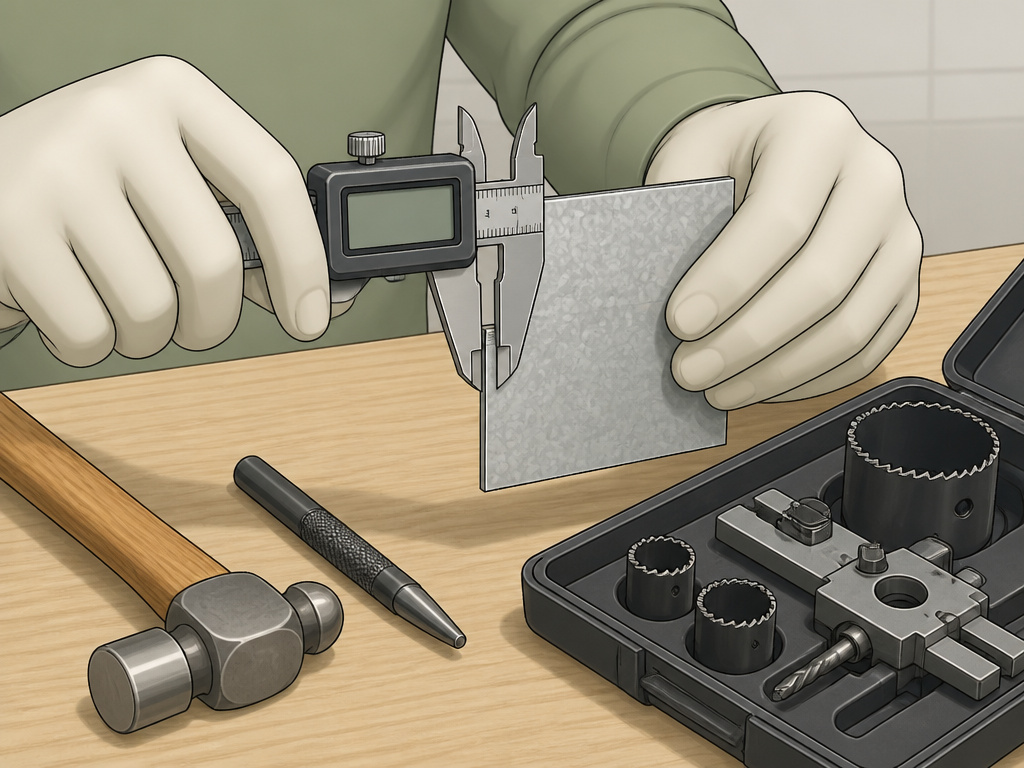
- What is the material and its exact thickness? Find a caliper. “Thin metal” isn’t a spec. “22-gauge galvanized steel” is.
- What is the required finish? Does a burr matter? Is the hole visible? For wiring, a burr can strip insulation.
- How many holes? Setting up a hydraulic punch takes five minutes. For one hole, a hammer and punch is faster. For ten holes, the punch pays off immediately.
For the majority of DIY scenarios involving metal or pipe, a manual hole saw kit with a guide fixture (like the VHCT900 concept) or a rented hydraulic punch driver is the correct answer. The learning curve is shallow, the result is professional, and the risk of ruining the workpiece is low.
For creating holes in wood without a drill, different rules apply, an auger bit in a hand brace is often the best manual tool.
Frequently Asked Questions
Can you punch a hole in stainless steel without a drill?
Yes, but you must use a tool and punch designed for it. A standard carbon steel punch will gall and stick. You need a Greenlee Slug-Splitter punch or an equivalent high-grade alloy punch in a hydraulic driver. The lubricated, relieved design prevents the stainless from adhering to the tool face.
What is the thickest metal you can punch by hand?
With a standard hydraulic punch driver, the universal limit is 10-gauge mild steel, which is about 0.134 inches (3.4mm) thick. Larger diameter punches may have lower thickness ratings. Always check the specific punch’s capacity chart, not just the driver’s rating.
Is a manual hole saw worth it?
Only if you have a fixture to hold it square and steady, like the Victaulic VHCT900 or a robust drill press converted to hand crank. Using a hole saw in a simple hand brace for metal is an exercise in frustration and broken tools. For wood, it’s more feasible but still requires significant effort.
How do you make a small hole in thin metal without power?
Use a center punch. Hammer it sharply to create a deep dimple. Then, use a hammer and a small nail or a pin punch to drive through the thin remaining web. The hole will be irregular and have a burr on the back, which you must file smooth. This is the same principle behind making holes in plastic manually, though plastic may crack.
What’s the difference between a knockout and a punch?
In common trade language, they are often used interchangeably. Technically, a “knockout” refers to the pre-formed, scored circle in an electrical panel designed to be punched out. A “knockout driver” or “punch driver” is the tool used to remove them or create new ones. The tools are functionally identical.
Before You Go
Making a hole without a drill involves choosing the right force for the material. A hydraulic punch applies tons of shear force in a controlled line.A hole saw applies rotational grinding force. A hammer applies blunt impact.
For a single, clean hole in sheet metal up to 10-gauge, rent a Greenlee hydraulic punch driver. The setup time is the only cost. For larger holes in pipe, a bi-metal hole saw in a guided fixture is the only manual method that produces a usable result. Forget the hand brace for metal. And always, always respect the thickness rating on the punch, that’s the line between a finished job and a broken tool.
