
What Is SCFM in Air Compressor | The Key to Matching Tools
This post contains affiliate links. As an Amazon Associate, we earn from qualifying purchases.
SCFM (Standard Cubic Feet per Minute) is the corrected airflow rate of an air compressor, calculated back to a set of standard conditions for temperature, pressure, and humidity. It allows you to compare the actual mass of air different compressors can move, regardless of their operating environment. The most common North American standard is 14.7 pounds per square inch absolute (psia), 60°F, and 0% relative humidity.
That definition is the starting line. It tells you what SCFM is, but it doesn’t tell you why a compressor rated for 10 SCFM at sea level might only deliver the equivalent of 8.3 SCFM to your tools in Denver, or why a 100 SCFM compressor only pushes about 13 actual cubic feet of compressed air through your pipes.
The rest of this guide walks through three specs, two competing standards, and the one conversion ratio that reframes every compressor spec sheet you’ll ever read. By the end, you’ll be able to decode any rating plate and know exactly how much air your tools will actually get.
Key Takeaways
- SCFM is a corrected mass-flow measure, not a physical volume. It answers: “If I took this air and brought it to standard conditions, what volume would it occupy?”
- The 7.8:1 compression ratio is critical: at 100 psi, 1 SCFM compresses to only about 0.128 ACFM. Using SCFM for pipe sizing oversizes your system by nearly 8 times.
- Altitude and temperature derate performance. A compressor rated for 100 SCFM at sea level delivers only about 83% of that mass flow in Denver (1,000 ft elevation, 85°F).
- Always confirm which standard (14.7 psia/60°F or 14.5 psia/68°F) a manufacturer uses before comparing specs, the difference is roughly 1.5% in mass flow.
- For continuous-duty applications like sandblasting or automotive painting, size your compressor’s SCFM rating with a minimum 25% headroom over your tool’s total demand.
SCFM vs ACFM vs ICFM: What’s the Real Difference?
The alphabet soup of airflow ratings exists because air is compressible. A cubic foot of air at your shop’s inlet is not the same as a cubic foot of air inside a pressurized pipe. The three terms map to different points in the system.
SCFM is the standardized benchmark. It’s the number on the spec sheet. ACFM (Actual Cubic Feet per Minute) is the physical volume of air flowing at a specific point, accounting for that point’s actual temperature and pressure. ICFM (Inlet Cubic Feet per Minute) is the volume of air entering the compressor’s intake, before any compression happens.
SCFM is directly proportional to mass flow, which is why it’s used for comparing compressor capacity and estimating input power. ICFM, used by manufacturers like CAGI and PNEUROP for centrifugal compressor selection, will yield varying amounts of mass flow depending on how much moisture is removed during intercooling and aftercooling.
If your shop’s conditions match the “standard” (sea level, 60°F, dry), then ICFM equals SCFM. That’s almost never the case. Your compressor pulls in warmer, maybe humid, air. The compressor then squeezes that air, which heats it further and drastically reduces its volume. That’s where ACFM lives, inside your pressurized pipes and tools.
Here’s how they relate across a typical system:
| Flow Type | Where It’s Measured | What It Tells You | Critical Use Case |
|---|---|---|---|
| ICFM | Compressor intake flange | Physical volume of air the compressor pulls in | Sizing inlet filters and predicting compressor selection |
| SCFM | Corrected to standard conditions | Comparable mass of air delivered | Selecting a compressor and comparing models |
| ACFM | At a specific point in the system (e.g., tool inlet) | Actual volumetric flow at that point’s pressure & temperature | Sizing pipes, hoses, and dryers |
The jump from SCFM to ACFM is where most DIY plans fail. At 100 psig, 1 SCFM compresses to about 0.128 ACFM. A “25 SCFM” compressor only pushes roughly 3.2 ACFM through your piping. Use an SCFM number in a pipe velocity calculator and you’ll install mains that are eight times too big.
The Two Standards: ISO vs. Traditional US
Not all “standard” conditions are the same. This is the fine print that makes direct comparison between a European-made compressor and a North American one tricky unless you convert.
The Traditional US standard, used on most North American datasheets, is 14.7 psia, 60°F (520°R), and 0% relative humidity. The ISO 1217 standard, adopted by CAGI and PNEUROP, uses 14.5 psia (1 bar), 68°F (20°C), and 0% RH.
The difference is about 1.5% in mass flow. It seems small, but it’s a direct mismatch. A compressor rated 100 SCFM on the ISO standard delivers slightly more mass flow than one rated 100 SCFM on the US standard. Before you compare two models, check the data sheet footnotes. If one doesn’t state its standard, assume it’s the US 14.7/60 standard, but call to confirm.
The ANSI standard requires manufacturers to list both actual and standard conditions on the rating plate. That plate is your first stop for verification.
How Altitude and Temperature Change SCFM
SCFM ratings assume sea-level air density. Install a compressor at altitude, or run it on a hot day, and the mass of air it can move drops. The physics are simple: warmer, thinner air weighs less per cubic foot.
The math from the research is concrete. A compressor rated for 500 SCFM at sea level (14.5 PSIA, 68°F, 0% RH) would need to be increased to 540 SCFM to deliver the same pneumatic system performance at 1,000 feet above sea level (14.2 PSIA) with a site temperature of 85°F and 60% relative humidity.
Where this goes sideways: Assuming a compressor’s nameplate SCFM is what you’ll get in your garage in July. In Denver, a 100 SCFM sea-level-rated compressor delivers only about 83 SCFM-equivalent mass flow. If your tools need 100 SCFM, you’re 17% short before you even flip the switch.
This derating is predictable. When evaluating an existing compressor at altitude, derate its sea-level nameplate by the atmospheric pressure ratio. At 5,000 feet, atmospheric pressure is around 12.2 psia. That’s roughly 83% of sea-level pressure (14.7 psia). Expect a proportional drop in mass flow.
Before you start: Compressed air systems generate heat and noise. Always install with adequate ventilation, wear hearing protection during extended use, and depressurize the system before performing any maintenance.
Why SCFM Matters for Tool Selection
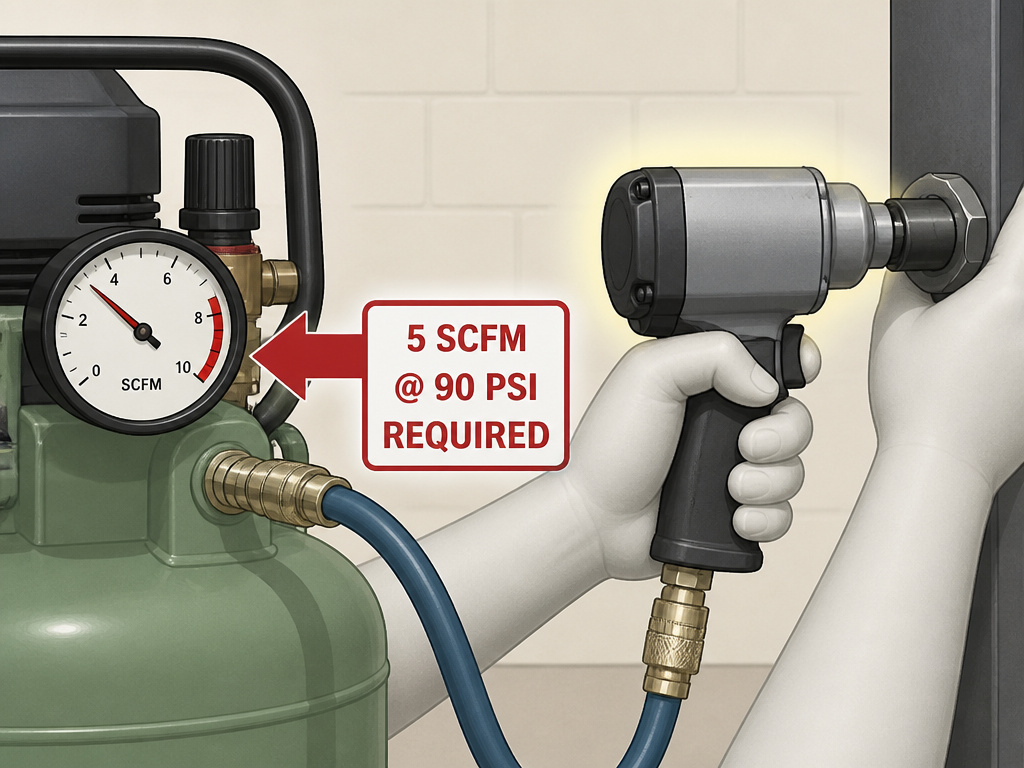 Your air tools have a minimum SCFM requirement, not an ACFM requirement. That’s because their internal mechanisms, vanes, pistons, gears, need a specific mass of air to develop rated torque or speed. A half-inch impact wrench might need 5 SCFM at 90 psi. If your compressor can only deliver 4 SCFM at that pressure, the wrench will be weak and slow.
This is the core of matching an air compressor for air tools. You total the SCFM demand of all tools you might run simultaneously, then add headroom. For intermittent-use tools in a home garage air compressor setup, a 25% buffer is a good rule. For continuous-use tools like sanders or spray guns, you need 50% or more.
| Common Tool | Typical PSI | Typical SCFM @ PSI | Compressor Size Guideline |
|---|---|---|---|
| Framing Nailer | 70-120 | 2-3 SCFM | A small compressor for framing nailers (4-6 gal) suffices. |
| 1/2″ Impact Wrench | 90 | 4-6 SCFM | Requires a mid-size compressor for impact wrenches (20+ gal). |
| Die Grinder | 90 | 4-8 SCFM | Demands steady flow; larger tank or continuous-duty screw compressor. |
| HVLP Spray Gun | 40-50 | III10-20 SCFM | Needs high, continuous SCFM; a dedicated compressor for painting cars is often necessary. |
The “guideline” column isn’t just about tank size. It’s about the compressor’s pump or screw element being able to replenish air at a rate that meets the tool’s SCFM draw. A small pancake compressor might run a nailer but will cycle constantly and wear out quickly on a grinder.
The Critical Conversion: SCFM to ACFM for Piping
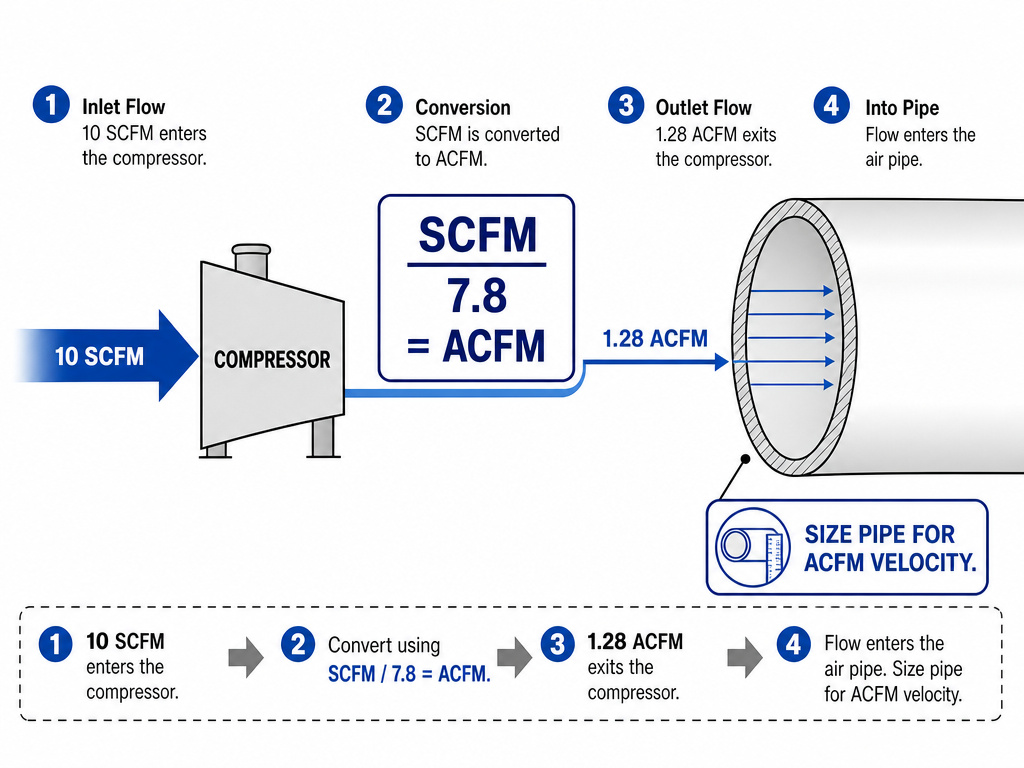 Your compressor delivers SCFM. Your pipes carry ACFM. Forget this conversion and your system will be loud, inefficient, or worse, undersized for pressure drop.
The formula is rooted in the ideal gas law, but the practical ratio is what you need to remember. At 100 psig, the compression ratio is roughly 7.8:1. So: * 10 SCFM ≈ 1.28 ACFM at the compressor outlet * 30 SCFM ≈ 3.85 ACFM * 100 SCFM ≈ 12.8 ACFM
You size pipe for velocity, aiming for 20-30 feet per second in mains to minimize pressure drop. Velocity depends on ACFM, not SCFM. Feeding an SCFM number into a pipe-sizing chart is the single most common error in DIY compressed air system design. You’ll install 3/4-inch pipe where 1/2-inch would do, wasting money and creating more volume for the compressor to fill.
For a home shop air compressor running a few tools, this mistake is annoying. For a professional garage air compressor setup running multiple stations, it’s a production bottleneck.
How to Use SCFM When Buying a Compressor
Armed with the definitions, your buying process changes. You stop looking at horsepower first. You start with SCFM.
- List your tools. Find the SCFM requirement for each at your operating pressure (usually 90-100 psi for most tools).
- Identify simultaneous use. Will you ever run the die grinder and the impact wrench at the same time? Add those SCFM numbers together.
- Apply headroom. Add 25% for intermittent shop use. For a busy workshop compressor or auto shop, consider 50%.
- Adjust for environment. Are you at altitude? Is your shop hot in summer? Use the derating estimates to bump your target SCFM number up.
- Compare compressor specs. Now look at compressor SCFM ratings at your desired pressure. Ignore peak SCFM; look for the continuous duty rating. This is where understanding the difference between SCFM and CFM is non-negotiable.
- Consider duty cycle. A reciprocating (piston) compressor with a 50% duty cycle needs time to cool. For continuous demand, a rotary screw compressor is the only answer.
The compressor that meets your calculated SCFM number at your pressure is the one that won’t let your tools down. The one with the highest horsepower but lower SCFM is just a noisier disappointment.
Frequently Asked Questions
Is a higher SCFM rating always better?
Not necessarily. A higher SCFM compressor is larger, more expensive, and consumes more power. You should match the SCFM to your actual tool demand with some headroom. Significantly oversizing wastes money on the initial purchase and on electricity.
Can I convert CFM to SCFM?
Only if you know the actual conditions (temperature, pressure, humidity) at which that CFM was measured. “CFM” by itself is ambiguous, it could be ICFM, ACFM, or even SCFM if the conditions were standard. Always ask for clarification. The Wikipedia SCFM definition page provides the full conversion formulas.
Why does my compressor’s SCFM drop as pressure increases?
This is normal for positive-displacement compressors (like piston and screw types). As discharge pressure rises, it becomes harder for the pump to push air out against that pressure, so the volumetric efficiency, and thus the SCFM output, decreases. The performance curve on a spec sheet shows this relationship.
Do I need to consider SCFM for a small nail gun?
Yes, but the requirement is low. A finish nailer might only need 0.5-1 SCFM. Even a small 1-gallon compressor can often meet this, but you must check the tool’s specs. The key for nail guns is often the recovery rate (how fast the compressor can rebuild pressure) more than the peak SCFM.
How does humidity affect SCFM?
SCFM calculations assume 0% relative humidity (dry air). Moist air is less dense because water vapor displaces some of the heavier nitrogen and oxygen. In very humid conditions, the actual mass flow (and thus the effective SCFM) from a compressor will be slightly lower than in dry conditions. For most home shops, this effect is minor compared to altitude and temperature.
The Bottom Line
SCFM isn’t marketing jargon. It’s the linchpin of a functional air system. It lets you compare a compressor in Phoenix to one in Portland and know which one actually moves more air to your tools.
Remember the three numbers: the standard (14.7/60 or 14.5/68), the 7.8:1 compression ratio for piping, and the altitude/temperature derate. Get those right, and you’ll buy a compressor that fits your nail gun, your impact wrench, and your shop’s climate. Get them wrong, and you’ll be listening to a motor cycle endlessly while your tools barely turn.
Match the SCFM, not the horsepower. That’s the whole game.
