
Kobalt Air Compressor Use Guide: Operation and Daily Draining
This post contains affiliate links. As an Amazon Associate, we earn from qualifying purchases.
To use a Kobalt air compressor, match your tool’s PSI requirement to the regulator, start with an empty tank, and drain the condensation every single time you shut it off. The manuals for the 5-gallon and 20-gallon models specify a daily tank drain to prevent internal rust, skip it, and the tank weakens from the inside out within a season.
That daily drain is the line between a compressor that lasts a decade and one that springs a leak in two years. The moisture from compressed air settles at the bottom of the tank.Leave it there, and you’re breeding corrosion where you can’t see it.
What follows is the sequence that keeps a Kobalt running: five steps for first-time startup, the one adjustment that burns out motors, the non-negotiable daily shutdown ritual, and the model-specific numbers (amperage, SCFM) that decide which tools you can actually run.
Key Takeaways
- Drain the tank after every use. The Kobalt 5-gallon manual states this as a daily requirement to prevent corrosion, this is the most skipped step with the costliest consequence.
- Never use an undersized extension cord. The 5-gallon model (14.5A) requires a 12 AWG cord if you must use one; a 16-gauge cord overheats and can trip the thermal overload.
- Let the pump cool before moving or servicing. The pump head reaches temperatures high enough to cause second-degree burns within minutes of operation.
- Match your air tool’s PSI requirement using the regulator, not the tank gauge. The tank stores pressure (up to 175 PSI on some models); the regulator controls what goes to your tool.
- Pull the pressure relief valve ring daily. This verifies the safety valve isn’t seized, which is your last defense against a tank over-pressurization.
The First-Time Startup Sequence (Get It Right in 5 Steps)
Mistakes here don’t just waste time. They burn out motors, blow O-rings, and send you back to the store. Follow this order exactly.
- Position and Ventilation. Place the compressor at least 12 inches from any wall. The motor and pump need airflow to cool. On a hot garage floor, that distance is your margin against the thermal overload switch tripping mid-job.
- Power Check. Plug directly into a 120V outlet. If you must use an extension cord for your portable air compressor, the manual is specific: for the 14.5-amp 5-gallon model, use a 12 AWG cord no longer than 30 feet. A 16-gauge cord on that load will overheat, voltage will drop, and the motor will struggle.
- Pre-Pressurization. Set the ON/OFF switch to OFF. Turn the regulator knob (clockwise increases pressure) fully counterclockwise to zero. Ensure the tank drain valve is closed. This ensures the pump starts against no backpressure, which is easier on the piston seals.
- Hose and Tool. Connect your air hose to the quick coupler. Attach your tool, a nailer, blow gun, or tire chuck. A proper hose connection is hand-tight plus a quarter-turn with a wrench. Overtightening cracks the plastic coupler.
- Start and Set. Now, flip the switch to ON. Let the tank fill until the motor automatically shuts off at the “cut-out” pressure (e.g., 175 PSI on the 5-gallon model). Then turn the regulator knob clockwise to match your tool’s required PSI. The regulated pressure gauge shows the output.
Where this goes sideways: Starting with pressure already in the tank and the regulator set high. The pump kicks on under a heavy load, the motor amps spike, and the thermal overload can trip in under 90 seconds. Always start from zero.
Know Your Model’s Limits: PSI, SCFM, and Amps
Your Kobalt isn’t a universal power plant. Each model has a printed spec sheet that dictates what it can do. Ignoring these numbers is how you end up with a compressor that runs constantly but never finishes the job.
The tank pressure (PSI) is about force. The airflow (SCFM) is about volume. A framing nailer needs high PSI (90-120) but low SCFM (2-3). A die grinder needs lower PSI (70-90) but high SCFM (4-6). Your compressor must meet both requirements.
| Kobalt Model (Example) | Tank Size | Max PSI | SCFM @ 90 PSI | Motor Amps | Best For |
|---|---|---|---|---|---|
| 6-gallon Pancake (02106410D) | 6 gal | 150 PSI | 2.6 | 12 A | Brad nailers, staplers, inflating tires, light blowing |
| 8-gallon (0300842) | 8 gal | 150 PSI | 4.0 | 12 A | Finish nailers, trim work, smaller air tools |
| 10-gallon (JFD-10G-S) | 10 gal | 175 PSI | 4.3 | 13 A | Roofing nailers, larger impacts, prolonged use |
| 5-gallon Twin-Stack (0320541) | 5 gal | 175 PSI | 5.0 | 14.5 A | Framing nailers, heavier duty spray gun work |
| 20-gallon (0332041) | 20 gal | 150 PSI | Not Specified | 12.5 A | Sandblasting, running two tools, for the garage shop |
The amperage matters for your circuit. The 5-gallon model at 14.5 amps is at the limit of a standard 15-amp household circuit if anything else is running on it. If the lights dim when it kicks on, you need a dedicated circuit.
The 5-gallon Kobalt electric air compressor (ITEM #0476123) requires a 14.5-amp, 120-volt circuit. Its manual explicitly states that if an extension cord must be used, it should be a minimum of 12 AWG wire and no longer than 30 feet to prevent voltage drop and motor damage.
The Non-Negotiable Daily Routine
This isn’t cleaning. This is preventing a pressure vessel from turning into a rust bucket. The sequence takes two minutes.
- Shut Down. Turn the ON/OFF switch to OFF. Unplug the compressor. This is non-negotiable. The switch is a mechanical contact; leaving it powered invites a rare but possible short.
- Depressurize. Pull the ring on the pressure relief valve. You’ll hear a loud hiss as all air leaves the tank and hose. Do this every time. It ensures the valve doesn’t seize shut.
- Drain the Tank. Place a shallow pan under the drain valve at the tank’s bottom. With pressure at zero, open the valve. Water and a little oil mist will spit out. Let it drain until it’s a drip.
- Leave it Open. After draining, leave the drain valve cracked open until the next use. This lets any residual moisture evaporate and tells you at a glance the tank is safe.
Skip the drain, and the water sits. In a month, the bottom of the tank starts to rust. In a season, that rust can perforate. A leaking air tank is scrap metal.
Adjusting Pressure and Using Tools
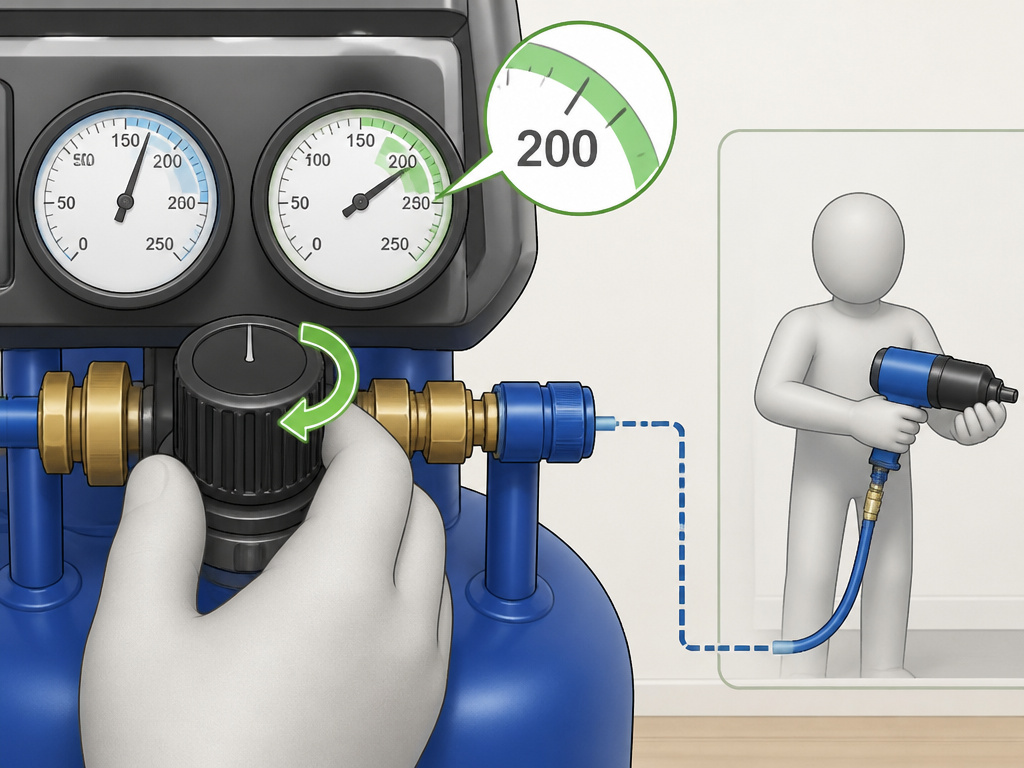
The regulator is your control center. The tank gauge tells you storage; the regulator gauge tells you delivery.
To increase pressure to your tool: With the tank pressurized, turn the regulator knob clockwise. Watch the regulated pressure gauge climb. Stop at your tool’s required PSI.
To decrease pressure: Turn counterclockwise past your target, then come back up to it. This ensures the regulator diaphragm settles accurately.
For tire inflation, set the regulator to your tire’s recommended PSI (often 32-35 PSI for cars). Use a clip-on chuck. The compressor will cycle on and off to maintain tank pressure as you fill.
For a spray gun, consult the gun’s manual. Most HVLP guns need 25-40 PSI at the gun, but you set a higher pressure at the regulator (e.g., 50-60 PSI) to account for pressure drop across the hose and filter. Start low and test.
Common mistake: Cranking the regulator to the tank’s max pressure because “more is better.” This blows out the tool’s internal O-rings, overdrives nails into the wood, and creates a foggy, runny paint job. Match the tool’s rating exactly.
Troubleshooting: When Your Kobalt Won’t Cooperate
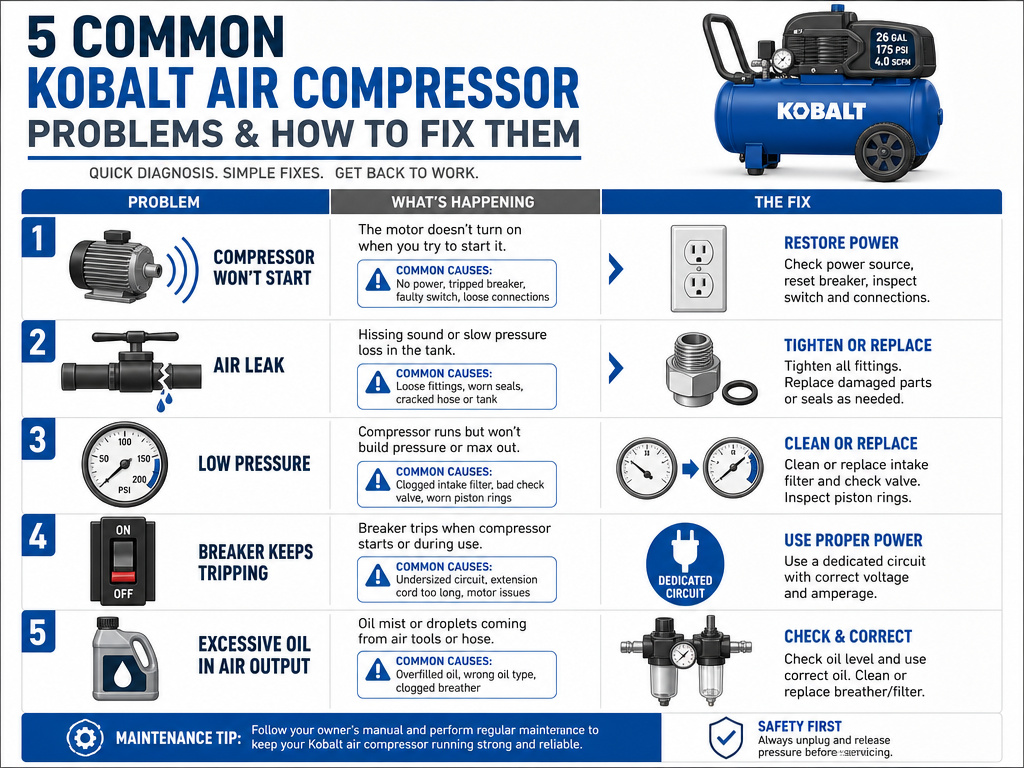
The compressor is simple. When it fails, it’s usually one of five things.
| Problem | Most Likely Cause | Immediate Fix |
|---|---|---|
| Motor hums but won’t start | Tank already pressurized above cut-in pressure. | Use air or pull relief valve to drop tank pressure below 120 PSI (or model’s cut-in). |
| Motor runs but builds no pressure | Faulty check valve at the pump outlet. | Unplug, depressurize, and listen for a hiss at the pump head. Replacement is a $15 part. |
| Trips circuit breaker on startup | Undersized extension cord or circuit overload. | Plug directly into wall. Ensure no other high-draw tools (shop vac, saw) are on the same circuit. |
| Excessive moisture at the tool | Ambient humidity is high, and the compressor has no aftercooler. | Add an in-line filter/regulator at the tool. Drain the tank more frequently during use. |
| Thermal overload switch tripped | Motor overheated from continuous duty, blocked vents, or low voltage. | Unplug. Wait 30 minutes for motor to cool. It will reset automatically. Improve ventilation. |
The thermal overload is a safety device inside the motor. If it trips, the motor stops until it cools. This design prevents a fire. Find and eliminate the cause: restricted airflow, too-small extension cord, or demanding a 5-gallon compressor to run a sander non-stop.
Safety: The Rules That Aren’t Suggestions
ANSI Z87.1 safety glasses are mandatory. Compressed air can blow chips, dirt, or a fitting failure straight into your eyes. Hearing protection is a close second. A compressor at 80 decibels will cause hearing damage over time.
Never modify the pressure switch or relief valve. They are preset at the factory. Tampering voids the warranty and creates a bomb.
The pump head gets hot enough to burn skin in seconds. Let the unit cool for 15 minutes before moving it or performing any basic air compressor use maintenance. Keep kids away, always.
Maintenance Beyond the Daily Drain
Weekly, check hose and cord for cracks. Monthly, inspect the air filter on the pump intake (if equipped). A clogged filter makes the pump work harder and overheat. Clean it with compressed air.
Annually, consider the environment. In a damp basement, corrosion happens faster. For a garage compressor, keeping it on a pallet off the concrete floor helps.
When you need fittings, couplers, or filters, a good air compressor accessory kits has everything. Don’t buy the cheapest brass couplers; they wear out and leak faster than forged steel.
Frequently Asked Questions
Why does my Kobalt compressor shut off before reaching full pressure?
The thermal overload protector in the motor has tripped. The motor is overheating due to blocked cooling fins, a dirty air filter, excessive duty cycle, or low voltage from a long, thin extension cord. Unplug it, let it cool for 30 minutes, and address the root cause.
Can I leave air in the tank when storing?
No. Always depressurize the tank completely after use via the relief valve. Storing under pressure keeps moisture sealed inside, accelerating rust. It also places constant stress on the tank welds and fittings.
What size air compressor do I need for home projects?
For 95% of home use, inflating tires, running a brad nailer, occasional blowing, a Kobalt 6-gallon pancake or 8-gallon compressor is sufficient. If you plan on framing, painting cars, or sandblasting, step up to a 10-gallon or larger model. Our guide on the best air compressor for home use breaks this down in detail.
How do I know if my tank is rusted inside?
The only sure sign is water that comes out rust-colored when you drain it. Severe internal rust can sometimes be heard as a faint “sandy” sound when the tank is shaken (depressurized first!). Once rust is present, the tank’s integrity is compromised. Replacement is the only safe option.
Can I use my Kobalt compressor in the rain?
Absolutely not. These are not weatherproof. Water entering the motor or pressure switch causes immediate electrical failure and a severe shock hazard. Use only in a dry, covered area.
The Bottom Line
Using a Kobalt air compressor boils down to three things: respect the electricity (plug direct, use heavy cords), control the pressure (with the regulator, not the tank), and defeat the moisture (drain it, every single time). The 5-gallon twin-stack model is the workhorse for serious DIY; the 6-gallon pancake handles the weekend stuff.
They’re simple tools that fail in predictable ways. Keep the tank dry, the vents clear, and the pressure matched to your tool. Do that, and it’ll outlast the project you bought it for.
