What is a Worm Drive Circular Saw? Pros, Cons & How it Works
This post contains affiliate links. As an Amazon Associate, we earn from qualifying purchases.
A worm drive circular saw is a heavy-duty power saw where the motor sits at the rear, inline with the handle, and drives the blade through a set of spiral-cut gears, a worm and a worm wheel, housed in an oil-bath gearbox. This design trades blade speed for massive torque, making it the go-to tool for cutting thick framing lumber, ripping sheets of plywood, and all-day professional framing.
Most people think a worm drive is just a heavier, more expensive circular saw. They miss the fundamental shift in balance and power delivery. The extra weight isn’t a flaw; it’s a feature that drives the blade through the cut with less effort from you. You don’t steer a worm drive saw, you guide it. The tool does the work.
This guide will walk you through exactly how the worm gear system creates that power, when you should absolutely buy one, when you shouldn’t, and the specific maintenance ritual that keeps it running for decades.
Key Takeaways
- Worm drive saws produce significantly more torque than sidewinders (direct-drive saws) because their gear system multiplies motor force, not speed. This lets them power through wet lumber, dense LVL beams, and stacked sheets without bogging down.
- The rear-mounted motor and left-side blade (for right-handed users) shift the center of gravity directly over your guiding hand. This improves balance and gives you a perfect, unobstructed view of the cut line.
- They require regular oil changes in the gearbox. Skip this, and the gears will wear out from metal-on-metal contact. The first sign is a high-pitched whine from the gearcase, followed by sloppy cuts and eventual failure.
- They are not the right tool for finish carpentry, overhead work, or quick crosscuts. The weight causes fatigue faster, and the power is overkill for trim. Use a lighter sidewinder for those tasks.
- Not all blades are interchangeable. Many worm drives use a 5/8-inch arbor with a specific diamond-shaped locating pin. Using a standard sidewinder blade can damage the arbor or cause a dangerous fit.
How a Worm Drive Circular Saw Works
The magic, and the weight, is in the gearbox. Forget the simple belt or direct-drive setup of a standard circular saw. Inside a worm drive’s sealed housing, a spiral-cut “worm” gear (it looks like a coarse-threaded bolt) sits perpendicular to the motor shaft. This worm meshes with a larger “worm wheel” gear attached to the blade’s arbor.
The worm gear turns once for every tooth it engages on the worm wheel. A typical 3:1 gear ratio means the motor spins three times for every single revolution of the saw blade. This converts high motor RPM into immense rotational force, or torque, at the blade.
That gear reduction is the core of its power. A sidewinder might spin its blade at 5,800 RPM. A worm drive like the SKILSAW SPT77WML-22 spins at around 4,500 RPM.
You lose some speed, but you gain a mechanical advantage that feels like a truck in low gear. The blade won’t stall when it hits a knot or a nail. It just chews through.
The gearbox is filled with oil, usually SAE 90 gear oil, to lubricate and cool those tightly meshing gears. This is the saw’s lifeblood.
The motor itself is positioned behind the gearbox, extending the saw’s length. That long body, combined with the blade being mounted on the left side of the motor, changes everything about how you handle it. Your right hand is on the rear trigger, your left guides the front, and your sightline runs straight down the left side of the shoe plate to the blade.
Worm Drive vs. Sidewinder: The Real-World Differences
This isn’t about which saw is “better.” It’s about which one is the right tool for the job in your hands right now. Picking the wrong one makes the work harder.
| Feature | Worm Drive Saw | Sidewinder (Direct-Drive) Saw |
|---|---|---|
| Drive Mechanism | Worm gear & wheel in oil bath | Motor shaft coupled directly to blade |
| Motor Position | Rear, inline with handle | Side, perpendicular to blade |
| Typical Weight | 13–16 lbs (corded) | 8–11 lbs |
| Blade Speed (RPM) | Lower (~4,500) | Higher (~5,800) |
| Torque Output | Very High | Moderate |
| Best For | Framing, ripping, dense material, repetitive cuts | Finish work, crosscuts, overhead work, DIY projects |
| Blade Side | Usually left (for right-hand sightline) | Usually right (some left-blade models exist) |
| Maintenance | Regular gear oil changes | Mostly brush replacement, occasional grease |
The sidewinder is your everyday saw. It’s lighter, faster, and cheaper. For 90% of homeowner tasks, crosscutting a 2×4, trimming a door, breaking down a sheet of plywood once in a while, it’s perfect. Learning circular saw basics on a sidewinder is the standard path.
The worm drive is your workhorse. That weight is stabilizing. When you’re making a 10-foot rip cut through a stack of 3/4-inch plywood, the saw’s mass keeps it planted on the guide. The torque ensures the blade speed stays constant, preventing burn marks and jagged edges. The left-side blade means you’re not leaning over the saw to see your mark; you stand to the side, in a natural, balanced stance.
I used a borrowed sidewinder for a deck rebuild. Cutting through 30 pressure-treated 6×6 posts, the saw bogged down constantly. I had to push it, which flexed the base and threw my cuts off. Switched to a worm drive for the last ten posts.
The difference was night and day. The saw pulled itself through the cut. My job was just to follow the line. I bought my own worm drive the next week.
The Core Advantages: Why Pros Reach for the Worm Drive
Unmatched Torque for Tough Cuts
The gear reduction creates brute force. This is why framers use them to cut through wet, pressure-treated lumber, laminated veneer lumber (LVL), and even concrete form boards with embedded grit. The blade maintains speed under load.
Superior Balance and Control
The inline motor design places the heaviest component directly over your pivot point. This gives the saw a pendulum-like stability. It’s less prone to tipping or twisting mid-cut, which is critical for the long, straight rips required in framing and sheathing.
Clear Line of Sight
For a right-handed user, a left-blade saw puts your body to the left of the cut line. You can see the blade’s path without craning your neck over the top of the saw. This single feature reduces errors more than any laser guide.
Legendary Durability
The enclosed, oil-bathed gears are protected from dust, debris, and moisture. The components are built heavier to handle the torque. A well-maintained worm drive can last a professional career. I’ve seen 20-year-old Skilsaws still on job sites.
The Trade-Offs: When a Worm Drive is the Wrong Tool

It’s a specialist. Using it for everything is like using a sledgehammer to hang a picture.
Weight is the biggest drawback. At 15 pounds, holding it overhead to cut roof rafters or wall plates will wear out your shoulder before lunch. For finish carpentry like installing trim or cabinetry, the saw is overkill and clumsy. The power can also be a liability on thin stock, leading to tear-out if you don’t use a sharp, fine-tooth blade.
They’re louder. The gear mesh and lower-frequency motor hum create a distinct growl. Hearing protection is non-negotiable for more than a few cuts.
Maintenance is mandatory. The gear oil needs to be checked and changed per the manual, typically every 6-12 months of heavy use. Neglect this, and the gears will wear. You’ll hear it first: a sharp, metallic whine replacing the usual growl. If you keep going, the cut quality degrades, and eventually, the gears will strip. Replacing that gearbox costs nearly as much as a new saw.
Essential Worm Drive Maintenance You Can’t Skip
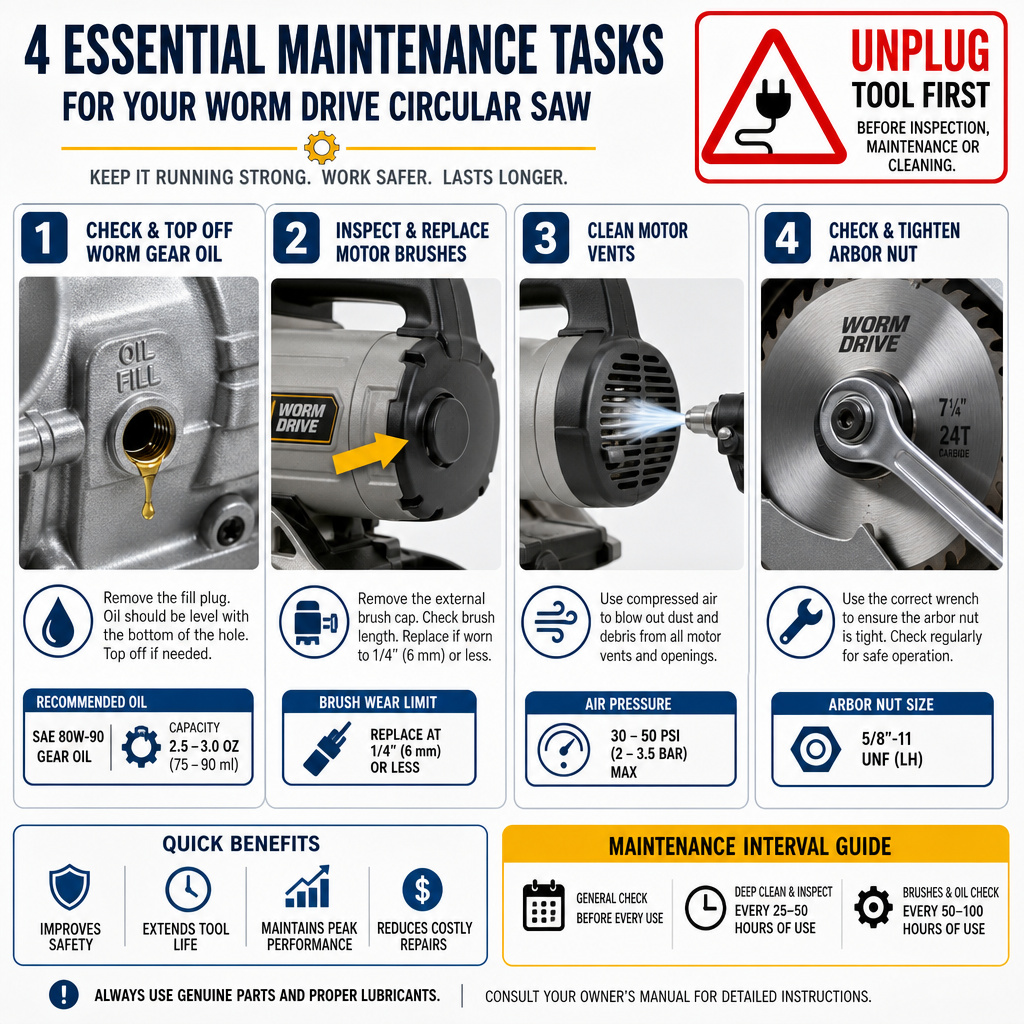
This isn’t optional cleaning. It’s preventative surgery.
- Gear Oil Check & Change. This is the most critical task. Find the fill plug (often on top of the gearbox). Unplug the saw. Lay it on its right side so the plug is upright. Wipe the area clean, remove the plug, and check the oil level. It should be near the top of the hole. Use only the oil specified in the manual (often SAE 90). Change it annually under heavy use, or if the oil looks metallic or milky.
- Brush Replacement. Like any brushed motor, the carbon brushes wear down. Most models have external brush caps for easy inspection. When they’re worn to the marked line, replace them in pairs. Worn brushes cause loss of power, sparking, and can damage the motor commutator.
- Exterior Cleaning. After use, blow out the motor vents with compressed air. Wipe down the shoe plate to prevent rust. A rusty shoe plate snags on material and ruins accurate cutting techniques.
- Blade and Arbor Care. Always use a wrench to secure the arbor when changing a circular saw blade. Check the arbor flange and washer for sawdust buildup before reinstalling a blade. A dirty interface causes blade wobble.
Before you start any maintenance: Unplug the saw. For cordless models, remove the battery. Never assume the trigger lock is fail-safe. The blade can spin if the switch is bumped during brush or gear inspection.
Choosing the Right Blade and Why it Matters
Worm drive saws often use a unique 5/8-inch arbor with a locating pin. You cannot use a standard sidewinder blade without removing that pin, which is not recommended, it’s there for a reason.
| Blade Type | Tooth Count | Best For | What Happens If You Use the Wrong One |
|---|---|---|---|
| Framing/General Purpose | 24–30 | Dimensional lumber, plywood, OSB | A fine-tooth blade on thick wood will overheat and burn. A coarse blade on plywood will splinter the top layer. |
| Plywood/Finish | 40–60 | Plywood, melamine, veneered materials | The high tooth count creates a smoother cut with less tear-out. Using a framing blade here will chip the surface. |
| Masonry/Concrete | Diamond or abrasive | Concrete, brick, block | Using a wood blade will destroy it instantly and is dangerously prone to kickback. |
| Specialty (Aluminum, etc.) | 80–100 (Triple-chip grind) | Non-ferrous metals, plastics | A standard blade will load up, overheat, and can shatter metal teeth. |
The locating pin on the arbor fits into a corresponding hole in the blade. This ensures the blade is perfectly centered and balanced at high torque, reducing vibration. Always match the blade to the material. For cutting plywood, a 60-tooth blade is worth the investment.
Frequently Asked Questions
Can I use my worm drive saw for finish carpentry?
You can, but you shouldn’t. The weight and power make it harder to control for delicate cuts on trim or cabinetry. You’ll get better results with a lighter, faster sidewinder or a dedicated trim saw. The worm drive’s strength is raw power, not finesse.
How often do I really need to change the gear oil?
For a professional using it daily, check the oil level monthly and change it every six months. For a serious DIYer using it on weekends, an annual change is sufficient. The oil breaks down from heat and contaminates with microscopic metal wear. If you store the saw for winter, change the oil before you put it away to prevent corrosion inside the gearbox.
Are cordless “rear-handle” saws the same as worm drives?
No. Saws like the DEWALT DWS535B are often called “worm drive style” because they have a rear handle and a left-side blade. However, most use a helical gear system, not a true worm and wheel. They offer better balance than a sidewinder and more power than older cordless saws, but they don’t generate the same extreme torque as a corded worm drive with its oil-bath gearbox.
Why is the blade on the left side?
It’s for visibility. Most people are right-handed. With a left-blade saw, you stand to the left of the cut line. Your body and the motor housing are out of the way, giving you a direct, unobstructed view of the blade following your pencil mark. Some sidewinders now offer left-blade versions for the same reason.
My worm drive is making a high-pitched whining noise. What’s wrong?
The gear oil is low or has broken down. The sound is metal-on-metal contact between the worm and the wheel. Stop using it immediately. Unplug the saw, let it cool, and refill or replace the gear oil with the correct type. Running it dry will score the gears, creating permanent damage that requires a full gearbox rebuild.
The Bottom Line
A worm drive circular saw isn’t just a heavier circular saw. It’s a different class of tool built for a specific type of work: demanding, repetitive, heavy-duty cutting where torque and durability trump speed and lightness. If your projects involve framing, sheathing, or ripping thick hardwoods, the investment pays off in straighter cuts and less user fatigue.
If you’re a homeowner doing occasional projects, a quality sidewinder is more versatile and cost-effective. But when you need to power through a stack of wet 2x12s or rip sheets of 3/4-inch plywood all day, nothing pulls through the cut like a worm drive. Just remember to keep oil in it. That low growl is the sound of a tool that gets the job done.
