
What is a 5mm Drill Bit in Fraction? The 13/64″ Substitute
This post contains affiliate links. As an Amazon Associate, we earn from qualifying purchases.
A 5mm drill bit is 0.1969 decimal inches. Its closest fractional inch equivalent is 13/64″ (0.2031 inches), which is 0.0062 inches, or about 4.4 thousandths, oversize. For precision work like tapping or press fits, that difference matters. The correct wire gauge substitute is a #7 drill bit at 0.2010 inches, which is closer but still oversize.
That thousandth-of-an-inch gap is the line between a fastener that threads cleanly and one that strips. You’re not just converting a number; you’re matching a physical hole to a physical part. The wrong choice here doesn’t just make a sloppy hole, it breaks taps, ruins threads, and leaves you with a part that wobbles.
What follows: the exact decimal conversion, the two standard substitutes, and the three jobs where you must use the actual 5mm bit. We’ll also walk through how to read a drill chart so you never have to guess again.
Key Takeaways
- A 5mm bit measures 0.1969 inches. The nearest 1/64-inch fraction is 13/64″ (0.2031″), which is 0.0062″ larger.
- For a closer match, use a #7 wire gauge drill bit at 0.2010 inches. It’s still oversize, but by only 0.0041″.
- Never substitute for tapping, press fits, or reamed holes. The tolerance stack-up from a 0.006″ oversize hole will cause fasteners to strip or parts to spin.
- The ANSI B94.11M-1979 standard defines fractional drill sizes in 1/64-inch increments, which is why a perfect 5mm equivalent doesn’t exist in the U.S. Fractional set.
- Machinists work in thousandths of an inch (0.001″). A 4.4-thousandth error sounds small, but it’s the difference between a 75% thread engagement and a 55% one.
The Short Answer: 5mm to Inches
Divide 5 by 25.4. That’s the conversion constant, and it’s exact. The math gives you 0.1968503937, which machinists and drill charts round to 0.1969 inches.
The ANSI B94.11M-1979 standard for jobber-length twist drills lists sizes in 1/64-inch increments from 1/64″ through 1 inch. A 5mm bit (0.1969″) falls between the 12/64″ (0.1875″) and 13/64″ (0.2031″) marks, with no exact fractional match.
Your first instinct might be to grab a 13/64″ bit. It’s the next size up in a standard fractional set. That choice works for clearance holes in wood or drilling a pilot for a drywall anchor. The hole will be a hair larger, but the screw will still bite.
Where it fails is metalwork. A 13/64″ bit cuts a hole 0.0062 inches larger than 5mm. In thousandths, that’s 6.2 thou. For a #10 machine screw, that’s enough slop to prevent proper thread formation if you’re tapping. The tap will chatter, the threads will be weak, and the fastener will strip out on the first real torque.
Why 13/64″ is the Default (And When It’s Fine)
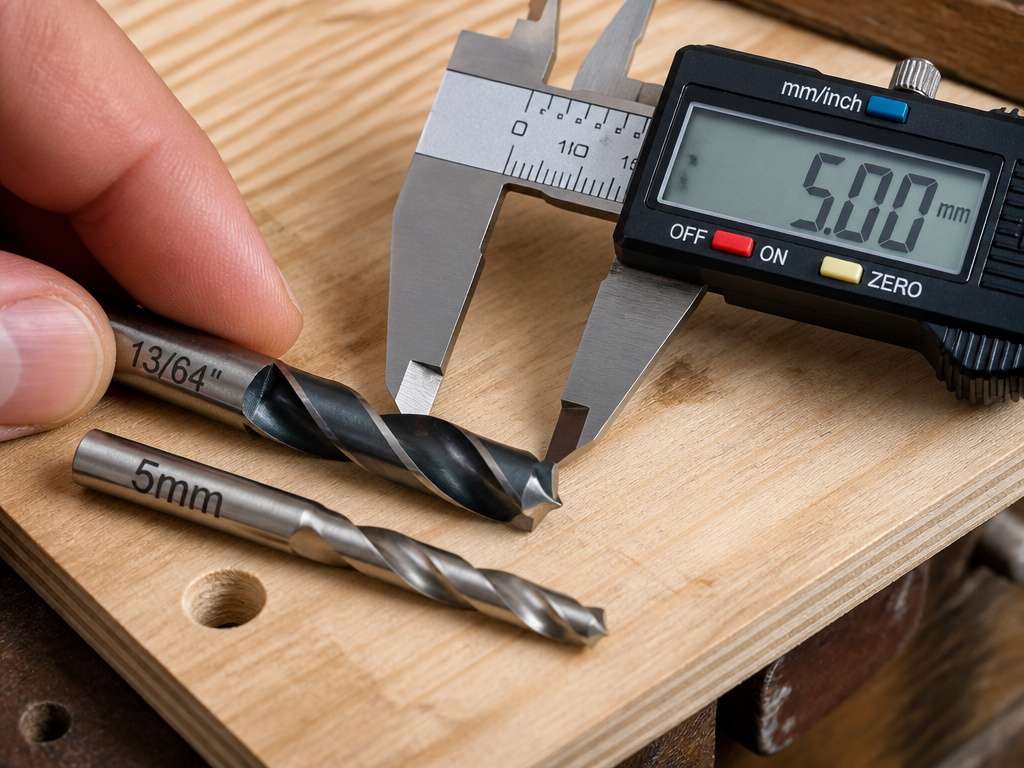 Fractional drill sets are built around the 1/64-inch grid. Because 5mm doesn’t land on that grid, you pick the nearest mark. The nearest larger mark is 13/64″.
| Drill Bit | Decimal Inches | Difference from 5mm | Best Use Case |
|---|---|---|---|
| 5mm | 0.1969 in | — | Precision tapping, reaming, press fits |
| 13/64″ | 0.2031 in | +0.0062 in (oversize) | General wood/plastic clearance holes |
| #7 Wire Gauge | 0.2010 in | +0.0041 in (oversize) | Closer-tolerance clearance in metal |
For rough carpentry, hanging a shelf, or drilling through plywood, the 13/64″ bit is fine. The hole will be about the thickness of two sheets of printer paper larger. The screw will still have wood to grip. The difference is functionally invisible.
The problem starts when you treat that substitution as universal. It’s not.
Common mistake: Using a 13/64″ bit for a 5mm tapped hole in steel. The tap cuts threads on the diameter of the hole you drilled. An oversize hole means less material for the threads to bite, which drops the shear strength of the joint by roughly a third.
If your project calls for a 5mm hole because a 5mm bolt or dowel must fit snugly, you need the actual 5mm bit. Substituting a 13/64″ bit gives you a sloppy, weak fit every time.
When a 13/64″ Bit Will Burn You
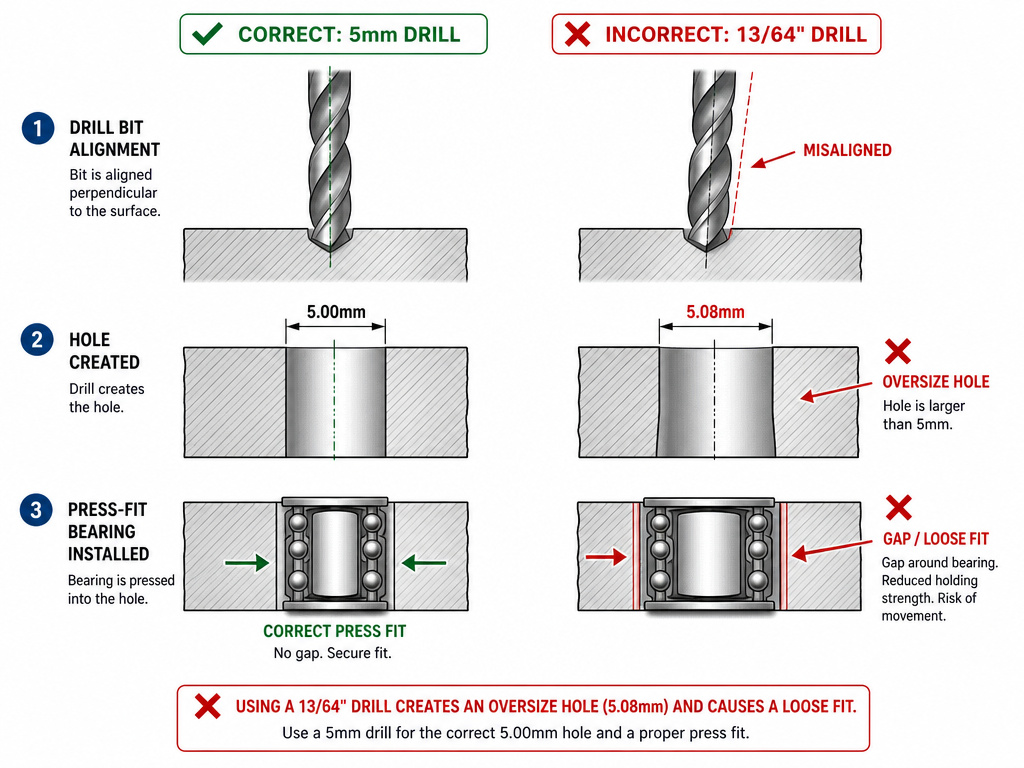 Three jobs demand the exact 5mm diameter. Substituting here costs you a part, a tap, or the structural integrity of the joint.
- Tapping threads. The drill size for a metric tap is calculated to leave the correct amount of material for the threads to form. A 5mm tap drill leaves a specific minor diameter. Use a 13/64″ bit, and the minor diameter is too large. The tap cuts shallow, weak threads that strip under load. You might get the bolt started, but it will pull out when you tighten it.
- Press fits. A bearing or bushing pressed into a 5mm hole relies on interference, the hole is slightly smaller than the part. An oversize hole means no interference. The part spins, walks out, or just falls through. The joint is dead on arrival.
- Reamed holes. Reaming is a finishing operation to achieve a precise diameter. You drill an undersized hole (say, 4.8mm) and ream it to 5.00mm. If you drill the starter hole with a 13/64″ bit, you’ve already overshot the final size. The reamer has nothing to cut, and the hole is irreversibly too big.
The tolerance for these operations is often within half a thousandth of an inch (0.0005″). A 6.2-thousandth error is twelve times that limit. It’s not a close call.
The Machinist’s Choice: Wire Gauge and Letter Sizes
Between the fractional-inch grid sit 135 other standard sizes: number drills (#80–#1) and letter drills (A–Z). These fill the gaps. For a 0.1969″ hole, the closest standard bit isn’t a fraction, it’s a number drill.
A #7 wire gauge drill bit is 0.2010 inches in diameter. That’s 0.0041″ oversize, which is about 1.6 thousandths better than the 13/64″ bit. It’s still not exact, but for many non-critical clearance holes in metal, it’s the better pick from a standard U.S. Set.
Why do these odd sizes exist? They’re holdovers from when drills were made from piano wire, sized by gauge. They stuck around because they provide a finer grid of sizes between the clunky 1/64″ fractions. The Wikipedia drill bit sizes entry details the full number and letter series, which run from #80 (0.0135″) up to Z (0.4130″).
Most homeowner drill sets don’t include #7 bits. You’ll find them in machinist sets or industrial supply shops. If you’re drilling a one-off hole in a bracket and only have a fractional set, the 13/64″ is your practical choice. If you’re building something that needs repeated, accurate holes in metal, buy the 5mm bit.
How to Read a Drill Bit Conversion Chart
You don’t need to memorize conversions. You need to read the chart. A good chart cross-references four systems: metric (mm), fractional inches, decimal inches, and wire/letter gauge.
Find the “mm” column, scan down to 5.0, and read across. You’ll see 0.1969 in the decimal column, 13/64″ in the fraction column, and often a #7 in the number column. The ICS Cutting Tools drill chart is a classic reference that lays this out cleanly.
Here’s what a segment of that grid looks like for sizes around 5mm:
| Fraction | Decimal (in) | Metric (mm) | Wire Gauge |
|---|---|---|---|
| 3/16″ | 0.1875 | 4.7625 | — |
| — | 0.1969 | 5.0 | — |
| 13/64″ | 0.2031 | 5.1594 | #7 |
| 7/32″ | 0.2188 | 5.5563 | — |
Notice the blank spot in the fraction column for 5mm. That’s the hole in the standard, literally. The chart confirms that 5mm has no exact fractional twin. It also shows that 13/64″ is the next official size up, and that a #7 bit sits between them.
When choosing a drill bit, the chart is your final arbiter. Don’t guess. Don’t assume “close enough” is good enough. Look it up.
The One Tool That Ends the Guesswork
A digital caliper. Not a ruler, not a tape measure, a $25 digital caliper that reads in both millimeters and inches to three decimal places.
Measure your 5mm bit. It will read 5.00 mm or 0.197 in. Measure a 13/64″ bit. It will read 0.203 in. The difference is visible on the screen. This tool removes all doubt and pays for itself the first time you save a precision part from the scrap bin.
For identifying unmarked bits, the caliper is essential. That mystery bit in your drawer might be 5mm, or it might be a 13/64″ bit from an old set. Measuring it tells you instantly which jobs it’s suited for. This is the fastest way to determining bit size when the markings have worn off.
Worth knowing before you start: Cheap plastic calipers flex and give inconsistent readings. A metal-bodied, battery-powered model from a brand like iGaging or Neiko is accurate enough for workshop use. Wipe the jaws clean before each measurement, a speck of dust is a thousandth of an inch.
Drill Bit Standards and Why They Matter
Drill bits aren’t made in random sizes. In the U.S., the sizes are defined by the ANSI B94.11M-1979 standard. This standard says jobber-length twist drills come in 1/64-inch increments from 1/64″ to 1″. That’s the grid.
Metric bits follow their own standard sets, like ISO 235. A 5mm bit is a standard metric size. When the two systems meet, you get a gap, 0.1969 inches doesn’t land on the 1/64″ grid. This is why you can’t find a 5mm bit in a standard U.S. Fractional set. It doesn’t exist there.
The standard also explains why the increments feel uneven. The jump from 1/64″ to 1/32″ is a 100% increase in diameter. The jump from 1″ to 1-1/64″ is less than 2%. As bits get larger, the size steps become a smaller percentage of the total, which is why the fractional system works for rough work but fails for precision.
If you’re working from a metric blueprint or with metric fasteners, buy a metric drill bit set. A basic set from 1mm to 10mm in 0.5mm steps covers 90% of common tasks. Trying to force fractional bits to do metric work is a recipe for frustration and failed parts.
Frequently Asked Questions
Is 5mm the same as 13/64 inch?
No. A 5mm drill bit is 0.1969 inches. A 13/64″ bit is 0.2031 inches. The difference is 0.0062 inches, or about 4.4 thousandths. For a clearance hole in soft material, it’s close enough. For a tapped hole or press fit, it’s not the same at all.
What is a 5mm drill bit closest to in standard size?
In a standard U.S. Fractional set, the closest size is 13/64″. In a machinist’s set that includes wire gauge sizes, the closest is a #7 drill bit (0.2010 inches). The #7 is 0.0041″ oversize, which is closer than the 13/64″ but still not exact.
Can I use a 13/64 drill bit instead of 5mm?
You can, but only for non-precision work. Use it for drilling clearance holes in wood, plastic, or drywall where the fastener has room to move. Never use it as a substitute for tapping threads, press fits, or any operation where the hole diameter is critical to the function of the part.
What is a #7 drill bit in mm?
7 drill bit is 0.2010 inches in diameter. Converting that to millimeters (0.2010 x 25.4) gives you 5.1054 mm. So a #7 bit is about 0.105 mm larger than a true 5mm bit. It’s the standard drill bit for a 1/4-20 tap.
Why is there no exact 5mm equivalent in inches?
Because the two measurement systems use different base grids. The metric system uses 1mm increments (and 0.5mm for common drill sets). The U.S. Fractional system uses 1/64-inch increments. The conversion factor (25.4 mm per inch) means most metric sizes don’t land neatly on the 1/64″ grid. A 5mm bit lands between 12/64″ (0.1875″) and 13/64″ (0.2031″).
Before You Go
Grab the right bit for the job. If the print says 5mm, use a 5mm bit. They’re cheap, they’re available, and they’re the only way to get the hole diameter the engineer specified.
For your general workshop, a basic metric set and a solid fractional set cover 99% of tasks. Keep a chart on the wall or bookmark one on your phone. When you need to tap a hole for an M6 bolt or drill a clearance hole for a 6mm drill bit, you’ll have the right size on hand.
And if you find yourself constantly converting between systems, just buy a twist drill bit set that includes both metric and fractional sizes. It ends the conversion math for good.
