
8mm Drill Bit in Inches: The Exact Conversion & Substitute
This post contains affiliate links. As an Amazon Associate, we earn from qualifying purchases.
An 8mm drill bit is 0.3150 inches. The closest common fractional inch equivalent is 5/16 inch (0.3125 in), which is 0.0025 inches or about 0.064mm smaller. For general woodworking or clearance holes, that difference is negligible. For tapping an M8 thread or any precision metalwork, you must use the exact 8mm bit, the fractional substitute will produce a hole that’s too small, causing the tap to bind and potentially break.
That 0.064mm gap is the line between a functional thread and a stripped one. It’s also the reason the global tool industry hasn’t settled on one system. A workshop in Michigan stocks fractional bits; a machinist in Berlin uses metric; and an electronics bench in both places needs wire-gauge sizes.
What follows: the math behind the conversion, the three jobs where the exact size is non-negotiable, and a walkthrough of the four competing drill-bit sizing systems that explain why this simple question has so many answers.
Key Takeaways
- The exact conversion is 8mm = 0.3150 inches. The nearest fractional size is 5/16″ (0.3125 in), which is 0.064mm undersize.
- For tapping M8×1.25 threads, you need a 6.8mm tap drill, not 8mm. Using 17/64″ (6.75mm) is acceptable; using 1/4″ (6.35mm) will break the tap.
- New HSS drills are typically 0.025–0.075mm oversize due to manufacturing tolerance. The hole you drill will be another 0.05–0.30mm larger than the bit.
- In the U.S., you’ll find 5/16″ bits on the shelf. In Europe and Australia, you’ll find 8mm bits. For precision work, order the exact metric size online.
- Wire gauge (#1–#80) and letter (A–Z) sizes fill the gaps between fractional inches, crucial for American UNC/UNF thread standards.
The Exact Conversion: 8mm to Inches

The math is straightforward: divide the millimeter measurement by 25.4, the number of millimeters in one inch. For 8mm, that’s 8 ÷ 25.4 = 0.31496062992…, which rounds to 0.3150 inches.
This figure comes straight from the ANSI/ASME B94.11M-1993 standard for twist drills and is echoed in the Machinery’s Handbook. It’s not an approximation for the calculator; it’s the defined dimensional equivalent.
The nearest fractional inch size on a typical hardware store rack is 5/16 inch. Convert that to metric: (5 ÷ 16) × 25.4 = 7.9375mm. That puts it 0.0625mm under the 8mm mark. Another close candidate is 21/64 inch (0.3281 in or 8.334mm), which is 0.334mm oversize.
| Size | Decimal Inches | Metric (mm) | Difference from 8mm |
|---|---|---|---|
| 8mm | 0.3150 | 8.000 | 0.000 |
| 5/16″ | 0.3125 | 7.9375 | –0.0625 mm |
| 21/64″ | 0.3281 | 8.334 | +0.334 mm |
The difference seems microscopic. In softwood, it is. The material compresses, and a pilot hole for an 8mm bolt will still work with a 5/16″ bit. The problem starts when the material doesn’t give, metal, hard plastic, or a pre-threaded insert.
When the spec sheet says 8mm, drill 8mm. This is the first rule for any job sourced from European machinery, automotive work on Asian cars, or CNC files. The cumulative error from using “close enough” substitutes can throw off an entire assembly.
When ‘Close Enough’ Isn’t: Tapping, Clearance, and Precision Fits
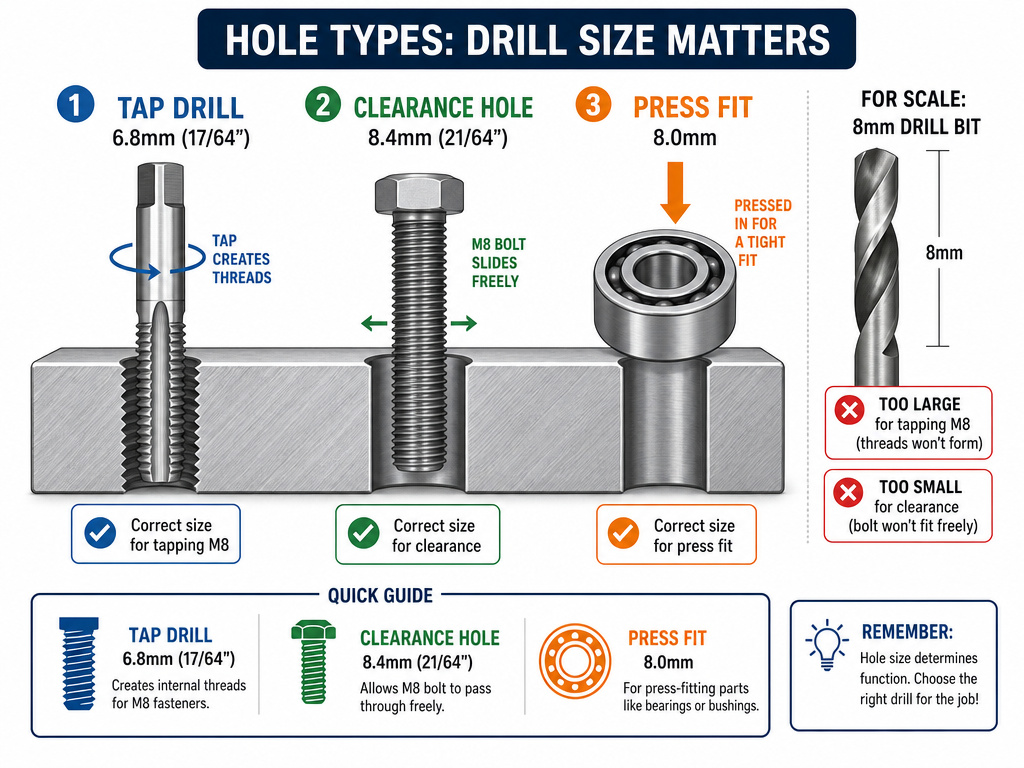
You don’t use an 8mm bit to make a hole for an M8 bolt. That’s a classic beginner mistake. An M8 bolt needs a clearance hole larger than 8mm so it can pass through freely. To tap an M8 thread, you need an even smaller tap drill. This is where substitutions fail catastrophically.
Tapping Holes: The 6.8mm Rule
An M8×1.25 standard metric thread requires a tap drill size calculated as the major diameter minus the pitch: 8mm – 1.25mm = 6.8mm.
Common mistake: Grabbing a 1/4″ bit (6.35mm) for an M8 tap because it’s “close.” The tap drill is 0.45mm too small. The tap will bind, overheat, and snap off in the hole, leaving you with a ruined workpiece and a major extraction job.
The closest fractional inch size to 6.8mm is 17/64″ (6.746mm), which is 0.054mm undersize, an acceptable substitution. Better yet, use a proper 6.8mm metric bit. They’re standard in any metric drill index.
Clearance Holes: Always Go Larger
For a hole where an 8mm bolt must slide through, you need a diameter larger than 8mm. A standard clearance hole for an M8 bolt is 8.4mm (about 21/64″). The 8mm bit makes a hole the bolt will screw into, not pass through.
If you only have fractional bits, 21/64″ (8.334mm) is slightly undersized but may work if you chamfer the edges. 11/32″ (8.731mm) is better. For a true sliding fit, you’d drill undersize and finish with a reamer.
Press Fits and Bearings: Exact Size Only
Press-fitting a bearing into an 8mm hole demands the exact diameter. A hole drilled with a 5/16″ bit will be 0.0625mm too small. You’ll need a hammer and excessive force, deforming the bearing race. A hole drilled with a 21/64″ bit will be 0.334mm too large; the bearing will spin loosely and fail. There is no substitute here.
Why Your Hole is Bigger Than Your Bit
You buy an 8mm drill bit, drill into mild steel, and measure the hole. It reads 8.15mm. Did you get a bad bit? Probably not, this is normal physics and manufacturing.
A brand-new HSS twist drill has a manufacturing tolerance. Per the ISO 235 standard, it can be 0.025–0.075mm oversize straight from the factory. A used or re-sharpened bit can be 0.025–0.10mm undersize because material is ground off the cutting edges.
Then, during drilling, the bit deflects, vibrates, and cuts slightly beyond its own diameter. In soft materials like aluminum or plastic, this “wobble” can add 0.20–0.30mm to the hole size. In hard steel, it might only add 0.05mm.
Where this goes sideways: Assuming a 5/16″ bit will make a 7.94mm hole. With wear and deflection, it might produce a 8.10mm hole, now it’s larger than your intended 8mm target, and your press fit is ruined.
This is why precision mechanics never rely on a drill alone for a final dimension. The sequence is drill undersize, then ream to exact size. For that 1/4″ shaft requiring a 6.350mm H7 tolerance sliding fit, you’d drill with a 6.2mm bit and finish with a 6.35mm reamer.
The Four Systems: Why This is So Confusing
The question “what is 8mm in inches?” exists because at least four different drill bit sizing systems operate in parallel. Your location and your project dictate which one you use.
| System | Range | Primary Use | Example |
|---|---|---|---|
| Metric (mm) | 0.5mm – 25mm+ (0.5mm steps) | International machining, CNC, automotive, metric threads | 8mm, 6.8mm, 10mm |
| Fractional Inch | 1/64″ – 1″+ (1/64″ steps) | U.S. Woodworking, DIY, construction, plumbing | 1/4″, 5/16″, 3/8″ |
| Wire Gauge (#) | #80 (0.34mm) – #1 (5.79mm) | U.S. Precision work, electronics, model-making, UNC/UNF tap drills | #29 (3.45mm for 8-32 UNC) |
| Letter (A–Z) | A (5.94mm) – Z (10.49mm) | U.S. Mid-range sizes, filling gaps between fractions | F (6.35mm, exact for 1/4″) |
Metric is global standard. ISO 235 defines dimensions for parallel-shank drills. If you work on anything with metric fasteners, from furniture to German cars, you need a metric set.
Fractional inch is dominant in the U.S. It’s a legacy of 18th-century English industry. The steps are coarse, but for framing or drilling wood, 1/64″ increments are fine.
Wire gauge and letter systems are American gap-fillers. The fractional system has big jumps between, say, 1/4″ (6.35mm) and 9/32″ (7.14mm). Wire gauge sizes (#1–#80) densely cover the small-drill range. Letters (A–Z) cover the 6–10.5mm range critical for Unified National (UNC/UNF) tap drills.
I keep a 6mm drill bit set for European projects and a separate fractional set for rough North American work. Trying to force one system to do both leads to a drawer full of almost-right bits and a shelf of failed projects.
This regional divide means a U.S. Hardware store won’t stock an 8mm bit. You’ll find a 5/16″ bit labeled as its “metric equivalent.” An Australian or German hardware store will have the 8mm bit front and center. For precision work, you order the exact size online from a specialist like Ceres Tools, which manufactures to ISO 235.
How to Choose: A Practical Workflow
Stop guessing. Follow this decision tree every time you need a hole.
- Identify the specification. Is it a metric bolt size (M8), an inch screw (#8), a bearing part number, or a CNC drawing callout? The spec wins.
- Determine the hole’s purpose. Is it a tap drill, a clearance hole, a pilot hole, or a precision bore? Each has its own size rule.
- Check your available tools. Do you have a 6mm drill bit for that M6 clearance hole, or only a 15/64″? Know the difference the substitution will make.
- When in doubt, drill undersize. You can always enlarge a hole with a stepped bit or a reamer. You can never shrink one.
For a pilot hole in wood, the nearest fractional size is almost always fine. Wood compresses.
For a clearance hole in metal, go to the next available size up. An M6 bolt (6mm) needs a 6.4mm hole. If you only have fractional, 1/4″ (6.35mm) is tight; 17/64″ (6.75mm) is better.
For a tap drill, never go oversize. Use the exact metric size or the closest undersize fractional equivalent. The M8×1.25 tap drill is 6.8mm. Use that, or 17/64″ (6.75mm). Never use 1/4″.
Frequently Asked Questions
Is 5/16″ the same as 8mm?
No. A 5/16″ drill bit is 7.9375mm, which is 0.0625mm smaller than an 8mm bit. For rough work in soft materials, they are interchangeable. For precision metalwork, tapping threads, or press fits, they are not the same, use the exact size called for.
What is the closest drill bit to 8mm?
The closest standard fractional inch drill bit is 5/16 inch. The closest wire gauge bit is #32 (3.26mm) for smaller sizes, but nothing is close to 8mm in that system. The closest letter-size bit is P (8.18mm), but it’s rare.
Can I use an 8mm bit for a #8 screw?
No. A #8 wood screw typically needs a pilot hole around 3.2mm (1/8″) for softwood and 2.8mm for hardwood. An 8mm hole would be massive and provide no grip. You need to choose a drill bit based on the screw’s shank diameter, not its number.
What do you use an 8mm drill bit for?
An 8mm bit is commonly used for creating clearance holes for M8 bolts, drilling holes for 8mm dowels in woodworking, or preparing holes for certain electrical conduits. Its primary uses of a drill bit are defined by the fastener or component you’re accommodating, not the bit itself.
Why are some drill bits numbered and lettered?
The numbered (#1–#80) and lettered (A–Z) systems are American standards that fill the size gaps between fractional inches. They are essential for tapping Unified National (UNC/UNF) threads, where the required tap drill size (like #29 for an 8-32 screw) doesn’t correspond to a clean fraction. Understanding these systems is key to identifying drill bit size.
Before You Go
An 8mm drill bit is 0.3150 inches. The 5/16″ bit in your kit is a stand-in, not a twin. Use it for rough work where a few hundredths of a millimeter won’t matter.
But when the job specifies metric, a thread tap, a bearing seat, a machined part, put the fractional bit down. Order the correct 8mm or 6.8mm metric bit. The extra wait and few dollars save the cost of a broken tap, a loose bearing, or a scrapped workpiece.
The right tool isn’t just the one that fits in your chuck. It’s the one that matches the number on the print. Everything else is a workaround, and in metal, wood, and plastic, workarounds have a short lifespan.
