
Decoding String Trimmer Inches: What They Refer To & Mean
This post contains affiliate links. As an Amazon Associate, we earn from qualifying purchases.
The inches specification on a string trimmer refers to its cutting swath or cutting width. This is the maximum diameter of the circular area the spinning trimmer line can clear in a single pass. A trimmer listed as “15-inch” can cut a 15-inch wide path through grass or weeds with each sweep.
Most people think a bigger number is automatically better. They buy the widest swath they can afford, dreaming of faster work. The reality is more nuanced. A swath that’s too large for your motor bogs down in thick growth, and a swath that’s too wide for your property makes intricate edging around flower beds a clumsy, destructive chore.
This guide explains what the inches mean, why the power demand isn’t linear, and how to match the cutting swath to your yard’s size, your trimmer’s power, and even the type of line you use.
Key Takeaways
- The “inches” measure the cutting swath, not string length. It’s the diameter of the circle the line traces.
- Swath directly dictates power needs. A 17-inch trimmer needs roughly 70% more motor torque than a 13-inch model to maintain the same cutting speed in identical grass.
- For small yards under 1/4 acre, a 10-13 inch swath offers the best balance of speed and control. Go above 15 inches only if you have over 1/2 acre of consistent trimming.
- Always match your line diameter to the swath. A 0.105-inch line on a 10-inch trimmer will stall the motor; a 0.065-inch line on an 18-inch model will snap constantly.
- An adjustable swath head (like on some EGO models) is a battery-life extender. Drop the swath for light grass to double your runtime.
What is the Cutting Swath?
The cutting swath is the effective working width of the tool. Imagine the two ends of the trimmer line as points on the circumference of an invisible circle. The distance across that circle, through the center point where the head spins, is the swath. It’s stamped on the trimmer’s specification plate for a reason.
The cutting swath of a string trimmer is the maximum diameter of the path cleared by the rotating trimmer line in one pass. This measurement, typically between 10 and 18 inches for residential models, determines the tool’s coverage efficiency and is directly correlated to the required motor power and compatible line diameter.
This number is your primary efficiency metric. A wider swath covers more ground per sweep. But that wider circle means the tip of the line, the part doing the cutting, is moving much faster.
The physics here are critical. The centripetal force on the line, and the drag from cutting grass, increases with the square of the tip speed. Go from a 12-inch to a 16-inch swath, and the motor load doesn’t just increase by 33%. It can triple under heavy conditions.
You’ll feel this when the trimmer head bogs down and the motor pitch drops from a high whine to a labored groan. The smell of hot electrical insulation or burning grass clippings hitting a hot muffler follows about thirty seconds later.
Why Does Cutting Swath Matter for Power?
The engine or motor doesn’t just spin the line. It fights air resistance, centrifugal force, and the shearing action of cutting vegetation. The tip of the line on a 15-inch trimmer travels a longer circumference than on a 10-inch trimmer at the same RPM. It hits more grass per revolution.
The relationship isn’t gentle. Think of it like pushing a broom. A wide push broom moves more leaves, but it requires exponentially more effort to shove through a wet, matted pile than a standard hand broom. The string trimmer version of that matted pile is tall fescue or damp weeds.
I learned this the hard way with a mid-range gas trimmer rated for a 15-inch swath. The manual said it could run 0.095-inch line. In early summer Kentucky bluegrass, it was fine. Then I tried to clear a patch of overgrown ditch weeds, stalky, fibrous stuff.
The engine lugged down, the line speed died, and the weeds just wrapped around the head. I had to stop every three feet to clean it off. The tool was underpowered for its stated swath in that specific condition. I switched to a lighter 0.080-inch line for that job, which reduced the load enough to power through, albeit with more frequent line advances.
| Cutting Swath (inches) | Minimum Recommended Power | Best For Property Size | Risk of Under-Powering |
|---|---|---|---|
| 10 – 12 | 12-18V Cordless / 25cc Gas | Small (< 1/4 acre) | None for intended use |
| 13 – 15 | 40V Cordless / 30cc Gas | Medium (1/4 – 1/2 acre) | Bogs in wet, thick grass |
| 16 – 18 | 80V Cordless / 40cc+ Gas | Large (> 1/2 acre) | Chronic overheating, stalling |
| 18+ (Commercial) | 2-Cycle Gas / High-torque AC | Acreage, Commercial | Rapid clutch wear |
How to Choose the Right Swath for Your Yard
This is where you stop looking at specs and start looking at your land. Walk the perimeter you’ll actually trim. Count the tight corners, garden bed edges, and obstacles like trees and fence posts. A massive swath is a liability here.
For small, intricate yards: A 10 to 13-inch swath is your friend. The smaller circle gives you pinpoint control. You can edge along a sidewalk without scalping the lawn on the other side of the line. Battery-powered trimmers excel here, offering plenty of power in a lightweight package. If your main task is tidying up lawn edges after mowing, this is the sweet spot.
For medium, open yards: A 14 to 16-inch swath balances reach and manageability. You can clear open stretches along a fence line quickly but still maneuver reasonably well. This is the most common range for homeowner-grade gas trimmers and high-performance battery models like the EGO Power+ ST1521S. It’s the default for a reason.
For large, open areas: Consider a 17-inch or larger swath. You’re trading finesse for raw coverage speed. These tools are heavier, often require a harness, and demand your respect. They’re for clearing fields, ditch banks, and large perimeter areas where you take long, sweeping passes. For true acreage, a dedicated brush cutter with a steel blade is often a better choice than a string trimmer with a giant swath.
If you have more than three tight corners or garden beds per 100 feet of trimming, drop down one swath size from what you think you need. The time you save on the straightaways will be lost wrestling the tool around the obstacles.
Matching Swath to Line Diameter
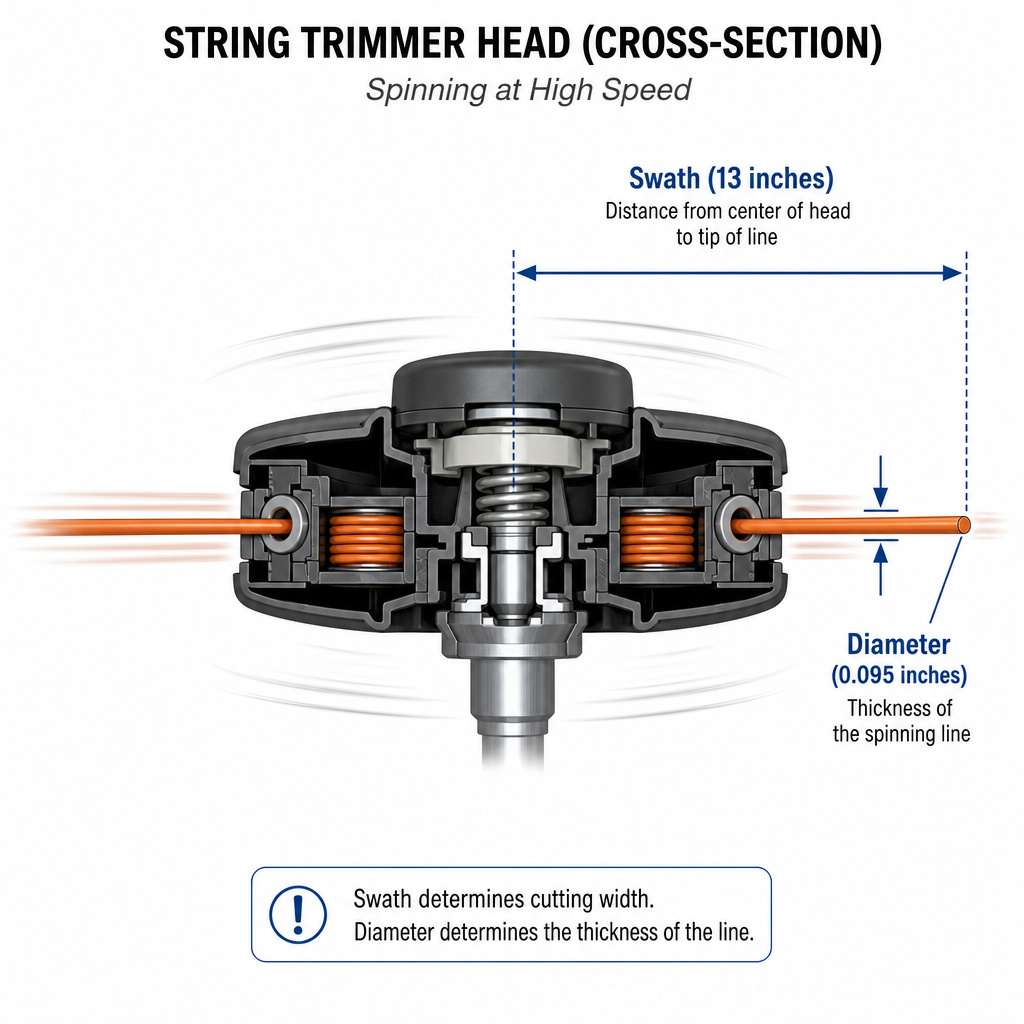
The cutting swath and line diameter are a matched set. The manufacturer designs the power system to efficiently spin a specific mass of line at a specific radius. Stray outside those parameters and performance suffers predictably.
Too thick a line for the swath: The motor can’t accelerate the heavier line to the required tip speed. It bogs down, overheats, and the line doesn’t snap against weeds, it pushes them over. A 0.105-inch line on a trimmer built for 13-inch 0.080-inch line is a recipe for a burned-out motor. You’ll hear the strain immediately.
Too thin a line for the swath: The line reaches fantastic tip speeds but has no mass or durability. It disintegrates against moderately tough vegetation, leading to constant bump-feeding and frustration. You’re always stopping.
Follow the manual’s line diameter recommendation. It’s there for physics, not upselling. For example, a Ryobi 40V trimmer typically specifies 0.095-inch diameter line for its standard head. Going to 0.105-inch might seem tougher, but you’ll drain the battery 25% faster and may trip the thermal protection.
The Swath and Line Type Connection
Line shape matters too. Round line is general-purpose. Square or twisted line has sharper edges for a more aggressive cut, which increases drag.
* For large swaths (16″+) in heavy grass, round 0.105-inch line is often more efficient, it has less drag than square line of the same diameter, so it maintains RPM better.
* For medium swaths (13-15″) doing clean edging, a square 0.095-inch line gives a cleaner, scissor-like slice on grass blades.
Here’s a quick reference for pairing:
| Swath Size | Ideal Line Diameter | Best Line Shape for Efficiency | Why It Works |
|---|---|---|---|
| 10″ – 12″ | 0.065″ – 0.080″ | Round | Minimal drag, preserves battery/engine life for small motors. |
| 13″ – 15″ | 0.080″ – 0.095″ | Square or Twisted | Aggressive cut balances added drag; power plant can handle it. |
| 16″ – 18″ | 0.095″ – 0.105″ | Round or Heavy-Duty Twisted | Durability is key; round line maintains critical RPM under heavy load. |
Common Swath Misconceptions and Mistakes
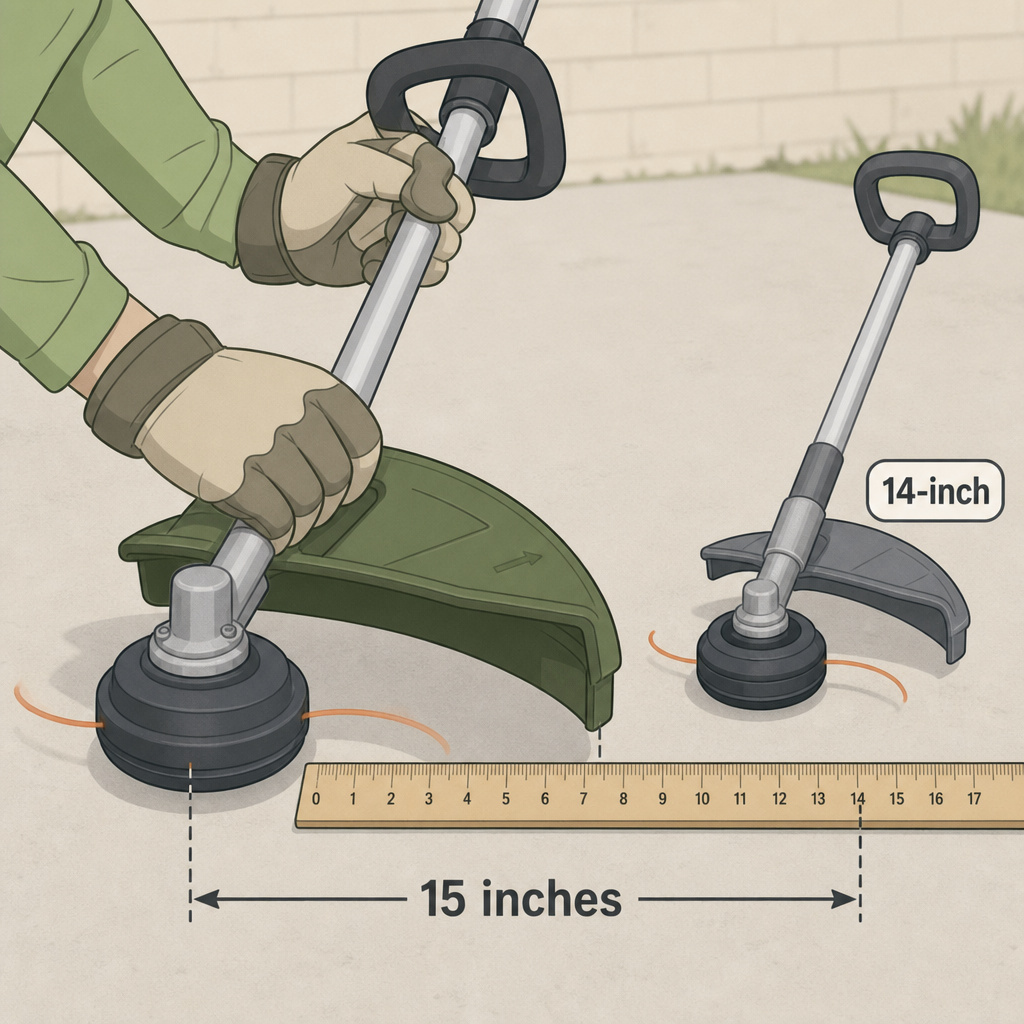
The biggest error is confusing swath with capability. A 18-inch swath trimmer isn’t automatically “more powerful” than a 15-inch model. It simply requires more power to function correctly. A cheaply made 18-inch trimmer with a weak motor is worse than a quality 15-inch trimmer with a strong motor.
Mistake: Assuming a wider swath always finishes faster.
On paper, yes. In practice, no. If the wider tool is too heavy for you to control precisely, you’ll move slower. If it constantly bogs down, you stop more often. Fatigue sets in quicker. For suburban lots, the efficiency gain of a 16-inch swath over a 14-inch is often negligible when you account for real-world handling.
Mistake: Using the swath as the only buying metric.
The swath is one of three critical numbers. The others are engine displacement (cc) or motor voltage/amp-hours, and weight. A lightweight 40V trimmer with a 15-inch swath might be perfect. A heavy 30cc gas trimmer with the same swath might leave your arms aching after 20 minutes. Always cross-reference.
Mistake: Overlooking adjustable swath heads.
Some modern trimmers, particularly from EGO, have a clever feature: a flip-down secondary blade on the guard that shortens the effective swath. This isn’t a gimmick. In normal grass, using the reduced swath lowers the motor load significantly. On a battery trimmer, this can extend your runtime by 50% or more. It’s like having two trimmers in one.
Swath, Power Source, and Real-World Performance
Your choice of power, gas, corded electric, or battery, interacts with the swath to define the tool’s character.
Battery-Powered (18V-80V): Excellent for swaths up to about 15 inches. Their torque is instant and they’re quiet and light. The limitation is runtime under heavy load. A 15-inch swath on a 40V battery will drain it much faster than a 13-inch swath. Pay close attention to Amp-hour (Ah) ratings. For a 15-inch swath, don’t buy a tool with a battery under 4.0Ah if you have more than a postage stamp to trim.
Gas-Powered (25cc-50cc): The traditional choice for wider swaths and longer runtimes. A 30cc engine comfortably handles a 15-16 inch swath. They’re louder, require fuel mix, and need more maintenance. But for a full acre of rugged trimming, a gas model like a Stihl FS 56 RC-E with a 16-inch swath is still the reliable benchmark. The vibration is noticeable after an hour.
Corded Electric: Generally limited to smaller swaths (10-14 inches) due to the inherent power limitation of a standard household circuit and the cord. They’re powerful for their size but the cord is a constant management issue. Swath is less of a differentiating factor here; cord length is king.
Before you start: Always wear eye protection and long pants. The line spins at over 200 mph and can throw stones, debris, and pieces of trimmer line with enough force to cause serious injury. Clear the area of bystanders, especially children and pets, by at least 50 feet.
Frequently Asked Questions
Does a bigger cutting swath mean a better trimmer?
Not necessarily. It means a trimmer designed for a larger area. A “better” trimmer matches its power, weight, and swath to your specific needs. A poorly powered trimmer with a big swath is worse than a well-powered trimmer with a moderate swath.
Can I put a larger trimmer head on my tool to increase the swath?
You can, but you shouldn’t. The motor, drive shaft, and gear head are engineered for a specific load range. Increasing the swath increases the load exponentially. You risk overheating the motor, stripping gears, or burning out the clutch. It voids the warranty and is a good way to break an expensive tool.
How do I measure the cutting swath on my current trimmer?
Run the trimmer at full speed and gently tap it against a tall, vertical surface like a piece of cardboard. The line will leave a dust mark or cut a curved line. Measure the width of that arc. That’s your effective cutting swath. It’s often slightly less than the advertised spec due to line flex.
What’s more important, swath or line feed system?
For usability, the line feed system (bump-feed, auto-feed, fixed line) is more important day-to-day. A reliable bump-feed on a 13-inch trimmer is better than a frustrating one on a 16-inch model. However, the swath determines the job’s scope. Choose a reliable feed system within the correct swath category for your yard.
Why does my trimmer bog down even with the correct line?
Three likely causes. First, you’re extending too much line beyond the cutter head. Only 6-8 inches of total line (3-4 inches per side) should be exposed. Second, the vegetation is simply too dense for the tool’s power-to-swath ratio, you need to take smaller bites. Third, the spool is wound unevenly or too tightly, creating imbalance and drag.
The Bottom Line
The inches on your string trimmer are a blueprint for its capability, not just a marketing number. That cutting swath dictates the tool’s power hunger, its suitability for your property, and the type of line it needs to run smoothly. Ignoring this spec leads to the most common trimmer failures: bogged-down motors, snapped lines, and unfinished jobs.
Match the swath to your actual terrain, not your aspirational one. A 13-inch tool will handle 90% of suburban lawns with more precision and less fatigue than an oversized 17-inch model. Then, feed it the exact line diameter the manual specifies. This simple pairing of correct swath and correct line is what separates a frustrating chore from a quick, clean trim. Your shoulders and your tool will thank you.
