
Compare Pancake vs Hotdog Air Compressors: 3 Specs That Matter
This post contains affiliate links. As an Amazon Associate, we earn from qualifying purchases.
Pancake vs hotdog air compressors are decided by three specs: tank shape, air delivery (SCFM), and duty cycle. The pancake’s flat, wide tank offers lower center of gravity and stability for rolling, while the hotdog’s tall, narrow tank saves floor space. The real choice hinges on your tool’s CFM demand, most nail guns run on a 3-gallon hotdog, but a spray gun needs a 6-gallon pancake or larger.
That split between space and air is where owners get stuck. The manual’s SCFM number is a ceiling, not a average. Run a tool that needs 3.0 SCFM on a compressor rated for 2.6 SCFM, and the motor never cycles off. It overheats inside fifteen minutes.
What follows is the spec sheet breakdown most comparisons skip: the certified SCFM numbers from Greenworks, Husky, and Makita manuals, the two documented failure modes that trace to mismatched air flow, and the tool pairings that actually work.
Key Takeaways
- Match CFM, not PSI. Every air tool lists a required CFM. Your compressor’s SCFM rating at the tool’s working PSI (usually 90 PSI) must meet or exceed it. Falling short burns out the motor.
- Hotdog for space, pancake for tools. A 3-gallon hotdog fits in a corner. A 6-gallon pancake delivers the sustained air volume for a finish nailer or small impact wrench.
- Oil-lubricated lasts longer. Oil-free pumps are lighter and maintenance-free but wear out after 500-1000 hours. An oil-lubricated pump, like in the General International AC1106, runs for decades with biannual oil changes.
- The 50% duty cycle is a hard limit. Most small compressors are rated for a 50% duty cycle, 30 minutes of runtime per hour maximum. Exceed it, and the thermal overload switch trips, shutting the unit down.
- Bigger isn’t always better. A larger tank doesn’t increase air delivery; it only extends run time between motor cycles. For continuous use tools like sanders or grinders, you need high SCFM, not just a big tank.
The Core Differences: It’s About Shape and Air, Not Brand
The names tell you everything. A pancake compressor has a short, wide tank that sits low to the ground. A hotdog compressor has a tall, narrow tank that stands upright. This isn’t just packaging, it changes where you can use it and how it performs.
A Greenworks 6-gallon pancake compressor delivers 2.6 SCFM at 90 PSI and weighs 35 lbs. A Husky 3-gallon hotdog compressor delivers 0.65 SCFM at 90 PSI and weighs 17.6 lbs. The pancake holds nearly double the air and delivers four times the continuous flow, but it takes up more floor space.
The shape dictates stability and storage. A pancake’s wide base makes it very difficult to tip over, which is why most models come with a handle and wheels, it’s meant to be rolled around a jobsite. A hotdog’s tall profile is tippy on wheels, so it’s designed to be carried by its handle and stashed vertically in a corner. Your first decision is footprint versus portability.
The second difference is internal: the pump and motor assembly. To fit in the low-profile housing, pancake compressors often use a sideways-mounted “pancake” pump. Hotdog compressors use a more conventional upright pump mounted atop the tank. There’s no inherent performance advantage to either layout, but it does affect serviceability. The hotdog’s top-mounted pump is easier to access for a skilled technician.
Which Air Compressor Is Louder: Pancake or Hotdog?
Both are loud. Expect 75-90 decibels, which is like standing next to a running lawnmower. The difference is in the tone and vibration.
Pancake compressors, with their larger motors and broader surface area, tend to produce a lower-frequency hum that transmits through the floor. Hotdog compressors often have a sharper, higher-pitched whine from the smaller, faster-spinning motor. Neither is “quiet,” but the hotdog’s sound is more directional. If noise is a primary concern, you need to step up to a larger garage air compressor with a sound-dampening enclosure, not choose between these two portable types.
Where this goes sideways: Assuming a “quiet” model exists in this category. The decibel rating in the manual is usually taken at a distance with no load. Under load, all small compressors are hearing-protection-required loud.
Decoding the Specs: CFM, Tank Size, and Duty Cycle
You can’t choose by looking at the tank. The three numbers that matter are on the spec sheet, and most buyers only check one of them.
| Specification | What It Means | Why It Matters |
|---|---|---|
| SCFM @ 90 PSI | Standard Cubic Feet per Minute at 90 Pounds per Square Inch. The volume of air the compressor can deliver continuously. | This is the deal-breaker. If your tool requires 3.0 CFM, your compressor must deliver at least 3.0 SCFM at 90 PSI. Less, and the tool starves. |
| Tank Gallons | The storage capacity for compressed air. | Determines how long you can run the tool before the motor kicks on. More tank = longer run time, but not more power. |
| Duty Cycle | The percentage of time the compressor can run within an hour. | A 50% duty cycle means it can run 30 minutes, then must cool for 30 minutes. Exceeding it trips the thermal overload. |
SCFM is king. A compressor with a high SCFM but a small tank will keep up with a demanding tool, but the motor will cycle on and off frequently. A compressor with a large tank but low SCFM will take forever to fill and still won’t power the tool. For most home garage compressors, you’re balancing these two factors.
Let’s apply this to real models from the manuals:
- Greenworks 6-Gallon Pancake: 2.6 SCFM @ 90 PSI, 6-gallon tank.
- Husky 3-Gallon Hotdog: 0.65 SCFM @ 90 PSI, 3-gallon tank.
- Makita MAC700 Hotdog: 3.3 CFM @ 90 PSI, 2.6-gallon tank.
The Makita MAC700 is the outlier here. It’s a hotdog shape but uses a larger, oil-lubricated pump to deliver pancake-level air flow. This is why you never choose by shape alone, you must read the SCFM.
The part nobody mentions: The U.S. Consumer Product Safety Commission (CPSC) states that “air compressor receiver tanks do not have an infinite life.” Moisture inside the tank causes rust from the inside out. Draining the tank after every use is the single biggest factor in extending its life past five years.
Matching the Compressor to Your Tools (Finally, a Clear Answer)
This is where vague advice falls apart. You don’t need a “good all-rounder.” You need a compressor that can run the specific tools you own. Here is the exact pairing data, pulled from tool manuals and compressor specs.
| Tool Type | Required CFM Range | Minimum Compressor | Why It Works |
|---|---|---|---|
| Brad Nailer (18ga) | 0.3 – 0.5 CFM | Husky 3-Gal Hotdog (0.65 SCFM) | Low demand lets the tiny tank keep up. The hotdog’s portability is perfect for trim work. |
| Finish Nailer (16ga) | 0.7 – 1.2 CFM | Greenworks 6-Gal Pancake (2.6 SCFM) | The higher CFM demand needs the pancake’s delivery. The larger tank supports longer runs. |
| Impact Wrench (1/2″) | 2.5 – 4.0 CFM | Makita MAC700 Hotdog (3.3 CFM) | Needs high, sustained CFM. The Makita’s pump delivers it, despite the small tank shape. |
| Spray Gun (HVLP) | 4.0 – 12.0 CFM | Not these compressors | Even the best pancake falls short. HVLP spraying requires a dedicated, large air compressor for spray guns. |
The table shows the hierarchy. For light duty, inflating tires, blowing dust, running a brad nailer, a small hotdog compressor is sufficient. The moment you step up to a finish nailer, framing nailer, or die grinder, the CFM requirement jumps, and you must move to a pancake or a performance hotdog like the Makita.
I learned this the hard way trying to run a 1/2″ impact wrench on a standard 6-gallon pancake. The wrench would spin one lug nut, then wait 45 seconds for the tank to refill. The job took three times longer. The compressor wasn’t broken; its SCFM was simply too low for the tool’s appetite. Now I match the numbers before I plug anything in.
For painting or sanding, you leave this category entirely. A continuous-use tool needs a compressor with a 50-100% duty cycle and a high SCFM, like the ones we list in our guide to the best air compressor for air tools.
Pancake vs Hotdog: Head-to-Head in Your Garage
Let’s settle the common scenarios. Which type wins?
For a crowded workshop where every inch counts: The hotdog wins. Its vertical footprint lets you tuck it between a cabinet and the wall. A 3-gallon hotdog is the ultimate space-saving air source.
For rolling around a driveway or deck project: The pancake wins. Its wide, stable base and integrated wheels make it a mobile workhorse. A 6-gallon pancake can follow you without constant lifting.
For longevity and heavy use: The oil-lubricated pump wins, regardless of shape. The Makita MAC700 (hotdog) and the General International AC1106 (hotdog) use oil-lubricated pumps. They run cooler, last longer (often 2000+ hours), and maintain their SCFM rating over time. Oil-free pumps, common in budget pancakes, eventually lose compression and air output.
For quick, intermittent tasks: The hotdog wins again. Its smaller tank fills faster from empty. If you’re just topping off a tire or blowing out a computer, the hotdog is ready in 30 seconds, not 90.
For powering a finish nailer for crown molding: The pancake is the safer bet. The higher SCFM ensures consistent driving power, and the larger tank means fewer motor cycles during a long install, which keeps the noise down.
The Hidden Costs: Maintenance and Upkeep
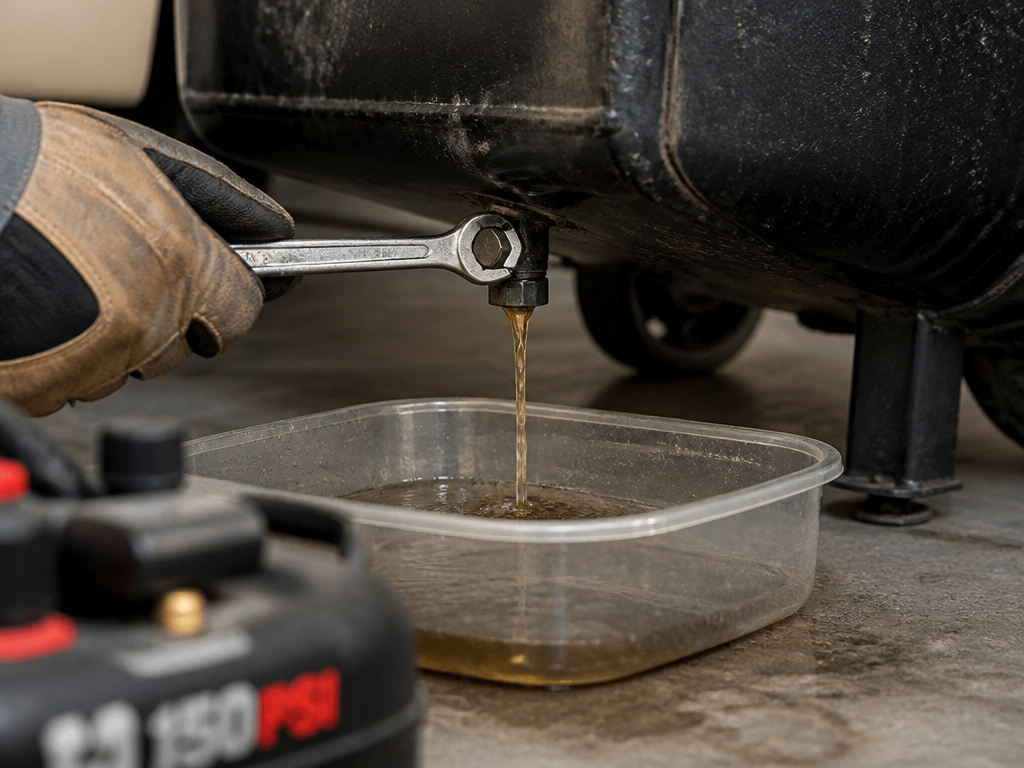
The purchase price is the first cost. The maintenance schedule is the real, long-term price of ownership.
Oil-Free Compressors (Most Pancakes & Hotdogs):
- Maintenance: Virtually none. Drain the tank after each use.
- Lifespan: 500 – 1,000 hours of use. The Teflon-coated piston rings wear down, and the pump loses efficiency.
- Best for: The DIYer who uses it a few weekends a year.
Oil-Lubricated Compressors (Makita MAC700, Industrial Air):
- Maintenance: Check oil level monthly. Change oil every 6 months or 250 hours (per the WEN manual spec). This requires SAE 5W-30 motor oil.
- Lifespan: 2,000+ hours with proper maintenance. The oil bath reduces friction and heat on the piston and cylinder.
- Best for: The serious hobbyist or light professional who needs reliability.
The drain valve is your best friend. Water condenses inside the tank every time the air cools. If you don’t drain it, that water sits against the steel, accelerating rust. A rusted tank is a failed tank, it cannot be safely repaired. This applies equally to pancake air compressors and hotdogs.
Frequently Asked Questions
Can a pancake compressor run a framing nailer?
Maybe, but not well. A typical framing nailer needs 2.0-2.5 CFM. While a 6-gallon pancake might meet that CFM on paper, the small tank will cause the motor to cycle constantly under the sustained demand, overheating the compressor. For framing, you need a larger tank (10+ gallons) paired with adequate CFM, like a home shop compressor.
Is a hotdog compressor good for airbrushing?
Yes, it’s excellent. Airbrushing requires very low, consistent PSI (20-30 PSI) and minimal CFM (0.1-0.5). A small hotdog compressor provides a stable air supply without the bulk. Its quick recovery time is irrelevant because the demand is so low.
Why does my hotdog compressor run constantly?
It’s undersized for the tool you’re using. The compressor is trying to maintain tank pressure while the tool consumes air faster than the pump can produce it. The motor never reaches cut-out pressure, so it runs non-stop. This will trigger the thermal overload and shut the unit down within 15-20 minutes. Check your tool’s CFM requirement against your compressor’s SCFM rating.
Which type is easier to repair?
Hotdog compressors are generally easier for a technician to service. The pump is mounted on top, with clear access to the cylinder head, valves, and motor. The pancake’s sideways, shrouded pump is more integrated and often requires more disassembly. For the home user, both types are typically “replace, not repair” units unless you’re very mechanically inclined.
Can I daisy-chain two small compressors to get more air?
No. You cannot connect the outputs of two compressors to double the CFM. Their pressure switches will fight each other, and you risk damaging both units. If you need more air, sell the small one and buy a correctly sized single air compressor for nail guns or other tools.
The Bottom Line
Skip the shape debate. Look at your tool’s CFM spec, find a compressor whose SCFM at 90 PSI matches or exceeds it, and then let footprint decide the rest.
For the majority of homeowners tackling trim work, inflation, and light cleaning, a 3-gallon hotdog compressor is the most practical pick. It stores away, fills fast, and handles the basics.
If your projects regularly include a finish nailer, a small impact wrench, or any tool that lists a CFM over 2.0, step up to a 6-gallon pancake compressor or a high-performance hotdog like the oil-lubricated Makita MAC700. That extra air delivery is what stands between you and a burned-out motor.
When in doubt, buy for the tool you use most, not the tool you might use someday. Air power is a numbers game, and the right numbers are printed on the side of your nail gun.
