Table Saw Blade Thickness: Kerf Size, Types & How to Choose
This post contains affiliate links. As an Amazon Associate, we earn from qualifying purchases.
A table saw blade’s thickness, defined by its kerf, is typically 1/8 inch (0.125″) for a full kerf blade or 3/32 inch (0.09375″) for a thin kerf blade. The kerf is the width of the material the blade removes, which is always wider than the steel body of the blade itself due to the set of the teeth.
Most people think a thicker blade is just stronger. They buy a full kerf blade for their underpowered jobsite saw because it feels more substantial. The motor strains, the cut slows, and the blade deflects in the kerf anyway, leaving a burned, wavy cut that needs sanding. The thickness matters, but matching it to your saw’s power matters more.
This guide breaks down exactly what kerf is, how to measure it, and the real-world consequences of choosing a full kerf, thin kerf, or ultra-thin kerf blade. You’ll learn how to pair blade thickness with your saw’s horsepower, your project materials, and even the noise level you can tolerate in your shop.
Key Takeaways
- Kerf is not blade gauge. Kerf is the cut width; gauge is the steel plate thickness. Always reference kerf when buying.
- Match kerf to saw horsepower. Use thin kerf (3/32″) for saws under 1.5 HP. Use full kerf (1/8″) for saws over 2 HP.
- Thin kerf saves material. On expensive hardwoods, a thin kerf blade can save you a board foot of waste for every 12 feet of cut.
- Full kerf resists deflection. For deep cuts in dense material or when using a dado stack, the rigidity of a full kerf blade is non-negotiable.
- Always check riving knife fit. A riving knife thicker than your blade’s kerf will cause immediate, violent binding.
What is Kerf? The Real Definition
Kerf is the width of the channel a saw blade leaves in the workpiece. It’s the material that turns to dust. This width is always greater than the thickness of the blade’s steel body, known as the gauge.
The kerf of a saw blade is determined by the width of its carbide teeth at their furthest point of set—the slight outward angle ground into each tooth. This design clears the blade’s body from the sides of the cut, preventing friction and heat buildup. A 10-inch blade with a 0.125-inch kerf removes a strip of wood 0.125 inches wide.
The gauge is just the carrier. Think of it as the spine of the blade. A typical 10-inch blade has a gauge around 0.071 inches.
The carbide teeth, which are brazed onto this plate, are what actually define the kerf. They’re wider. If you try to use a blade without proper tooth set, the steel plate rubs against the wood. You’ll smell burning resin before you see smoke curling from the cut.
This is why you can’t judge a blade by looking at its side. You have to measure the teeth.
How Thick is a Table Saw Blade? The Numbers
Forget vague terms. Here are the actual specifications you’ll find on blade packaging and in manufacturer charts. These numbers are stable, printed specs.
| Kerf Type | Typical Width (Inches) | Typical Width (mm) | Primary Use Case |
|---|---|---|---|
| Full Kerf | 1/8″ (0.125″) | 3.175 mm | Cabinet saws (3+ HP), heavy-duty ripping, dado stacks. |
| Thin Kerf | 3/32″ (0.09375″) | ~2.38 mm | Jobsite/contractor saws (1-2 HP), cutting expensive hardwoods. |
| Ultra-Thin / Micro Kerf | 5/64″ (0.0781″) | ~1.98 mm | Specialized finish work on very low-power saws; often requires a stiffener. |
A so-called “standard” blade is usually a full kerf. The thin kerf became popular as portable jobsite saws with smaller motors flooded the market. That 3/32 inch difference is a big deal to a 1.75 HP motor trying to rip 8/4 maple.
I learned this the hard way with a Freud LM72M010 10-inch full kerf combo blade on a Ridgid R4512 hybrid saw. The saw was rated at 1.75 HP. On paper, it should have handled it. The first rip through 12-foot poplar was fine.
The second through 8/4 ash bogged the motor down mid-cut. The blade stalled, the breaker tripped, and I spent ten minutes smelling that distinct hot-electrical odor. I switched to a Freud LU83M010 thin kerf blade and never had the issue again. The saw didn’t get more powerful; the blade just asked less of it.
How to Measure Your Blade’s Kerf
Don’t trust the packaging if you’ve lost it or are buying used. Verifying kerf is a one-minute job with the right tool.
- The Caliper Method (Most Accurate). Use a digital caliper. Measure across the widest part of the carbide teeth, not the steel plate. Take the measurement near the blade’s rim. Write it down.
- The Cut-and-Measure Method (Practical). Make a clean, straight cut through a piece of scrap wood. Do not move the wood or the fence. Turn the saw off, raise the blade fully, and measure the width of the slot left in the wood with your calipers. This is your true cutting kerf.
Why does this matter? If you’re building cabinets and your joinery calculations assume a 1/8″ kerf but your blade is actually 0.118″, your tenons will be loose. That 0.007″ error per cut adds up over multiple joints. The piece will rack.
Full Kerf vs. Thin Kerf: The Detailed Breakdown
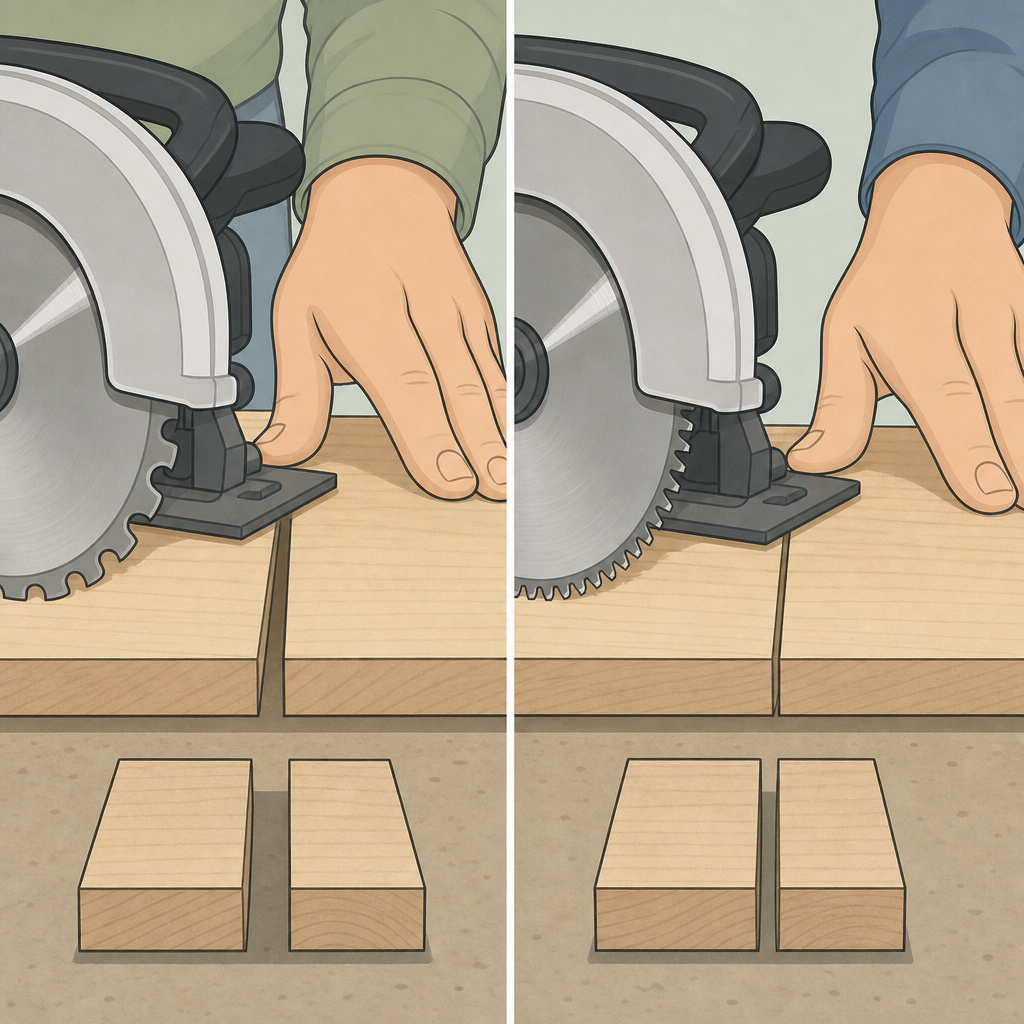
The choice isn’t about good and bad. It’s about matching a tool to a job. This table lays out the real trade-offs.
| Aspect | Full Kerf Blade (1/8″) | Thin Kerf Blade (3/32″) |
|---|---|---|
| Power Requirement | High. Best for 2 HP (15A) motors and above. | Low. Ideal for 1-1.75 HP (10-13A) motors. |
| Material Waste | Higher. Removes 33% more wood per cut than thin kerf. | Lower. Significant savings on expensive exotic woods. |
| Blade Stability | Excellent. Resists deflection, especially in deep cuts. | Good, but can deflect in hardwoods or with misalignment. |
| Cut Quality | Potentially smoother on powerful saws due to zero flex. | Can be just as smooth if the blade is sharp and the saw is tuned. |
| Heat Dissipation | Better. More steel mass absorbs and dissipates heat. | Can run hotter, requiring more frequent cool-down pauses. |
| Dado Stack Compatibility | Yes. Standard dado shims are designed for full kerf chippers. | Rarely. The chippers are too thin for standard shims. |
| Noise Level | Noticeably louder. More mass vibrating at high RPM. | Slightly quieter. Less air displacement and mass. |
If you run a thin kerf blade on a saw with a full-kerf riving knife, the knife will be thicker than the cut. The workpiece will pinch the back of the blade the instant you finish the cut. This is a guaranteed kickback event. The board becomes a missile. Check this fit every time you change blades.
The stability point is crucial. A thin kerf blade can wander in a deep cut. The cut might start straight, but the blade can flex sideways if it encounters a harder grain pattern.
You’ll see a faint burn line that curves. A full kerf blade just plows through. This is why for table saw angle cuts or any precision joinery on a powerful saw, I default to full kerf. The margin for error is smaller.
Why Does Blade Thickness Matter? The Mechanics
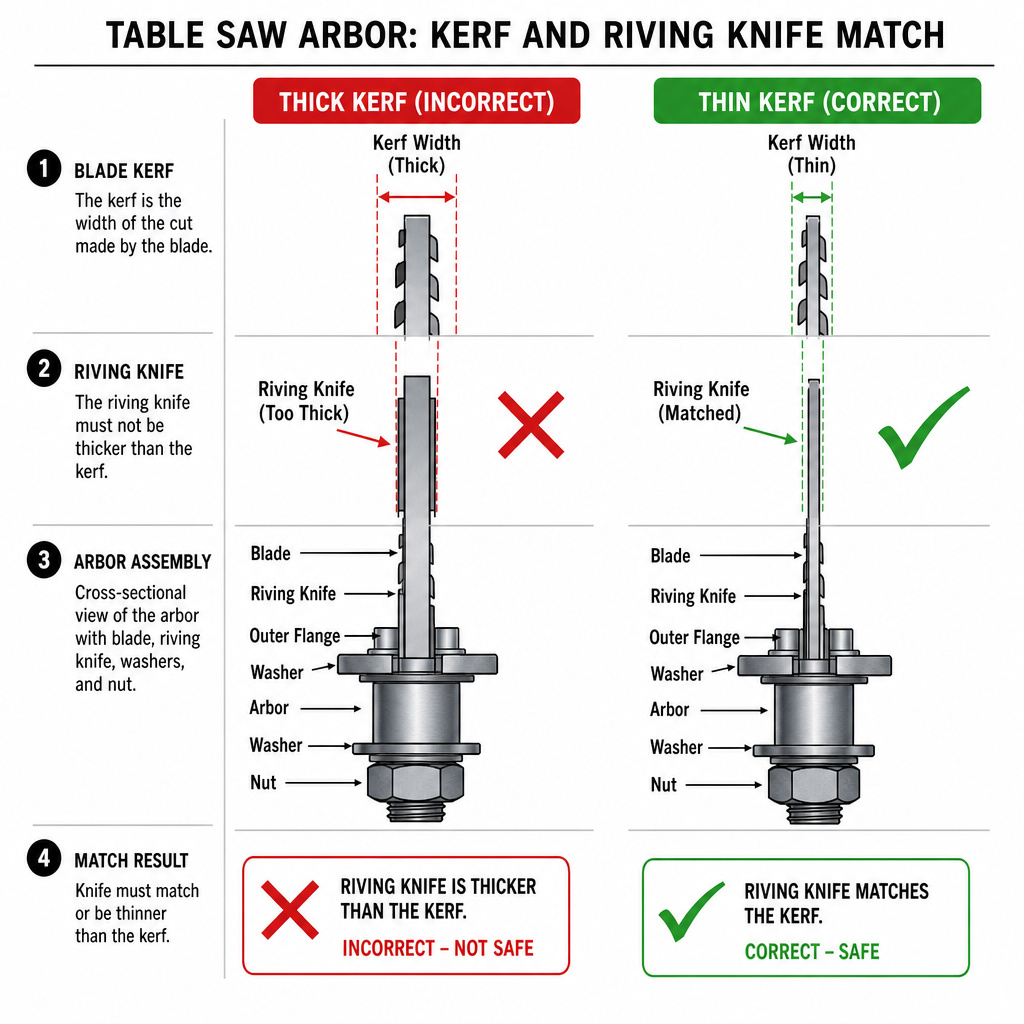
This isn’t just shop lore. The thickness of the kerf directly changes the physics at the saw’s arbor.
- Power Consumption: A thicker kerf means the blade is removing more cubic inches of material per minute. This requires more torque from the motor. The formula is simple: more work equals more power demand. A struggling motor heats up, and thermal overload protectors click off. That’s your saw shutting down mid-cut.
- Kickback Risk: This ties directly to riving knife alignment. The riving knife’s job is to keep the kerf open behind the blade, preventing the workpiece from pinching the blade’s rear teeth. If the knife is even 0.010″ thicker than the kerf, it acts as a wedge, forcing the workpiece into the blade. The blade’s rotation then launches the workpiece backward. This is not a minor hazard.
- Cutting Accuracy: Blade deflection equals inaccurate cuts. A thin kerf blade under lateral pressure (like from a slightly misaligned fence) will bend. It doesn’t take much. A deflection of 0.005 inches over a 10-inch radius translates to a noticeable taper over a 24-inch rip. Your glue joints fail.
- Dado Stack Function: A standard 8-inch dado stack uses two 1/8″ outer blades and multiple 1/8″ chippers with thin shims for fine adjustment. Thin kerf chippers simply don’t exist in this system. Attempting to use a thin kerf outer blade with standard chippers creates a mismatched, unstable stack that will vibrate excessively and produce terrible cuts.
For a deep dive on keeping your blades in top shape, our guide on table saw blade sharpening covers the techniques that maintain these critical dimensions.
How to Choose: Thin Kerf or Full Kerf?
Follow this decision tree. It’s the same logic I use in my own shop.
- What is your saw’s real horsepower? Check the nameplate amperage. A 15-amp, 120V motor produces about 1.75 HP under ideal conditions. At 240V, that same motor might be rated for 3 HP. If you’re on 120V and 15 amps, start with thin kerf. If you have a 3 HP 240V cabinet saw, you can run full kerf all day.
- What are you cutting? Ripping long, thick hardwoods (oak, maple, hickory) demands a stable blade. On a powerful saw, use a full kerf rip blade (24-tooth Flat Top Grind). For sheet goods or trim work on any saw, a thin kerf 50-tooth combination blade (ATB grind) is often perfect.
- Is material cost a factor? Building a dining table from 8/4 walnut? The wood is $25 a board foot. A thin kerf blade will save you about one board foot of waste for every 12 linear feet of rip cuts. That’s a tangible savings.
- Do you use a dado stack? If yes, you are committed to a full kerf system. Purchase a dedicated full kerf blade for your general work to avoid constant blade swaps.
I keep a Forrest Woodworker II 10-inch thin kerf blade on my jobsite saw for 90% of my work. It’s a 40-tooth ATB grind that crosscuts and rips cleanly enough for glue-ready edges. But when that saw goes to the curb for a 3 HP cabinet saw, the first purchase will be the full kerf version of that same blade. The tool serves the work.
Related Factors: Tooth Count, Grind, and Blade Quality
Kerf is the headline, but the blade’s other specs determine if the cut is rough or ready for finish.
- Tooth Count & Grind: More teeth (80-100) with an Alternate Top Bevel (ATB) grind yield a smoother crosscut. Fewer teeth (24-30) with a Flat Top Grind (FTG) rip faster and clear chips better. A 50-tooth ATB with a raker (ATBR) is a general-purpose “combo” grind.
- Carbide Quality: Not all carbide is equal. Look for C3 or C4 micro-grain carbide tips. They hold an edge 5-10 times longer than cheap carbide and can be sharpened multiple times. The tips on a premium blade are also thicker, which contributes to a consistent kerf over the blade’s life.
- Vibration Dampening: Look for laser-cut expansion slots or anti-vibration slots in the blade plate. These reduce harmonic noise and help stabilize the cut, which is especially beneficial for thin kerf blades. Some blades have built-in dampening material sandwiched in the plate.
Understanding these features helps you master table saw basics, turning a simple cut into a precision operation.
Frequently Asked Questions
Can I use a thin kerf blade on any table saw?
You can physically mount it, but you shouldn’t use it on any saw without checking two things. First, your saw’s riving knife or splitter must be thinner than the blade’s kerf. Second, while a thin kerf blade is easier on a weak motor, using one on a very powerful saw (3+ HP) can sometimes allow it to deflect more because the motor isn’t straining at all. It’s a mismatch.
How much wood does a thin kerf blade save?
Over a 10-foot rip cut, a thin kerf blade (0.09375″) removes about 1.125 square inches less wood than a full kerf blade (0.125″). In a dense hardwood like maple, that’s roughly 0.4 board feet of material saved. On a large project, this adds up to real money.
Do thin kerf blades dull faster?
Not inherently. Dullness comes from cutting abrasive materials, hitting nails, or poor sharpening. However, because a thin kerf blade has less steel supporting the carbide tooth, that tooth can be more susceptible to chipping if it strikes a knot or foreign object. The blade doesn’t wear faster, but it can be damaged more easily.
What blade thickness do I need for a dado stack?
You need a full kerf setup. Dado stacks are a system: two 1/8″ outer blades and several 1/8″ chippers. The chippers are designed to nest together with the outer blades to form a single, rigid cutting width. Thin kerf blades and chippers are not part of this standardized system and are extremely rare.
Can I sharpen a thin kerf blade myself?
Yes, but with caution. The carbide tips are smaller. If you use a bench grinder with a jig, you must ensure the jig is calibrated for the smaller tooth size. Removing too much material during one sharpening session can weaken the tooth’s bond to the steel plate. Many woodworkers send thin kerf blades to professional sharpening services for this reason.
The Bottom Line
Table saw blade thickness isn’t a minor detail. It’s a critical spec that determines if your saw works with you or against you. Match a thin kerf blade to lower-horsepower saws and expensive materials to reduce strain and waste. Choose a full kerf blade for heavy-duty ripping, dado work, and saws with ample power to ensure absolute stability and straight cuts.
Ignore the riving knife thickness at your peril—it’s the single most important safety check when swapping blades. Finally, invest in a blade with quality carbide and the right tooth grind for your common tasks. A sharp, correctly chosen blade doesn’t just make better cuts; it makes the entire saw safer and more pleasant to use.
