
How to Build a Sled for Your Table Saw: Essential DIY Jig
This post contains affiliate links. As an Amazon Associate, we earn from qualifying purchases.
A table saw crosscut sled is a shop-built jig with a flat base that rides on runners in the saw’s miter slots, featuring a squared rear fence that guarantees perfect 90-degree cuts. You build it by milling precise hardwood runners, attaching a plywood base, cutting a zero-clearance kerf, and using the five-cut method to square the fence with microscopic accuracy. The result is safer, more accurate crosscuts on wide stock.
Most woodworkers rush the fence squaring step. They eyeball a square against the blade or trust the miter slot, which is almost never perfectly parallel to the blade. The sled feels smooth, but every cut drifts a hair. That error compounds across a cabinet side or a picture frame, and the joint won’t close. The fence looks square, but the blade’s path tells a different story.
This guide walks through building a dead-square sled from the ground up. We’ll cover material choices that prevent warping, the exact process for fitting runners so they glide without slop, and the mathematical five-cut method that eliminates guesswork. We’ll also add practical upgrades like T-tracks and blade guards.
Key Takeaways
- The rear fence must be squared to the blade’s path, not the miter slot or the table’s edge, using the five-cut measurement method.
- Hard maple or UHMW plastic runners, milled 0.005-inch undersized, provide the ideal balance of smooth glide and zero play.
- Baltic birch plywood is the best base material, it’s stable, void-free, and holds screw threads at the edges better than MDF.
- Always make the initial through-cut with the sled before attaching the rear fence, creating a zero-clearance kerf that minimizes tear-out.
- A front fence is not for alignment; its only job is to prevent the sled base from racking, so attach it only after the rear fence is perfectly square.
What You’ll Need: Tools and Materials
Gather everything before you start. Waiting for a glue-up to dry because you’re missing screws is how small mistakes happen.
Before you start: A table saw is involved. Unplug it before fitting runners or making non-cutting adjustments. The initial kerf cut will throw fine dust backward, wear safety glasses and a respirator. When testing runner fit, never reach over the blade area, even with the saw off.
You need a flat, stable material for the base. I used a 24-inch by 27-inch piece of 3/4-inch Baltic birch plywood for years. MDF is heavier and sags over a 30-inch span if not supported, and it doesn’t hold edge screws well for the fence attachment. The extra cost for Baltic birch pays off in longevity.
The runners are critical. Hard maple is the classic choice. White oak works, but avoid red oak, its open pores can compress unevenly. UHMW plastic is a modern alternative; it’s self-lubricating and ignores humidity, but you must buy it pre-dimensioned. You’ll need a piece about 3/4-inch thick by 1-inch wide by 30 inches long for two runners.
For fasteners, use #8 x 2-1/2-inch flat-head wood screws for the fences and #6 x 3/4-inch flat-head screws for the runners. The shorter screws won’t protrude through the base.
| Component | Recommended Material | Why This Works |
|---|---|---|
| Sled Base | 3/4″ Baltic Birch Plywood | Stable, void-free layers, holds edge screws well, lighter than MDF. |
| Runners | Hard Maple or UHMW Plastic | Dense, wears slowly, can be precisely milled; UHMW is self-lubricating and stable. |
| Rear Fence | 1.5″ Laminated Plywood | Massive and rigid to resist deflection during cuts; lamination prevents warping. |
| Front Fence | 3/4″ MDF or Plywood | Provides anti-racking stability; doesn’t need to be as tall as the rear fence. |
| Blade Guard | 1/4″ Clear Cast Acrylic | Allows you to see the kerf while keeping fingers away from the blade opening. |
For tools, a table saw is obviously essential. A drill/driver, a combination square, and a random orbital sander are the other basics. A router with a 1/4-inch straight bit is optional but helpful for embedding T-track. Digital calipers are non-negotiable for the five-cut method, a tape measure won’t cut it.
Step 1: Build the Sled Base and Fit the Runners
Cut your plywood base to size. A good starting dimension is 24 inches front-to-back and 27 inches wide. This gives you about 12 inches of cut capacity to the right of the blade, which handles most cabinet sides and shelf stock.
Now, mill the runners. This is the first precision task.
- Measure your miter slot width with digital calipers. Take the measurement at several points along the slot, they can vary. Note the smallest measurement.
- Rip your hardwood stock to a width that is 0.005-inch less than that smallest measurement. If your slot measures 0.750 inches, rip the runner to 0.745 inches.
- Test the fit. The runner should slide the full length of the slot using only light finger pressure. It must not rock side-to-side. If it binds, sand the sides evenly with 220-grit sandpaper wrapped around a flat block. Check fit after every few passes.
The goal is “snug but effortless.” A runner forced into the slot will create friction and heat, expanding the wood and seizing the sled mid-cut. Too loose, and the sled will wiggle, ruining accuracy.
A properly fitted hardwood runner should slide the length of a clean, waxed miter slot with the weight of the sled alone, requiring no more than one finger to initiate movement. Binding indicates the runner is still oversize or the slot has a burr that needs filing.
With runners fitted, place them in the slots. Apply a thin bead of wood glue to the top face of each runner. Carefully lower the sled base onto them, aligning the base so it overhangs evenly on both sides of the saw table. Press down firmly.
From underneath, secure each runner with four #6 x 3/4-inch screws, predrilling to avoid splitting. Wipe any squeezed-out glue immediately. Let the glue cure for an hour before moving to the next step. This is a good time to review table saw basics if you’re new to the machine.
Step 2: Make the Initial Kerf Cut and Build the Fences
With the base attached but no fences installed, you’ll cut the sled’s zero-clearance kerf. Raise your table saw blade to its maximum height. Position the sled so the blade will cut roughly down the centerline. Turn on the saw and push the sled completely past the blade, cutting a slot through the entire base.
This kerf does two things. It gives the blade a clean, tear-out-free path. And it becomes your primary reference line for the next step. Don’t attach any fence until this cut is made.
Now, build the fences. The rear fence is the heart of the sled. It should be tall enough to support your workpiece, 4 inches is common, and thick enough to resist flex. I laminate two pieces of 3/4-inch plywood to get a 1.5-inch thick fence. The front fence is just a stabilizer; 3 inches tall and 3/4-inch thick is sufficient.
Cut both fences to the exact width of your sled base. Sand the faces that will contact the base.
Step 3: Square the Fence with the Five-Cut Method
This is the moment that separates a useful sled from a precision instrument. You will square the rear fence to the blade’s path, not to anything else.
The Five-Cut Method is a mathematical self-calibration technique that uses a series of cuts on a known-width board to magnify and measure any error in the fence’s squareness, allowing for adjustments smaller than the thickness of a human hair.
Temporarily attach the rear fence to the sled base. Use only two #8 screws near the ends, and don’t fully tighten them, just enough to hold the fence in place. Do not use glue yet.
Take a flat piece of plywood or MDF about 12 inches square. Joint one edge perfectly straight. This is your “test piece.”
- Place the test piece against the rear fence, to the right of the kerf. Make a cut, trimming off a sliver. Do not move the test piece.
- Rotate the test piece so the freshly cut edge is against the fence. Make a second cut.
- Repeat this rotate-and-cut process four times total. After the fifth cut, you will have a final, narrow strip.
- Measure the width of this strip at both ends with your digital calipers.
The difference between these two measurements is your error, magnified by the process. The formula to find the actual fence error per inch of cut is: Error = (Difference in measurements) / 4. If your strip is 0.012-inch wider at one end after five cuts, your fence is out of square by 0.003-inch per inch of cut.
To adjust, lightly tap the high end of the fence with a mallet. A tiny movement changes the measurement dramatically. Re-tighten the screws, make another set of five cuts, and re-measure. Repeat until the difference between the two measurements is less than 0.004 inches (which translates to an error of 0.001-inch per inch, more than enough for fine woodworking).
Once square, drive in the rest of the screws, add glue along the fence-bottom joint, and let it cure. Now attach the front fence. Its only job is to keep the sled square, so simply clamp it parallel to the rear fence, then screw and glue it in place.
Design Variations and Advanced Features
Your basic sled is now fully functional. But you can add features that make it indispensable.
Adding T-Track: A length of aluminum T-track embedded flush into the sled base, parallel to the fence, allows you to use stop blocks for repeatable cuts. Rout a groove the width and depth of the track, then secure it with epoxy or small screws from underneath.
Integrated Dust Collection: Cut a port in the rear fence directly behind the blade kerf. Glue a 2.5-inch PVC flange to the back, and connect your shop vac hose. It captures about 70% of the dust from the cut.
Auxiliary Fence for Small Parts: For cutting pieces under 3 inches, the blade guard gets in the way. Make a secondary, lower fence from 1/2-inch plywood that attaches over the main fence via French cleats or bolts. It provides support while keeping the guard functional.
| Upgrade | Best For | Consideration |
|---|---|---|
| T-Track & Stop Block | Batch production, identical parts | Ensure track is parallel to fence; use a star-knob bolt for quick adjustments. |
| Dust Collection Port | Cleaner shop air, better visibility | Place the port within 2 inches of the blade kerf for maximum suction efficiency. |
| Small-Parts Fence | Cutting splines, box joints, tiny pieces | Make it easily removable; height should be just above the blade’s highest point. |
| Replaceable Kerf Plate | Protecting the base when using dados | Inlay a strip of 1/8-inch hardboard over the kerf; replace when chewed up. |
Dedicated Dado Sled: If you use a dado stack frequently, build a second, heavier sled with a wider kerf. Use 1/2-inch MDF for the base because it’s cheap to replace when the kerf gets ragged. This saves your primary sled’s crisp zero-clearance edge.
Common Problems and How to Fix Them
Even a well-built sled can develop issues. Here’s how to diagnose and correct them.
The sled binds or sticks mid-cut.
This is almost always a runner problem. Sawdust and grime build up in the miter slots. Clean them thoroughly with a brass brush and mineral spirits. Then, wax the slots and the runners with paste wax or a dedicated UHMW dry lubricant. If binding persists, remove the sled, place the runners back in the slots alone, and check for high spots with a feeler gauge. Sand those spots down.
Cuts are no longer square.
Wood moves. Check if your rear fence has loosened or if the base has warped. Re-check squareness using the five-cut method. If the error has returned, the fence screws may have stripped in the base. Remove the fence, fill the old screw holes with epoxy mixed with sawdust, and re-drill. For a warped base, you might need to shim between the base and the runner during re-attachment.
The front of the sled lifts during a cut.
This is dangerous and indicates the front fence is not doing its job. The sled is racking. Ensure the front fence is securely glued and screwed, and that it is perfectly parallel to the rear fence. Adding a second runner in the outfeed miter slot (for very wide sleds) can also add stability.
Never ignore a sled that rocks or teeters during a cut. That lateral pressure can twist the blade slightly in the arbor, causing a burn or, worse, a kickback. If the sled doesn’t sit flat on the table with the runners seated, disassemble and re-mill the runners.
Maintaining Your Crosscut Sled
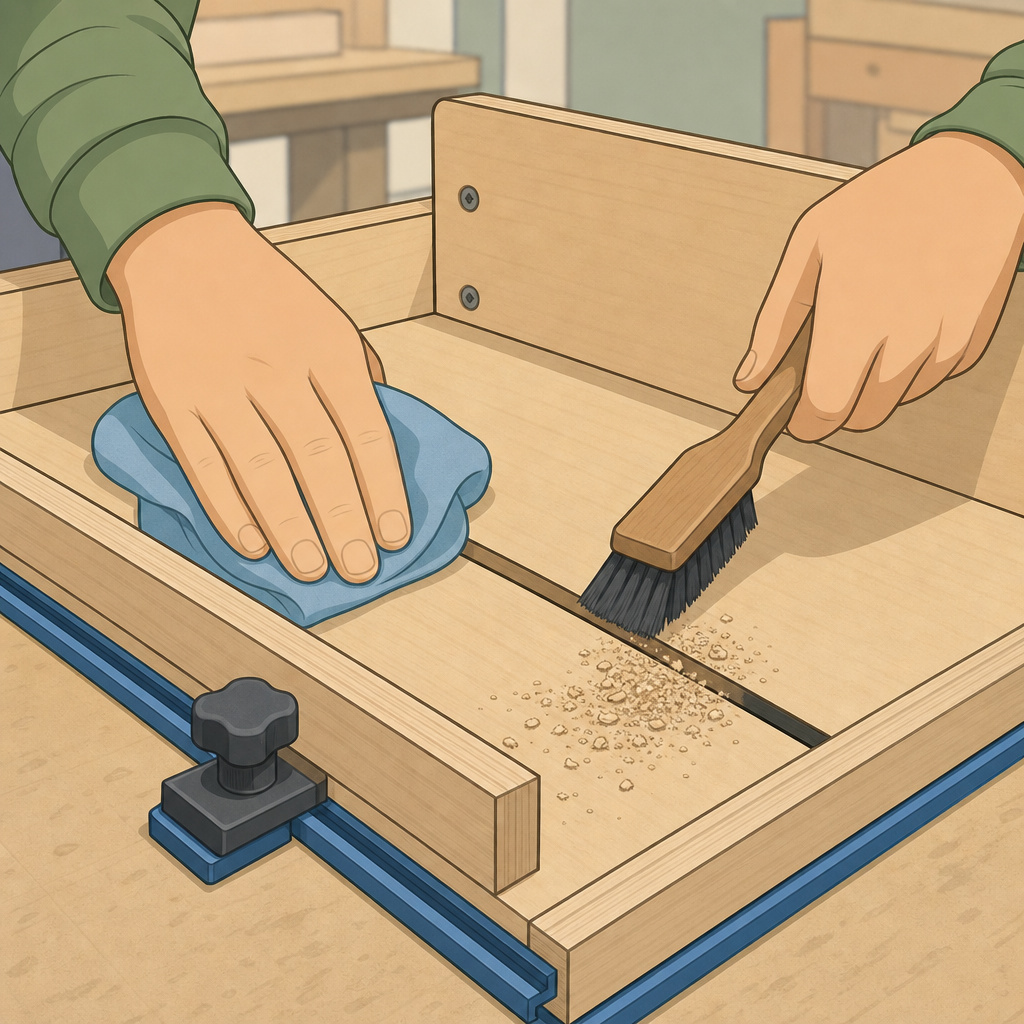
Treat the sled like a precision tool. Store it flat, hanging on a wall or on a dedicated shelf. Never lean heavy objects against the fence.
Every few months, re-wax the runners and miter slots. Inspect the fence for squareness with a known-accurate square, and run the five-cut method if you’re doing critical work. Check all screws for tightness. Keep the kerf clean of packed sawdust, which can deflect thin stock.
If the zero-clearance kerf becomes widened and ragged from many blade changes, you can fill it with a strip of hardwood and re-cut it. Or, build a new base and transfer the fences and runners, they’re the valuable parts. This is also a good time to think about cleaning a table saw blade to ensure clean cuts.
Frequently Asked Questions
How much does it cost to build a crosscut sled?
Material costs are relatively low. A half-sheet of Baltic birch plywood, some hardwood, and screws might run between $60 and $100, depending on local prices. This is far less than a commercial sled, and yours will be custom-fit to your saw.
Can I build a sled for a jobsite table saw?
Absolutely. The process is identical. The main challenge is that jobsite saw tables are often smaller, so design a more compact sled. Also, the miter slots on portable saws can be less consistent, take extra care when measuring and fitting the runners. A well-made sled dramatically improves the accuracy of a jobsite saw.
Is MDF or plywood better for the sled base?
Plywood wins for durability and screw-holding ability at the edges where the fence attaches. MDF is denser and heavier, which can be good for vibration damping, but it sags over long spans unless supported and it turns into a sponge if it gets wet. I’ve used both; Baltic birch plywood is worth the upgrade.
How do I cut angles with a crosscut sled?
standard sled is for 90-degree cuts only. For angles, you have two options. You can build a dedicated sled with a fence fixed at a common angle like 45 degrees. Or, you can use a precision miter gauge for those cuts. Don’t try to clamp a workpiece at an angle to your 90-degree fence, it’s unsafe and inaccurate.
Why is my sled leaving burn marks on the wood?
This usually points to a dull blade or a fence that is not perfectly square, causing the workpiece to pinch the blade slightly. First, verify your fence’s squareness. Then, inspect your blade. A clean, sharp blade is crucial. Consider sharpening table saw blades or replacing it if it’s old.
The Bottom Line
Building a crosscut sled transforms your table saw from a dangerous rip-cutting machine into a safe, precision crosscutting station. The investment in time, a solid afternoon, pays back on every project that requires a square end. Remember that the runners must glide without play, the five-cut method is non-negotiable for accuracy, and the front fence is there only for rigidity. Start with the basic design, use stable materials, and add features like T-tracks only after the core sled is perfect. Once you use a sled you built yourself, you’ll never go back to wrestling large panels with a miter gauge.
