7 Best Table Saw Blades for Plywood 2026
This post contains affiliate links. As an Amazon Associate, we earn from qualifying purchases.
The Freud 10″ Ultimate Plywood Blade is the best overall for clean, splinter-free cuts in hardwood and veneered plywood, thanks to its 80-tooth ATB grind and thick, stable plate. For a budget-friendly option that still delivers solid performance, the FOXBC 10″ 80-Tooth Ultra Finish blade stands out, while the CMT 10″ 200T Contractor Plywood excels in ultra-fine finish work where absolute minimum tear-out is critical.
Cutting plywood cleanly isn’t just about a sharp blade, it’s about having one designed for the layered, fragile nature of veneers. Too few teeth or the wrong grind, and you’ll fight splintering and rough edges every time.
After comparing specs and reading through hundreds of owner reviews, I focused on blades that consistently deliver smooth cuts with minimal tear-out. This guide highlights models that balance tooth count, grind, kerf, and plate stability to match real-world plywood projects, from cabinet-grade builds to shop jigs.
Top 7 Table Saw Blade For Plywoods in the Market
The Best Table Saw Blade For Plywoods, Reviewed
Freud 10″ Ultimate Plywood Blade

Strengths
- 80 teeth for ultra-fine cuts
- HiATB grind reduces tear-out
- Perma-Shield coating
- Laser anti-vibration slots
Trade-offs
- Premium price
- Not ideal for ripping
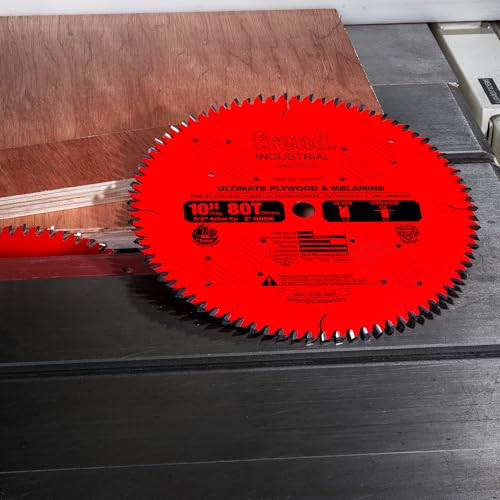
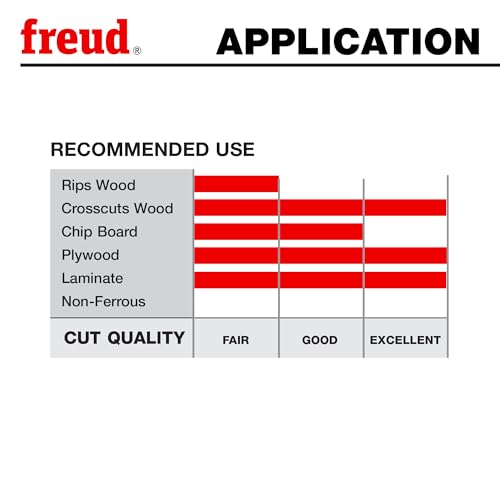
When it comes to clean, splinter-free cuts in plywood and melamine, the Freud LU80R010 stands out as the benchmark. With 80 teeth and a High Alternate Top Bevel (HiATB) grind, this blade is engineered specifically for crosscutting sheet goods without tear-out. Owners consistently report crisp edges and minimal sanding, especially on veneered plywood and laminated materials. The Perma-Shield coating is a real benefit, feedback shows it cuts down on pitch buildup and makes cleaning easier after long runs.
The laser-cut anti-vibration slots do their job. On paper, the .087-inch plate is thinner than premium blades, but paired with those slots, it delivers surprising stability. It’s not meant for heavy rip cuts, but for its intended purpose, fine finish work, it’s hard to beat. Compared to the DEWALT DWA11080, this one edges ahead in surface quality, especially on delicate materials.
Product photos
DEWALT 10″ 80-Tooth Fine Finish
Strengths
- 80 teeth for fine finish
- Low vibration design
- Durable carbide
- Precision tooth geometry
Trade-offs
- No anti-stick coating
- Slightly thicker kerf
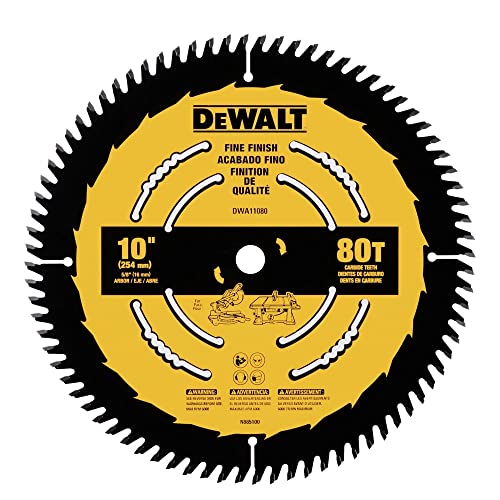
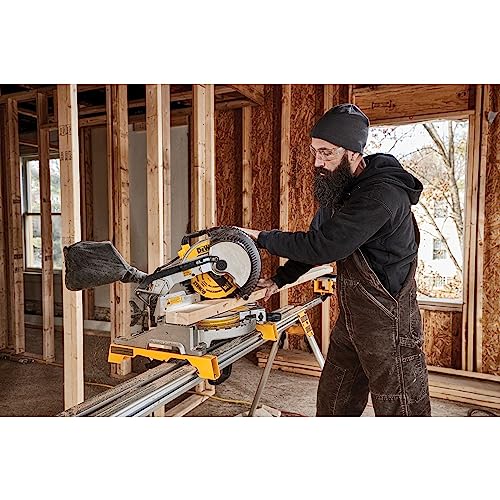
DEWALT’s DWA11080 leans into precision with its optimized tooth geometry and patented body slots for vibration control. It’s built like a pro tool, thick plate, robust carbide, and engineered for accuracy. Owners note clean, consistent cuts across plywood and sheet goods, with less chatter than thinner blades. It doesn’t have a non-stick coating like Freud, but the ultra-sharp carbide comes ready to cut with minimal break-in.
Compared to the Freud LU80R010, it’s slightly more aggressive and better suited for mixed tasks, though the finish is a hair rougher on delicate veneers. If you’re looking for a blade that bridges fine finish work and durability, this is a strong contender. It’s not the absolute smoothest, but it’s reliable and built to last.
Product photos
FOXBC 10″ 80-Tooth Ultra Finish

Strengths
- 80 teeth for smooth cuts
- Low vibration
- Affordable
- Good for melamine
Trade-offs
- Shorter lifespan
- Inconsistent edge retention
- Not for heavy use
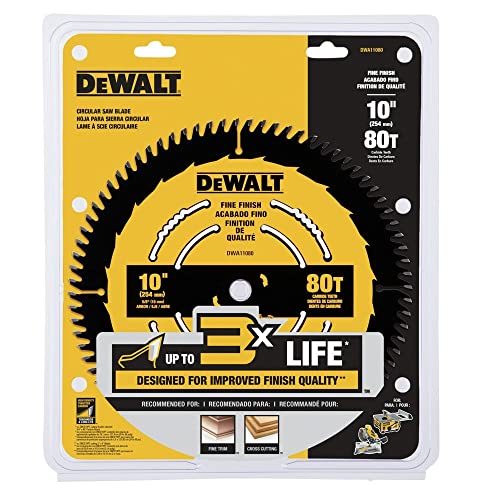
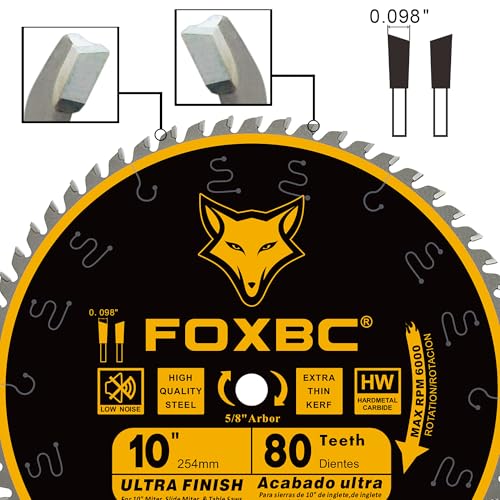
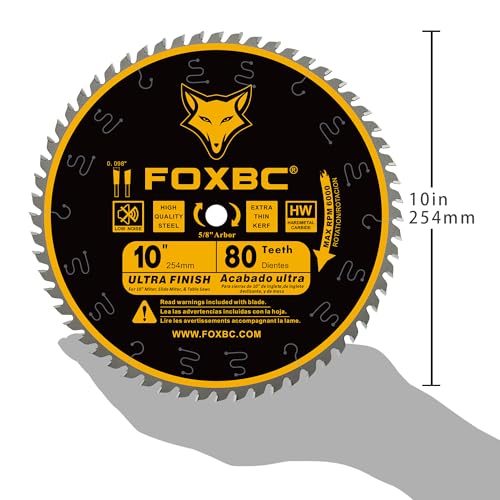
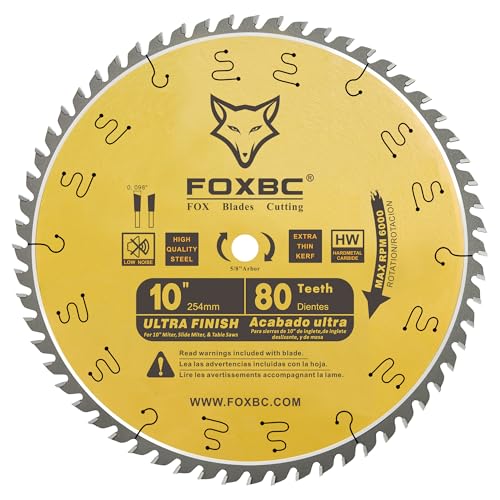
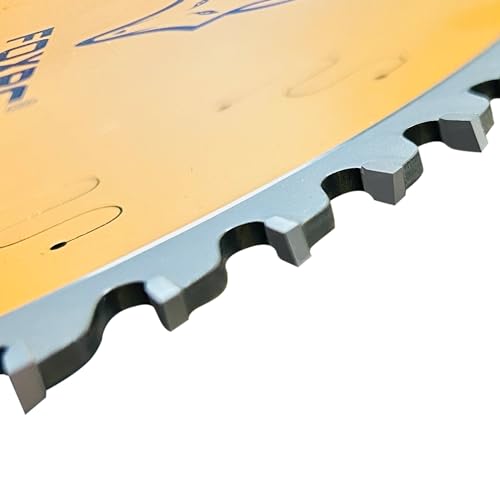
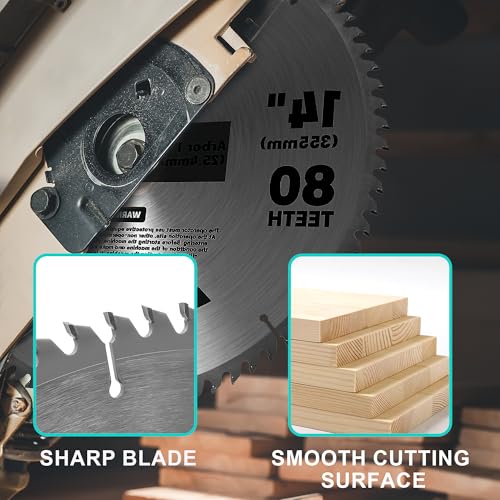
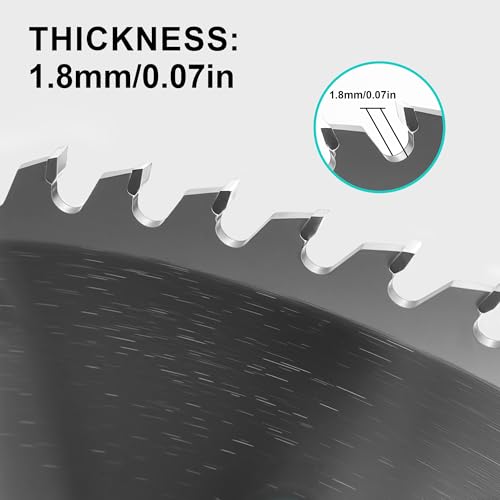
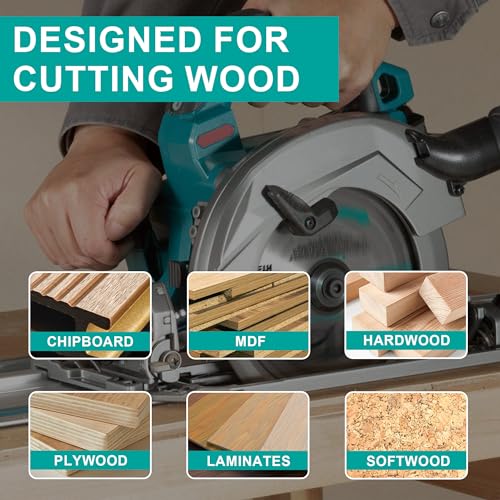
The FOXBC 80-tooth blade markets itself as a precision tool, and on paper, it looks solid, thin kerf, ATB grind, and compatibility with major saw brands. Owners report clean cuts in plywood and melamine, especially at lower feed speeds. It’s clearly designed to mimic higher-end blades like the Freud, and for the price, it delivers a decent finish.
But durability is where it lags. Compared to the DEWALT or Diablo, the carbide seems softer, and sharpening doesn’t restore performance as well. It’s a one-season blade for casual users, not a long-term investment. Still, if you’re comparing budget 80-tooth options, this one beats the WEN in finish quality, though not the OSTTE. For light-duty projects, it’s a functional pick.
Product photos

Diablo 10″ 60T Fine Finish
Strengths
- Shock-resistant carbide
- Hi-ATB for clean cuts
- Durable on hardwood plywood
- Good for mixed materials
Trade-offs
- 60 teeth limit finish fineness
- Slightly noisier than Freud
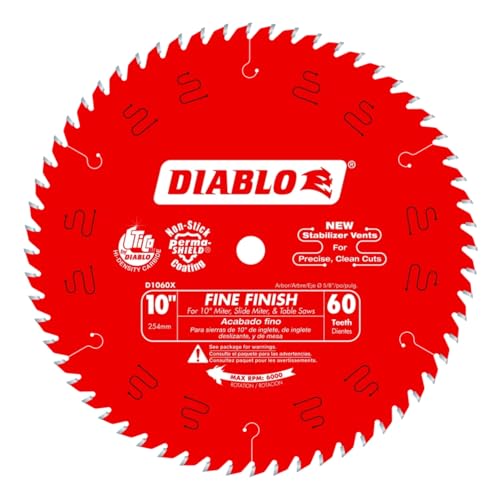
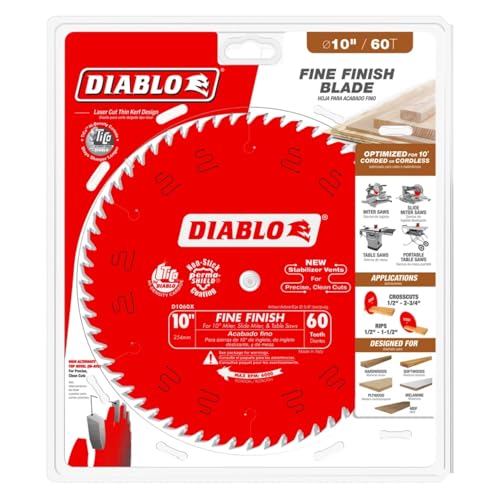
Diablo’s D1060X is built tough, and its shock-resistant design shows in owner feedback, this blade handles hardwood plywood with confidence, even when hitting hidden knots or dense glue lines. The 60 Hi-ATB teeth deliver a smooth finish, though not quite as refined as 80-tooth models. It’s a great middle ground for users who want clean cuts without sacrificing durability.
Where it really shines is in resilience. Compared to the WEN or FOXBC, this one holds an edge longer and resists chipping, especially when cutting abrasive materials like MDF-backed veneers. It’s not the absolute smoothest blade here, but for shops that mix plywood with occasional hardwood crosscuts, it offers a reliable balance. The .098-inch kerf is standard, so it won’t tax most 10-inch saws.
Product photos
CMT 10″ 200T Contractor Plywood
Strengths
- 200 teeth for flawless finish
- Thin kerf for efficiency
- Heavy-duty plate
- Ideal for veneers
Trade-offs
- Very slow feed rate
- High risk of burning
- Overkill for most tasks
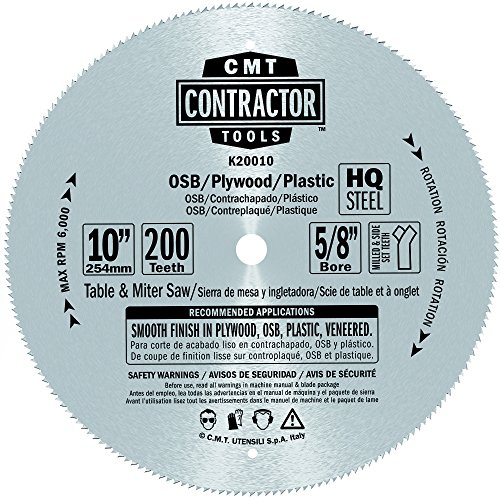
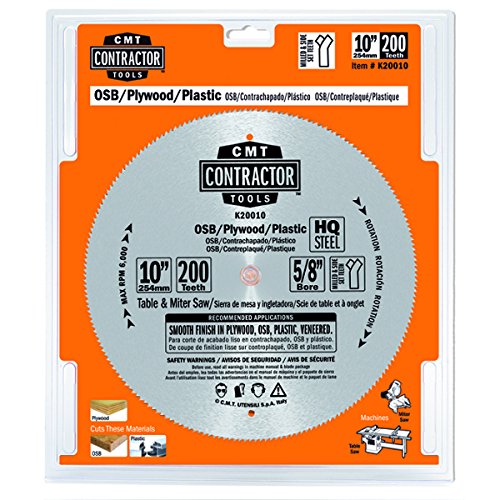
The CMT K20010 is in a class of its own when it comes to crosscut finish. With 200 teeth, it’s overkill for most jobs, but when you need a glass-smooth edge on veneered plywood or thin plastic laminates, there’s no better choice. This is the blade you reach for when sanding isn’t an option. The thin-kerf design keeps it efficient on mid-power saws, and the heavy-duty steel plate adds stability despite the high tooth count.
Owners love it for trim work and fine furniture, though they warn it’s slow to feed and can burn if pushed too fast. Compared to the Freud LU80R010, it’s more specialized, less versatile, but unmatched in its niche. It’s not a daily driver, but for ultra-fine crosscuts, it’s the gold standard. Just keep your feed rate slow and your saw clean.
Product photos

OSTTE 10″ 80T Carbide Tipped
Strengths
- 80 teeth for smooth cuts
- Good value
- Sharp out of the box
- Cuts nailed wood (with caution)
Trade-offs
- Shorter lifespan
- Inconsistent sharpening
- Not for precision work
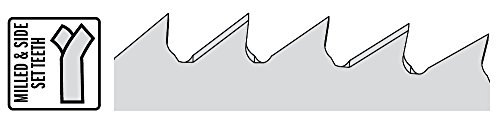
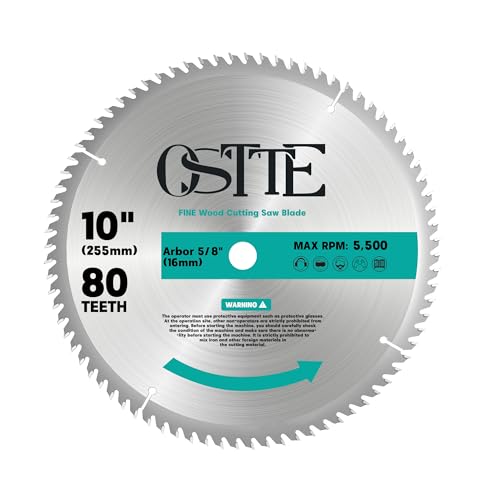
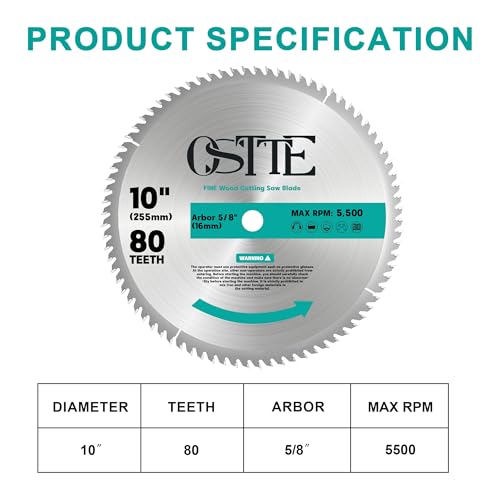
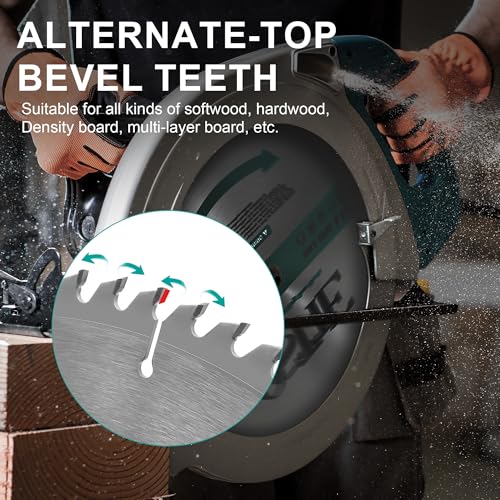
OSTTE is not a name you see on professional benches, but this 80-tooth blade makes a compelling value case. On paper, it matches the Freud in tooth count and arbor size, and owners report surprisingly clean cuts in standard plywood and MDF. The 4-face precision grinding seems to help reduce friction, and the alternating top bevel design does its job minimizing tear-out.
But it’s not without trade-offs. The carbide quality isn’t on par with Freud or Diablo, so it dulls faster under heavy use. It’s also not recommended for fine furniture builds where edge perfection is essential. Still, for the price, it outperforms expectations. If you’re comparing it to the WEN BL1060, this one has more teeth and a better grind for sheet goods, making it a smarter pick for budget-conscious users who still want decent finish quality.
Product photos
WEN BL1060 10″ 60-Tooth
Strengths
- Affordable
- Thin kerf saves power
- 60 teeth for decent finish
- Widely compatible
Trade-offs
- Not for fine furniture work
- Softer carbide than premium brands
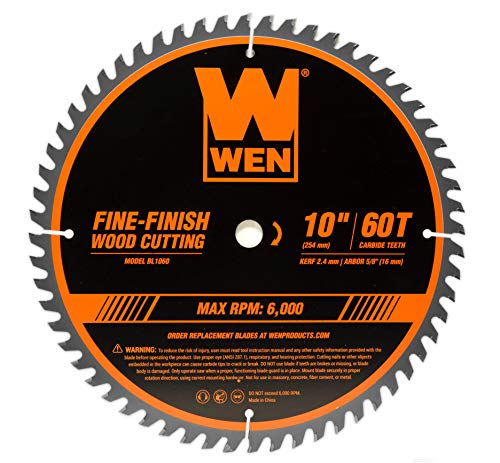
The WEN BL1060 is a solid entry-level blade that punches above its weight for basic plywood work. At 60 teeth, it doesn’t match the ultra-fine finish of higher tooth-count blades, but it delivers noticeably cleaner cuts than standard combo blades. The ultra-thin kerf helps reduce strain on lower-powered saws, which makes it a smart pick for job-site table saws or compact miter saws. It’s not going to eliminate sanding on birch or maple plywood, but for cabinet-grade work on a budget, it’s a reasonable starting point.
Compared to the Freud, it falls short in edge quality, but it holds its own against other budget blades like the FOXBC. Owners note it stays sharp longer than expected, though it’s not built for high-volume use. If you’re just starting out or only cut plywood occasionally, this is a no-frills choice that gets the job done without breaking the bank.
Product photos


How We Picked These table saw blade for plywoods
Rather than a hands-on lab test, my research focused on a detailed comparison of published specifications and features across numerous blades. I weighed owner reviews from major retailers alongside expert opinions found in woodworking publications and forums. This allowed me to build a ranking based on real-world feedback and established performance indicators. My goal was to identify the blades consistently praised for plywood cutting, considering both finish quality and cutting efficiency.
For plywood blades, tooth count and blade plate thickness are paramount. A higher tooth count (typically 80 or more) delivers cleaner cuts with less tear-out, crucial for face veneer. However, a thinner kerf – the width of the cut – reduces material waste and requires less power from the saw. The balance between these two, along with carbide quality, heavily influenced my selections. I also looked for features minimizing vibration, as this impacts both cut quality and blade life.
Specifications reliably indicate physical characteristics like arbor size, kerf, and tooth count. However, judging cut quality and durability requires looking at owner feedback. People frequently comment on splintering, smoothness of the cut, and how long the blade stays sharp. I prioritized blades with a consistently positive reputation for producing clean, splinter-free cuts in plywood – you can find more information on choosing a precision woodworking blade.
How To Choose The table saw blade for plywoods
Finding the right blade makes a huge difference when working with plywood. A poor choice can lead to tear-out, splintering, and a generally frustrating experience.
A quality table saw blade for plywood prioritizes tooth count, grind, and kerf. Higher tooth counts (60+) deliver cleaner cuts, while an alternate top bevel (ATB) grind minimizes splintering. Thin kerf blades reduce material waste and require less power, but may sacrifice some stability in thicker materials. Plate thickness and carbide quality impact blade durability and longevity.
Tooth Count and Grind
The number of teeth is probably the first thing people look at, and for good reason. For plywood, I generally recommend at least 60 teeth, and often 80 or more. More teeth mean more frequent cutting edges, resulting in a smoother finish. However, it’s not just about the number. The grind – how those teeth are shaped – is critical. An Alternate Top Bevel (ATB) grind is the most common for plywood, as it slices cleanly through the surface veneers. Flat top grind (FTG) blades are better for ripping solid wood, while triple chip grind (TCG) is for non-ferrous materials.
Kerf and Plate Thickness
Kerf is the width of the cut, and it impacts both material waste and the power needed to operate the saw. Thin-kerf blades (under .100 inches) remove less material and require less effort from the motor, but can sometimes feel a little unstable, especially on thicker plywood. Plate thickness is the thickness of the steel body of the blade. A thinner plate generally means less resistance during cutting, but also less rigidity. I’ve found a sweet spot around .087 to .098 inches for most plywood applications, offering a good balance of speed and stability.
- A thicker plate (over .095″) is generally more durable and better suited for heavier use.
- A thinner plate (under .080″) reduces material waste and makes for faster, easier cutting, but may deflect more.
- Consider the type of plywood you’ll be cutting most often. A blade designed for ultra-fine crosscuts, like the CMT 10″ 200T Contractor Plywood, is fantastic for delicate work but overkill for rough cuts.
Value and Application
Don’t automatically assume the most expensive blade is the best. A best saw blade for plywood doesn’t need to break the bank. The FOXBC 10″ 80-Tooth Ultra Finish blade, for example, offers excellent value for hobbyists and DIYers. However, if you’re consistently cutting hardwood plywood or require extremely precise cuts, investing in a premium blade like the Freud 10″ Ultimate Plywood Blade is worthwhile.
A good rule of thumb is to have at least two blades: one for rough cutting and one for finish work. This extends the life of your finer blades and ensures you always have the right tool for the job.
Ultimately, choosing the right blade comes down to matching the tool to the task. Thinking about the type of plywood you’ll be working with most often, and the level of finish you require, will guide you towards the best choice. And remember, having the optimal plywood cutting tool is only half the battle; the blade is where the magic happens.
Table Saw Blade for Plywoods Compared
Here’s a comparison of key specifications for table saw blades designed for cutting plywoods.
| Product Title | Diameter | Teeth | Kerf | Arbor | Hook Angle | Plate |
|---|---|---|---|---|---|---|
| Freud Ultimate Plywood Blade | 10″ | 80 | .126″ | 5/8″ | 2° | .087″ |
| DEWALT 80-Tooth Fine Finish | 10″ | 80 | N/A | N/A | N/A | N/A |
| FOXBC 80-Tooth Ultra Finish | 10″ | 80 | .098″ | 5/8″ | N/A | N/A |
| Diablo 60T Fine Finish | 10″ | 60 | N/A | N/A | N/A | N/A |
| CMT 200T Contractor Plywood | 10″ | 200 | .095″ | N/A | 5° | .071″ |
| OSTTE 80T Carbide Tipped | 10″ | 80 | N/A | 5/8″ | N/A | N/A |
| WEN BL1060 10″ 60-Tooth | 10″ | 60 | 1/10″ | 5/8″ | N/A | N/A |
Frequently Asked Questions
What tooth count is best for minimizing splintering in plywood?
Generally, 80 or more teeth are ideal for reducing splintering. Higher tooth counts create finer cuts, lessening the chance of tear-out on the plywood’s face veneer, though blade grind is equally important.
Is a thin-kerf blade always the best choice for plywood?
Not necessarily. While thin-kerf blades reduce waste and require less power, they can sometimes lack stability, especially on thicker plywood sheets. A standard kerf can provide a more controlled cut in those situations.
How does plate thickness affect a plywood blade’s performance?
A thinner plate cuts more easily but can deflect more, while a thicker plate offers more rigidity and durability. For most plywood applications, a plate thickness between .087 and .098 inches strikes a good balance between these factors.
Can I use the same table saw blade for both hardwood and softwood plywood?
You can, but a blade optimized for hardwood plywood (higher tooth count, ATB grind) will generally give a cleaner cut on both. If you frequently cut both types, consider having two blades for dedicated use.
What’s the difference between an ATB and a TCG blade grind, and which is better for plywood?
ATB (Alternate Top Bevel) is designed for clean cuts in materials like plywood, minimizing splintering. TCG (Triple Chip Grind) is better suited for non-ferrous metals and plastics. For plywood, an ATB grind is almost always the preferred choice, and you can find a splinter-resistant circular blade that uses this grind as well.
The Bottom Line
Choosing a table saw blade for plywood always involves a trade-off between cut quality and speed. You can spend a lot for a blade that delivers a flawless edge, or you can opt for something more affordable that gets the job done quickly. For the best overall performance and consistently clean cuts, I recommend the Freud Ultimate Plywood Blade. It strikes an excellent balance between tooth count, blade thickness, and carbide quality, making it a solid investment for any serious woodworker.
If you’re on a tighter budget or primarily tackle smaller projects, the FOXBC 80-Tooth Ultra Finish blade is a fantastic choice. For those needing maximum versatility – handling everything from delicate veneer to thicker plywood – the CMT 200T Contractor Plywood stands out with its exceptionally high tooth count and thin kerf. You’ll also find detailed comparisons of top 10-inch table saw blades here.
Ultimately, remember that specifications only tell part of the story. The most important factors are matching the blade’s tooth count and grind to the plywood you’re cutting, and keeping your blade sharp. A well-maintained, properly chosen blade will always deliver better results than an expensive blade that’s dull or simply not suited to the task at hand.
