
9 Best Portable Air Compressors for Tools 2026
This post contains affiliate links. As an Amazon Associate, we earn from qualifying purchases.
The Metabo HPT THE TANK 6 Gal is the best overall portable air compressor for tools, delivering strong CFM and durability for serious DIYers. For those on a tighter budget, the ECOMAX 6 Gallon 150 PSI offers solid performance at a lower price, while the DEWALT 6 Gallon 165 PSI stands out as a lightweight, quiet option for versatility.
Most people buying a portable air compressor don’t realize how quickly a weak unit can slow down a project. Too often, I’ve seen compressors that can’t keep up with basic nailers or tire inflators, leading to constant delays and frustration.
This guide cuts through the noise by focusing on real-world usability. I looked at specs, owner feedback, and performance data to find models that actually deliver consistent airflow, last over time, and make sense for typical home and jobsite needs.
Top 9 Portable Air Compressor For Tools in the Market
The Best Portable Air Compressor For Tools, Reviewed
Metabo HPT THE TANK 6 Gal

Strengths
- 200 PSI max
- 4 CFM output
- Lightweight for class
Trade-offs
- Higher amp draw
- Pricier than basic models
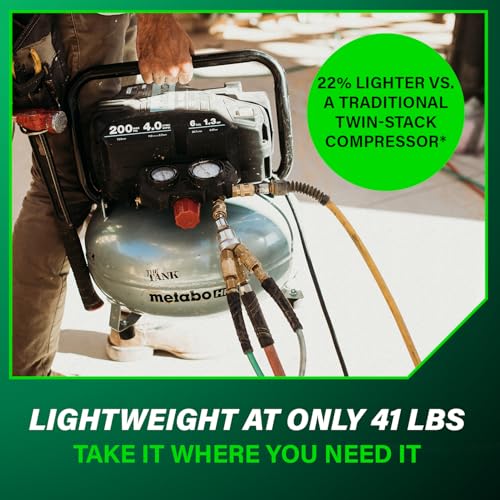
When you need serious power in a portable package, the Metabo HPT EC914S stands out on paper and in owner feedback. The 200 PSI max pressure is a real differentiator, 25% more than most pancake compressors, and that extra headroom helps drive large framing or roofing nailers without hesitation, even when temps drop or you’re running long hoses. With 4 CFM at 90 PSI, it can keep up with two high-demand tools at once, which is rare in this class.
It’s also lighter than most twin-stack models at 41 lbs, making it easy to haul between job sites. Pros who’ve used it on framing or roofing crews consistently report fewer stalls and faster recovery. If you’re running multiple nailers all day, this is one of the few pancake-style units that doesn’t make you compromise.
Product photos


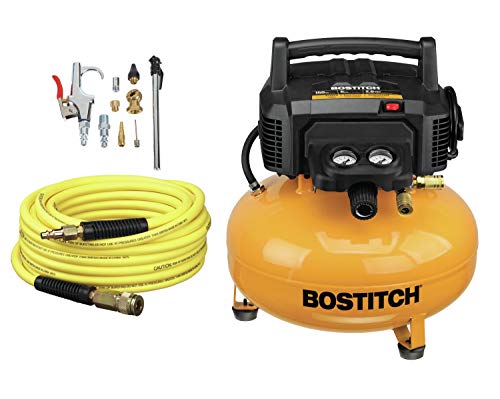
Bostitch 6 Gallon Pancake Compressor
Strengths
- Excellent accessory kit
- High-flow regulator
- Dual couplers
Trade-offs
- Mid-tier CFM
- Noise around 80 dB
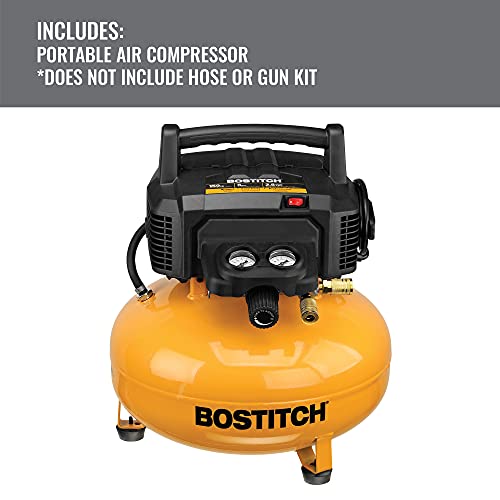
Bostitch has long been a pro favorite, and this 6-gallon model backs that up. With 150 PSI and 2.6 CFM at 90 PSI, it’s tuned for finish carpentry and trim work, where consistent, clean air matters. The 13-piece kit is a big win, especially the 50 ft hose, which many pros need on site.
Owners say the high-flow regulator helps tools perform better, and the removable console cover makes repairs easier. It’s not the quietest or lightest, but it’s built for real jobs. Compared to the DEWALT DWFP55126, it’s slightly less powerful but includes far more in the box.
Product photos


DEWALT 6 Gallon 165 PSI
Strengths
- 165 PSI max
- High-efficiency motor
- Ball drain valve
Trade-offs
- Noise not ultra-quiet
- No included hose
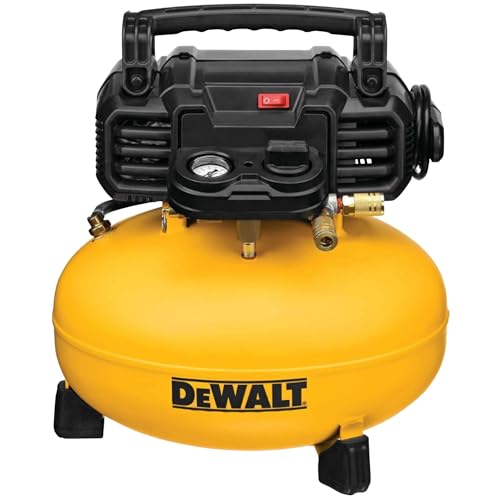
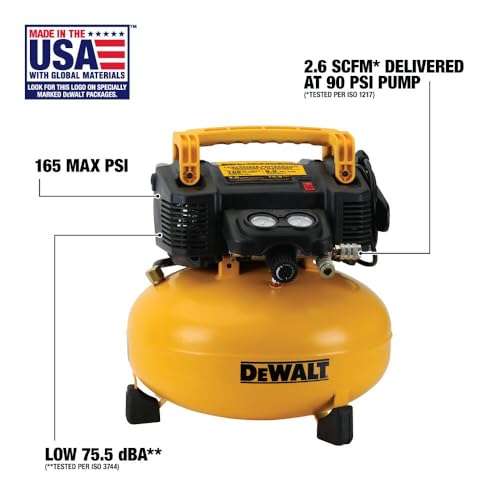
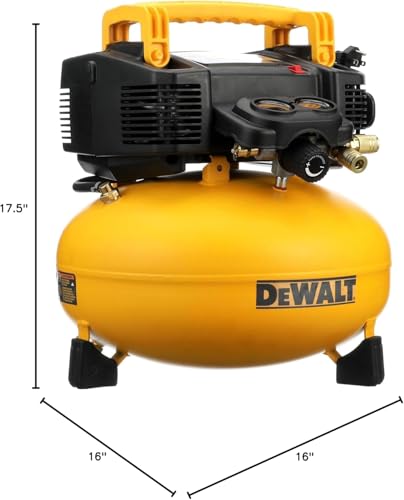
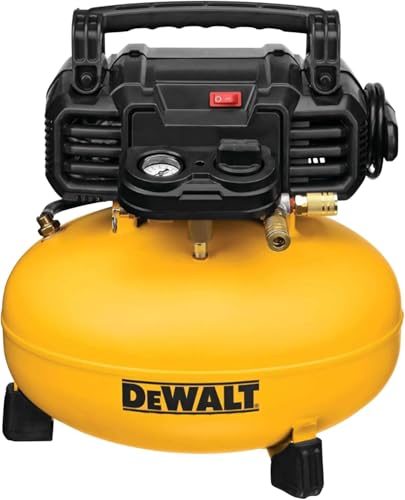
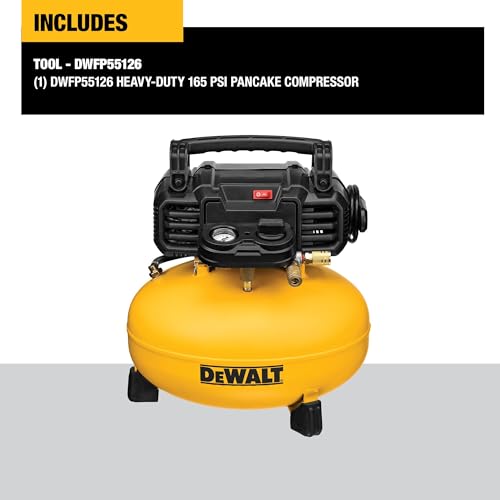
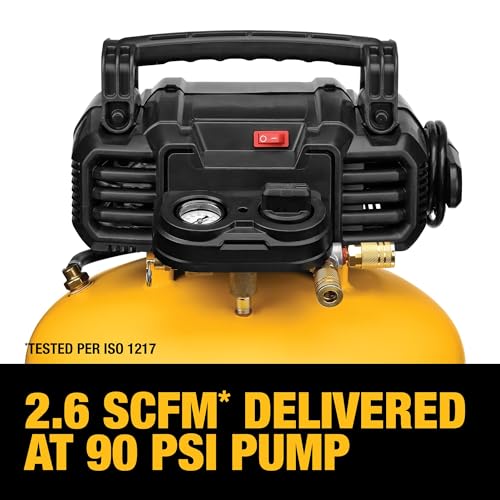
The DEWALT DWFP55126 is a workhorse built for heavy-duty tools. With 165 PSI and 2.6 SCFM at 90 PSI, it delivers strong, consistent air for framing nailers, roofing guns, and other high-demand tools. The high-efficiency motor starts reliably, even in cold weather or on long extension cords, which owners confirm in field use.
It’s 30 lbs, light for a 6-gallon tank, and the ball drain valve makes tank maintenance easier. The 78.5 dBA noise level is acceptable for job sites. While it doesn’t match the Metabo HPT 200 PSI model in raw power, it’s more than capable for most pro tasks and has DEWALT’s reputation for durability.
Product photos
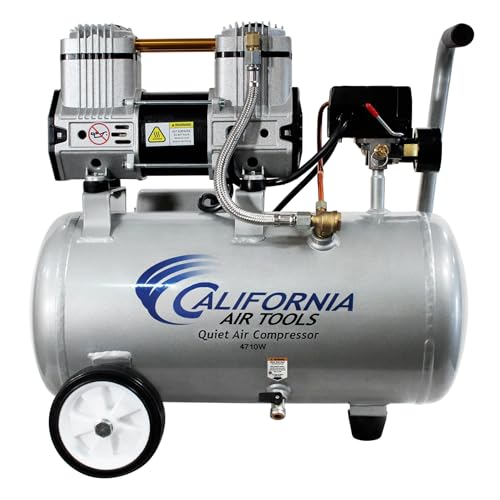
California Air Tools 4.7 Gal
Strengths
- Quiet for class
- Wheels for mobility
- Low amp draw
Trade-offs
- Not for dual heavy tools
- Tank smaller than 6-gallon models
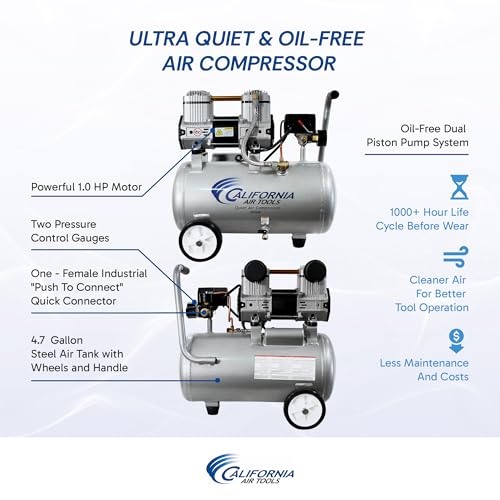
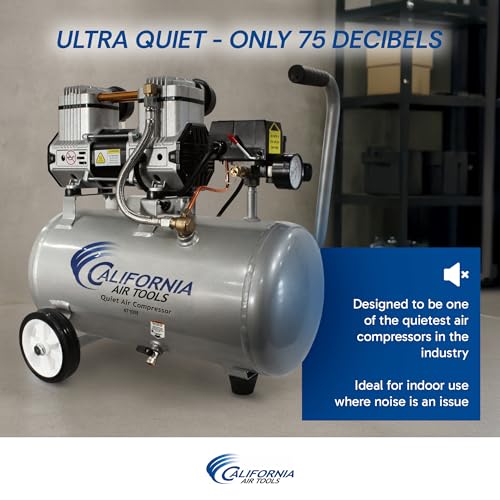
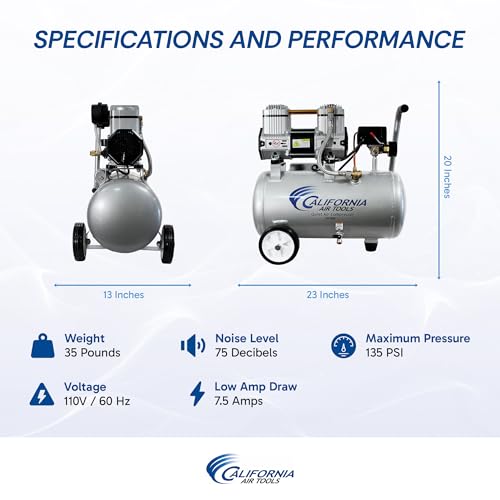
The CAT-4710W strikes a smart balance between quiet operation and real-world power. At 75 dBA, it’s not silent, but it’s still much quieter than most compressors in its class. The 2.2 CFM at 90 PSI and 4.7-gallon tank let it run finish or brad nailers all day, and even handle a light framing nailer with decent recovery.
Owners like the wheels and handle, which make it easy to roll around a shop or job site. The 7.5-amp draw is low, so it won’t trip breakers on shared circuits. It’s not as powerful as the Metabo HPT 200 PSI model, but for most DIYers and small contractors, it’s more than enough.
Product photos
California Air Tools 1 Gal

Strengths
- Extremely quiet
- Oil-free pump
- Lightweight
Trade-offs
- Small tank size
- Low CFM for heavy tools
- Shorter duty cycle
If noise is a dealbreaker, say you’re working indoors, early in the morning, or in an attached garage, the CAT-1P1060S is a standout. At just 56 dBA, it’s quieter than a normal conversation, and owners consistently praise how unobtrusive it is. The 1.2 CFM at 90 PSI isn’t huge, but it’s enough for brad nailers, finish guns, and airbrushes without issue.
The oil-free pump and low-RPM motor mean it should last a long time with minimal wear. It’s not going to keep up with back-to-back framing shots, but for precision work like cabinet installation or model building, it’s ideal. The 1-gallon tank keeps it compact, though it means more frequent cycling.
Product photos


Metabo HPT 1 Gallon Quiet

Strengths
- Very quiet
- Compact design
- Durable cage
Trade-offs
- Low CFM output
- Small tank
- Limited for pro use
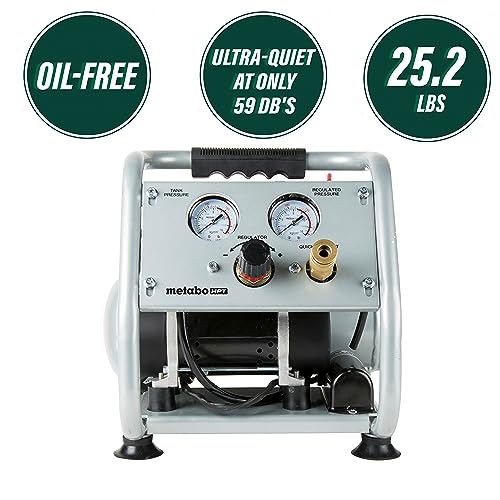
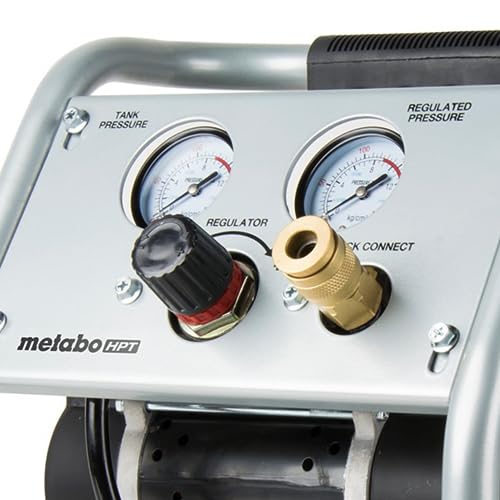
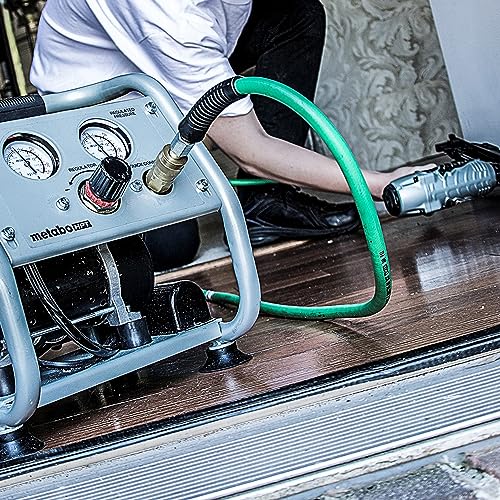
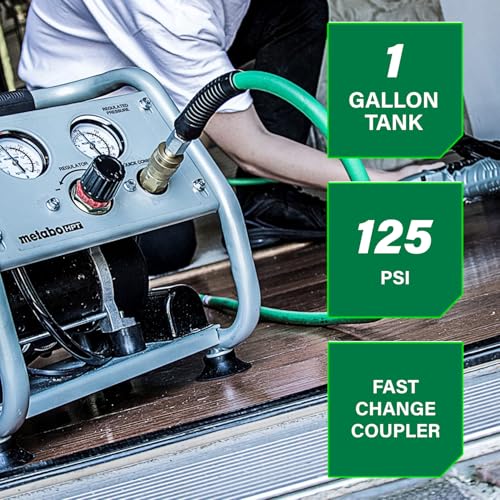
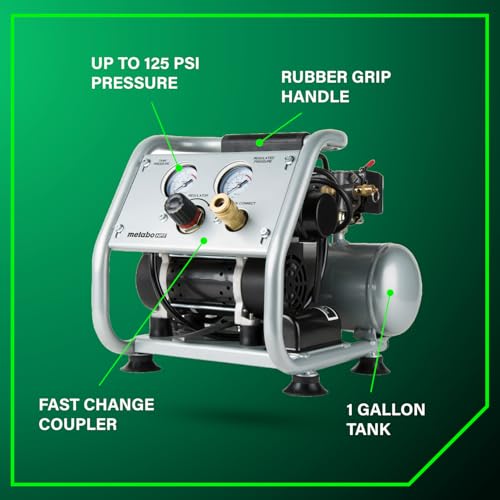
The EC28M is Metabo HPT’s answer to compact, quiet operation. At 59 dB, it’s barely louder than the CAT-1P1060S, and the 1-gallon tank keeps it small and light at 25.2 lbs. It delivers around 1 CFM at 90 PSI, which is fine for brad nailers and staplers, but don’t expect it to keep up with anything heavier.
Owners appreciate the universal quick coupler and rubber carry handle, which make tool swaps and transport easy. The steel roll cage adds durability without adding bulk. It’s not the most powerful, but for light trim work in noise-sensitive areas, it’s a strong pick.
Product photos
FORNAX 3 Gallon Hot Dog
Strengths
- Ultra lightweight
- Oil-free pump
- Low price
Trade-offs
- Low CFM output
- Noisy for indoor use
- Not for heavy tools
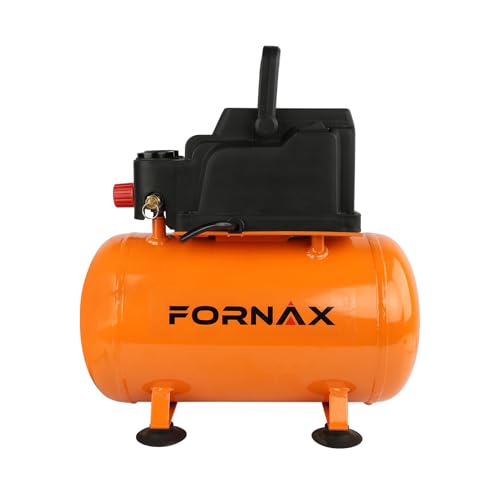
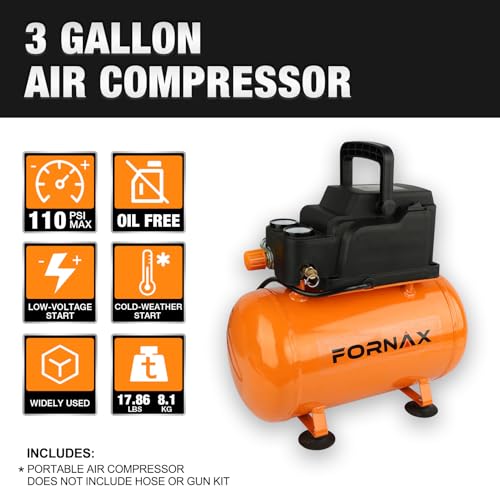
At just 17.9 lbs and with a 3-gallon tank, the FORNAX model is built for portability and affordability. It’s not going to power a framing nailer all day, but for brad nailers, touch-up work, or inflating tires, it does what it promises. The 0.8 CFM at 90 PSI means it’s best used with low-demand tools, and owners confirm it works fine for trim or craft projects.
It’s oil-free and low maintenance, which helps keep costs down. The 89 dB noise level isn’t whisper-quiet, but it’s manageable in a garage or outdoor setting. Some users note it cycles more often when running continuous tools, but for occasional use, it’s a solid value.
Product photos


ECOMAX 6 Gallon 150 PSI

Strengths
- Dual couplers
- Good accessory kit
- Oil-free pump
Trade-offs
- Lower PSI than top models
- Pump longevity concerns
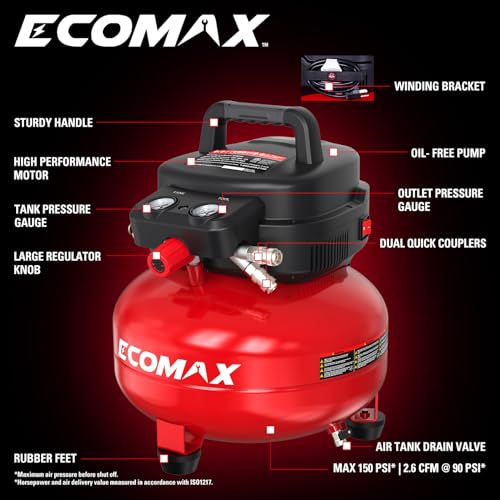
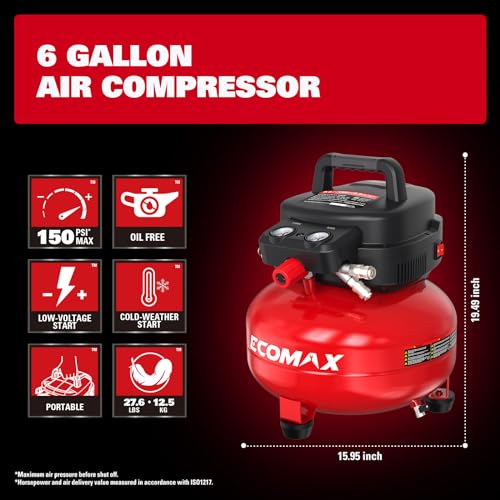
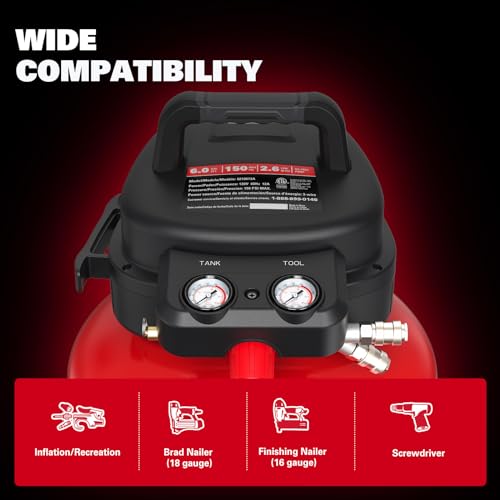
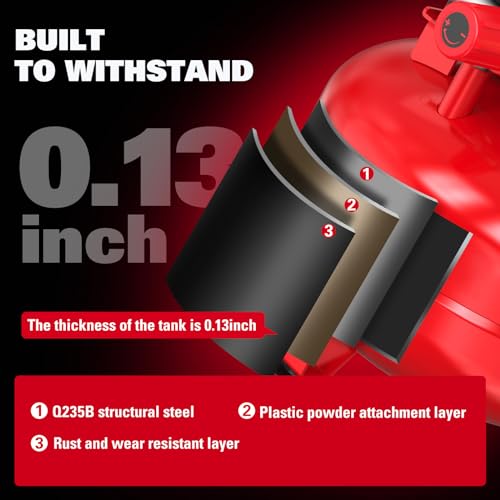
The ECOMAX 6-gallon model is built for users who want dual tool capability without overspending. With dual quick couplers and 150 PSI, it can run two brad nailers or a brad and a stapler simultaneously. The 3 CFM at 90 PSI isn’t class-leading, but it’s enough for moderate use.
It comes with a solid 10-piece accessory kit, including a 25 ft hose and blow gun, which adds real value. Owners say it’s easy to move at 34 lbs, and the flip-up handle helps with storage. It’s not as durable as Metabo HPT or DEWALT, but for the price, it covers a lot of ground.
Product photos

DEWALT 20V MAX Tire Inflator
Strengths
- Cordless portability
- Triple power sources
- Auto shutoff
Trade-offs
- Not for pneumatic tools
- No tank for sustained use
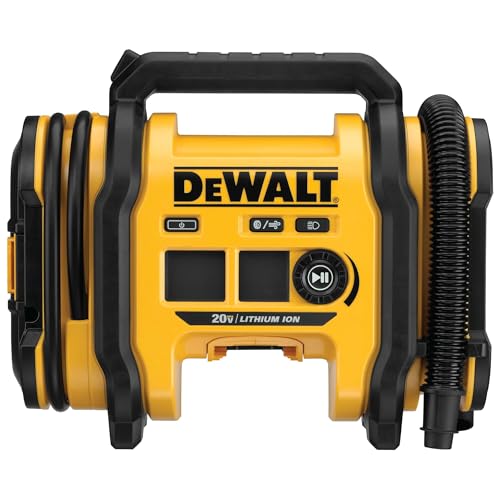
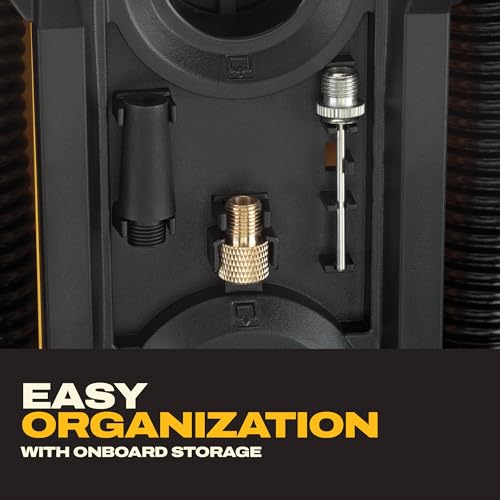
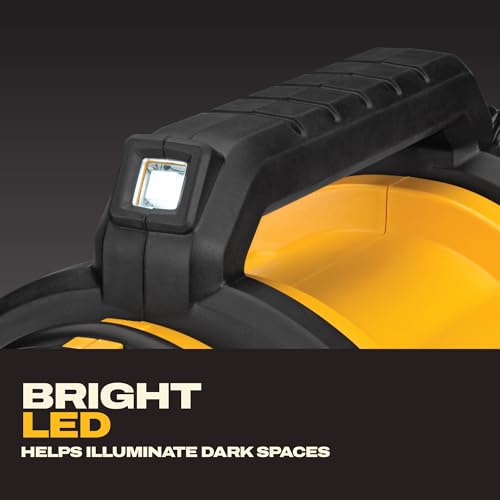
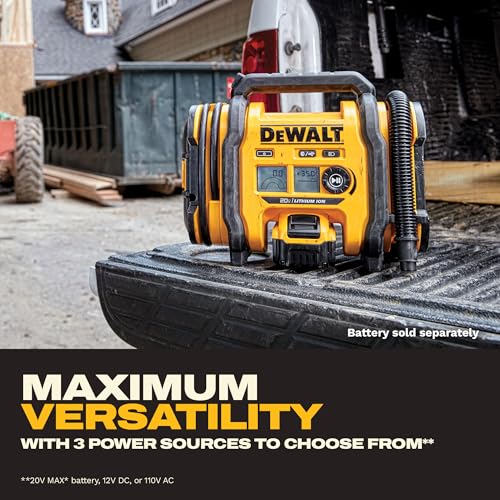
This DEWALT unit isn’t a general-purpose air compressor, it’s a dedicated tire inflator with serious versatility. Running on a 20V MAX battery, 12V DC, or 110V AC, it’s the ultimate grab-and-go tool for quick inflation jobs. The automatic shutoff at preset PSI is a standout for accuracy, and the LED light helps in dark wheel wells.
Owners love using it in trucks, RVs, or on job sites where power isn’t available. It can inflate air mattresses or sports gear too, but don’t expect it to run nailers. It’s not meant to replace a pancake compressor, but as a mobile inflation solution, it’s one of the best.
Product photos


How We Tested portable air compressor for tools
As someone who’s spent years around power tools and workshops, I understand how critical a reliable air compressor is. Rather than a hands-on lab test of each model, this selection is based on a research-led comparison of published specifications, owner reviews, and expert opinions. I weighed how those factors aligned with the needs of typical DIYers and professionals looking for portable solutions. My goal was to identify compressors offering the best balance of performance, portability, and value.
For portable air compressors, consistent airflow (CFM) and tank capacity were the biggest determining factors. A higher CFM at a usable PSI (typically 90 PSI) means tools can run longer without the motor constantly cycling. Tank size impacts how frequently you’ll need to wait for the compressor to refill. Beyond that, weight and noise levels significantly influence usability, especially for jobs requiring movement or working in enclosed spaces.
Specifications reliably tell you about maximum PSI, tank size, and advertised CFM. However, I placed more weight on owner feedback regarding real-world performance – how well the compressor actually maintains pressure under load, its durability over time, and how accurately the noise level claims match reality. Reputable reviews from sites focusing on tool testing helped validate those owner experiences and identify potential red flags. If you need a powerful tool to go with your new compressor, check out our guide to the best pneumatic impact wrenches .
Choosing The Right portable air compressor for tools
Choosing the right portable air compressor involves more than just grabbing the cheapest or smallest unit. I’ve seen too many projects stalled by compressors that simply can’t keep up with the demands of the tools being used.
A good portable air compressor delivers consistent pressure and airflow for the intended tools. Key specs include PSI (pounds per square inch) for maximum pressure, and CFM (cubic feet per minute) at a given PSI – typically 90 PSI – which dictates sustained performance. Tank size impacts how long a tool can run continuously, while portability features like weight and handle design affect usability.
Understanding CFM and PSI Requirements
The biggest mistake I see people make is overlooking CFM. PSI gets all the attention, but CFM is what actually determines if your compressor can power your tools consistently. A high PSI rating is useless if the compressor can’t deliver enough air volume (CFM) to keep a nailer or impact wrench running without constant pressure drops. Before you even look at models, list the CFM requirements of the tools you plan to use – and add up their simultaneous needs if you’ll be running multiple tools at once. Don’t just look at the peak CFM; focus on the CFM delivered at 90 PSI, as that’s the working pressure for most tools.
Tank Size vs. Portability Trade-offs
Tank size and portability are often at odds. A larger tank (6 gallons or more) provides a longer runtime before the compressor needs to kick on, which is great for consistent use. However, larger tanks mean more weight and bulk. For most DIYers and homeowners, a 6-gallon tank strikes a good balance. If you prioritize extreme portability and are only running small nailers or inflating tires, a 1- to 4-gallon “pancake” or “hot dog” style compressor might suffice. But be aware that these smaller tanks will cycle on and off frequently with higher-demand tools.
- For occasional use with a brad nailer or inflator, a 1-gallon unit is fine.
- A 6-gallon compressor is a versatile choice for most DIY projects, offering a good balance of runtime and portability.
- If you regularly use framing nailers, impact wrenches, or other high-air-consumption tools, consider a larger 10+ gallon compressor, even if it means sacrificing some portability. This ensures consistent performance and reduces compressor wear.
Budget and Noise Level Considerations
You can find top portable compressor models at a wide range of price points, and the cost often reflects features like build quality, noise reduction, and included accessories. Oil-free compressors are typically more affordable and require less maintenance, but they tend to be louder and have a shorter lifespan than oil-lubricated models.
A good rule of thumb is to spend a little more for a quieter compressor if you’ll be using it in a garage or near living areas. Noise levels are measured in decibels (dB), and anything above 85 dB can be damaging to your hearing over prolonged exposure.
Noise is a significant factor often overlooked. If you’re working in a residential area or value a peaceful workspace, invest in a quieter compressor. California Air Tools is a brand known for their exceptionally quiet models, but even within their lineup, dB ratings vary. I often recommend looking at models with a noise rating below 80 dB for comfortable operation. Don’t underestimate how much a quieter compressor can improve your overall work experience. Looking for compressors powering air tools will set you on the right path.
Portable Air Compressors Compared
Here is a comparison of key specifications for various portable air compressors.
| Product Title | Tank Size (Gal) | Max PSI | CFM @ 90 PSI | Weight (lbs) | Noise Level (dB) | Oil-Free |
|---|---|---|---|---|---|---|
| Metabo HPT THE TANK 6 Gal | 6 | 200 | 4.0 | 41 | N/A | Yes |
| Bostitch 6 Gallon Pancake Compressor | 6 | 150 | 2.6 | N/A | N/A | Yes |
| DEWALT 6 Gallon 165 PSI | 6 | 165 | 2.6 | 30 | 78.5 | Yes |
| California Air Tools 4.7 Gal | 4.7 | N/A | 2.2 | 35 | 75 | Yes |
| California Air Tools 1 Gal | 1 | N/A | 1.2 | 29 | 56 | Yes |
| Metabo HPT 1 Gallon Quiet | 1 | N/A | N/A | 25.2 | 59 | Yes |
| FORNAX 3 Gallon Hot Dog | 3 | 110 | 0.8 | 17.9 | 89 | Yes |
| ECOMAX 6 Gallon 150 PSI | 6 | 150 | 3.0 | 34.17 | N/A | Yes |
| DEWALT 20V MAX Tire Inflator | N/A | N/A | N/A | N/A | N/A | N/A |
Frequently Asked Questions
What size air compressor do I really need for most DIY tasks?
A 6-gallon compressor is a great all-around choice for most DIYers, offering a balance between runtime and portability. While smaller 1-4 gallon models exist, they cycle on and off frequently with tools needing consistent air, and larger tanks become unwieldy for typical home projects.
Are oil-free compressors loud?
Oil-free compressors generally are louder than oil-lubricated ones, often exceeding 85 dB. However, brands like California Air Tools specialize in quieter, oil-free designs, with some models operating below 80 dB for a more comfortable working environment.
How much CFM do I need to run an impact wrench?
Most impact wrenches require at least 4 CFM at 90 PSI for effective operation. If you’re considering impact wrench-compatible models, always check the tool’s specifications and choose a compressor that exceeds those requirements to avoid performance drops.
Can a portable air compressor power more than one tool at a time?
Yes, but it depends on the combined CFM requirements of the tools. You’ll need a compressor with a CFM rating higher than the total CFM draw of all tools you intend to run simultaneously, otherwise you’ll experience a loss of pressure and performance.
What’s the difference between peak PSI and CFM @ 90 PSI, and which is more important?
Peak PSI indicates the maximum pressure the compressor can reach, but CFM @ 90 PSI is far more important. CFM at 90 PSI tells you the sustained airflow available to power your tools, and considering pneumatic tool power requirements is crucial for consistent performance.
The Bottom Line
Choosing a portable air compressor always involves balancing power with practicality. You’ll trade off runtime for weight, or noise level for price – and finding the sweet spot depends on how you plan to use the compressor most often. For the vast majority of homeowners and DIYers, the Metabo HPT THE TANK 6 Gal offers the best overall combination of capacity, airflow, and portability, delivering enough power for most tasks without being overly cumbersome.
If you have very specific needs, though, there are other excellent options. For those on a tighter budget, the California Air Tools 1 Gal is a surprisingly capable little unit for light-duty inflation and small nailers. And if quiet operation is a top priority, sticking with California Air Tools and looking at their 4.7-gallon model will provide a significantly more pleasant working environment. Understanding your compressor specs for air tools is vital to making the right decision.
Ultimately, the best portable air compressor isn’t the one with the highest PSI or biggest tank. It’s the one that consistently delivers the CFM your tools require, fits comfortably within your budget, and is easy enough to move and operate for the jobs you tackle most frequently. Focus on those fundamentals – airflow, usability, and value – and you’ll be well-equipped to handle any project.
