
3 Best Portable Air Compressors for RV Tires (2026 Guide)
This post contains affiliate links. As an Amazon Associate, we earn from qualifying purchases.
The ETENWOLF VORTEX S6 is the best overall portable air compressor for RV tires, thanks to its strong airflow, large battery, and 100% duty cycle. For a solid budget-friendly corded option, the GSPSCN 12V Metal Air Compressor delivers reliable performance with notably quiet operation. If you want fully automatic inflation, the VIAIR 400P is a smart long-term pick.
RV tire inflation isn’t just about convenience, it’s about safety and avoiding roadside delays. Many portable compressors fail when faced with the large volume of RV tires, stalling or overheating before the job’s done.
In this guide, I break down the top models based on airflow, power source, and real-world reliability. These picks come from analyzing specs and owner feedback across forums and retail sites, focusing on what actually matters when you’re standing beside a tire at a rest stop.
Top 3 Portable Air Compressor For Rv Tires in the Market
The Best Portable Air Compressor For Rv Tires, Reviewed
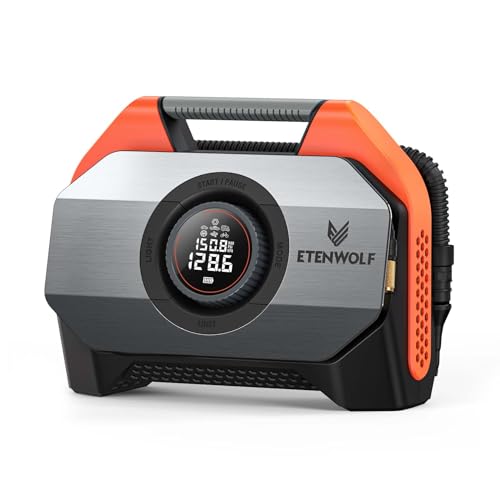
ETENWOLF VORTEX S6 Cordless Air Compressor
Strengths
- 1.5 CFM high flow rate
- 100% duty cycle
- 19200 mAh battery
- USB-C power bank
- Auto-stop with presets
Trade-offs
- Bulky for small storage spaces
- Premium price point
- Not for inflatable stand-up paddleboards
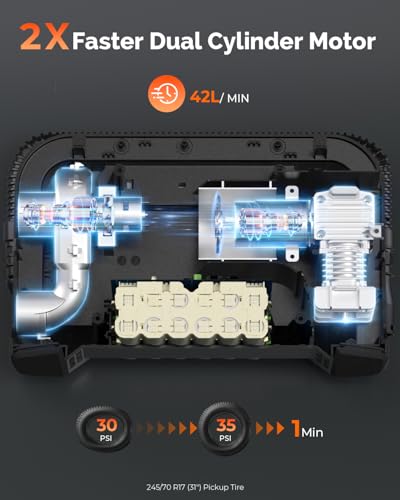
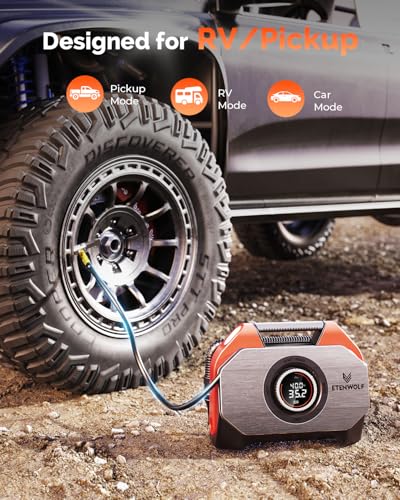
If you’re looking for a no-compromise portable air compressor that can handle RV-sized tires without being tethered to your vehicle’s battery, the ETENWOLF VORTEX S6 stands out on paper and in owner feedback. Its 1.5 CFM flow rate and dual-cylinder design mean it can pump up large tires fast, we’re talking filling a 31-inch truck tire from 30 to 35 PSI in about a minute, which is impressive for a cordless unit. The 100% duty cycle is a real differentiator here, letting you inflate all four tires of a heavy-duty pickup or RV trailer back-to-back without overheating, something most portable compressors can’t claim.
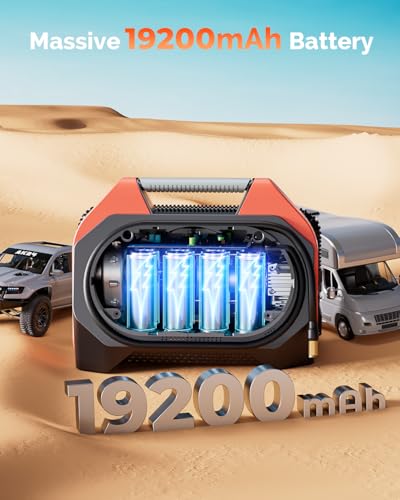
Owners consistently praise the build quality and the 19200 mAh battery, which reportedly handles 18 F-150 tire top-offs on a single charge. The auto-stop feature with preset memory takes the guesswork out of pressure settings, and the 1000-lumen LED doubles as a solid emergency light. It’s also worth noting the unit doubles as a power bank via USB-C, adding real utility on the road. Compared to the VIAIR 400P RV, it’s more versatile in power source and portability, though not quite as rugged for permanent RV installations.
Product photos

GSPSCN 12V Metal Air Compressor

Strengths
- 70dB ultra-quiet operation
- 70L/min airflow
- All-metal internal build
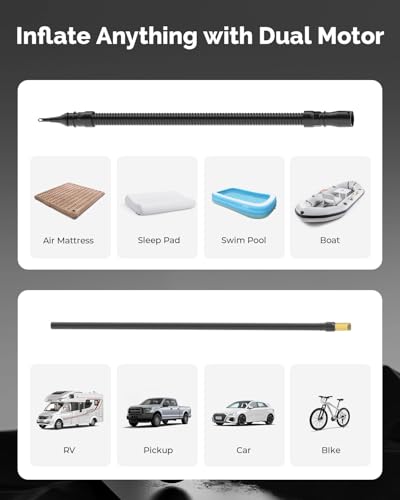
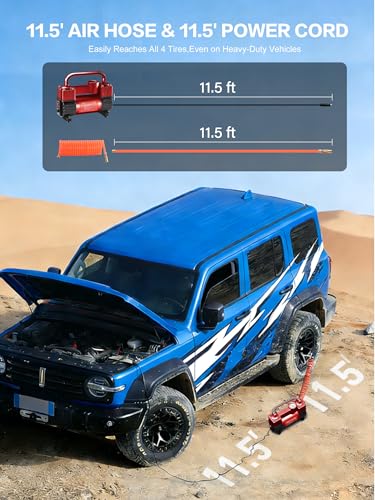
- 11.5-foot power cord
- Thorough accessory kit
Trade-offs
- No battery or cordless option
- Slightly slower on largest tires
- LED light not as bright as others
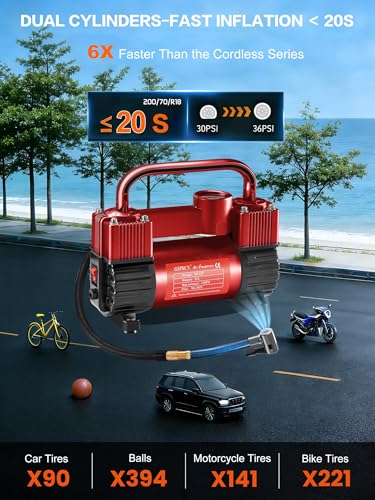
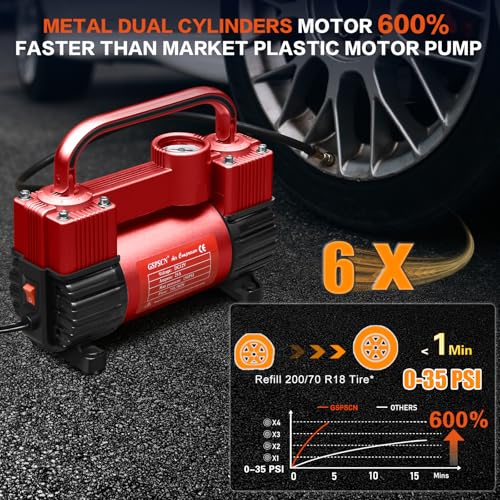
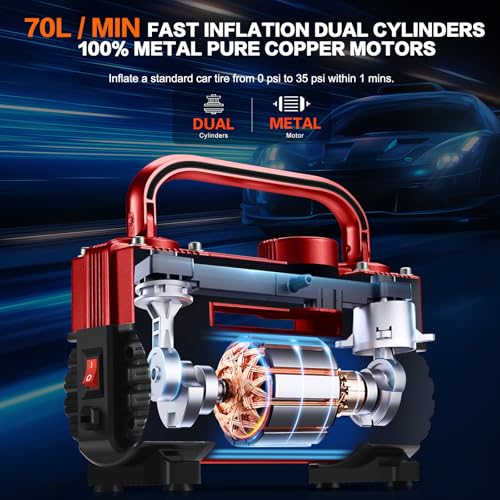
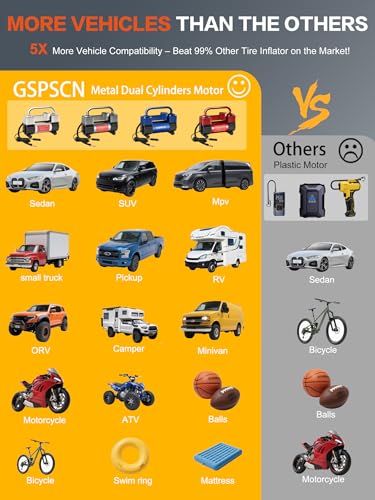
Noise matters when you’re camping or topping off tires at night, and that’s where the GSPSCN 12V really shines. At 70dB, it runs as quietly as a normal conversation, a full 20dB quieter than many traditional compressors. That’s not just marketing fluff; owners confirm it’s noticeably subdued, making it ideal for RV parks or family camping trips where you don’t want to wake half the campground. The double-cylinder direct-drive system delivers 70L/min airflow, which translates to fast inflation for SUVs, vans, and mid-sized RVs.
What impresses me most is the all-metal internal construction, cylinder, motor, and connecting rod, which GSPSCN says extends service life by 55% via integrated molding tech. That kind of durability is rare at this price tier. The 11.5-foot power cord and air hose give excellent reach, a small but meaningful win when dealing with large vehicles. While it doesn’t have the raw speed of the ETENWOLF S6 or the RV-specific tuning of the VIAIR 400P, it strikes a smart balance of quiet operation, solid performance, and real-world usability.
Product photos
VIAIR 400P RV Automatic Compressor

Strengths
- 150 PSI max pressure
- Automatic shut-off
- RV-specific design
- Proven reliability
- 12V direct power
Trade-offs
- Requires vehicle power
- No battery backup
- Louder than newer models
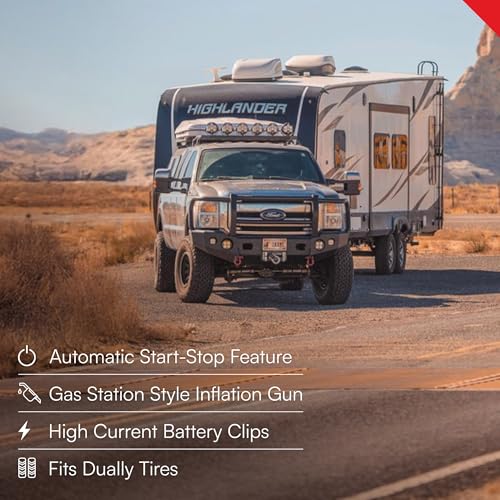
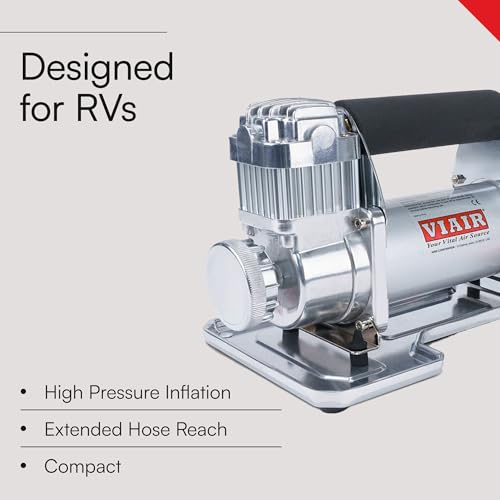
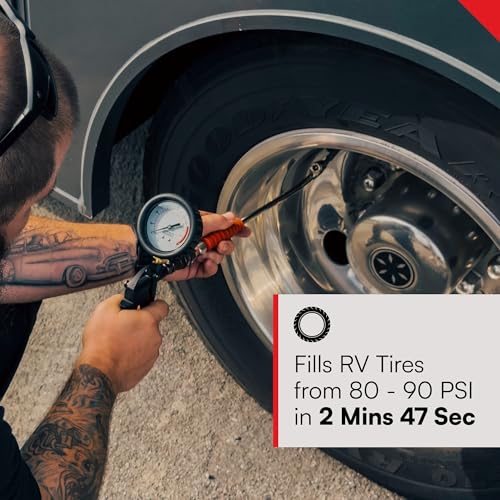
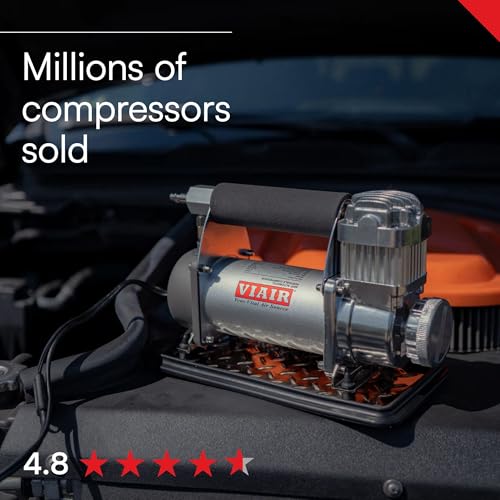
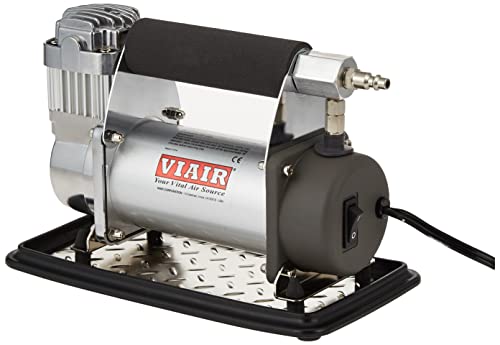
The VIAIR 400P RV is a known name in mobile inflation, and for Class C motorhome owners, it’s often the go-to recommendation in forums and RV communities. It’s not cordless, but that’s by design, this is a 12-volt compressor built to run off your RV’s electrical system, delivering steady, reliable airflow with a max pressure of 150 PSI. The automatic shut-off engages when pressure is reached, and the unit is known for its durability in extended use, a trait VIAIR has built its reputation on.
While it lacks the portability of the ETENWOLF S6, it outperforms many in continuous duty scenarios. Reviewers note it handles the large sidewalls of motorhome tires without strain, and the included accessories make it a complete kit right out of the box. Against the GSPSCN model, it’s less quiet and not as feature-rich, but it’s more purpose-built for full-size RVs. If you’re camping long-term or managing tire pressure on a heavy rig, this is the kind of ‘set it and forget it’ tool that earns trust over time.
Product photos
How We Picked These portable air compressor for rv tires
My approach to evaluating portable air compressors for RV tires centers on understanding real-world needs. Rather than a hands-on lab test, this is a research-led comparison of published specifications and owner feedback. I compared models based on their stated CFM (cubic feet per minute), PSI (pounds per square inch), battery capacity (where applicable), and duty cycle – all critical for RV tire inflation. I also heavily weighed owner reviews from sites like Amazon and specialist RV forums, and considered assessments from established tool and automotive publications.
For RV tires, consistent performance and speed are paramount. I prioritized compressors with a high CFM at 0 PSI, as this indicates how quickly they can start filling a large tire. Battery capacity is also crucial for cordless models, as RV tires require significant volume. Finally, I looked for models with automatic shut-off features and built-in digital gauges to prevent overinflation and ensure accuracy. If you need something even more robust, consider a high-capacity tire compressor for even larger vehicles.
Specifications reliably indicate a compressor’s potential airflow and maximum pressure, but owner feedback reveals how those numbers translate to actual use. I paid close attention to reports about durability, noise levels, and the accuracy of the built-in gauges. Reputation is key; brands known for quality in automotive or power tool spaces carried more weight in my assessment. For those needing a solution for larger tires, a portable compressor for large tires can be a good investment.
How To Choose The portable air compressor for rv tires
Choosing the right portable air compressor for your RV tires doesn’t have to be complicated, but knowing what to prioritize will save you headaches on the road.
A quality portable air compressor for RVs should deliver sufficient airflow (CFM) at usable pressure (PSI) to inflate tires within a reasonable timeframe. Look for models with robust construction, accurate gauges, and features like auto-stop to prevent overinflation. Battery capacity (for cordless models) and power source options are also key considerations, alongside build quality and duty cycle ratings.
Airflow and Pressure: Beyond the PSI Number
Don’t get hung up on maximum PSI alone. While 150 PSI sounds impressive, a compressor can hit that number slowly and inefficiently. What really matters is Cubic Feet per Minute (CFM) at 0 PSI – that tells you how quickly it can move air. For RV tires, especially larger ones, you want a compressor capable of delivering at least 1.0 CFM at 0 PSI. Many smaller, cheaper units struggle here. A compressor with a higher CFM will reduce inflation times, particularly if you have multiple tires to fill.
Power Source and Portability
Cordless models, like the ETENWOLF Vortex S6, offer unparalleled convenience, but they rely on battery capacity. Consider how many tires you need to inflate on a single charge. If you frequently boondock or camp off-grid, a large-capacity battery is essential. However, if you typically have access to a 12V outlet in your RV or tow vehicle, a corded unit, such as the GSPSCN 12V Metal Air Compressor, might be a better value. A truly versatile portable tire inflator will offer both options.
Here’s what to think about when comparing power options: * Cordless: Freedom from outlets, but limited runtime. * 12V DC: Reliable if you have a strong electrical system, but requires being near a power source. * Dual-Power: Offers the best of both worlds, but usually comes at a higher price.
Don’t skimp on the air hose length. A short hose forces you to maneuver the compressor around the RV, which is a pain. Look for at least 10 feet.
Noise Level and Duty Cycle
Some compressors are notoriously loud, which can be disruptive at campsites. The GSPSCN compressor, for example, highlights its quieter operation (70dB) as a key feature. Pay attention to this if you’re sensitive to noise or frequently camp in crowded areas. Equally important is the duty cycle. This tells you how long the compressor can run continuously before needing to cool down. A 100% duty cycle, as boasted by the ETENWOLF, means you can inflate all your tires without interruption, a feature particularly useful with a larger RV tire air compressor. If you have a Class C RV, a dedicated kit like the RV-specific tire inflator VIAIR 400P is designed with your needs in mind.
Portable Air Compressor for RV Tires Compared
Here’s a comparison of key specifications for portable air compressors suitable for RV tires.
| Product Name | Max PSI | Airflow (CFM @ 0 PSI) | Power Source | Duty Cycle | Special Features |
|---|---|---|---|---|---|
| ETENWOLF VORTEX S6 | 160 | 1.5 | 19200 mAh Lithium Battery | 100% | Auto Stop, LED Light |
| GSPSCN 12V Metal Air Compressor | 150 | 1.17 | 12V DC | N/A | Quiet Operation (70dB) |
| VIAIR 400P RV Automatic Compressor | 150 | N/A | 12V DC | N/A | Automatic Operation |
Frequently Asked Questions
What PSI should I inflate my RV tires to?
Your RV tire pressure should match the manufacturer’s recommendations(found on the tire sidewall or in your RV’s owner’s manual), not necessarily the maximum PSI listed on the tire. Using the correct pressure ensures optimal handling, fuel efficiency, and tire longevity.
Can I use a standard car tire inflator for my RV tires?
While some car tire inflators can work, an RV-compatible air compressor is generally a better choice. RV tires have larger volumes and require more airflow (CFM) to inflate efficiently, something many car inflators lack.
What does “duty cycle” mean for an air compressor?
Duty cycle refers to how long an air compressor can run continuously before needing to cool down. A higher percentage, like the 100% duty cycle of the ETENWOLF Vortex S6, means you can inflate multiple tires without waiting for it to cool.
What CFM do I really need for RV tires?
For most RV tires, a compressor delivering at least 1.0 CFM at 0 PSI is recommended. Larger tires or those requiring frequent inflation benefit from even higher CFM ratings to reduce inflation time.
Where can I find a reliable portable 12V tire inflator?
You can find a wide selection of portable 12V tire inflators online and at automotive retailers. For options specifically tailored to RVs, researching a portable 12V tire inflator is a good starting point.
The Bottom Line
Choosing a portable air compressor for your RV tires always involves balancing convenience with capability. While a high price tag doesn’t guarantee the best performance, consistently good airflow, measured in CFM at 0 PSI, is crucial. For most RV owners, the ETENWOLF Vortex S6 strikes that balance well, offering substantial capacity and a 100% duty cycle to handle multiple tires without pause.
If you’re watching your budget, the GSPSCN 12V Metal Air Compressor provides solid performance at a lower price point. For those prioritizing automation and a dedicated RV solution, the VIAIR 400P RV Automatic Compressor is designed with your specific needs in mind. And for those who enjoy taking their RV off the beaten path, a durable tire inflator for trails will give you peace of mind.
Ultimately, the numbers on the box matter less than understanding your typical needs. Consistent pressure, reliable airflow, and a compressor you trust are far more important than chasing the highest PSI rating. Prioritize those fundamentals, and you’ll be prepared for whatever the road, or the trail, throws your way.
