
6 Best Portable Air Compressors for Off-Roading 2026
This post contains affiliate links. As an Amazon Associate, we earn from qualifying purchases.
The ETENWOLF VORTEX S6 stands out as the best overall portable air compressor for off-roading, combining solid performance with excellent durability and a 100% duty cycle. For those on a tighter budget, the VIAIR 400P delivers reliable power for larger tires, while the EZ FLATE M.O.A.B. is the top choice if you’re running massive 40-inch wheels and need serious airflow.
Most off-road enthusiasts have been stranded with soft tires and no way to air up fast. A weak or underbuilt compressor can turn a simple recovery into a long wait under the sun. I know how critical it is to have a unit that won’t quit when you need it most.
This guide cuts through the marketing noise. I focused on real-world specs, owner experiences, and the demands of trail use to pick compressors that deliver speed, reliability, and ruggedness where it counts.
Top 6 Portable Air Compressor For Off Roadings in the Market
The Best Portable Air Compressor For Off Roadings, Reviewed
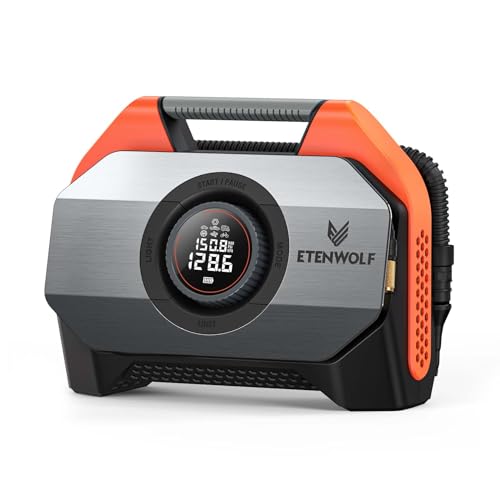
ETENWOLF VORTEX S6 Cordless Air Compressor
Strengths
- 100% duty cycle
- Built-in 19200 mAh battery
- USB-C dual-direction charging
Trade-offs
- Slightly slower at high PSI
- Plastic housing feels less rugged
- Noisy under load
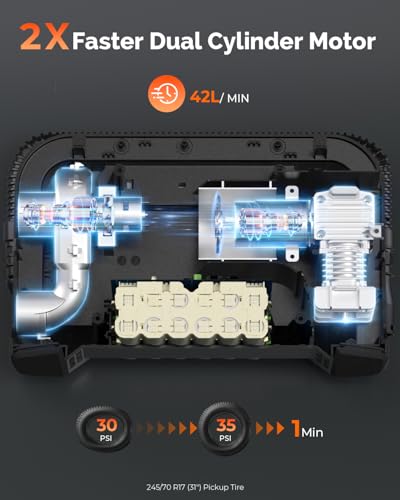
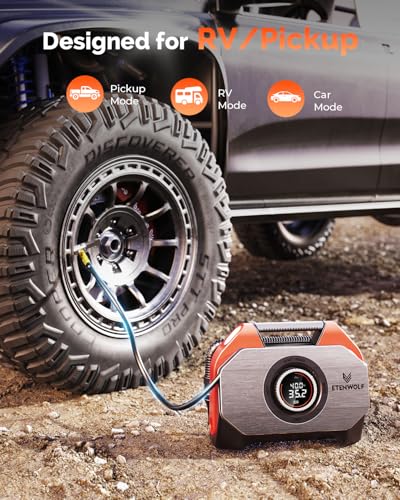
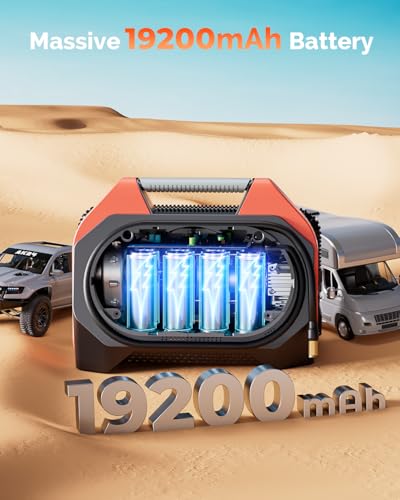
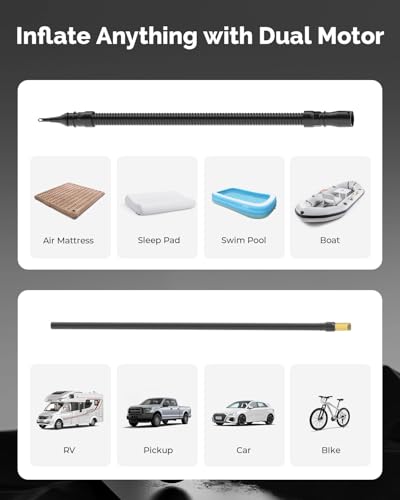
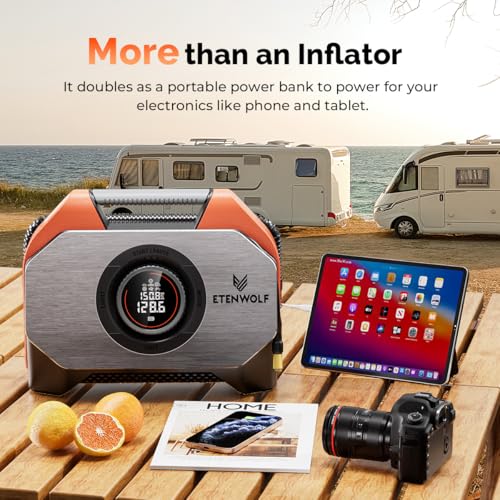
This is the only truly cordless dual-cylinder compressor on the list with a 100% duty cycle, and that changes the game. The built-in 19200 mAh battery means no vehicle power is needed, which is huge when you’re airing up at a trailhead or campsite. Owners report it can handle four F150 tires back-to-back without stopping, and the 1.5 CFM output delivers real speed. The auto stop with seven preset modes is intuitive, and the 1000-lumen LED doubles as a solid emergency light.
It’s not perfect, the max 160 PSI is high, but the airflow tapers as pressure builds, so it’s not quite as fast on larger tires as the MOAB. Still, when you factor in the USB-C charging (it can charge your phone or tools), the duty cycle, and the cordless freedom, it becomes the most versatile option. I’d pick this over the WOLFBOX for true independence from vehicle power.
Product photos
VIAIR Digital EVC88P Portable Compressor

Strengths
- Preset digital pressure
- Compact and lightweight
- Trusted VIAIR build
Trade-offs
- Max 120 PSI
- Limited to 33″ tires
- Shorter duty cycle
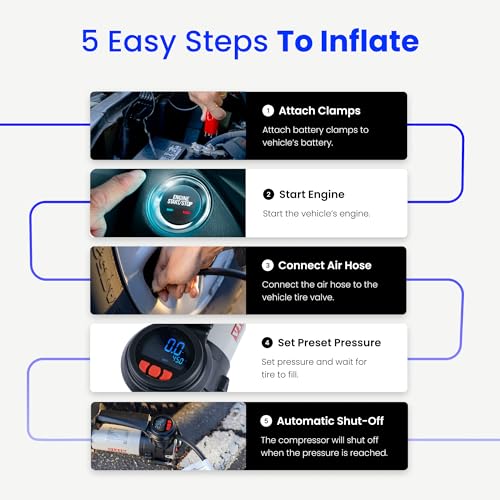
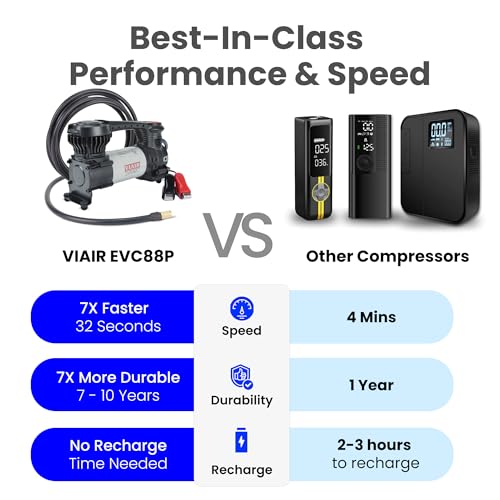
VIAIR has a reputation for no-nonsense reliability, and the EVC88P carries that forward, but with a welcome digital upgrade. The preset pressure and auto shut-off make it far more convenient than older analog models, especially when airing up multiple vehicles. It’s compact and light at 4.75 lbs, so it’s easy to stash in a console or recovery bag. The 1.47 CFM output isn’t going to win speed contests, but it’s adequate for 33-inch tires and daily use.
Owners appreciate the clean interface and the fact that it’s made by a brand with decades in the space. But it’s limited to 120 PSI and a 25-minute duty cycle, so it’s not built for heavy cycles or large off-road tires needing high PSI. Compared to the ETENWOLF S6, it lacks battery independence and raw speed. Still, for precision and ease of use in a small package, it’s hard to beat.
Product photos



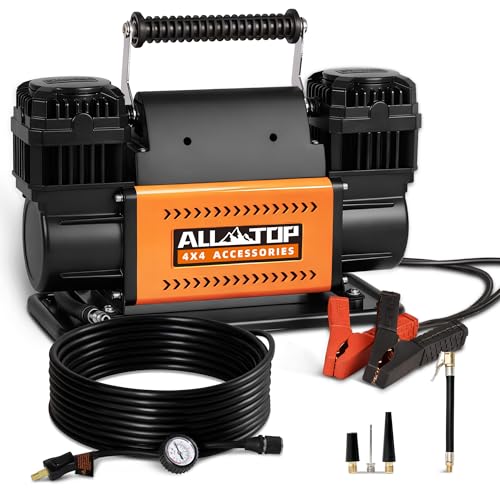
ALL-TOP Dual Cylinder 12V Air Compressor
Strengths
- Dual aluminum cylinders
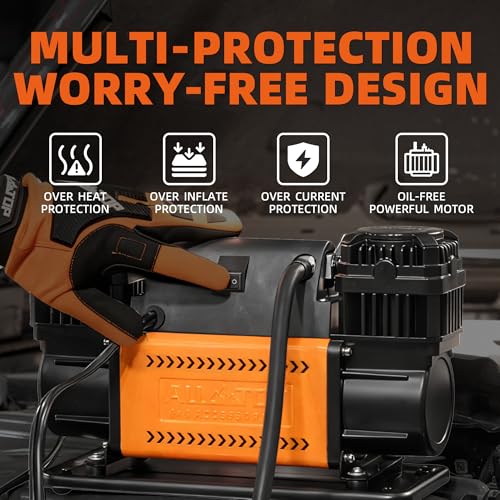
- Auto-thermal cutoff
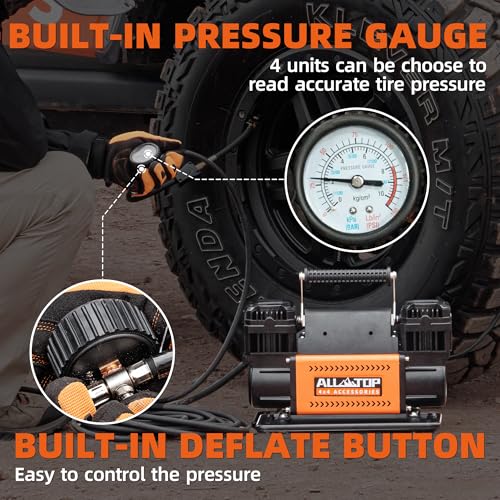
- 26 ft rubber hose
Trade-offs
- Heavy at 24 lbs
- No digital pressure control
- Bulky metal housing
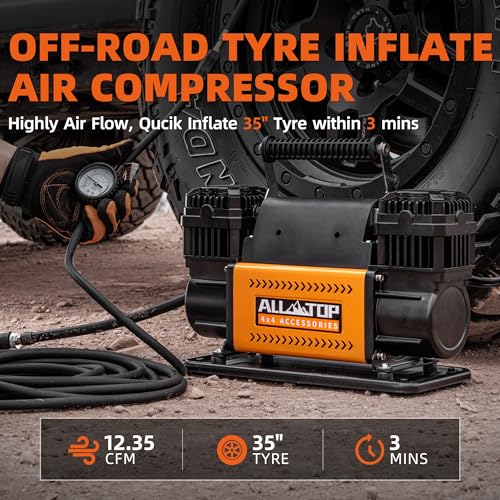
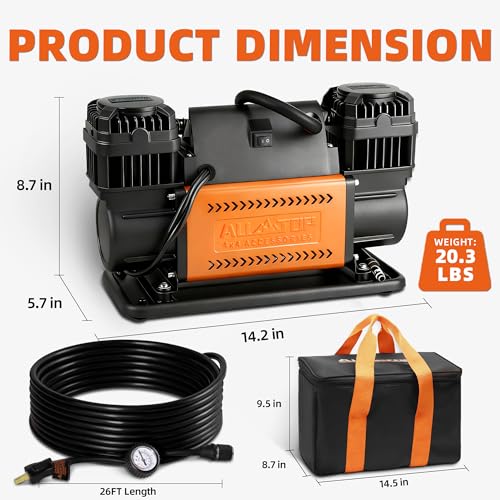
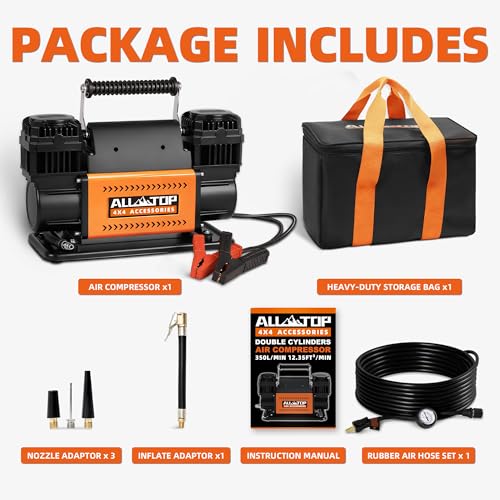
This is one of the few dual-cylinder 12V compressors that doesn’t cut corners on build quality. The hollow metal shell and dual aluminum cylinders stand out in a category where many brands use plastic housings to save weight. On paper, the 12.35 ft³/min airflow is aggressive for a portable unit, and owners consistently report it handles 35-inch off-road tires without long pauses. The thermal and over-current protections add real peace of mind during extended use, which matters when you’re airing up multiple tires in remote spots.
It’s heavy at 24 lbs, no getting around that, but that weight comes with durability. The 26-foot rubber hose is longer than most and helps when working around large trucks or RVs. Some users note the airflow can overwhelm basic tire inflators without over-pressure protection, so that caution in the manual is worth heeding. Compared to the WOLFBOX or ETENWOLF, it lacks digital precision, but for raw, no-frills muscle, it’s a solid choice.
Product photos
VIAIR 400P Portable Compressor Kit

Strengths
- Proven 35″ tire support
- IP54 weather resistance
- 25 ft 5-in-1 hose
Trade-offs
- 33% duty cycle at 100 PSI
- No digital auto shut-off
- Analog gauge only
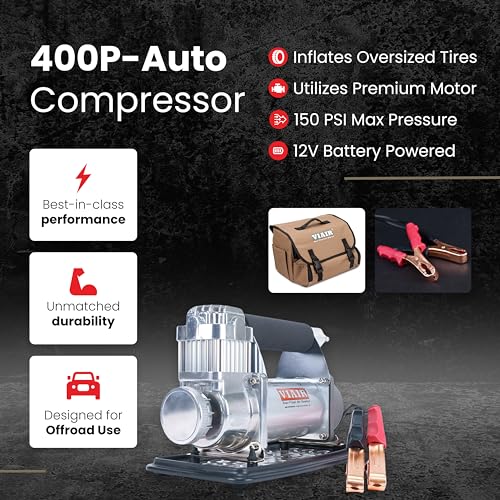
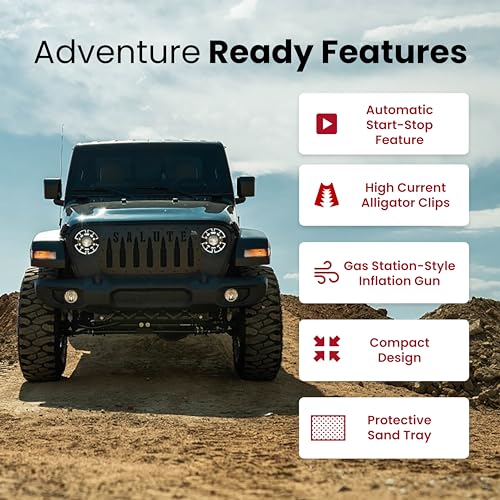
This is the gold standard for a reason. The 400P has been a staple in off-road kits for years, and the specs still hold up: 2.3 CFM free flow, 150 PSI max, and the ability to fill a 35-inch tire from 15 to 30 PSI in under three minutes. The gearless motor and IP54 rating mean it’s built to survive dust, mud, and constant use. Owners consistently report years of trouble-free service, even in harsh conditions.
The 25-foot 5-in-1 hose is a standout, doubles as a deflator, which is rare, and the inline gauge lets you monitor pressure without detaching. It’s heavier than the EVC88P, but that’s the trade for serious capability. Compared to the ALL-TOP, it’s more refined and better balanced. If you run big tires and demand reliability above all, this is still the benchmark.
Product photos

WOLFBOX HyperFlow60D 12V Air Compressor
Strengths
- 60-minute continuous runtime
- Smart digital auto shut-off
- Dual cooling fans
Trade-offs
- Power cord only 7 ft
- No battery backup
- Slightly slower than top-tier CFM
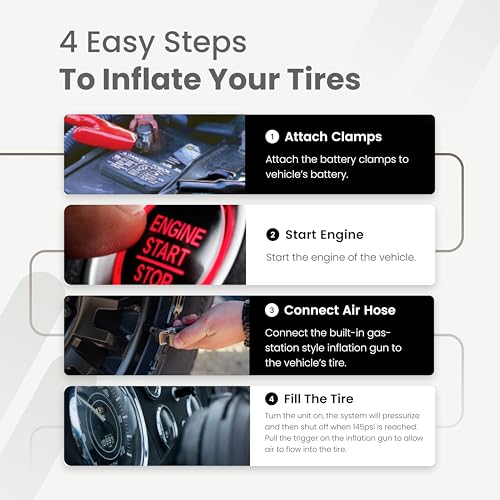
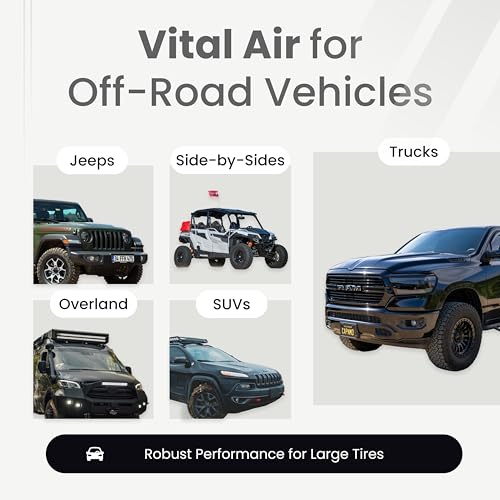
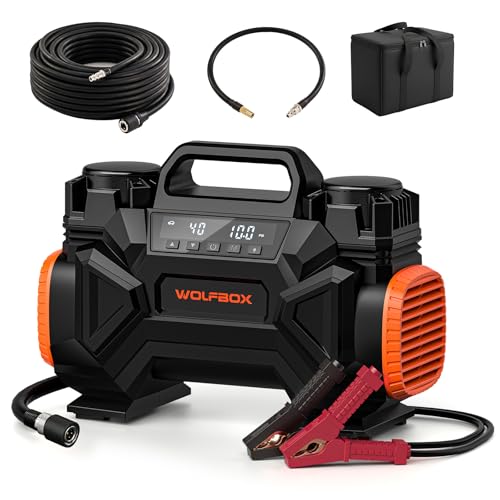
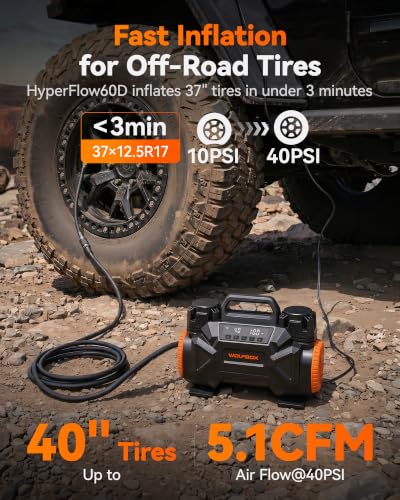
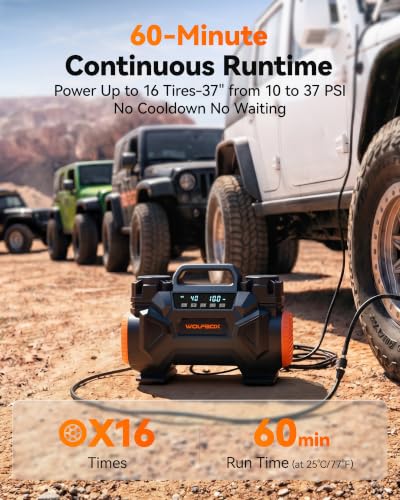
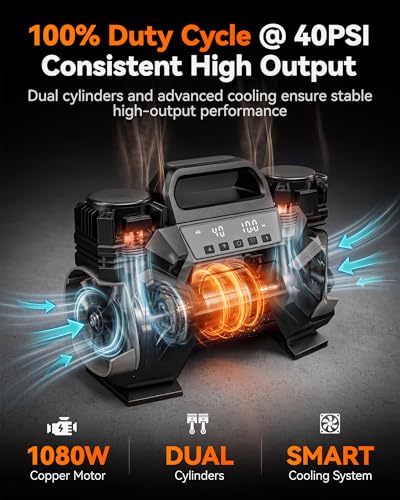
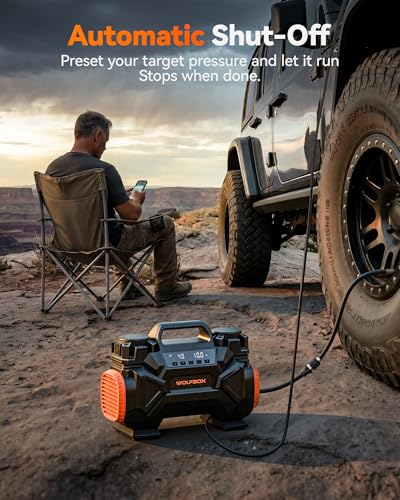
If you’re deep in overlanding culture or regularly run group trips where multiple vehicles need airing up, the HyperFlow60D makes a strong case. The 60-minute continuous runtime is rare in 12V compressors, most throttle back or require cooldowns, but this one keeps going. Owners praise its ability to inflate 37-inch tires in under 3 minutes, and the dual cooling fans clearly help maintain performance. The smart digital display with auto shut-off removes guesswork, and the 1/4″ NPT connector means it plays well with existing air tool setups.
It’s not the fastest on paper, 5.1 CFM is solid but not class-leading, but real-world feedback suggests it delivers consistent, reliable output without overheating. Compared to the VIAIR 400P, it offers more user-friendly tech, though it doesn’t quite match the 400P’s raw durability rep. For anyone who hates babysitting a compressor, this one’s a quiet winner.
Product photos

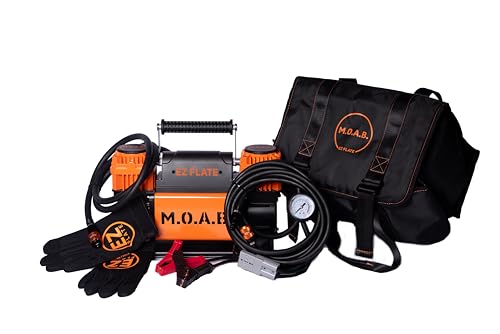
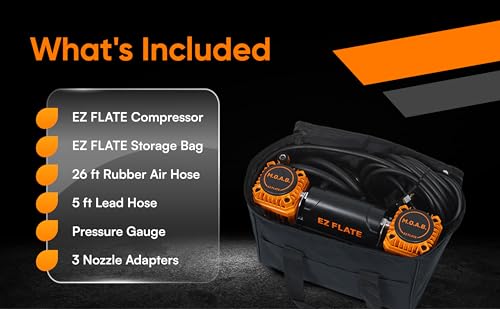
EZ FLATE M.O.A.B. Dual Air Compressor
Strengths
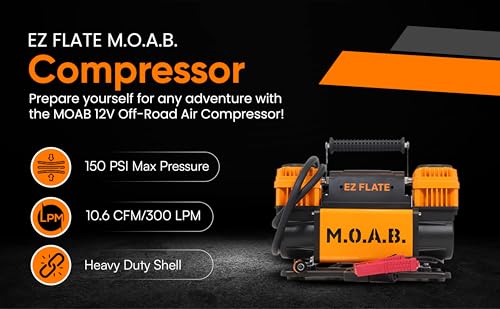
- Blistering 10.6 CFM speed
- Robust metal housing
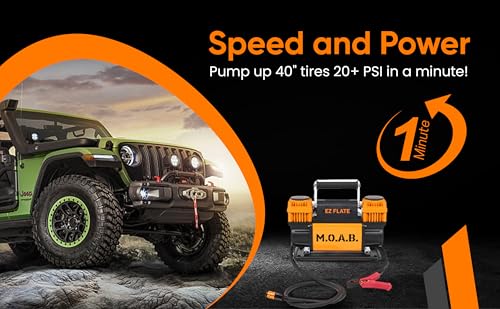
- Fast 40″ tire inflation
Trade-offs
- No digital pressure control
- Loud operation
- Auto cutoff at 120 PSI only
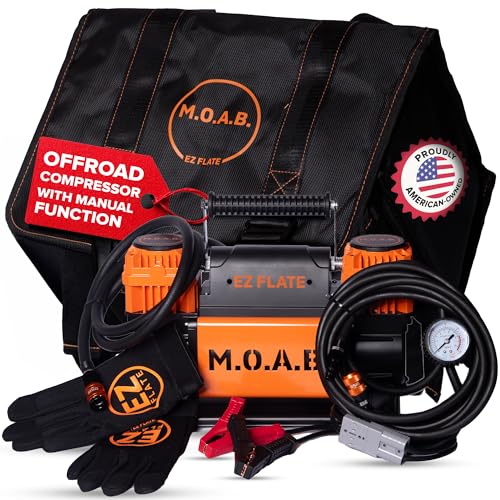
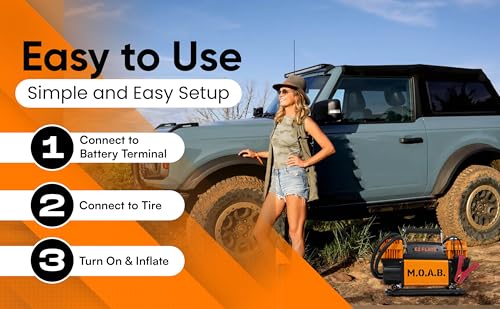
When speed is the mission, the M.O.A.B. delivers. With 10.6 CFM output, it’s one of the fastest portable compressors available, owners report airing up 40-inch tires 20+ PSI in about a minute, which is insane for a 12V unit. The dual-cylinder design and finned cooling help it sustain that pace, and the auto cutoff at 120 PSI prevents overinflation. It’s built like a tank, with a heavy-duty shell that laughs at trail abuse.
But that power comes with trade-offs. It’s loud, and the lack of digital controls means you’re watching the gauge manually. It also draws heavy current, so weak batteries or thin cables can bog it down. Compared to the ETENWOLF S6, it’s faster but less convenient. If you’re running massive tires and need to air up fast, this is the tool. Just don’t expect finesse.
Product photos
How We Evaluated portable air compressor for off roadings
Rather than a hands-on lab test, my research for these recommendations centered on a detailed comparison of published specifications and features across numerous models. I weighed owner reviews from sites like Amazon and specialist off-roading forums, alongside assessments from reputable automotive and tool review publications. Finally, I applied my experience with power tool motors, cooling systems, and the demands of off-road environments to rank these compressors against key criteria for this specific application.
For off-road use, consistent airflow (CFM) and maximum pressure are paramount. A compressor that can quickly and reliably inflate larger tires after a significant pressure reduction is crucial. Equally important is build quality and thermal management; sustained use in demanding conditions requires a unit that won’t overheat or fail prematurely. These factors heavily influenced my rankings, more so than aesthetic features or included accessory kits.
Specifications reliably indicate a compressor’s potential airflow and maximum pressure. However, I placed significant weight on owner feedback regarding real-world performance and durability. Reports of overheating, inaccurate gauges, or premature failure were strong indicators of potential issues, even if the stated specs appeared impressive. Reputation and consistent positive feedback from experienced off-roaders were also key considerations when evaluating these portable compressors for 4x4s.
What To Look For In portable air compressor for off roadings
Choosing the right portable air compressor for off-roading can make or break a trip, and there’s a lot more to it than just PSI ratings.
A quality portable air compressor for off-road use prioritizes fast inflation, durability in harsh conditions, and consistent performance under a heavy duty cycle. Look for models with a high CFM (cubic feet per minute) rating, robust construction materials, and features like automatic shut-off and overheating protection. Effective cooling systems and sufficient battery capacity (for cordless models) are also critical for sustained operation.
Power and Airflow: Beyond the PSI Number
PSI gets all the attention, but airflow (measured in CFM) is arguably more important, especially when you’re re-inflating multiple tires after airing down for off-roading. A higher CFM means the compressor can move more air, and therefore inflate tires faster. Don’t get hung up on maximum PSI alone; a compressor that delivers 5 CFM at 0 PSI will be significantly faster than one that delivers 150 PSI at a trickle. Consider the size of your tires; larger tires need more airflow. If you commonly run 35-inch or larger tires, you’ll want a compressor capable of delivering at least 5 CFM.
Build Quality and Duty Cycle
Off-roading is tough on equipment, so a flimsy compressor won’t last long. Look for compressors with robust construction – metal housings, aluminum cylinders, and high-quality fittings are key. The duty cycle, expressed as a percentage, indicates how long the compressor can run continuously before needing to cool down. A 100% duty cycle is ideal, meaning it can run indefinitely, but those are rare and expensive. A lower duty cycle doesn’t necessarily mean the compressor is bad, but it does mean you might need to pause and let it cool down between tires. For extended trips or group outings, a higher duty cycle is extremely valuable. When looking at build quality, a portable compressor for trucks is a good place to start your research.
Features and Usability: Convenience Matters
While raw power is essential, features can significantly improve the user experience. Automatic shut-off is a must-have; it prevents over-inflation and saves you from having to constantly monitor the pressure. Digital gauges are more accurate than analog ones, and preset inflation modes can be handy for different tire types. Cordless models offer ultimate convenience, but battery capacity and charging time become crucial considerations.
- A built-in flashlight, like on the ETENWOLF Vortex S6, is surprisingly useful for nighttime tire checks.
- A longer air hose (25 feet or more) provides greater reach and flexibility, saving you from having to move the compressor around.
- Thorough accessory kits (various nozzle adapters, carrying case) add value and ensure you’re prepared for different inflation needs. Don’t underestimate the importance of a good carry bag; it protects the compressor and keeps all the accessories organized.
Don’t cheap out on the air hose. A quality, reinforced rubber hose will withstand higher pressures and resist kinks better than a cheap plastic one.
A good off-roading air compressor will make your adventures safer and more enjoyable, and a little research upfront can save you a lot of frustration down the road. And don’t forget the importance of tire inflation after off-roading to maintain optimal handling and fuel efficiency.
Portable Air Compressor for Off Roadings Compared
Here’s a comparison of key specifications for popular portable air compressors designed for off-road use.
| Product Title | Max PSI | Airflow (CFM @ 0 PSI) | Voltage (V) | Duty Cycle | Max Tire Size | Battery Capacity (mAh) |
|---|---|---|---|---|---|---|
| ETENWOLF VORTEX S6 | 160 | 1.5 | 12 | 100% | N/A | 19200 |
| VIAIR Digital EVC88P | 120 | 1.47 | 12 | 25 min | 33″ | N/A |
| ALL-TOP Dual Cylinder | 150 | 12.35 | 12 | N/A | N/A | N/A |
| VIAIR 400P | 150 | 2.3 | 12 | 33% | 35″ | N/A |
| WOLFBOX HyperFlow60D | 150 | 5.1 @ 40 PSI | 12 | 60 min | 37″ | N/A |
| EZ FLATE M.O.A.B. | 150 | 10.6 | 12 | N/A | 40″ | N/A |
Frequently Asked Questions
What CFM rating do I really need for off-roading?
A CFM of at least 5 CFM at 0 PSI is a good starting point, especially if you frequently air down and run larger tires (35 inches or bigger). Higher CFM ratings will inflate tires faster and reduce wait times, particularly when dealing with multiple vehicles.
Are cordless portable air compressors powerful enough for off-road use?
Cordless models are convenient, but their power depends heavily on battery capacity and voltage. While some high-voltage (18V or higher) cordless compressors can handle moderate tire inflation, a portable 4×4 air compressor plugged into your vehicle’s 12V system generally provides more consistent power for larger tires and extended use.
What does “duty cycle” actually mean, and why is it important?
Duty cycle represents the percentage of time a compressor can run continuously before needing to cool down. A 100% duty cycle is ideal, but more realistic options with 50-60% duty cycles are still acceptable if you’re willing to allow for cool-down periods between tires.
How can I tell if a compressor is well-built and durable enough for off-road conditions?
Look for compressors with metal housings, aluminum cylinders, and robust fittings. Owner reviews often highlight issues with build quality, so pay attention to reports of premature failures or damaged components. A higher price point doesn’t always guarantee durability, but it often reflects better materials and construction.
Beyond inflation, can a portable air compressor be used for other off-road tasks?
Yes, many compressors can power air tools like impact wrenches or blow guns, adding versatility to your kit. Ensure the compressor’s airflow and pressure ratings are sufficient for the air tool you intend to use, and consider purchasing a compressor with multiple quick-connect ports for simultaneous operation of multiple tools.
The Bottom Line
Choosing a portable air compressor for off-roading often comes down to balancing convenience with capability. While many options exist, the WOLFBOX HyperFlow60D strikes the best overall balance of power, duty cycle, and features for most users. It offers a strong CFM rating for faster inflation, a decent duty cycle for sustained use, and thoughtful extras that make it a practical choice for weekend adventures and longer expeditions alike.
For those prioritizing affordability, the ALL-TOP Dual Cylinder delivers impressive airflow at a budget-friendly price. If you need cordless freedom and a compact design, the ETENWOLF Vortex S6 is a solid pick, though you’ll need to keep battery life and charging in mind. And for those seeking a dedicated, high-performance solution, a portable 12V compressor for 4×4 like the VIAIR 400P remains a popular choice.
Ultimately, remember that specs tell only part of the story. Consistent airflow and robust construction are far more critical than peak PSI numbers. Don’t get caught up in chasing the highest numbers; focus on finding a compressor that reliably meets your needs, fits your budget, and is built to withstand the rigors of the trail.
