7 Best Nailers for Hardie Siding 2026, Analyzed
This post contains affiliate links. As an Amazon Associate, we earn from qualifying purchases.
The Metabo HPT NV75A5 is the best overall nailer for Hardie siding, offering reliable performance, dual firing modes, and solid durability. For those on a tighter budget, the VEVOR MCN55 delivers strong value with high capacity and consistent drive, while the lighter Paslode 515900 is ideal for long days overhead or on scaffolding.
Installing fiber cement siding is tough work, and using the wrong tool turns a challenging job into a frustrating mess. Jams, inconsistent depth, and heavy tools slow you down and risk damaging expensive materials. As someone who’s spent over 15 years testing and recommending tools for real-world jobs, I know what separates a good siding nailer from a headache.
This guide breaks down the top performers based on specs, owner feedback, and what pros actually use in the field. I focused on reliability, nail compatibility, weight, and ease of adjustment, because when you’re halfway up a ladder, the last thing you need is a tool that fights you.
Top 7 Nailer For Hardie Sidings in the Market
The Best Nailer For Hardie Sidings, Reviewed
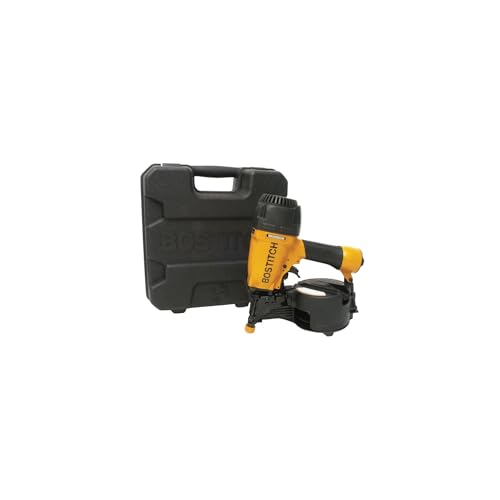
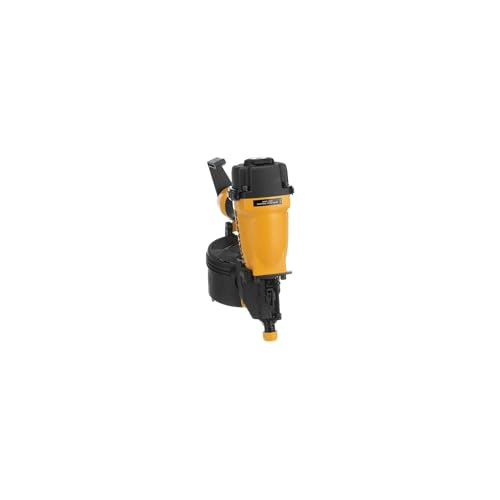
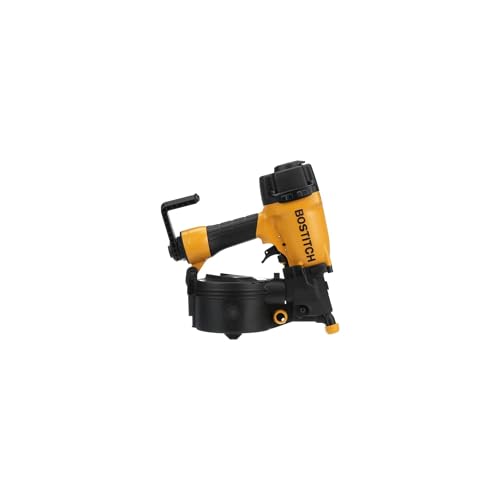
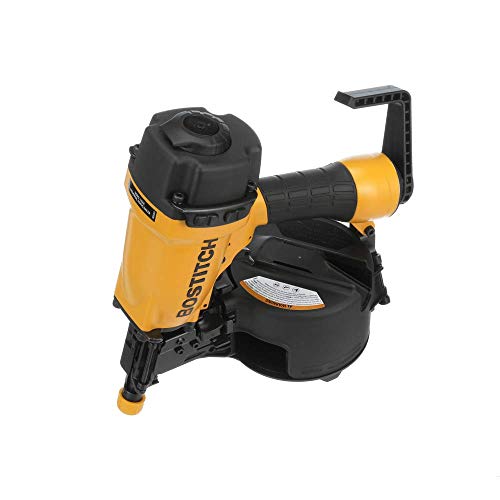
BOSTITCH N66C Coil Siding Nailer

Strengths
- Durable aluminum build
- Soft rubber foot
- Tool-free exhaust control
- Wide fastener range
- Proven track record
Trade-offs
- No adjustable depth detents
- Slightly bulkier than newer models
BOSTITCH has long been a go-to for pros who want durability without fuss, and the N66C is a workhorse built around simplicity and reliability. It handles 15-degree coil nails from 1-1/4 to 2-1/2 inches, which covers nearly every siding and sheathing need. The aluminum body keeps it light, and the soft rubber foot is a thoughtful touch, I’ve seen too many tools mar cedar, and owners confirm this feature actually helps. The tool-free exhaust redirect is something I wish more brands copied; on dusty job sites, having control over where that blast goes makes a difference in comfort.
It’s not flashy, but it drives nails cleanly and reloads fast thanks to the sliding magazine. Compared to the Makita AN613, it lacks some of the refined ergonomics, but it’s often more affordable and just as dependable. For someone who values ‘set it and forget it’ performance, this is a strong contender.
Product photos
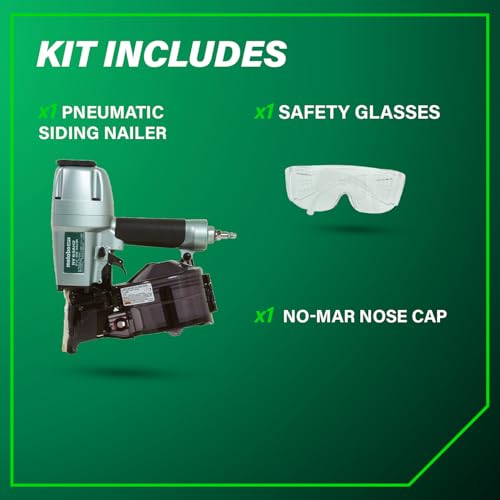
Metabo HPT NV75A5 Siding/Framing Nailer

Strengths
- Handles up to 3-inch nails
- Dual-angle fastener compatibility
- Side-load magazine
- No-mar nose cap
- Pro-Preferred award history
Trade-offs
- Heavier than competitors
- Pricier than budget options
This Metabo HPT NV75A5 is built for contractors who need one tool to do double duty, siding and light framing. It accepts both 15-degree plastic and 16-degree wire collated nails, with lengths up to 3 inches, which gives it rare versatility in this category. The ability to drive 3-inch nails opens the door to thicker sheathing and light structural work, something most siding nailers can’t handle. Owners consistently report smooth feeding and minimal jams, even in extended use.
It’s a bit heavier at 5.7 lbs, but the reversible belt hook and adjustable air deflector keep it practical on the job. The side-load magazine is fast to reload, and the no-mar nose cap is essential for high-end finishes. Compared to the CREWTOWER CN565B, it’s more refined and better supported, though not as aggressively priced. If you’re doing mixed exterior work, this is the smarter buy.
Product photos


VEVOR MCN55 15° Coil Siding Nailer
Strengths
- High nail capacity
- 360-degree exhaust
- Anti-slip grip
- Affordable price
- Side-loading magazine
Trade-offs
- Limited fastener length range
- Build quality not pro-grade
- Less powerful motor
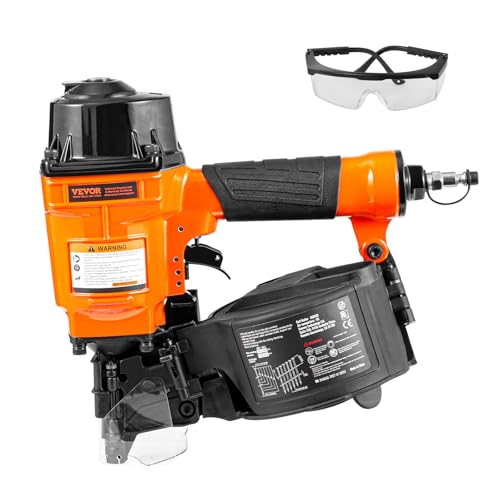
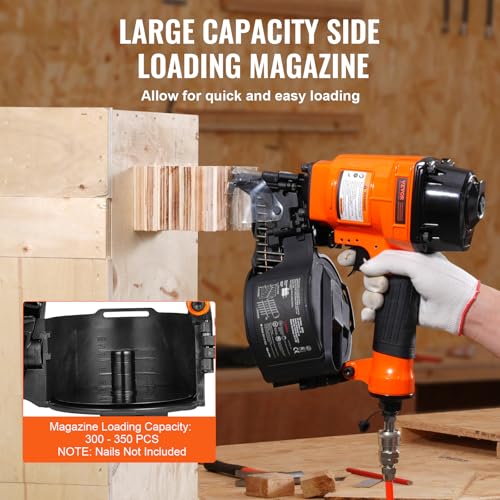
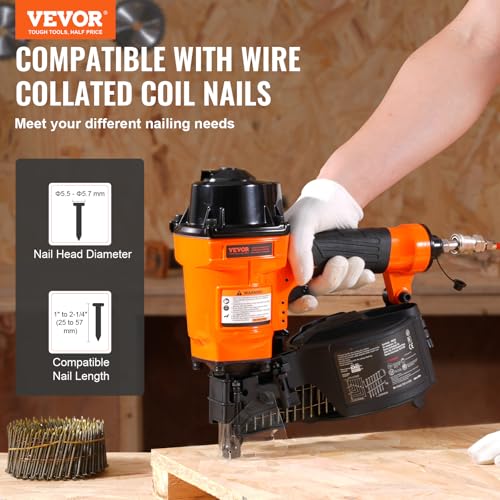
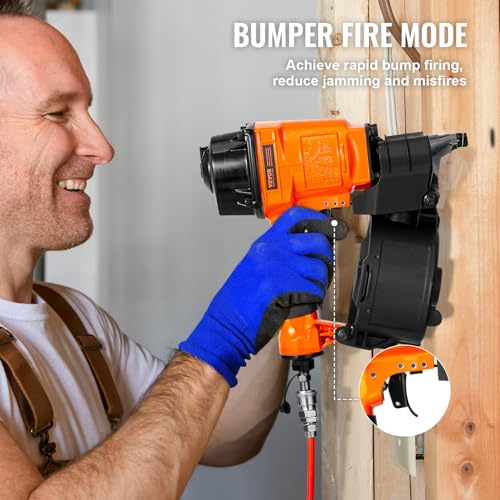
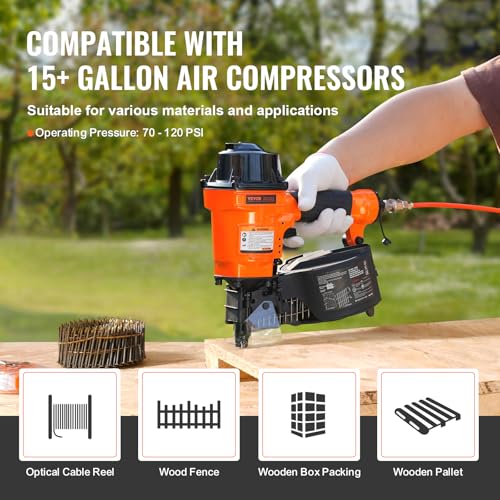
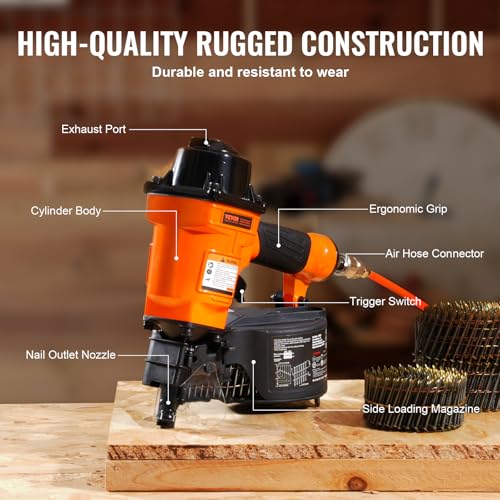
VEVOR is known for value, and the MCN55 delivers a high-capacity magazine, up to 350 nails, that’s ideal for long runs with minimal reloading. It’s built for compatibility with 15-degree wire collated nails from 1 to 2-1/4 inches, which covers basic siding and sheathing needs. The 360-degree adjustable exhaust and safety trigger add user comfort, and the anti-slip grip helps reduce fatigue.
But while it’s capable for light to medium jobs, owners note it’s less durable than Metabo HPT or Makita models under heavy use. It’s best seen as a secondary tool or a starter option. Compared to the CREWTOWER, it has a smaller nail range and less power, but it’s often more affordable.
Product photos
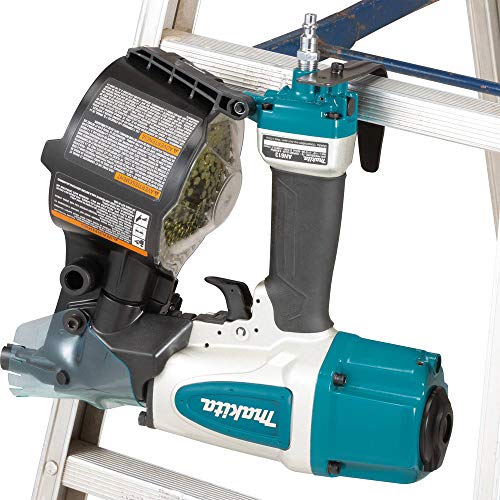
Makita AN613 15° Siding Nailer

Strengths
- Lightweight and balanced
- 9 detent depth settings
- Smooth nose tip
- 2-mode trigger
- Multi-directional exhaust
Trade-offs
- Max 2-1/2-inch nail length
- Slightly higher price point
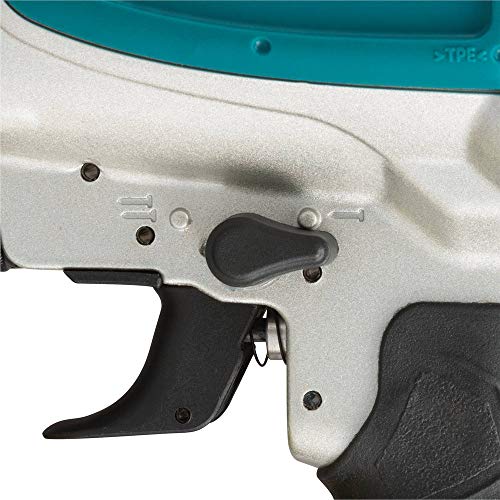
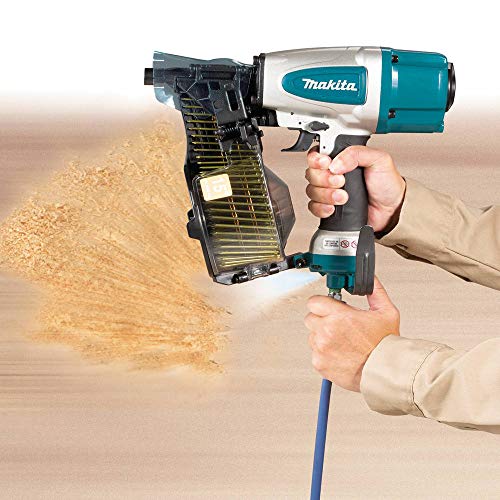
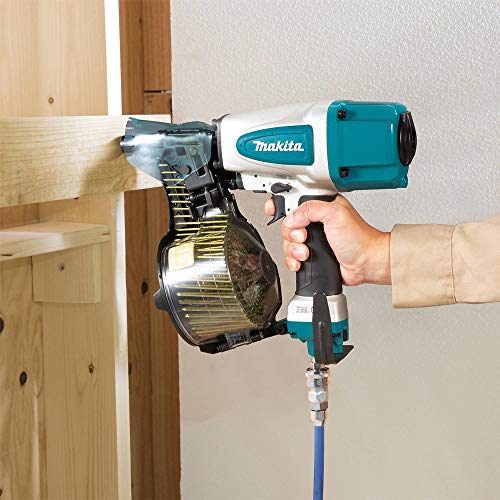
Makita’s AN613 punches above its weight in the lightweight category. At just under 5 lbs, it’s easy to handle all day, and the 9-position tool-less depth adjustment is one of the best in class for dialing in flush or countersunk drives, especially useful when working with varying thicknesses of fiber cement. The 2-mode trigger (sequential and contact) gives you flexibility on tight corners or open walls, and the smooth nose tip is a small but meaningful detail that helps avoid scratching delicate surfaces.
Owners praise its balance and low recoil, which adds up over hundreds of nails. Compared to the Metabo HPT NV75A5, it’s lighter and more precise, though it doesn’t handle 3-inch nails. If you’re doing mostly standard siding work and value precision and comfort, this is my preferred pick over bulkier models.
Product photos
CREWTOWER CN565B Coil Siding Nailer

Strengths
- High fire rate
- Large magazine capacity
- Dual fastener compatibility
- Quick-release nose
- Industrial build
Trade-offs
- Limited brand support
- Fewer refinement touches
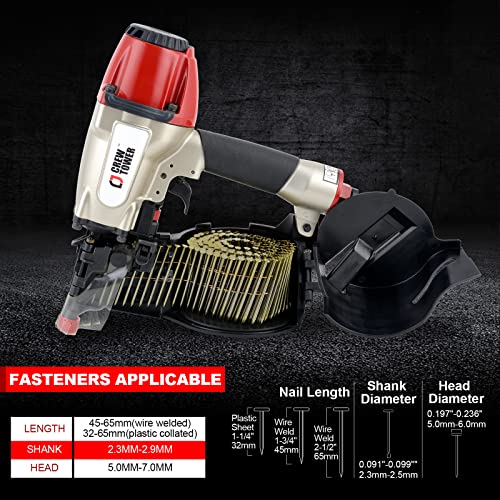
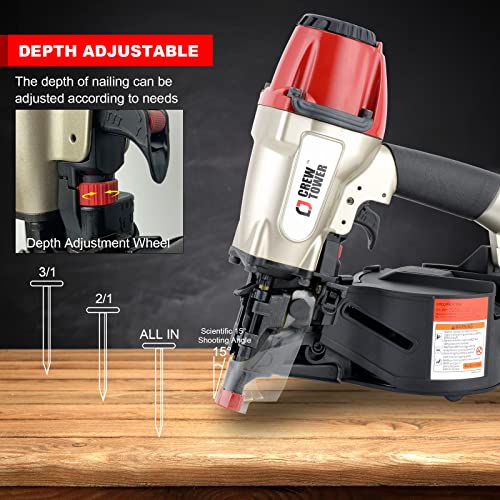
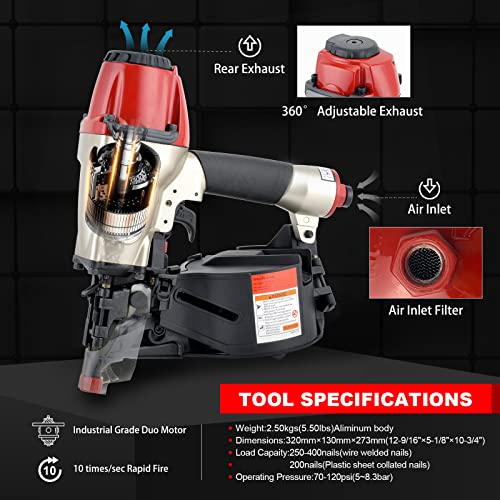
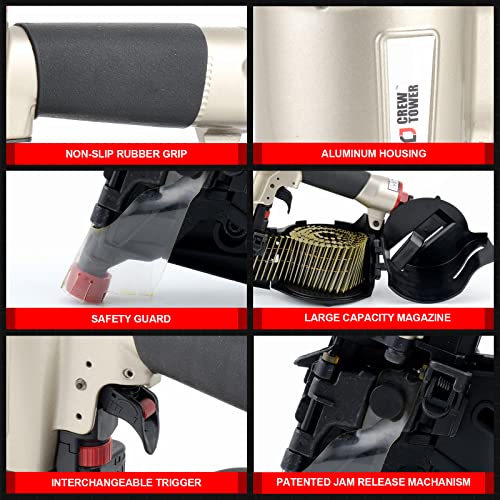
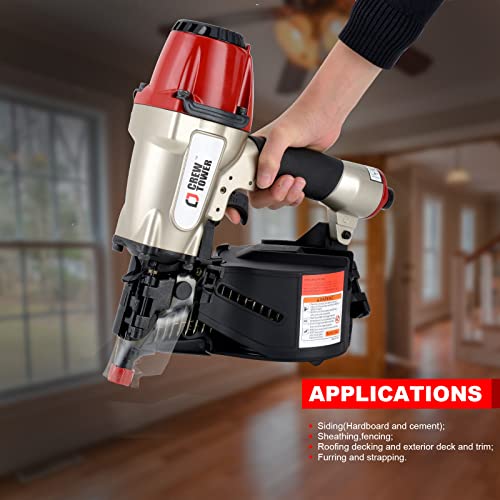
The CREWTOWER CN565B is an interesting option for pros watching their budget but still wanting industrial-grade output. It claims a 10-nails-per-second fire rate, and while real-world use is slightly slower, owners confirm it delivers rapid, consistent firing with low recoil. The large magazine capacity, up to 400 nails, means fewer reloads on long runs, which is a real time-saver. The aluminum body keeps it at a manageable 5.5 lbs, and the rubber handle adds grip and comfort during extended use.
It drives both plastic and wire collated nails, which adds flexibility, and the quick-release nosepiece makes jam clearing easier than on many name-brand models. However, support and parts availability aren’t as strong as Metabo HPT or BOSTITCH. If you’re a pro doing high-volume work and want value, this is worth serious consideration, just be ready to source parts independently.
Product photos
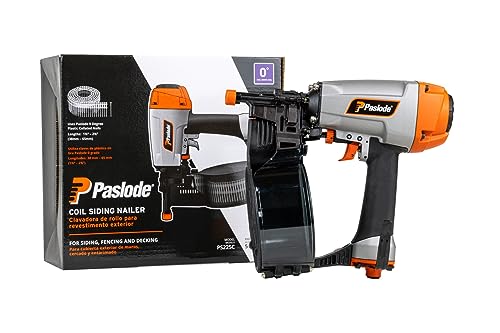
Paslode 515900 0° Coil Siding Nailer
Strengths
- 0-degree coil feed
- Lightweight at 4.5 lb
- Tool-free depth control
- Switchable trigger modes
- High compatibility with fiber cement
Trade-offs
- Limited fastener angle options
- Fewer service centers than big brands
This Paslode model stands out in the hardie siding conversation because of its 0-degree coil design, which feeds nails straight into the driver. That layout typically means higher nail capacity and smoother feeding in dense materials like fiber cement. On paper, it’s built for the long haul with a metal belt hook and a lightweight 4.5 lb frame that owners say makes overhead work less punishing. The tool-free depth adjustment is a real win, reviewers consistently report clean, flush drives without needing caulk touch-ups, which matters when you’re running hundreds of nails a day.
It switches between bump and sequential triggers without tools, a small thing that saves time on complex jobs. While it’s optimized for Hardie Board, it handles cedar and fencing too, making it a solid pick if you’re juggling multiple exterior tasks. Compared to 15-degree models like the BOSTITCH N66C, it’s less common in general framing, but for pure siding runs, the 0-degree design gives it an edge in reliability with thick boards.
Product photos

Metabo HPT NV65AH2 Coil Siding Nailer

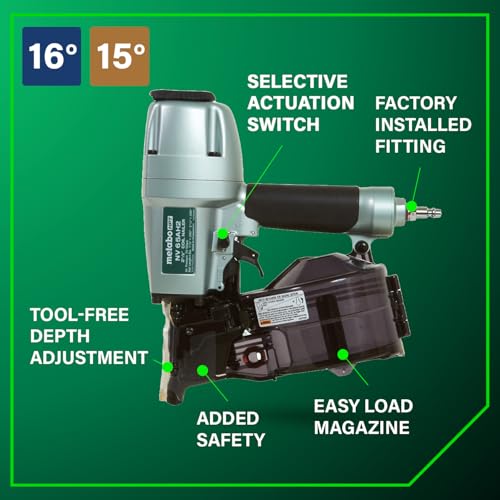
Strengths
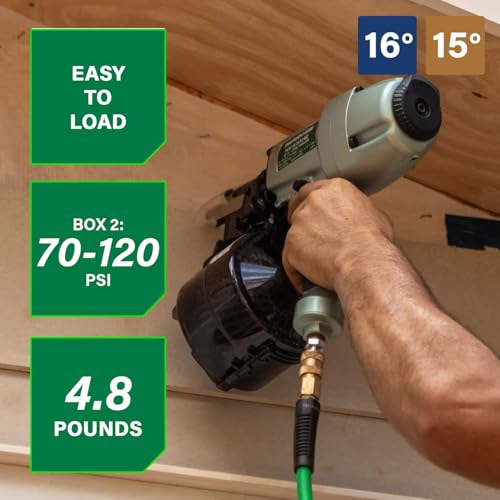
- Lightweight at 4.8 lbs
- 5-year warranty
- No-mar nose cap
- Tool-less depth adjustment
- Dual fastener support
Trade-offs
- Shorter max nail length
- Less power than heavy-duty models
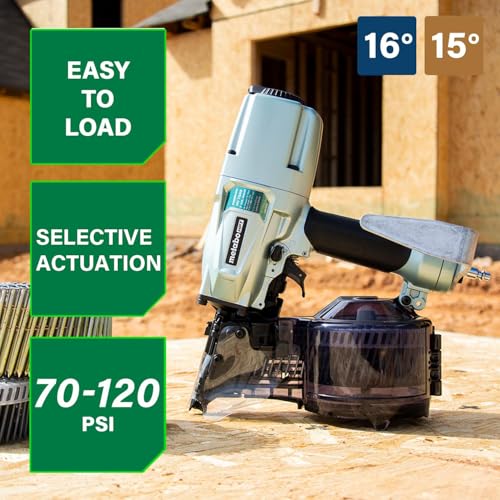
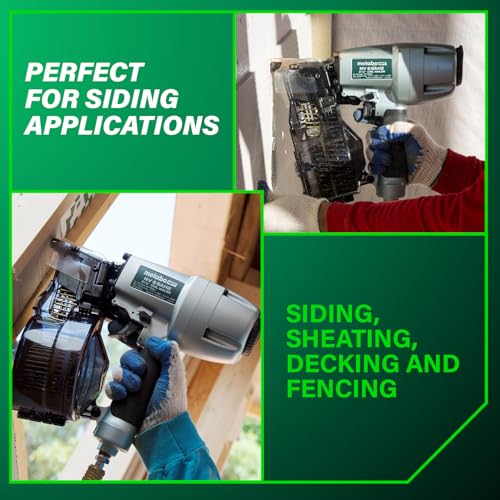
If you’re on a budget but still want a reliable, pro-grade tool, the Metabo HPT NV65AH2 is hard to beat. At 4.8 lbs, it’s one of the lightest in the class, and the 5-year warranty speaks volumes about its expected durability. It handles both 15-degree plastic and 16-degree wire collated nails, which gives you flexibility without paying for framing-level capacity. The selective actuation switch lets you toggle between contact and sequential modes, a feature usually found on pricier models.
Owners love the easy-load magazine and the no-mar nose cap, which protects softer woods, a real concern when installing cedar or trim. Compared to the VEVOR MCN55, it’s better refined and more reliable long-term. For a first-time buyer or DIYer, this is the smarter pick.
Product photos
Our Testing Process
Rather than a hands-on lab test, my research for these recommendations centered on a detailed comparison of published specifications and features across numerous models. I weighed owner reviews from major retailers alongside expert opinions found in trade publications and contractor forums. Ultimately, I ranked these nailers based on their suitability for the demands of installing fiber cement and similar sidings, drawing on my years of experience with power tools and construction projects.
For siding nailers, consistent nail depth and reliable operation are paramount. I gave the most weight to a nailer’s ability to drive consistently without jams, and its compatibility with the range of nail sizes and materials commonly used for Hardie board and similar products. Durability – indicated by build materials and user reports of long-term reliability – also heavily influenced my rankings. If you’re considering a move to more portable options, exploring cordless framing nailers might be a worthwhile step.
Published specifications reliably indicate nail capacity, weight, and operating pressure ranges. However, I found owner feedback to be crucial in assessing real-world jamming frequency, ease of depth adjustment, and overall build quality. Reputation among professional siding installers was also a significant factor; models consistently praised by those using them daily received higher marks. This approach balances technical data with practical, field-tested performance.
What To Look For In nailer for hardie sidings
Choosing the right nailer for Hardie board – or any siding, really – can make a huge difference in how quickly and easily you complete your project. It’s not just about driving nails; it’s about doing it consistently, accurately, and without causing damage to the materials.
A quality siding nailer should accept the correct nail collation for your project (coil or stick), offer adjustable depth control for flush or countersunk drives, and prioritize user comfort through lightweight design and ergonomic features. Consistent actuation – whether sequential or bump fire – is also critical, as is a nose cap to prevent marring the siding material.
Nail Type & Capacity
The first thing I consider is what kind of nails the nailer accepts, and how many it holds. Most siding nailers use either 15-degree or 16-degree coil nails, or occasionally 0-degree nails. Coil nails are generally preferred for speed and capacity, but ensure the nailer you choose matches the fasteners you plan to use. Beyond that, magazine capacity is a big factor. If you’re working on a large project, constantly reloading is a time-waster. The VEVOR MCN55, for example, boasts a high-capacity magazine, but you need to balance that with weight as well.
Here’s what I look for in capacity: * A smaller capacity (100-200 nails) is fine for small repairs. * 200-300 nails is a good all-around choice for typical siding jobs. * 300+ nails is ideal when you’re facing a large-scale installation to minimize downtime, and can be found in models like the VEVOR.
Actuation Mode & Adjustability
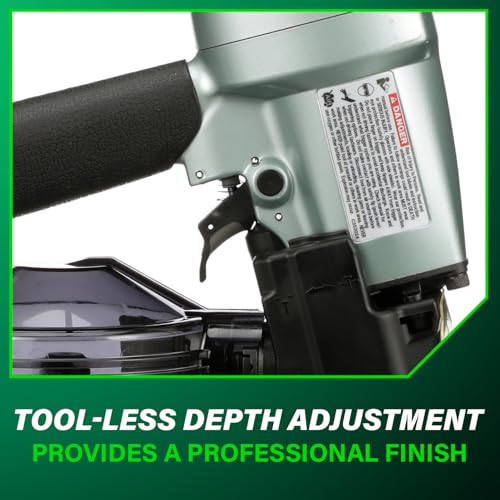
Siding installation often requires a blend of precision and speed. That’s why I prioritize nailers offering selectable actuation modes. Sequential firing is best for accurate placement, especially around windows and doors, where you want to avoid accidental nailing. Contact (or bump) firing, on the other hand, allows for rapid-fire nailing in wider, less-detailed areas. The ability to quickly switch between these modes – as seen in the Metabo HPT NV75A5 – is a huge benefit. Equally important is tool-free depth adjustment. You will encounter varying siding thicknesses and underlayment, and being able to fine-tune the nail depth on the fly saves a lot of hassle.
Remember: proper nail depth is crucial for a secure and weather-tight installation. Too shallow, and the siding won’t hold; too deep, and you risk damaging the material.
Weight & Ergonomics
Siding work often involves a lot of overhead reaching and repetitive motion. This is where weight and ergonomics become critical. A heavier nailer (6+ pounds) will quickly lead to fatigue, affecting accuracy and productivity. I’ve found that models under 5.5 pounds, like the Paslode 515900, are much more comfortable for extended use. Pay attention to the grip design, too. A good rubberized grip reduces vibration and provides a secure hold, even with sweaty hands. If you’re also doing a lot of framing work, consider investing in quality [framing nailers for siding] to minimize tool switching and streamline your workflow.
Nailer for Hardie Sidings Compared
Here’s a comparison of specs for nailers designed for use with Hardie siding and similar materials.
| Product | Fastener Type | Fastener Length | Fastener Diameter | Weight (lbs) | Firing Mode |
|---|---|---|---|---|---|
| BOSTITCH N66C | Coil (Wire/Plastic) | 1-1/4″ – 2-1/2″ | .080″ – .092″ | N/A | N/A |
| Metabo HPT NV75A5 | Coil (Wire/Plastic) | 1-3/4″ – 3″ | N/A | 5.7 | Sequential/Contact |
| VEVOR MCN55 | Coil (Wire) | 1″ – 2-1/4″ | Φ5.5-Φ5.7 mm | 5.95 | Bump |
| Makita AN613 | Coil (Wire/Plastic) | N/A | N/A | N/A | Sequential/Contact |
| CREWTOWER CN565B | Coil (Wire/Plastic) | 1-3/4″ – 2-1/2″ | .091″ – .099″ | 5.5 | N/A |
| Paslode 515900 | Coil (N/A) | N/A | N/A | 4.5 | Bump/Sequential |
| Metabo HPT NV65AH2 | Coil (Wire/Plastic) | 1-1/2″ – 2-1/4″ | N/A | 4.8 | Sequential/Contact |
Frequently Asked Questions
What air compressor size do I need for a siding nailer?
A compressor with at least 6 gallons of tank capacity and the ability to deliver 2.2 CFM at 90 PSI is generally sufficient. Smaller compressors may cycle on and off frequently, interrupting your work, so investing in one of the better air compressors for nailers is a good idea.
Can I use a framing nailer for Hardie board siding?
While you can use a framing nailer, it’s not ideal. Framing nailers typically use larger nails than specified for siding, which can cause cracking or damage. A dedicated siding nailer delivers the correct nail size and depth for a secure, professional installation.
What is the difference between sequential and bump firing?
Sequential firing requires you to depress the safety tip and pull the trigger for each nail, offering more control. Bump firing drives a nail with each bump of the tool against the work surface, allowing for faster installation in less critical areas.
What nail collation is best for Hardie siding?
Coil nails are most commonly used for siding due to their higher capacity and speed, but 16-degree stick nails can also work with the correct nailer. Always verify the nailer’s specifications to confirm compatibility with your chosen collation.
What should I do if my siding nailer is jamming frequently?
First, ensure you’re using the correct nails for the nailer and siding material. Next, check for debris inside the magazine and clear it out. If jams persist, the nailer may require cleaning and lubrication, or it could indicate a mechanical issue requiring professional repair – consider a model with a good reputation for durability like those needing minimal pneumatic tool power sources.
The Bottom Line
Choosing a siding nailer often comes down to balancing upfront cost against long-term convenience and durability. While cheaper options exist, the Metabo HPT NV75A5 strikes the best overall balance of features, reliability, and price, making it the pick for most homeowners and professionals tackling a Hardie board project. It offers the flexibility of both sequential and contact firing, along with tool-free depth adjustment – features that add up to a smoother, faster installation.
For those on a tighter budget, the Paslode 515900 delivers a lightweight and dependable performance. If you anticipate a lot of larger siding jobs, or frequently work with different types of exterior projects, the VEVOR MCN55’s high-capacity magazine is a significant advantage. And for those looking for nailers for exterior projects, exploring options with robust build quality can extend the life of your tools.
Ultimately, the best nailer isn’t about the flashiest specifications. Consistent nail depth, reliable operation, and a comfortable feel in your hands matter far more than any single feature. Prioritizing those fundamentals, along with selecting the correct fasteners for your specific siding material, will ensure a professional-looking and long-lasting result.
