
5 Best Jigsaw Blades for Wood (2026 Guide)
This post contains affiliate links. As an Amazon Associate, we earn from qualifying purchases.
The Bosch T101AO Clean Wood Blades are the best overall for smooth, splinter-free cuts in plywood and softwoods, thanks to their high 20 TPI count and precision-ground teeth. For a budget-friendly multipack with solid versatility, the WORKPRO 25-Piece HCS/HSS Blades offer strong performance across wood types and value for frequent users.
Most DIYers don’t realize how much blade choice affects cut quality and project time. A mismatched blade can tear up your board, snap mid-cut, or leave you sanding for hours trying to fix rough edges.
I researched the top options by analyzing specs, tooth geometry, and real owner feedback to find blades that deliver clean cuts, last through multiple projects, and match common jigsaw models. These picks focus on proven performance in real woodworking tasks, not just marketing claims.
Top 5 Jigsaw Blades For Woods in the Market
The Best Jigsaw Blades For Woods, Reviewed
20-Piece Assorted T-Shank Blades
Strengths
- Well-rounded blade selection
- Clear shank labeling
- Excellent storage case
Trade-offs
- Only one of some types
- No BIM or bi-metal for heavy metal
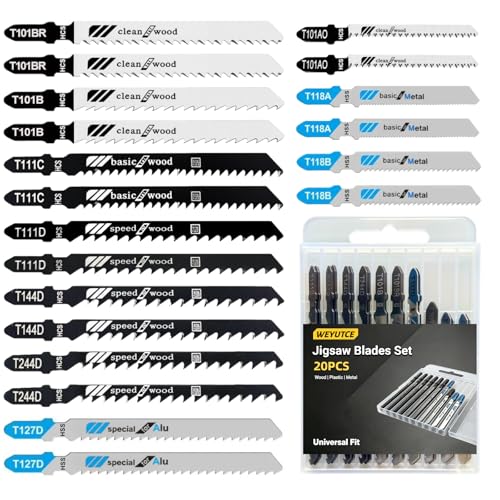
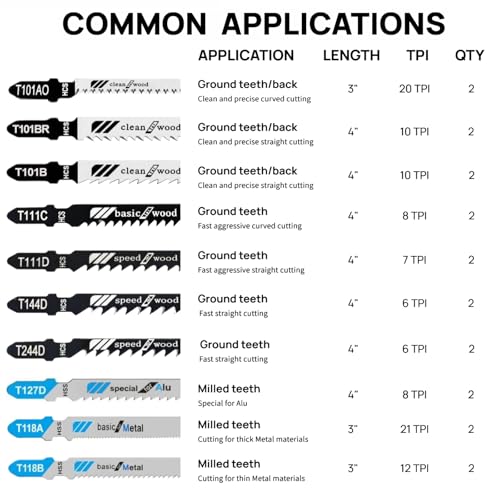
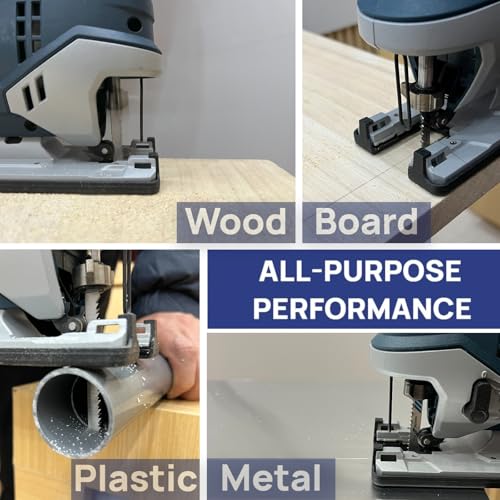
This 20-piece set is the smart buy for anyone who wants one case that covers nearly every jigsaw task around the shop. With duplicates of Bosch-recognized models like the T101AO for clean wood cuts and T144D for fast ripping, plus T118A and T127D for metal, it bridges the gap between wood-specific sets and true multi-material versatility. The inclusion of reverse-cut blades (like T101BR) is a thoughtful touch, those really do help reduce top-side splintering on veneered plywood.
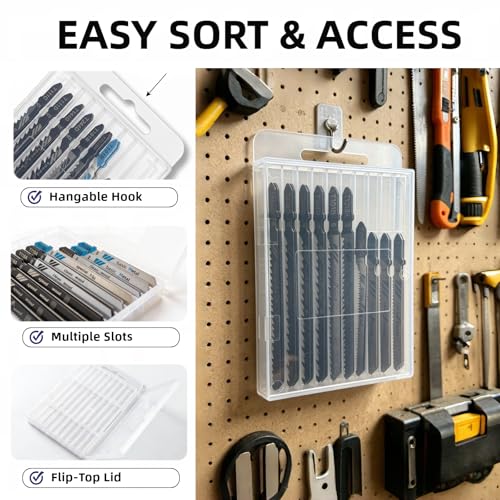
What seals the deal is the organization. Each blade type is clearly labeled on the shank, and the storage case uses divided slots and a hangable hook, small details that make a difference when you’re mid-project. Compared to the WORKPRO set, it’s more thoughtfully curated, with better blade variety and clearer sorting.
Product photos
WORKPRO 25-Piece HCS/HSS Blades

Strengths
- 25 blades for broad use
- Includes BIM and HSS types
- Good value per blade
Trade-offs
- Mixed performance quality
- Less consistent than Bosch
- Some duplicates unnecessary
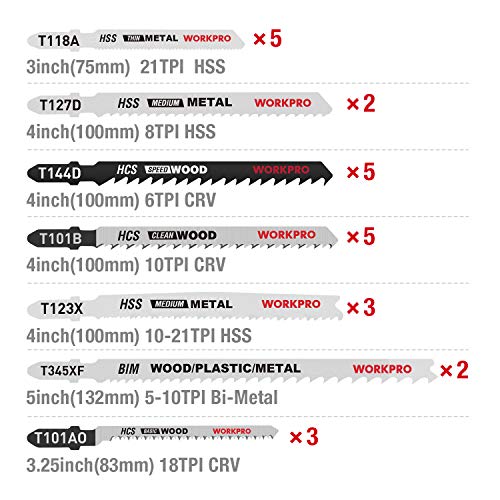
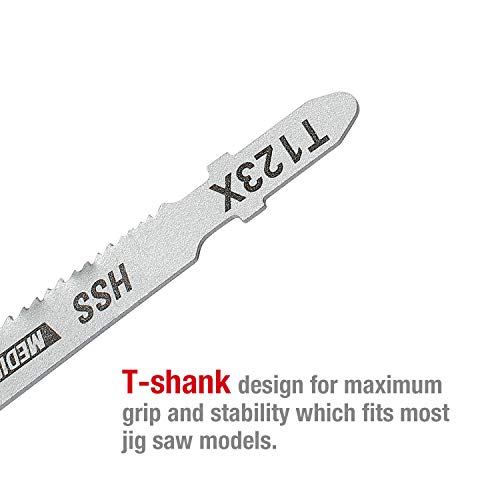
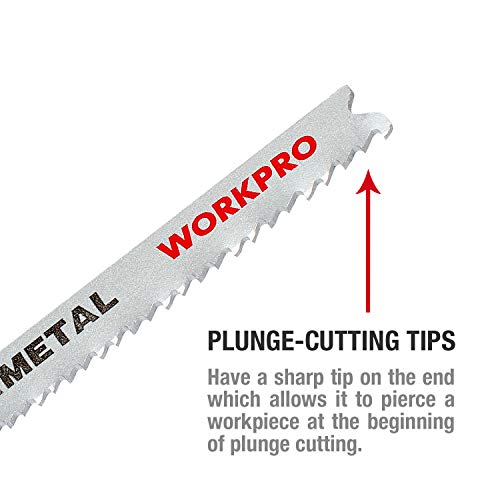
The WORKPRO 25-piece set throws a lot of blades into one case, HCS, HSS, and BIM, which sounds great on paper, especially if you’re tackling hardwoods or even light metal. The inclusion of BIM (bi-metal) blades like the T123X means you’ve got some real durability for tougher jobs, and the HSS blades can handle reinforced plastics or thin steel where standard HCS would dull fast.
But while it wins on variety, it doesn’t beat the 20-piece Bosch-mix set in organization or consistency. Some owners note that while the Bosch-branded blades in this set perform well, the WORKPRO-branded ones feel less refined. Still, for the sheer number of blades and the solid storage case, it’s a strong pick if you want one set to cover a wide range of materials and don’t mind a few mixed-quality performers.
Product photos
Bosch T101AO Clean Wood Blades
Strengths
- 20 TPI for clean cuts
- Minimizes splintering
- Narrow profile for curves
Trade-offs
- Short length
- Too slow for thick wood
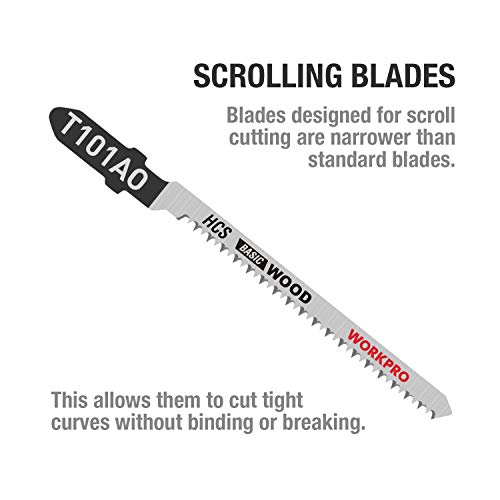
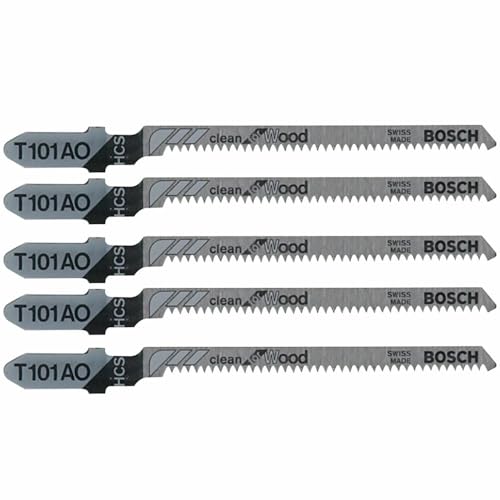
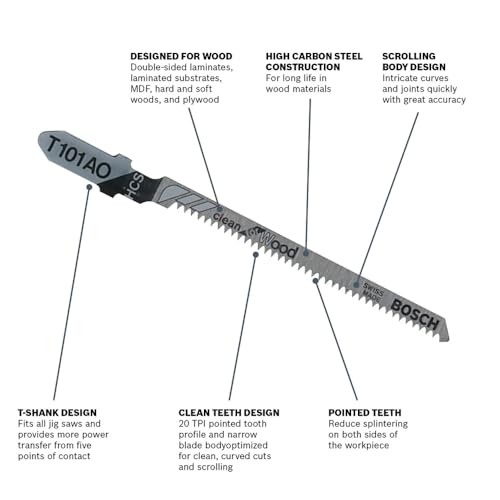
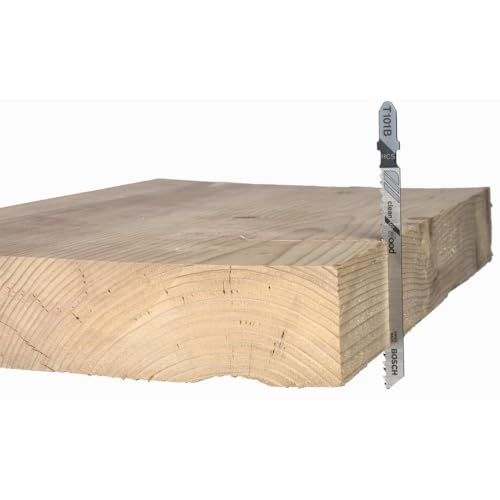
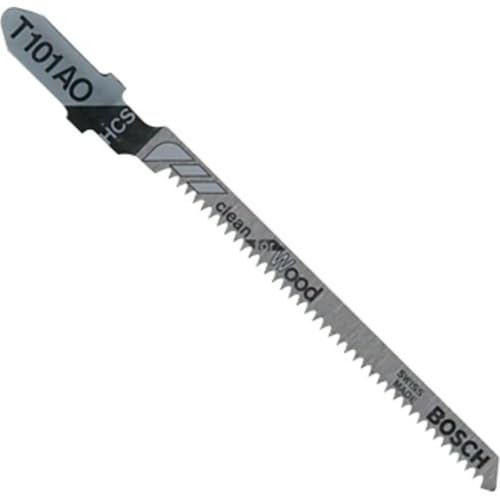
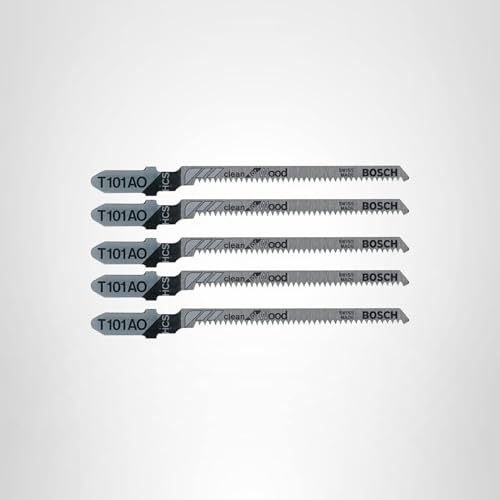
When it comes to clean, precise cuts in wood, especially plywood, MDF, or laminated materials, the Bosch T101AO stands out. The 20 TPI pointed tooth design is engineered to reduce splintering, and owner feedback confirms it delivers smooth, chip-free results on both sides of the material. The narrow blade body makes it ideal for curves and scrollwork, where control and finish matter more than raw speed.
These aren’t meant for thick stock, the 3-1/4 inch length limits plunge depth, but in their lane, they’re hard to beat. I’d pick these over the T144D any day for cabinetry or trim work. They’re the kind of blade that makes your jigsaw feel like a precision tool instead of just a rough cutter.
Product photos

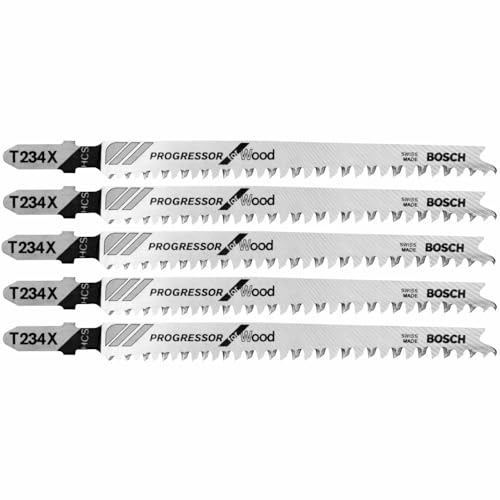
Bosch T234X Progressor Wood Blades
Strengths
- Progressor tooth design
- Balanced speed and finish
- Good usable length
Trade-offs
- Not for fine finishing
- Pricier than basic HCS
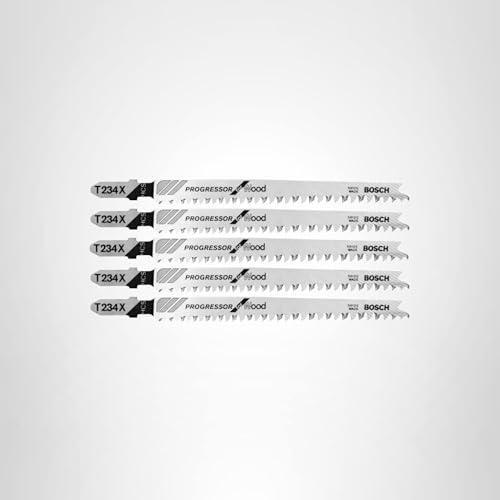
The Bosch T234X hits a sweet spot between speed and cut quality, thanks to its Progressor tooth design, variable pitch teeth that alternate between aggressive and fine. On paper, that means faster cuts with less tearing, and owners confirm it: these blades chew through thick softwood and plywood while leaving a noticeably cleaner edge than standard high-TPI or low-TPI blades. The 4-1/2 inch length gives you solid reach without sacrificing stability.
They’re more versatile than the T101AO or T344D alone, making them a better everyday default if you’re tired of swapping blades constantly. I’d pick these as the go-to for framing, deck builds, or rough shaping where you want something faster than a finish blade but cleaner than a demolition-grade T144D.
Product photos
20Pack T344D Long Wood Blades

Strengths
- Long 6-inch length
- 6 TPI for fast cuts
- Durable HCS steel
Trade-offs
- Rougher cut finish
- Not for detailed work
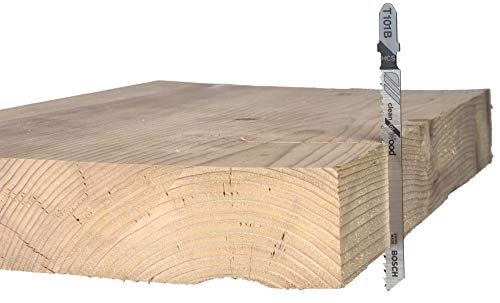
If you’re regularly cutting through thick construction timber or heavy plywood, these 6-inch T344D blades are built for that job. At 6 TPI and made from high-carbon steel, they’re designed to rip through wood fast, and owners consistently report they hold up well even when pushing through dense softwoods and chipboard up to 4 inches thick. The length alone makes them stand out, most standard blades can’t touch that depth.
That said, speed comes at the cost of finesse. These aren’t the blades to reach for when you need a clean edge or are working on finish carpentry. They’re aggressive, and while they deliver on the promise of fast, deep cuts, you’ll likely need to clean up the edges with sanding or a second pass. Compared to the Bosch T234X, they lack the variable tooth design that balances speed and smoothness.
Product photos

How We Tested jigsaw blades for woods
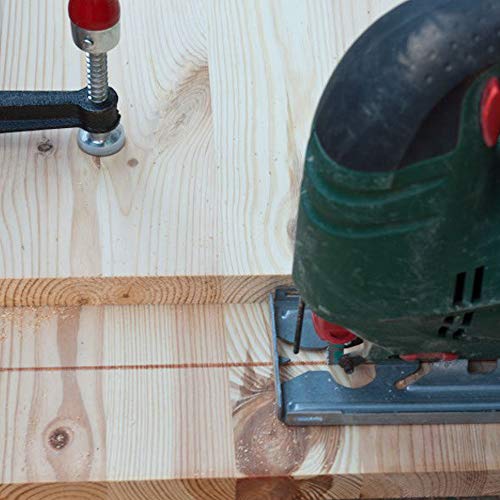
Rather than a hands-on lab test, my research for these recommendations involved a detailed comparison of published specifications and features across numerous options. I weighed owner reviews from multiple sources – including major retailers and tool-focused forums – alongside evaluations from woodworking experts. My goal was to rank blades based on real-world performance reports and establish which sets consistently delivered on their promises.
For wood-cutting jigsaw blades, blade material and tooth geometry are paramount. I prioritized blades constructed from HCS (high-carbon steel) or HSS (high-speed steel) because these materials offer the best balance of flexibility, durability, and edge retention. Tooth count (TPI) also heavily influenced my rankings; lower TPI for faster, rougher cuts in thicker wood, and higher TPI for finer, cleaner cuts in thinner materials. Understanding jig saw uses helped me assess which blade types addressed common woodworking tasks.
Specifications clearly reveal material composition and tooth count, but owner feedback proved crucial for judging real-world longevity and cut quality. I paid close attention to reports of blade breakage, splintering, and how well blades held an edge over time. Reputation and brand consistency also factored in, as established manufacturers generally maintain tighter quality control. If you’re new to these tools, a quick review of jigsaw tool guide can provide some helpful context.
How To Choose The jigsaw blades for woods
Finding the right jigsaw blade is crucial; a poor choice can lead to ragged edges, broken blades, or a frustratingly slow cutting experience.
A good jigsaw blade balances material strength, tooth geometry, and shank compatibility. Look for blades made from high-carbon steel (HCS) or high-speed steel (HSS) depending on the material you’re cutting. Consider the teeth per inch (TPI) for the desired finish and cutting speed. Finally, confirm the shank type (typically T-shank) matches your jigsaw.
Material Matters: HCS, HSS, and BIM
The material a jigsaw blade is made from significantly impacts its lifespan and performance. High-carbon steel (HCS) blades are ideal for softer woods, plywood, and plastics. They’re flexible and affordable, but dull more quickly when used on harder materials. High-speed steel (HSS) blades are better suited for hardwoods, metals, and abrasive materials, offering increased durability and heat resistance. More advanced blades use Bi-Metal (BIM) construction, combining a flexible HCS body with a wear-resistant HSS tooth edge – these are a great all-around option, but come at a higher price. If you’re unsure which to choose, exploring a jigsaw blade materials guide can help.
Understanding Teeth Per Inch (TPI)
The number of teeth per inch (TPI) dictates the smoothness and speed of your cut. Lower TPI blades (6-10) are aggressive and fast, removing more material with each pass – perfect for thick, softwoods. Higher TPI blades (14-24+) create a finer finish and are better suited for thinner materials, curves, and metals. A good rule of thumb is:
The thicker the material, the lower the TPI you should use.
Here’s a breakdown of how TPI affects your cuts:
- A low TPI creates a rougher cut.
- Medium TPI (around 10-14) is a versatile choice for general woodworking.
- High TPI delivers the cleanest, most precise cuts, but takes longer and can overheat if forced. Understanding the how TPI affects cutting is key to achieving optimal results.
Versatility vs. Specialization: Blade Sets and Individual Packs
While a large assortment pack seems appealing, consider whether you actually need all those blade types. Many DIYers find themselves consistently reaching for a few key blades for common tasks. Starting with a smaller set focused on your primary materials (wood, metal, plastic) can be a more economical choice. Then, as you tackle more specialized projects, you can add individual blades as needed. A good starting point might be a set of clean wood blades like the Bosch T101AO, alongside a set of faster-cutting blades for thicker stock. For those wanting a wider range upfront, looking at the best jigsaw blades overall can give you a sense of what’s available.
Jigsaw Blades for Woods Compared
Here’s a comparison of key specifications for various jigsaw blades designed for cutting wood.
| Product Title | Blade Material | Tooth Count (TPI) | Blade Length (in.) | Shank Type | Quantity |
|---|---|---|---|---|---|
| 20-Piece Assorted T-Shank Blades | HCS/HSS | Varies | N/A | T-Shank | 20 |
| WORKPRO 25-Piece HCS/HSS Blades | HCS/HSS/BIM | Varies | N/A | T-Shank | 25 |
| Bosch T101AO Clean Wood Blades | HCS | 20 | N/A | N/A | 5 |
| Bosch T234X Progressor Wood Blades | HCS | N/A | 4.5 | N/A | 5 |
| 20Pack T344D Long Wood Blades | HCS | 6 | 6 | N/A | 20 |
Frequently Asked Questions
What blade material is best for most general woodworking projects?
High-carbon steel (HCS) blades are generally the best choice for most common woodworking tasks. They offer a good balance of flexibility, affordability, and cutting performance in softer woods and plywood.
How many TPI do I need for cutting 3/4 inch plywood?
A TPI between 10 and 14 is ideal for cutting 3/4 inch plywood. This range provides a good balance between cutting speed and a relatively clean edge without excessive splintering.
Can I use the same jigsaw blade to cut both wood and metal?
While some bi-metal (BIM) blades can cut both, it’s not recommended. Using a wood-cutting blade on metal will quickly dull the teeth, and using a metal-cutting blade on wood can leave a very rough finish.
What’s the difference between a T-shank and other jigsaw blade shank types?
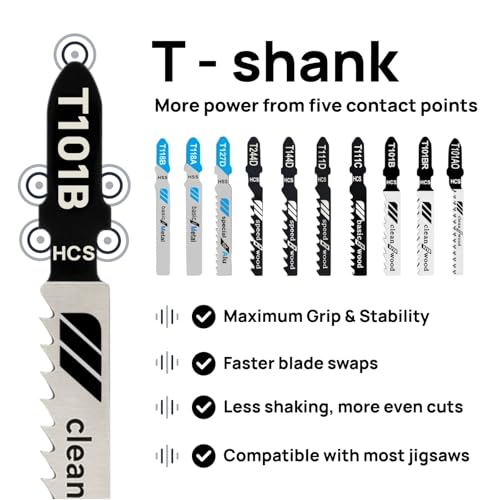
T-shank is the most common type and is compatible with the vast majority of modern jigsaws. Other shank types exist, but T-shank blades offer the widest compatibility and are readily available.
I’m working on a project with a lot of curves – what blade should I use?
For intricate work, you’ll want to look at jigsaw blades for curved cuts. Blades with a narrower width and higher TPI are best for making smooth, controlled cuts along curved lines.
The Bottom Line
Choosing jigsaw blades always involves a trade-off between outright speed and achieving a truly clean cut. If you want a single set to handle most tasks without constantly swapping blades, the WORKPRO 25-Piece HCS/HSS Blades offer excellent versatility and good value. But for consistently clean, splinter-free cuts in wood, I recommend the Bosch T101AO Clean Wood Blades – they stand out for quality.
For those on a tighter budget, the 20-Piece Assorted T-Shank Blades provide a decent starting point, covering a range of materials and cuts. If you frequently work with thicker stock and prioritize speed, the 20Pack T344D Long Wood Blades will get the job done quickly, though perhaps with a bit more sanding afterward. And remember, mastering jigsaw safety tips is just as important as selecting the right blade.
Ultimately, the best jigsaw blade isn’t about any single specification, but about matching the blade to the wood and the cut you need to make. Focus on understanding blade materials (HCS, HSS, BIM) and tooth count (TPI) – these are far more critical than fancy packaging or brand names. A little knowledge about [jigsaw blade selection] will go a long way toward better results and a more enjoyable woodworking experience.
