
What Is a Jig Saw? The Only Guide You Actually Need
This post contains affiliate links. As an Amazon Associate, we earn from qualifying purchases.
A jig saw is a handheld power tool that uses a thin, reciprocating blade to make curved cuts, straight lines, and intricate shapes in wood, plastic, metal, and other sheet materials. Its defining feature is maneuverability, letting you cut shapes a circular saw or table saw cannot touch. The tool consists of a motor, a handle, a flat baseplate called a shoe, and a blade clamp, with modern versions offering variable speed, orbital action, and tool-free blade changes.
Most people think a jig saw is just for rough cuts and scrollwork. They grab the cheapest blade, clamp nothing down, and wonder why the cut wanders, the blade snaps, or the plywood top splinters like crazy. The tool gets blamed for user error.
This guide walks through what a jig saw actually is, how its parts work together, and the specific techniques that separate a clean, controlled cut from a frustrating mess. You’ll learn how to match blades to materials, when to use its special features, and what projects it truly excels at.
Key Takeaways
- Jigsaw blades are not universal. The wrong tooth count or material will burn plastic, snap in metal, or tear out wood grain. Match TPI and blade material to your workpiece.
- Orbital action is a setting, not a default. It makes cutting faster but leaves a rougher underside. Turn it off for clean cuts in laminate, veneered plywood, or acrylic.
- The shoe must stay flat. Lifting the front or side during a cut bends the thin blade, causing it to drift off line, overheat, and eventually snap. Let the tool’s weight do the work.
- Blade breakage usually points to forcing the saw or using a blade that’s too fine for the turn radius. For tight curves in 3/4-inch stock, a 10 TPI blade will survive where a 20 TPI blade will bind and snap.
- Corded models deliver consistent power for long sessions cutting thick material. Cordless jigsaws offer portability but need a high-voltage battery (18V or higher) to avoid stalling in dense hardwoods.
How Does a Jig Saw Work?
The motor turns a rotary motion into an up-and-down reciprocating motion through a gear mechanism. This moves the blade, which is held in a clamp at the end of an arm called a plunger. The blade cuts on the upstroke. The flat metal shoe rests on your workpiece, stabilizing the saw and giving you a pivot point for steering.
A jigsaw’s cutting action is defined by stroke length and strokes per minute (SPM). A standard stroke length is about 1 inch. A motor rated for 3,000 SPM means the blade cycles up and down 3,000 times per minute. Higher SPM allows faster cutting in softer materials, while variable speed control lets you dial it back for plastics or metals to prevent melting or work hardening.
That basic mechanism gets modified by two critical features: orbital action and blade stroke. Orbital action adds a slight forward tilt to the blade on the upstroke. This makes the blade more aggressive, clearing chips faster and cutting more quickly. The trade-off is a rougher cut on the underside of the material. For a clean finish cut, you set orbital action to zero.
The blade stroke matters for cut capacity. If a saw has a 1-inch stroke, it can theoretically cut material up to 1 inch thick. In practice, you need a blade long enough to extend past the material, and you lose a bit of effective stroke depth. For cutting 2×4 lumber (which is actually 1.5 inches thick), you need a saw with a stroke over 1.5 inches and a blade long enough to match.
The plunger mechanism has a counterweight. This balances the violent up-down motion, reducing the vibration transferred to your hands. It’s not perfect. After an hour of cutting, even a good jigsaw will make your fingers tingle if you’re not wearing gloves.
Jigsaw Anatomy: A Parts Breakdown
Knowing the parts isn’t academic. It tells you what to look for when buying one and what to adjust when a cut goes wrong.
Motor and Power Source
Corded jigsaws plug into an outlet. They’re measured in amps—common ratings are 5 to 7 amps. More amps generally means more power to push through dense hardwoods or metals without bogging down. They run continuously, which is ideal for a long project like cutting out a countertop.
Cordless jigsaws run on battery packs, usually part of a larger tool system like DeWalt 20V or Makita 18V LXT. Their power is determined by the battery voltage. A 12V cordless jigsaw is fine for occasional plywood cuts. For all-day use or cutting 2-inch thick oak, you want an 18V or 20V model. The brushless motor versions are more efficient and give longer runtime.
Handle Design: Barrel Grip vs. Top-Handle
This is a pure comfort and control choice. A top-handle saw has a D-shaped handle over the motor. It feels like holding a drill. A barrel-grip saw has a handle that wraps around the body of the tool, lower down. It feels more like holding a knife.
I prefer the barrel grip for detailed, controlled cuts where I’m steering the blade with my wrist. The top-handle design gives me more leverage for pushing the saw on long, straight cuts. Try both in a store if you can. Your hand size and the type of cuts you do most will dictate the winner.
The Shoe (or Baseplate)
This is the flat metal plate that rides on your workpiece. It must be rigid and stay parallel to the blade. A cheap, flimsy shoe will flex, causing the blade to angle and the cut to wander. Most shoes can be tilted, usually up to 45 degrees left and right, for making bevel cuts.
They often have a soft plastic or rubber edge to prevent marring the workpiece surface. Over time, this edge wears down. If you start seeing metal scratches on your good plywood, it’s time to replace that pad or tape the shoe.
Blade Clamp: T-Shank vs. U-Shank
This is the most important upgrade in the last 20 years. Older jigsaws and some budget models use U-shank blades. They have a rounded top and require a hex key or a special lever to tighten a setscrew onto the blade. They work, but they’re slow and the blade can slip.
T-shank blades have a T-shaped head. They slide into the clamp and a spring-loaded lever locks them in place with a solid click. It’s tool-free and takes two seconds.
The connection is also more rigid, reducing blade deflection for straighter cuts. Any jigsaw you buy today should be T-shank compatible. It’s non-negotiable.
Controls: Trigger, Speed Dial, and Orbital Selector
The trigger is under your finger. Squeeze it to start the blade. Most are variable speed—squeeze lightly for a slow stroke, fully for max speed. A separate dial on the body sets the maximum speed the trigger can reach. This is crucial. You set the dial to a low max speed for cutting metal, then you can still squeeze the trigger fully without over-revving.
The orbital selector is usually a dial with settings from 0 to 3 or 4. Setting 0 is a straight up-and-down stroke for clean finishing. Setting 1 adds a little orbital action for general-purpose cutting. The highest setting is for the fastest, most aggressive rough cutting in thick softwood.
Blade Types & Materials Explained
The blade is the only part that touches your material. Getting this wrong ruins your project and your experience. The two specs that matter are Teeth Per Inch (TPI) and the blade material.
| Blade Material | Best For | Worst For | Why It Works |
|---|---|---|---|
| High-Carbon Steel (HCS) | Softwoods, plywood, particle board, plastics. | Hardwoods, metals, abrasive materials. | The steel is flexible and inexpensive. It stays sharp long enough for wood but dulls quickly on hard stuff. |
| High-Speed Steel (HSS) | Hardwoods, aluminum, non-ferrous metals, abrasive wood composites. | Steel, stone, tile. | Harder and more heat-resistant than HCS. It holds an edge longer when cutting dense or abrasive materials. |
| Bi-Metal (BIM) | Mixed materials, nail-embedded wood, thin steel, stainless steel. | Masonry, ceramic. | A flexible HCS body is welded to a hard HSS cutting edge. It’s durable, resists breaking, and handles surprises. |
| Carbide Grit (No Teeth) | Ceramic tile, fiberglass, slate, cast iron. | Wood, plastic, clean metals. | A continuous edge of tungsten carbide grit grinds instead of cuts. It’s brittle but chews through ultra-hard, brittle materials. |
TPI dictates cut speed and finish. A low TPI (like 6-10) has big, aggressive teeth that take big bites. It cuts fast but leaves a rough edge.
Use it for rough shaping in thick stock. A high TPI (18-24) has many small teeth. It cuts slower but leaves a much smoother finish. Use it for cutting sheet metal, plastics, or fine woodworking details.
Here’s a quick rule of thumb: For wood, start with 10 TPI. For metals, start with 21 TPI. For plastics, use a 10-14 TPI blade with little to no set (wider teeth) to prevent melting and chipping.
I burned through three HCS blades on a single oak plywood project because I was using orbital setting 3. The blades overheated, lost their temper, and went dull in minutes. Switching to a Bi-Metal blade and dropping to orbital setting 1 let me finish the job with one blade. The extra $3 for the BIM blade saved $12 in ruined HCS blades and an hour of frustration.
What Can You Actually Cut with a Jig Saw?
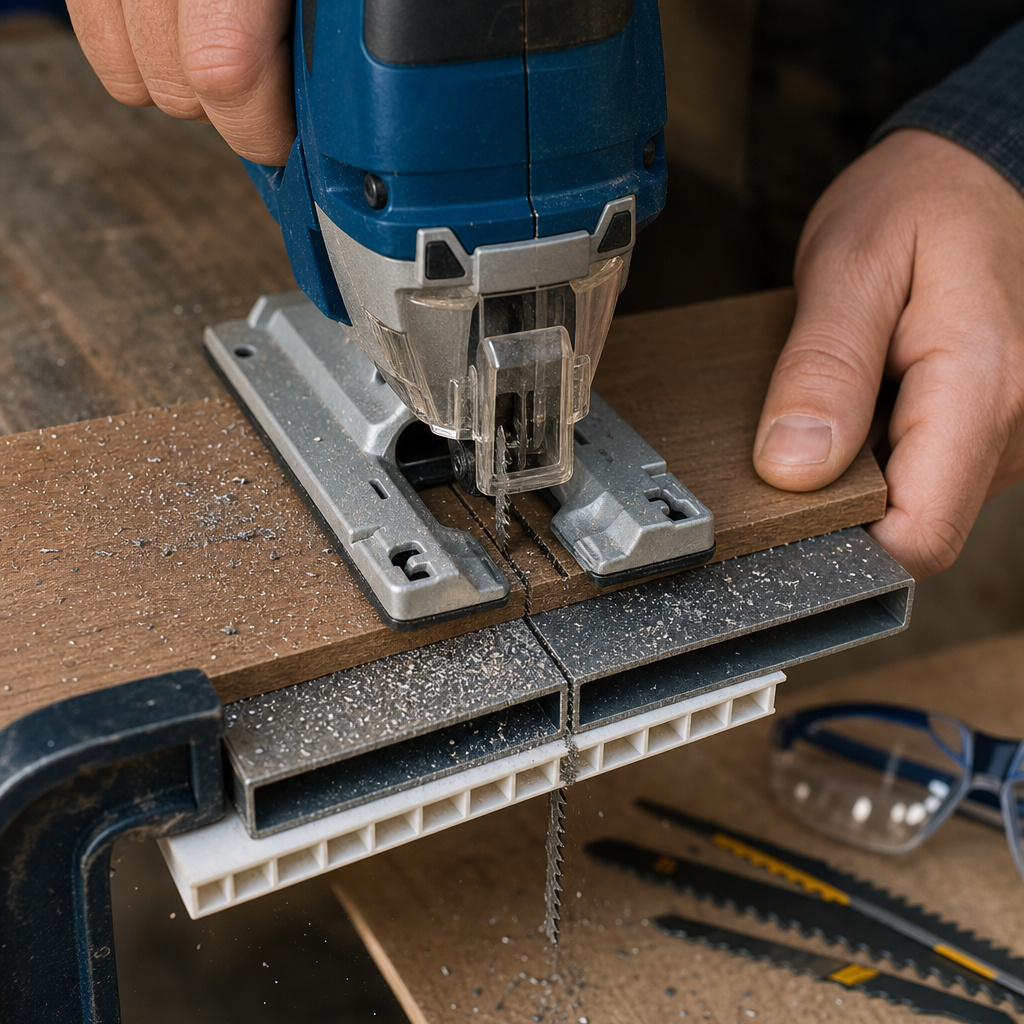
Its versatility is its superpower, but each material demands a specific approach.
Wood & Plywood: This is the jigsaw’s home turf. For clean cuts in veneered plywood, use a fine-tooth blade (10-12 TPI) with reverse teeth (teeth pointing downward). The downward cut happens on the upstroke, which splinters the bottom face instead of the visible top face. Clamp a sacrificial board underneath for perfect results. When you’re learning string trimmer basics, the same principle applies: let the tool do the work, don’t force it.
Metal: You need a high-TPI HSS or BIM blade, cutting oil, and a slow speed. Let the blade’s teeth do the cutting—pushing hard just heats and dulls the blade. For thin sheet metal, sandwich it between two thin pieces of plywood to prevent vibration and tearing.
Plastic & PVC: Use a low-TPI blade with little set. Run the saw at medium speed. Too fast generates heat and melts the plastic, which then re-welds behind the blade. A sharp blade and steady, moderate feed rate produce a clean, chip-free cut.
Laminate Countertops: This is a classic jigsaw task. Use a fine, sharp carbide blade designed for laminate. Set orbital action to zero. Cut from the backside of the countertop if possible, so any minor splintering happens on the underside. Support the overhang well to prevent snapping.
Drywall: You can cut outlet holes with a jigsaw, but a rotary tool or drywall saw is often cleaner and less dusty. If you do use it, a coarse wood blade works, but be prepared for a dust storm.
Jigsaw vs. Other Saws: When to Use What
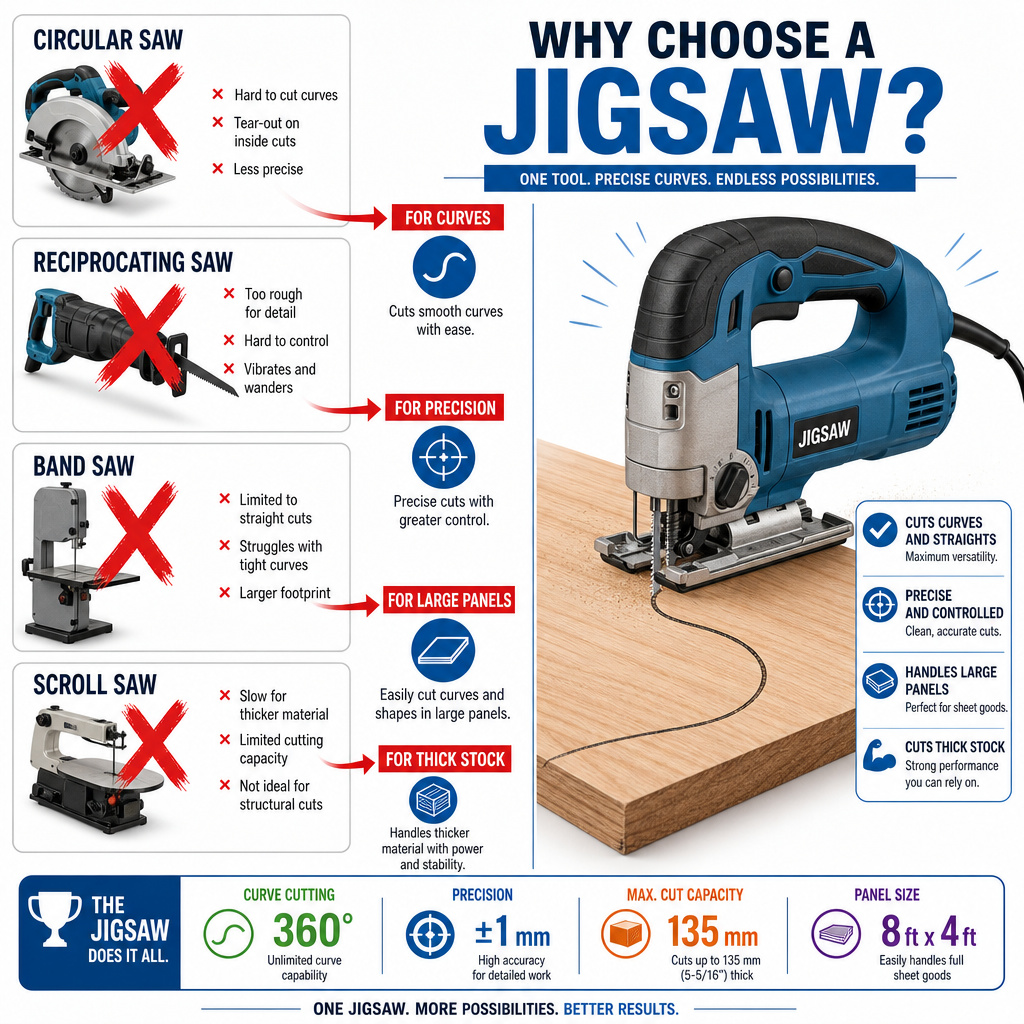
It’s not the only saw in the shed. Knowing its place saves you time and gives better results.
| Tool | Best For | Jigsaw is Better When… |
|---|---|---|
| Circular Saw | Long, perfectly straight cuts in sheet goods. | You need to cut a curve, a shape, or start a cut in the middle of a panel (plunge cut). |
| Reciprocating Saw (Sawzall) | Demolition, rough cuts in framing, pruning. | You need precision, a clean edge, or are working on a finished piece, not a wall stud. |
| Band Saw | Resawing thick stock, repetitive curved cuts in a shop. | The workpiece is too large for the band saw’s throat, or you’re working on-site, not in a workshop. |
| Scroll Saw | Extremely intricate, delicate interior cuts in thin wood. | The material is thicker than 2 inches, or the cut doesn’t require removing and re-threading the blade. |
Think of the jigsaw as your go-to for one-off, shaped cuts in a finished project. It’s the tool you use to cut a sink hole in a countertop, shape a custom bracket, or trim a door that’s sticking. It’s for making the piece fit, not for breaking down the 4×8 sheet of plywood to begin with.
Step-by-Step: Making Your First Controlled Cuts
Follow this sequence. Skipping steps leads to the common mistakes you’re trying to avoid.
- Secure the workpiece. This is not optional. Use clamps to fasten it to a workbench or sawhorses. If the material vibrates, the cut will be jagged and the blade is likely to bind or break. The sound changes from a clean zzzt to a chattering brrrrrrap when the piece is loose.
- Select and insert the blade. Match TPI and material to your job. For practice, use a scrap of 3/4-inch pine and a 10 TPI HCS blade. Insert the T-shank until it clicks. Give it a gentle tug to confirm it’s locked.
- Set the saw. Dial the orbital action to 1 for general wood cutting. Set the speed dial to mid-range. Put on safety glasses and hearing protection. The whine is deceptively loud, especially cutting metal.
- Start the cut. Position the saw with the shoe flat and the blade just outside your marked line (on the waste side). Start the blade before it touches the wood. Let it reach full speed, then gently lower it onto the line to begin a plunge cut, or line it up at the edge of the board.
- Guide, don’t push. Apply light forward pressure. Let the blade cut. For curves, turn the saw body smoothly, not the handle. The blade follows with a slight delay. If you smell burning or the motor bogs down, you’re pushing too hard or need a sharper blade.
- Finish and support. As you near the end of the cut, hold the off-cut piece with your free hand to keep it from falling and splintering the last bit. Let the blade come to a complete stop before setting the saw down.
Before you start: The blade is exposed below the shoe and remains hot after use. Never reach under the workpiece while the saw is plugged in or the battery is attached. The thin blade can snap and whip sideways, especially if forced on a tight curve. Always know what’s behind your cut line—a hidden nail or screw will shatter an HCS blade instantly.
Essential Safety Gear and Practices
This isn’t a gentle tool. Respect it.
- Eye Protection: Sawdust and metal chips fly upward. Safety glasses are the bare minimum. A face shield is better for extended work.
- Hearing Protection: Jigsaws run around 85-90 dB. That’s enough to cause hearing damage over time. Use earplugs or earmuffs.
- Respiratory Protection: Cutting MDF, pressure-treated wood, or sanded surfaces creates fine dust. A simple NIOSH-rated N95 mask is cheap insurance.
- Gloves: Vibration-resistant gloves help with fatigue and improve grip. They also protect your hands from sharp burrs on cut metal edges.
- Work Area: Keep the floor clear of cords and debris. A tangled cord can pull the saw off its line mid-cut.
The most common injury isn’t from the blade itself. It’s from the workpiece shifting or a snapped blade causing a loss of control. Clamping is a safety measure, not just an accuracy tip.
Troubleshooting Common Jigsaw Problems
When things go wrong, here’s what’s likely happening and how to fix it.
Problem: Blade wanders, won’t cut straight.
- Likely Cause: Dull blade, forcing the saw, or shoe not held flat.
- Fix: Check blade sharpness. If it’s dull, replace it. Re-focus on keeping the shoe fully planted. For long straight cuts, clamp a straightedge guide to the workpiece for the shoe to ride against.
Problem: Blade keeps breaking.
- Likely Cause: Forcing the saw on a curve too tight for the blade’s width, or using a blade with too many teeth (high TPI) for the turn radius.
- Fix: Use a narrower blade (1/4-inch wide) for tight curves. For a 2-inch radius in 3/4-inch wood, a 10 TPI blade will flex, a 20 TPI blade will bind and snap. Also, ensure the blade is fully seated and locked in the clamp.
Problem: Excessive splintering on top surface of wood.
- Likely Cause: Using a standard blade where the teeth cut on the upstroke, tearing out the top veneer.
- Fix: Switch to a “down-cut” or “reverse-cut” blade. The teeth point downward, so the clean cutting action happens on the downstroke against the shoe, protecting the top surface. The splintering happens on the bottom, which is often hidden.
Problem: Saw vibrates excessively, feels uncontrollable.
- Likely Cause: Worn or damaged counterweight mechanism inside the saw, or a severely bent blade.
- Fix: Try a brand new blade first. If vibration continues, the internal mechanics may be failing. For an older saw, it may be time for a replacement. This is a common point of wear.
Problem: Cut edge is burned or melted (especially plastic).
- Likely Cause: Blade speed too high, feed rate too slow, or a dull blade.
- Fix: Reduce the speed setting on the saw. Push the saw forward a bit more steadily to keep the teeth cutting fresh material. For plastics, a sharp blade with little set is mandatory.
Frequently Asked Questions
What’s the difference between a jigsaw and a saber saw?
Historically, they were the same thing. “Saber saw” was the common name. Today, “saber saw” is sometimes used to describe a reciprocating saw (like a Sawzall), which is a different, more aggressive tool. For clarity, stick with “jigsaw” for the fine-cutting tool and “reciprocating saw” for the demolition tool.
Can a jigsaw cut a 2×4?
Yes, but it’s not ideal. A jigsaw can cut through the 1.5-inch thickness of a 2×4, but it will be slow, and the blade can deflect, making the cut less square. A circular saw is the right tool for straight cuts in dimensional lumber. Use the jigsaw on a 2×4 only for notching or cutting out a shape.
How do I make a perfectly straight cut with a jigsaw?
You need a guide. Clamp a straight, true piece of wood or a metal straightedge to your workpiece, parallel to your cut line. Run the edge of the jigsaw’s shoe firmly against the guide for the entire cut. Don’t trust your eye alone for lines longer than a foot.
Why does my jigsaw blade seem to bend when I cut?
All thin jigsaw blades flex slightly—it’s how they cut curves. If the bend is severe, you are likely tilting the saw or forcing it sideways. The blade should follow the path of least resistance. If you need to steer, turn the whole saw body gradually, not abruptly.
Is a cordless jigsaw powerful enough for DIY?
modern 18V or 20V cordless jigsaw from a major brand is absolutely powerful enough for 95% of DIY tasks. The limitation is runtime and battery management. For a big project like cutting out a plywood subfloor, a corded model eliminates the worry of a battery dying mid-cut.
Can I use a wood-cutting blade to cut metal?
You can, but you shouldn’t. A wood blade has large, aggressive teeth that will grab, overheat, and dull almost instantly on metal. The cut will be ragged and dangerous. Always use a blade specifically designed for metal—high TPI and HSS or Bi-Metal construction.
The Bottom Line
A jigsaw is the problem-solving saw. It won’t break down sheets of plywood fastest, and it won’t make the most precise joinery cuts. But when you need to make a hole, shape an edge, or follow a line that isn’t straight, it’s the only tool that can do it in your hand, right on the workpiece.
Success with it comes down to three things: a sharp, correct blade; a securely clamped workpiece; and the patience to let the tool’s speed and teeth do the cutting, not your muscle. Ignore any one of those, and you’ll fight it every time. Get them right, and it feels like the blade is drawing the line for you. That’s when you stop wondering what a jig saw is and start knowing exactly what it can do for you.
