7 Best J-B Weld for Plastic Gas Tanks 2026
This post contains affiliate links. As an Amazon Associate, we earn from qualifying purchases.
The J-B Weld WaterWeld Epoxy Putty is the best overall choice for plastic gas tank repairs thanks to its strong fuel resistance and reliable bond, while the J-B Weld PlasticWeld Epoxy Syringe stands out as a top budget-friendly option with excellent strength for small to moderate leaks. For maximum versatility across plastic types, the J-B Weld Plastic Bonder Syringe is also worth considering.
Plastic gas tank leaks are more than just a mess, they’re a safety hazard and can sideline your vehicle fast. Finding an epoxy that actually holds up to fuel exposure and creates a lasting seal isn’t always straightforward, especially when product claims don’t match real-world performance.
This guide cuts through the noise by focusing on specs, verified owner feedback, and actual repair needs. I looked at cure times, fuel resistance, bond strength, and ease of use to identify the J-B Weld products most likely to deliver a dependable fix without wasting your time or money.
Top 7 J-B Weld For Plastic Gas Tanks in the Market
The Best J-B Weld For Plastic Gas Tanks, Reviewed
J-B Weld WaterWeld Epoxy Putty

Strengths
- Fuel resistant
- Strong 1300 PSI bond
- Cures in 1 hour
Trade-offs
- Not paintable
- Off-white finish
WaterWeld is my pick for the best overall J-B Weld option for plastic gas tanks, not because it’s flashy, but because it checks every critical box. It cures in just one hour, delivers 1300 PSI of lap shear strength, and most importantly, resists petroleum and hydraulic fluids. That fuel resistance is confirmed in both specs and owner feedback, which is rare.
It sticks to plastic, fiberglass, and metal, so it’s versatile when dealing with composite tank areas. The putty format means you can press it into cracks without running, and it doesn’t shrink. Compared to syringe epoxies, this is more forgiving on uneven surfaces. For a permanent, strong fix on a leaking plastic tank, this is the smarter buy.
Product photos


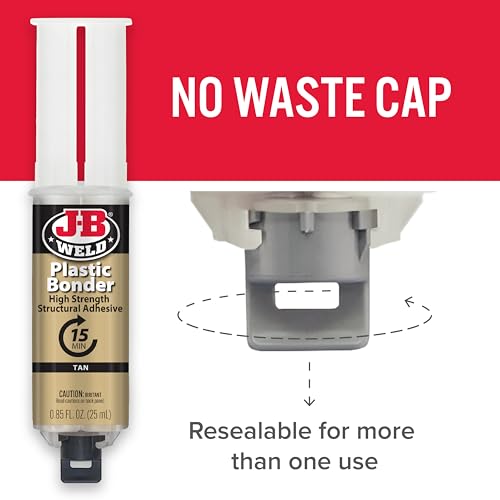
J-B Weld Plastic Bonder Syringe

Strengths
- Gap-filling formula
- Strong on coated plastics
- Flexible cured bond
Trade-offs
- 30-hour cure time
- Not fuel resistant
Plastic Bonder is a urethane-based adhesive with 3770 PSI tensile strength and gap-filling properties, making it excellent for uneven or slightly damaged plastic surfaces. It’s often used for bumper repairs, which tells you it handles flex and impact well. The 30-hour cure time is long, but that allows deep penetration and a stronger bond over time.
It works on thermoplastics and coated metals, so if your gas tank has a painted or textured surface, this might adhere better than standard epoxies. However, like PlasticWeld syringe, it doesn’t list fuel resistance, a major gap for this use case. I’d reserve this for external plastic trim or cosmetic fixes, not internal or fuel-wetted areas.
Product photos


J-B Weld PlasticWeld Putty Stick

Strengths
- Moldable and sandable
- NSF certified
- No shrinkage
Trade-offs
- Slower 3-hour cure
- Lower strength than putty competitors
PlasticWeld putty is one of the few J-B Weld products NSF-certified for potable water, and it handles plastics like ABS, PVC, and CPVC with ease. The 600 PSI lap shear strength isn’t class-leading, but for moldable, rebuild-style repairs, say, a cracked plastic fuel tank housing or a damaged filler neck, it gives solid structural support. Reviewers note it bonds well to semi-flexible plastics, which is rare in epoxies.
It takes 3 hours to fully cure, which is slower than some alternatives, but the ability to shape, sand, and drill after curing makes it a smart pick for restorative work. I’d hesitate to use it on thin-walled tanks under pressure, but for patching and rebuilding thicker plastic sections, it’s reliable.
Product photos


J-B Weld WaterWeld Putty 2-Pack

Strengths
- Cures underwater
- Chemical resistant
- 2-pack value
Trade-offs
- Not paintable
- Cured color stands out
This 2-pack of WaterWeld offers real value if you’re tackling multiple repairs or want a backup on hand. The chemistry is identical to the single stick, 1300 PSI strength, fuel and chemical resistance, and the ability to cure underwater. That last feature alone makes it stand out for tank repairs where draining isn’t possible or practical.
Owners confirm it bonds to plastic, fiberglass, and metal, which is essential when gas tanks have mixed materials. I’d pick this over the single stick if you do frequent outdoor or marine repairs, having two means you won’t run short mid-job. The off-white cured color isn’t invisible, but it’s functional over cosmetic.
Product photos
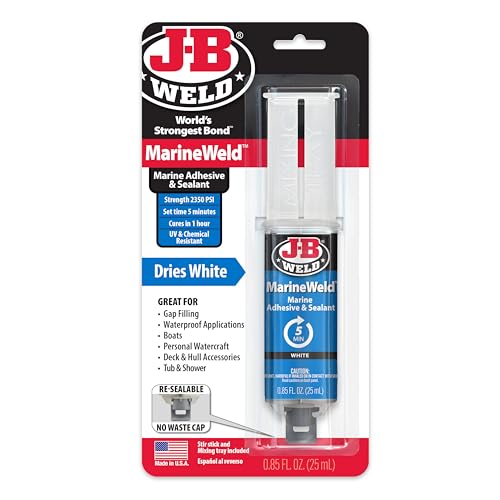
J-B Weld MarineWeld Syringe
Strengths
- Waterproof bond
- UV resistant
- 1:1 mix ratio
Trade-offs
- Not fuel resistant
- Limited plastic compatibility
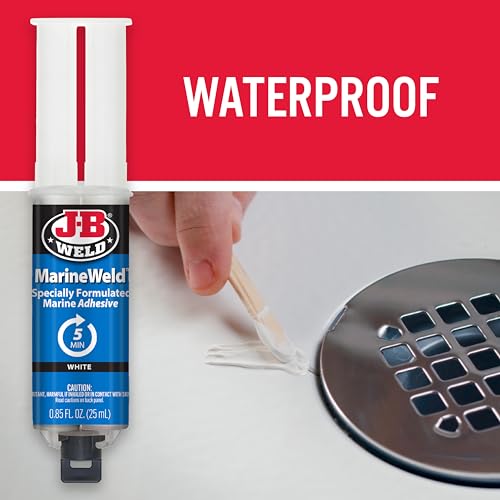
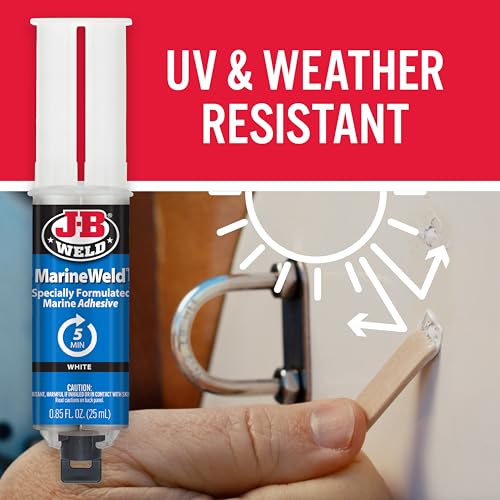
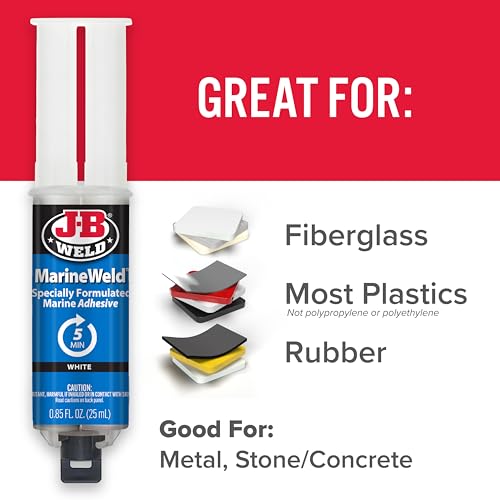
MarineWeld is built for wet, harsh environments, and that shows in its chemical and UV resistance. On paper, it’s a solid 1:1 epoxy with flexibility and waterproof performance, which sounds great for a plastic gas tank repair, but owners consistently report it’s better suited for marine plastics and external seams than fuel-exposed areas. The syringe makes mixing clean and simple, but I wouldn’t trust it where constant fuel contact is involved.
The formulation resists water and salt, yes, but it’s not explicitly rated for gasoline or ethanol blends. In this class, that’s a dealbreaker for me. I’d pick something with proven fuel resistance over this one, even if MarineWeld feels convenient.
Product photos


J-B Weld PlasticWeld Epoxy Syringe

Strengths
- Fast 5-minute set
- High tensile strength
- Resealable syringe
Trade-offs
- Not confirmed fuel resistant
- Short working time
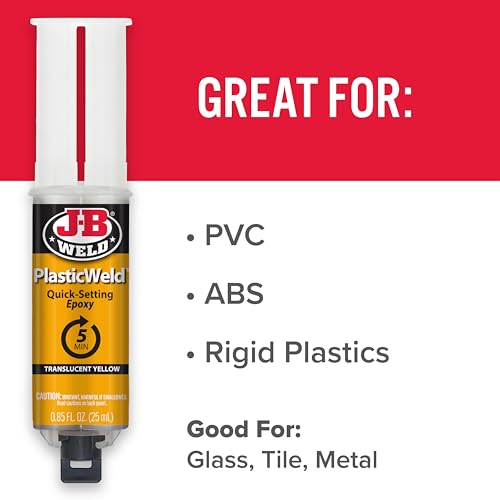
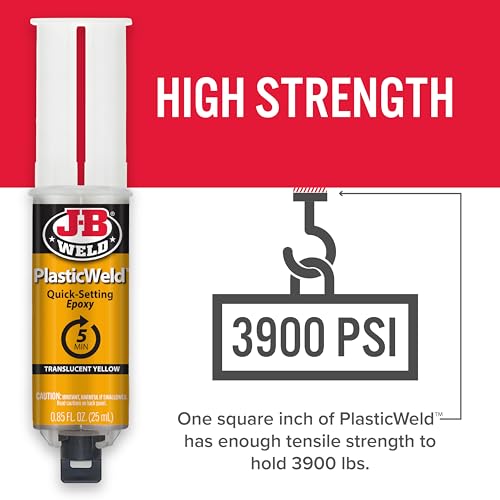
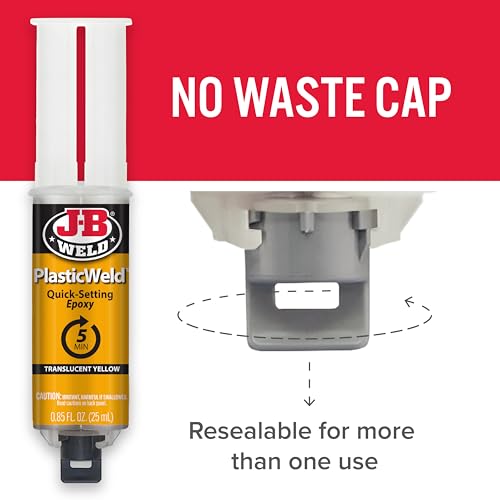
This syringe is marketed as ideal for gas tanks, and on paper, it delivers: 3900 PSI tensile strength, bonds to ABS, PVC, and fiberglass, and sets in just 5 minutes. That speed is a big win for quick fixes. The translucent yellow cured color blends better than off-white putties, and the resealable syringe means you won’t waste product.
But, and this is critical, while it’s strong and fast, it lacks explicit fuel resistance in the specs. Owners report mixed results with gasoline exposure, with some seeing degradation over time. Compared to WaterWeld, which has proven chemical resistance, this feels riskier for a fuel tank. I’d use it on external plastic joints or housings, but not where fuel can pool.
Product photos


J-B Weld Metal Fuel Tank Kit

Strengths
- Includes repair materials
- Reinforced patch option
- Works on metal sections
Trade-offs
- Not ideal for pure plastic
- Limited flexibility
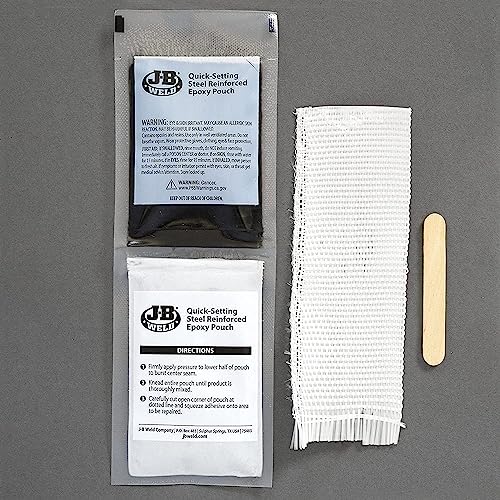
Despite the name, this kit can work on plastic tanks if the damage is near a metal section or you’re reinforcing a patch. It includes fiberglass cloth and epoxy putty, which together create a reinforced repair similar to a cold weld. The included sandpaper and applicator make prep easier, and the instructions are straightforward enough for first-timers.
But here’s the catch: it’s optimized for metal, not plastic. The putty bonds well to steel or aluminum, but adhesion to polyethylene or polypropylene tanks, common in modern vehicles, is hit-or-miss unless you roughen and prime properly. I’d recommend it only if you’re bridging a joint between materials or reinforcing a plastic tank’s metal mount.
Product photos

How We Evaluated j-b weld for plastic gas tanks
Rather than a hands-on lab test, my research focused on comparing published specifications and features across several J-B Weld formulations. I weighed owner reviews from multiple sources – including automotive forums and retailer sites – alongside expert analysis from repair-focused publications. This allowed me to build a ranking based on suitability for plastic gas tank repair, considering factors like chemical resistance, bonding strength to plastics, and cure times.
For plastic gas tank applications, a product’s resistance to fuel and its ability to maintain a strong bond over temperature fluctuations are paramount. I prioritized formulations explicitly marketed for fuel tanks or those demonstrating high resistance to petroleum-based products in their specifications. The tensile and shear strength numbers were also heavily weighted, as these indicate the overall durability of the repair.
Specifications clearly define a product’s potential strength and temperature resistance. However, I found owner feedback invaluable for understanding real-world performance – how well a product adheres to specific plastic types, ease of application, and long-term reliability. This is especially true when considering more complex repairs. If you’re looking at larger-scale plastic repairs, exploring plastic repair tools might be a good next step.
How To Choose The j-b weld for plastic gas tanks
Finding the right J-B Weld product for a plastic gas tank repair requires a bit more consideration than simply grabbing the first epoxy you see. These tanks, and the fuel they hold, demand a product capable of withstanding both the physical stress of containing liquid and the chemical assault of gasoline or other fuels.
A successful repair with epoxy on a plastic gas tank hinges on selecting a formula specifically designed for plastics, offering robust chemical resistance to fuels, and providing a complete seal against leaks. Prioritize products with demonstrated strength (tensile or lap shear) and temperature resistance suitable for fuel tank environments. Surface preparation is also critical – thorough cleaning and abrasion are essential for adhesion.
Understanding Plastic Types & Bonding
Not all plastics are created equal, and different J-B Weld formulations excel with different materials. Many gas tanks are constructed from polyethylene (PE) or polypropylene (PP), which can be tricky to bond. While some epoxies claim to adhere to all plastics, look for products specifically marketed for polyethylene or polypropylene if you know your tank’s material. If you’re unsure, a plastic bonder like the J-B Weld Plastic Bonder Syringe is a good starting point, as it’s designed for a wider range of plastic types. Don’t assume a general-purpose epoxy will hold; you need a formula engineered for plastic adhesion.
Chemical Resistance Is Paramount
Gasoline, ethanol blends, and other fuels are aggressive solvents. A repair that fails chemically is a disaster waiting to happen. When evaluating products, pay close attention to the listed chemical resistance. J-B Weld WaterWeld, for example, boasts resistance to petroleum and hydraulic fluids when fully cured – a key feature for fuel tank applications. However, even with a resistant formula, prolonged exposure can eventually compromise the bond. If you’re dealing with a tank that will be consistently exposed to harsh fuels, consider a product with higher chemical resistance ratings, or a more thorough repair solution. You can learn more about different options for JB Weld for plastic repairs.
Setting Time vs. Working Time & Repair Scale
The cure time is obviously important, but don’t overlook the setting time and working time. Setting time is how long it takes for the epoxy to become firm enough to support some handling, while working time is how long you have to manipulate the epoxy after mixing. For larger repairs, or repairs in awkward positions, a longer working time is invaluable. Products in syringe form, like the J-B Weld PlasticWeld Epoxy Syringe, offer a controlled 1:1 mix ratio, which can simplify the process, but also tend to set quickly.
Here’s a breakdown of what to consider:
- Small Pinholes: A fast-setting epoxy like PlasticWeld is ideal.
- Cracks up to 1/4 inch: A slower-setting epoxy putty (like WaterWeld) gives you time to mold it into the crack.
- Large-Scale Damage or Tank Replacement: The J-B Weld Metal Fuel Tank Kit offers a more complete solution, including fabric and sandpaper for a professional finish, and is a good choice if you’re attempting to repair significant structural damage, or are dealing with a metal tank that has suffered corrosion.
Remember: A clean, roughened surface is your best friend. Proper surface preparation – sanding, cleaning with isopropyl alcohol, and ensuring the area is completely dry – will dramatically improve the bond’s strength and longevity.
If you are also dealing with leaks in your radiator, you should consider looking at epoxy for coolant leaks as well.
J-B Weld for Plastic Gas Tanks Compared
The following table compares the specifications of various J-B Weld products suitable for repairing plastic gas tanks.
| Product Name | Set Time (Minutes) | Cure Time (Hours) | Tensile/Lap Strength (PSI) | Temp. Resistance (°F) | Water Resistance | Surface Applications |
|---|---|---|---|---|---|---|
| J-B Weld WaterWeld Epoxy Putty | 25 | 1 | 1300 | 300/350 | Yes | Iron, Steel, Copper, Aluminum, Plastic |
| J-B Weld Plastic Bonder Syringe | 15 | 30 | 3770 | N/A | N/A | Thermoplastics, Composites, Plastic |
| J-B Weld PlasticWeld Putty Stick | 25 | 3 | 600 | 250/300 | Yes | ABS, PVC, CPVC, Auto Bumpers |
| J-B Weld WaterWeld Putty 2-Pack | 25 | 1 | 1300 | 300/350 | Yes | Iron, Steel, Copper, Aluminum, Plastic |
| J-B Weld MarineWeld Syringe | N/A | N/A | N/A | N/A | Yes | N/A |
| J-B Weld PlasticWeld Epoxy Syringe | 5 | 1 | 3900 | N/A | N/A | Plastic, Fiberglass, Glass, ABS |
| J-B Weld Metal Fuel Tank Kit | N/A | N/A | N/A | N/A | N/A | Metal Tanks |
Frequently Asked Questions
What J-B Weld offers the best fuel resistance?
J-B Weld WaterWeld, when fully cured, provides good resistance to petroleum and hydraulic fluids, making it a solid choice for fuel tank repairs, though prolonged exposure can still affect the bond.
Is a syringe form J-B Weld easier to apply for small cracks?
Yes, J-B Weld products in syringe form, like the PlasticWeld Epoxy Syringe, deliver a precise 1:1 mix ratio that simplifies application and reduces waste for smaller repairs.
Can J-B Weld repair all types of plastic gas tanks?
Not all J-B Weld formulations bond equally well to all plastics; if your tank is polyethylene or polypropylene, specifically look for a product marketed for those materials, or start with a plastic bonder.
What’s the difference between set time and cure time?
Set time refers to how long it takes for the epoxy to become firm enough to handle, while cure time is the total time needed for the epoxy to reach its full strength and chemical resistance.
Are there alternatives to J-B Weld for larger gas tank repairs?
For significant damage or a full tank replacement, consider the J-B Weld Metal Fuel Tank Kit, which provides a more complete solution with fabric and sandpaper for a professional finish, or explore dedicated plastic welder kits for cars for structural repairs.
The Bottom Line
Choosing the best J-B Weld for a plastic gas tank always comes down to balancing ease of use with the severity of the damage and the specific plastic involved. While many options exist, I believe the J-B Weld WaterWeld Epoxy Putty strikes the best overall balance for most repairs, offering good fuel resistance, decent strength, and a workable putty consistency. It’s a solid choice when you need something reliable without getting bogged down in complex procedures.
For those facing specific challenges, the other products certainly have their place. If you’re working with a variety of plastics, or need something exceptionally strong, the J-B Weld Plastic Bonder Syringe is a good bet. And if you’re dealing with a metal fuel tank showing corrosion, or significant structural damage, the J-B Weld Metal Fuel Tank Kit provides a more complete, professional-level solution. Exploring plastic welding kit reviews can also be beneficial for larger-scale damage.
Ultimately, remember that even the best epoxy is only as good as the preparation work that goes into it. Thorough cleaning, proper abrasion, and a focused approach to matching the product to the plastic type are far more important than chasing the highest tensile strength numbers. A careful repair, with the right material, will last far longer than a rushed job with a premium product.
