7 Best Electric Sanders of 2026
This post contains affiliate links. As an Amazon Associate, we earn from qualifying purchases.
The DEWALT 5-Inch Orbital Sander Kit is the best overall electric sander for most people, delivering strong performance and solid dust control. If you’re on a tight budget, the WEN 1/3 Sheet Sander offers solid value. For tighter spaces and intricate work, the BLACK+DECKER Detail Sander is a reliable and affordable choice.
Most people don’t realize how much the wrong sander can slow them down, or ruin a finish with swirl marks and uneven pressure. It’s not just about sanding faster, it’s about having control, comfort, and a clean workspace.
As someone who’s evaluated hundreds of tools over the years, I focused this guide on real-world usability. These picks are based on specs, owner feedback, and what actually matters when you’re hours into a project. We looked at motor performance, dust collection, and ergonomics to find models that deliver consistent results without burning you out.
Top 7 Electric Sanders in the Market
The Best Electric Sanders, Reviewed
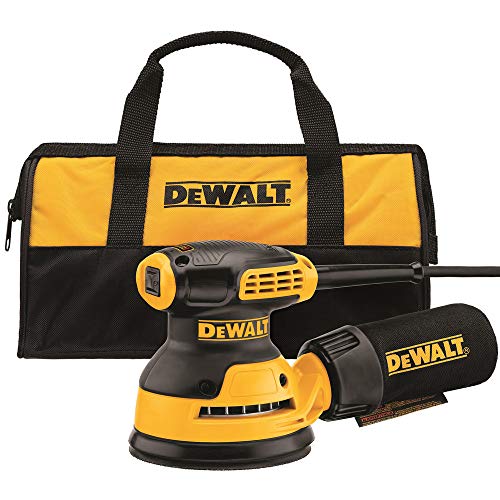
DEWALT 5-Inch Orbital Sander Kit
Strengths
- 3.0 amp motor
- Excellent dust collection
- Reduced vibration
- Dust-sealed switch
- Ergonomic rubber over-mold
Trade-offs
- Heavier than palm sanders
- No variable speed
When it comes to orbital sanders that deliver pro-level performance without the pro-level frustration, the DEWALT DWE6421K stands out in a crowded field. On paper, its 3.0 amp motor and 12,000 OPM give it strong power for a 5-inch sander, and owners consistently report it handles long sessions with minimal fatigue. The separate counterweight design really does make a difference, reviewers note noticeably less vibration than comparable models, which adds up over hours of use.
The dust collection system is one of the best in class. The one-handed locking dust bag is easy to remove and fits well with both DEWALT’s own vacuums and other brands via the universal connector. Combined with the dust-sealed switch, this sander is built to last in dusty environments. It’s heavier than some palm sanders, but that’s the trade-off for stability and power.
Product photos

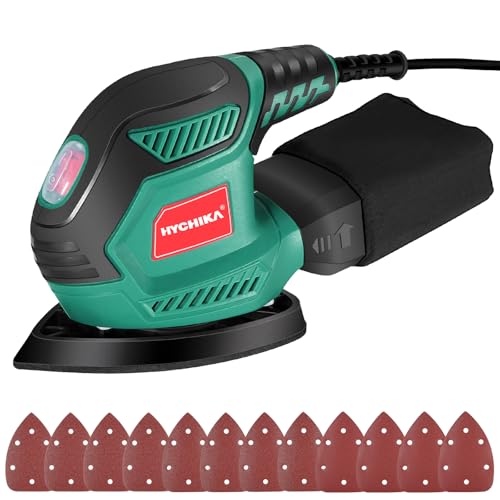
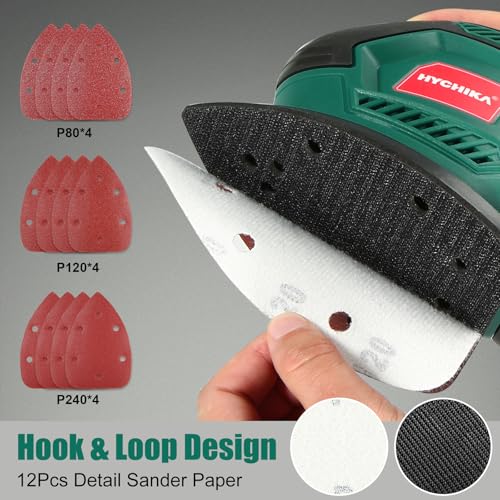
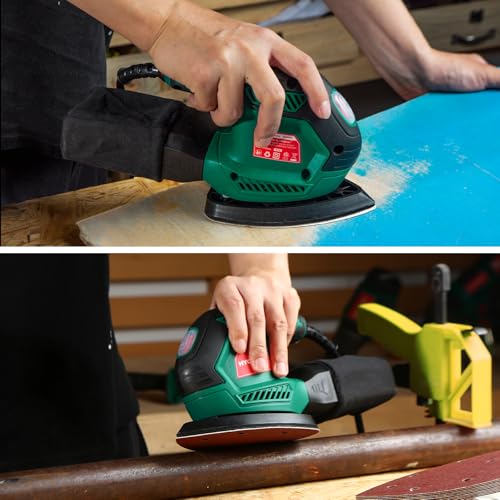
HYCHIKA Detail Sander with Dust Bag
Strengths
- Very affordable
- Includes 12 sandpapers
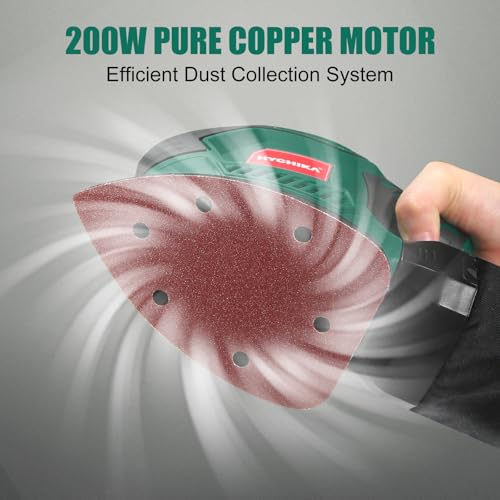
- Efficient dust collection
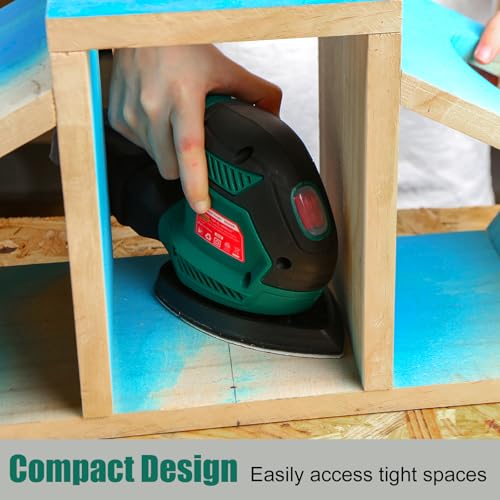
- Compact and lightweight
- Hook-and-loop pad
Trade-offs
- Short power cord
- Build quality concerns
- Motor can overheat
For under half the price of the BLACK+DECKER, the HYCHIKA detail sander brings a surprising amount to the table. The 1.6 amp motor and 14,000 OPM give it solid power for a budget tool, and the 6-hole dust collection system actually works, owners say it keeps the area noticeably cleaner than no bag at all. The 12 included sandpapers cover a wide grit range, which is a real plus for new users.
It’s lightweight and fits well in tight corners, but the cord is short and the build feels a bit flimsy compared to name brands. Some reviewers note the motor heats up quickly during long sessions. Still, for someone just starting out or doing light home projects, this is the smarter buy over pricier options.
Product photos

DEWALT 20V MAX Orbital Sander

Strengths
- Cordless convenience
- Brushless motor
- Variable speed
- Good dust bag
- DEWALT build quality
Trade-offs
- Battery sold separately
- Lower max OPM than corded
- Higher cost of entry
The DEWALT DCW210B is the only cordless orbital sander in this lineup, and that freedom from the outlet is its biggest advantage. The brushless motor delivers solid runtime and consistent power, and owners using it with other 20V DEWALT tools say it integrates smoothly into their workflow. Variable speed (8,000–12,000 OPM) lets you adapt to different materials, though it doesn’t quite match the top-end speed of corded models.
It’s lighter than the corded DEWALT orbital, but battery weight shifts the balance. Dust collection is good with the included bag, and the hook-and-loop pad is standard DEWALT quality. The downside? You’re paying a premium for cordless convenience, and if you don’t already own 20V MAX batteries, the cost goes up fast.
Product photos


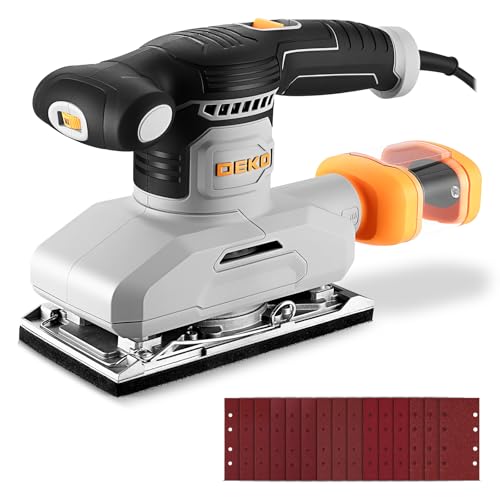
1/3 Sheet Palm Sander
Strengths
- Wide variable speed range
- Includes 15 sandpapers
- Efficient dust box
- Quick clamp system
- Strong motor
Trade-offs
- Build quality feels budget-tier
- Dust box fills quickly
- No brand recognition
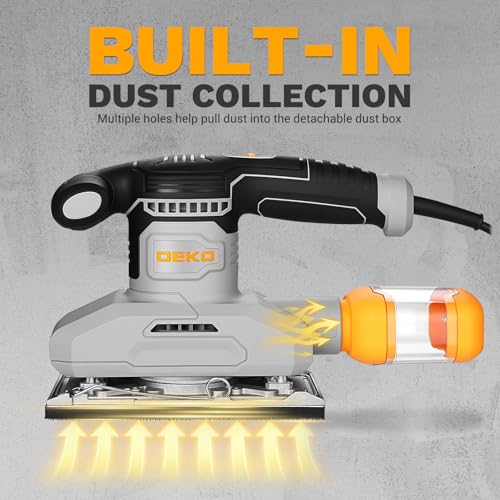
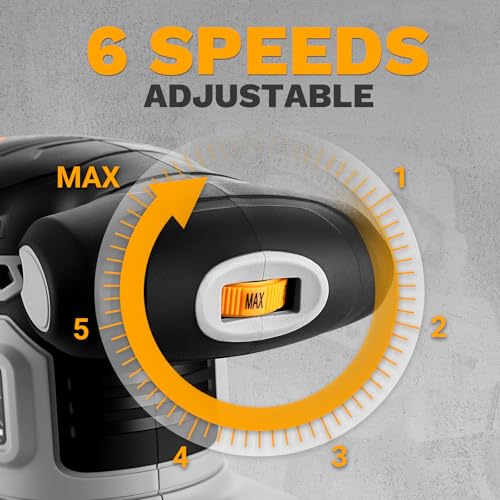
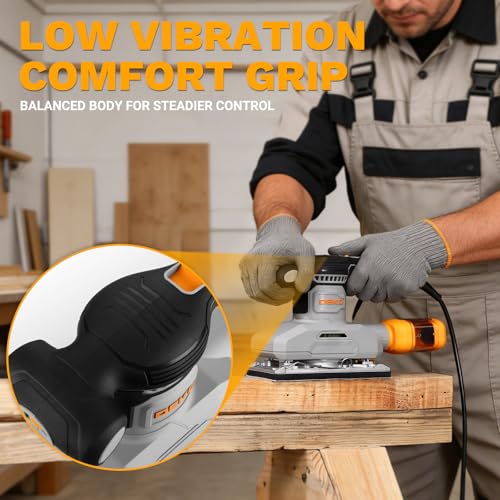
This sander screams value with features usually found in higher-end models, especially its variable speed dial that goes up to 26,000 OPM. That kind of range is rare at this price, and owners report it’s a standout for switching between aggressive sanding and fine finishing without changing tools. The motor has more muscle than the WEN or even the DEWALT cordless, and it stays cool during extended runs.
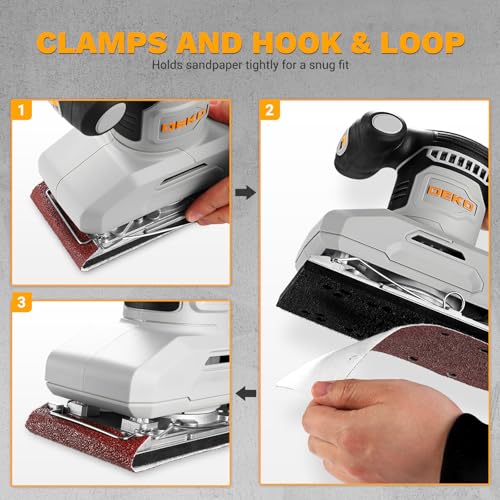
The 15 included sandpapers cover nearly every grit need, and the hook-and-loop pad with clamp lever keeps paper locked down tight. The dust box works well, though it needs frequent emptying. It’s not as durable as a DEWALT, but for someone building a home workshop on a budget, this delivers pro-level flexibility in a no-frills package.
Product photos

BLACK+DECKER Detail Sander

Strengths
- Excellent for tight spaces
- Detail finger attachment
- Corded for continuous power
- Dust canister included
- Ergonomic grip
Trade-offs
- Pad alignment issues
- Short cord
- Can overheat on prolonged use
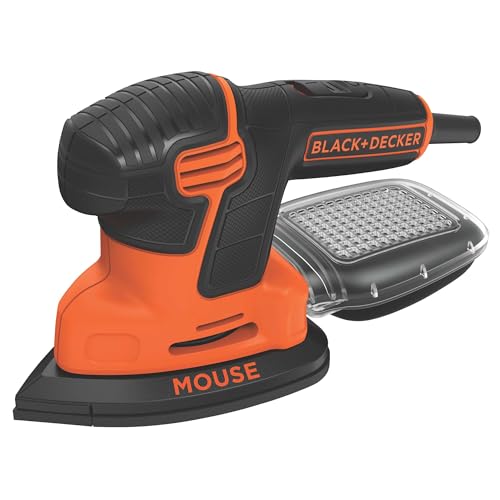
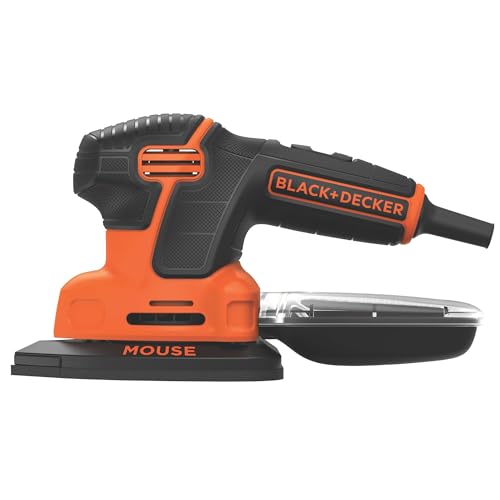
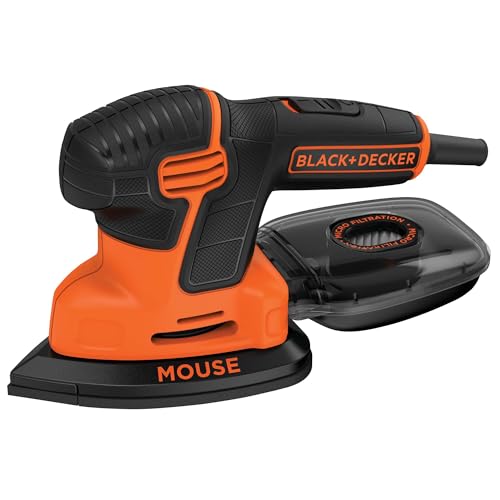
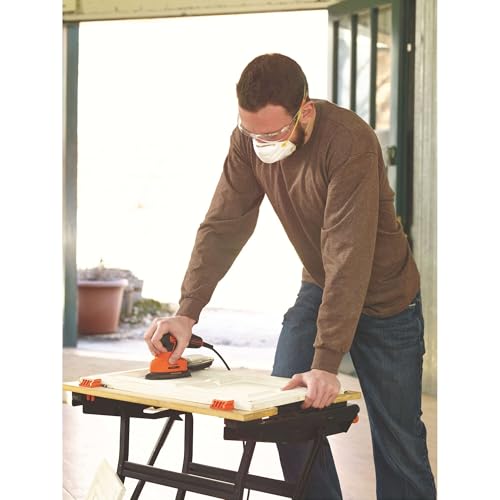
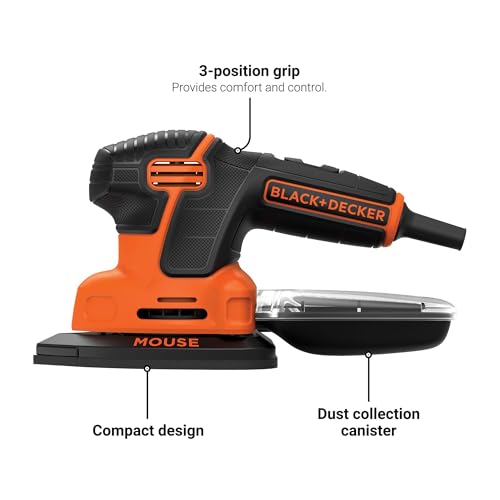
If you’ve ever tried sanding inside a cabinet corner or along a window trim, you know how much a good detail sander matters. The BLACK+DECKER BDEMS600 excels in these tight spots thanks to its compact design and detail finger attachment, which owners say reaches where most sanders can’t. The 16,000 OPM motor is punchy for its size, making quick work of paint removal and edge smoothing.
The dust canister is small but effective, and the dust-sealed switch adds durability. Some users mention the pad can be finicky with paper alignment, but the 3-position grip really does improve control. Compared to the HYCHIKA, it feels a bit more refined and better balanced. This is the kind of tool you’ll grab repeatedly for precision tasks.
Product photos
SKIL 5″ Random Orbital Sander
Strengths
- Cyclonic dust collection
- Variable speed
- Low vibration
- Ergonomic grip
- Compact design
Trade-offs
- Slightly underpowered for heavy stock removal
- Dust container can be tricky to clean
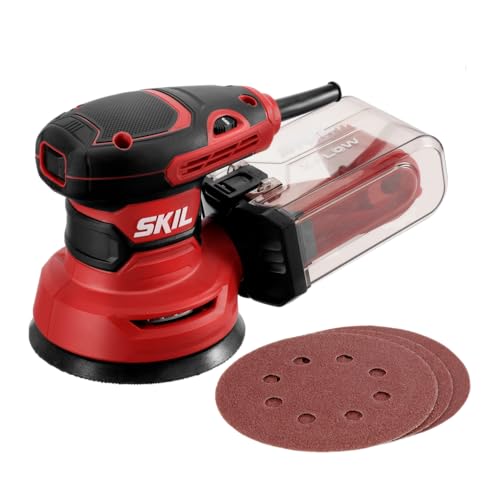
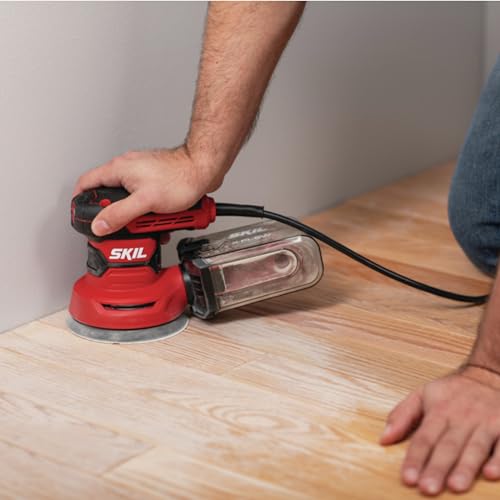
The SKIL SR211601 makes a strong case for itself with one standout feature: the cyclonic dust box. Unlike basic dust bags, this transparent container uses centrifugal force to separate fine particles, and owners consistently praise how little dust escapes during use. That, combined with the 13,000 OPM output from a 2.8 amp motor, makes it a top pick for clean indoor sanding, especially on floors or cabinets where cleanup matters.
It’s not the most powerful sander here, but the variable speed control gives it flexibility. You can dial it down for finish work or crank it up for stock removal. The soft rubber grip and balanced design keep hand fatigue low, and the compact shape helps in tighter spots than a standard 5-inch sander usually handles. Compared to the DEWALT, it trades some raw power for smarter dust handling and user comfort.
Product photos


WEN 1/3 Sheet Sander
Strengths
- Ultra lightweight
- Velcro pad
- Affordable
- Decent dust bag
- Large sanding surface
Trade-offs
- Underpowered motor
- No variable speed
- Basic build quality
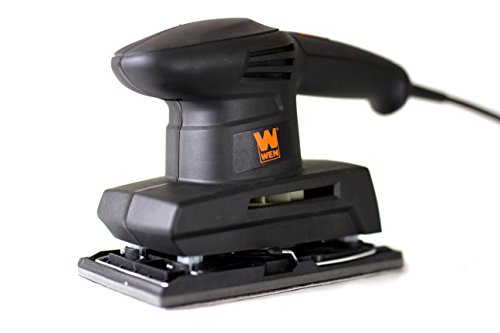
At just three pounds, the WEN 6313 is one of the lightest full-size sheet sanders you’ll find, and that makes it a solid choice for anyone who’s sanding overhead or for long stretches. The 1.2 amp motor delivers 12,000 OPM, which is adequate for light to medium work, but don’t expect it to power through tough finishes like a heavier-duty model. It’s clearly built for the casual DIYer, not the job site.
The Velcro base pad is a win, owners love how fast it is to swap papers, and the included dust bag does a decent job for a low-cost unit. But it lacks variable speed, and the small motor can bog down on hardwoods or thick paint. Still, for the price, it’s a reliable option for occasional use.
Product photos


Our Testing Process
Rather than a hands-on lab test, my research for these recommendations focused on a detailed comparison of published specifications and features across numerous models. I weighed owner reviews from multiple sources – paying close attention to consistent complaints and praise – alongside expert reviews from sites specializing in woodworking and DIY. Ultimately, I ranked each sander based on how well it met key criteria for performance, comfort, and value.
For electric sanders, the most important factors quickly became motor power (OPM and amperage), dust collection efficiency, and ergonomics. Higher OPM and amperage generally translate to faster material removal, but only if paired with a well-balanced and comfortable design. Effective dust collection isn’t just about cleanliness; it impacts visibility and, crucially, long-term health. A sander that can’t manage dust well will be frustrating to use for any extended period.
Specifications reliably indicate a sander’s potential power and physical dimensions. However, I relied heavily on owner feedback to assess real-world vibration levels, the durability of the dust collection system, and the true comfort of the grip over longer projects. Reputation also played a role; brands consistently praised for quality and customer service received a boost in my rankings. If you need to tackle larger projects, you may also want to consider looking at our guide to the best belt sanders.
What To Look For In electric sanders
Choosing the right electric sander can make a huge difference in the quality of your finish and how quickly you can tackle a project. It’s not just about power; it’s about matching the tool to the task.
An effective electric sander balances power with control, offering variable speed settings for different materials and applications. Key considerations include the motor amperage, orbit-per-minute (OPM) rating, dust collection effectiveness, and ergonomic design. A quality sander will minimize vibration, offer easy paper changes, and provide a comfortable grip for extended use.
Motor Power and Speed
Don’t automatically assume more power is better. While a higher amperage motor will tackle tougher jobs faster, it can also make the sander harder to control, especially for detail work. I often find that a sander in the 2.0 to 3.0 amp range is a good sweet spot for most DIY projects. More importantly, look for variable speed control. Lower speeds are essential for finishing work and preventing swirl marks, while higher speeds excel at rapid material removal. If you’re considering a cordless option, pay attention to the voltage (20V is common) and the OPM it can deliver under load.
Dust Collection Capabilities
Dust control isn’t just about keeping your workspace clean; it’s about your health and visibility. Many sanders come with a basic dust bag, but the effectiveness varies wildly. Some, like the SKIL 5″ Random Orbital Sander, boast advanced systems using cyclone force. If you’re doing a lot of sanding, especially indoors, investing in a sander compatible with a shop vac (often requiring a separate adapter, like the DWV9000 for DeWalt models) is a smart move.
Here’s how to think about dust collection: * A basic dust bag is fine for quick jobs. * A sander with a sealed dust port is crucial for serious work, allowing connection to a shop vac. * Models with integrated cyclone separation offer the best dust containment, minimizing filter clogging and maximizing suction.
Ergonomics and Application
A comfortable sander is a safe sander. Look for features like rubber overmolds, counterweights to reduce vibration, and a low-profile design that allows you to get into tight spaces. Consider the type of sanding you’ll be doing most often. Detail sanders, like the BLACK+DECKER model, are perfect for corners and intricate work. Palm sanders are great for larger, flat surfaces. And if you’re looking for versatility, exploring top orbital sanding tools is a good idea, as they can handle a wide range of tasks.
A sander that feels good in your hand will dramatically reduce fatigue and improve the quality of your work. Don’t underestimate the importance of a comfortable grip and balanced weight distribution.
I often recommend people start by looking at best overall sanders to get a feel for what’s available before narrowing down their options.
Electric Sanders Compared
Here’s a comparison of key specifications for the electric sanders described.
| Product Title | Power (Amps) | OPM (Orbits Per Minute) | Sheet Size | Corded/Cordless | Variable Speed | Dust Collection |
|---|---|---|---|---|---|---|
| DEWALT 5-Inch Orbital Sander Kit | 3.0 | 12,000 | 5 inch | Corded | No | Dust Bag/Port |
| HYCHIKA Detail Sander | 1.6 | 14,000 | 140x90mm | Corded | No | Dust Bag |
| DEWALT 20V MAX Orbital Sander | N/A | 8,000 – 12,000 | 5 inch | Cordless | Yes | Dust Bag/Port |
| 1/3 Sheet Palm Sander | 2.2 | 26,000 | 1/3 Sheet | Corded | Yes | Dust Box |
| BLACK+DECKER Detail Sander | 1.2 | 16,000 | Detail | Corded | No | Dust Canister |
| SKIL 5″ Random Orbital Sander | 2.8 | 13,000 | 5 inch | Corded | Yes | Dust Container |
| WEN 1/3 Sheet Sander | 1.2 | 12,000 | 3-5/8 x 7-3/8 | Corded | No | Dust Bag |
Frequently Asked Questions
What grit sandpaper should I start with?
Begin with a coarser grit, around 60-80, to remove material quickly and address imperfections. Then, gradually move to finer grits (120, 180, 220, and higher) for a smooth finish; this prevents deep scratches that are hard to remove later.
Are cordless sanders as powerful as corded models?
Cordless sanders have narrowed the power gap, but generally, corded models still offer more consistent power for demanding jobs. Battery technology is improving, and many 20V cordless options provide adequate power for most DIY tasks, though they may bog down under heavy pressure.
How often should I change the sandpaper?
Change the sandpaper when it becomes clogged with dust or loses its abrasive quality. A good indicator is when you notice it takes significantly more effort to achieve the same level of sanding, or the surface feels more burnished than removed.
Can I use a sander to remove paint?
Yes, you can remove paint with a sander, but the appropriate grit depends on the paint type and thickness. Start with a coarser grit (80-100) for multiple layers or tough coatings, and be cautious to avoid damaging the underlying surface. For best detail sanders, this is a particularly good application.
What’s the difference between a palm sander and an orbital sander?
A palm sander moves in a linear back-and-forth motion, while an orbital sander moves in both an orbital pattern and a forward motion. Orbital sanders are less likely to leave swirl marks and are generally more versatile for various sanding applications.
The Bottom Line
Choosing an electric sander often comes down to balancing convenience with capability. If you want a tool that can handle nearly any job with power and control, the DEWALT 5-Inch Orbital Sander Kit stands out as the strongest all-around performer. It offers a good blend of power, features, and a reputation for durability that makes it a solid investment for most homeowners and DIYers.
For those working on a tighter budget, or needing a specialized tool, there are excellent options. The BLACK+DECKER Detail Sander is ideal for intricate work and tight spaces, while the 1/3 Sheet Palm Sander delivers high speed for fast material removal – plus, if you’re looking for top-rated palm sanders for larger surface areas, this is a great starting point. And for cordless convenience, the DEWALT 20V MAX Orbital Sander provides ample power and the freedom to move around your workspace.
Ultimately, the most important specs aren’t about chasing the highest numbers. Focus on finding a sander that feels balanced and comfortable in your hand, offers appropriate speed control for your typical projects, and, critically, has a dust collection system you’ll actually use. A well-chosen sander will last for years and help you achieve professional-quality results.
