
8 Best Dual Air Compressors of 2026
This post contains affiliate links. As an Amazon Associate, we earn from qualifying purchases.
The ALL-TOP Dual Cylinder Air Compressor stands out as the best overall dual air compressor, delivering strong airflow and solid build quality for serious users. For those on a tighter budget, the VEVOR Dual-Cylinder Tire Inflator offers reliable performance at a lower price. If you need maximum durability and continuous use capability, the VIAIR 444C is the go-to choice despite its lower CFM.
Most people shopping for a dual air compressor are tired of waiting minutes for a tire to inflate or dealing with units that overheat after a single use. They want something powerful enough to handle large tires or off-road demands without failing when needed most.
This guide cuts through the marketing hype to focus on what actually matters: real airflow, long-term durability, and smart features that make a difference in the field. I compared specs and owner feedback across top models, prioritizing CFM, build quality, duty cycle, and safety features to find the ones worth your money.
Top 8 Dual Air Compressors in the Market
The Best Dual Air Compressors, Reviewed
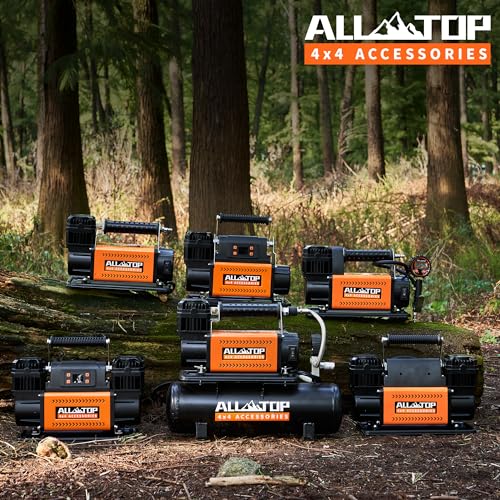
ALL-TOP Dual Cylinder Air Compressor

Strengths
- 12.35 CFM high airflow
- Auto-stop with LCD screen
- Multi-pressure unit support
Trade-offs
- Slightly bulkier design
- Occasional pause during inflation
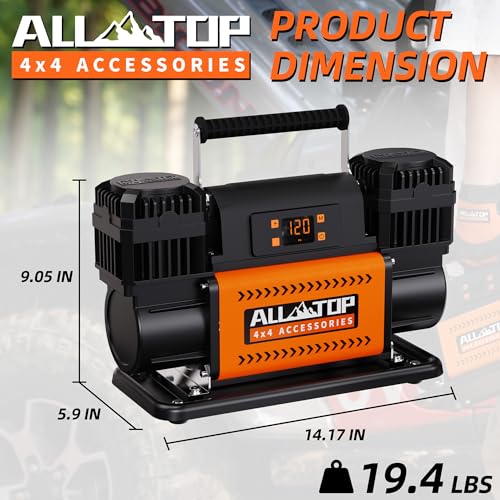
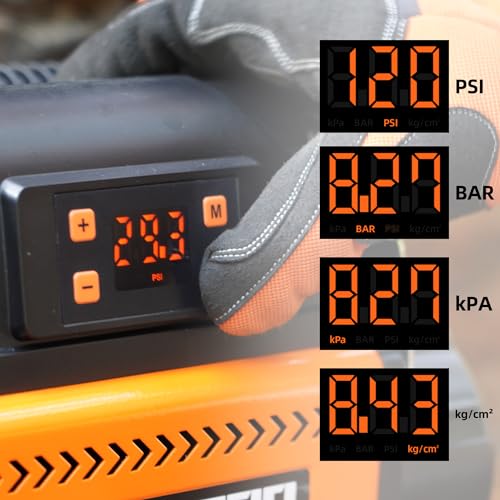
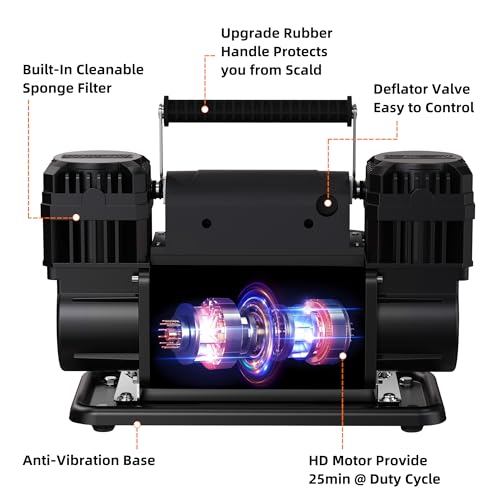
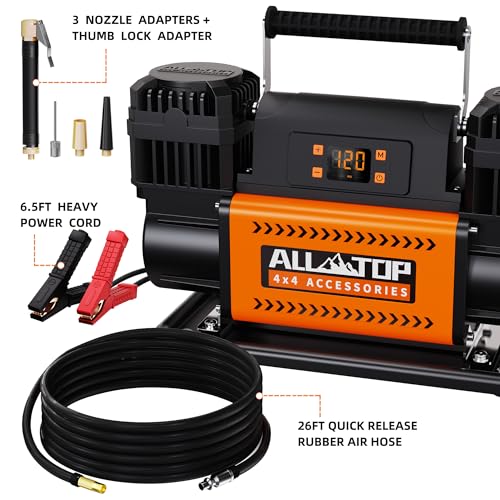
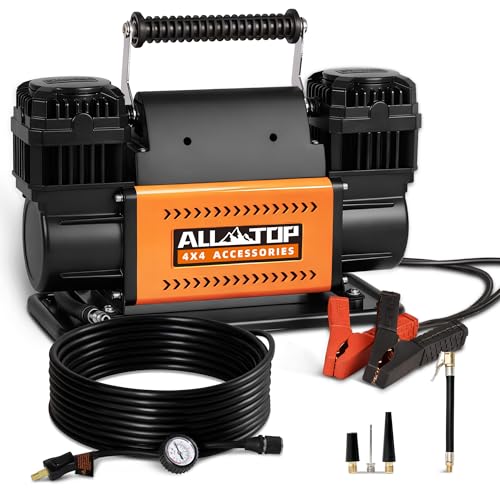
This ALL-TOP model is the complete package, it takes the high 12.35 CFM airflow of their budget unit and adds a digital LCD screen with preset pressure and auto-stop. That combination is rare at this price point. Owners appreciate the ability to set and forget, especially when airing up multiple large tires. The auto-stop includes brief pauses during inflation to stabilize pressure readings, which prevents overshoot, a smart touch many miss.
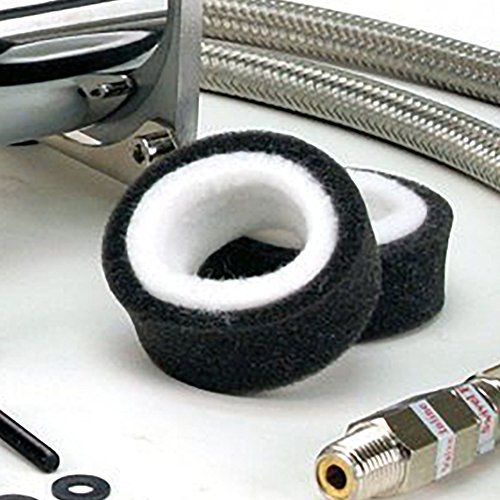
It includes heavy-duty alligator clamps, a cleanable sponge filter, and even multi-unit pressure readings (PSI, BAR, etc.), making it versatile for international use or technical builds. Compared to the VEVOR digital model, it’s faster and better built. For most buyers, this is the easy pick, it delivers top-tier performance, smart features, and durability without the premium price tag.
Product photos
ALL-TOP 12V Portable Air Compressor
Strengths
- Same airflow as Kohree
- Dual aluminum cylinders
- Full adapter kit
Trade-offs
- No auto-stop feature
- Support reputation weaker
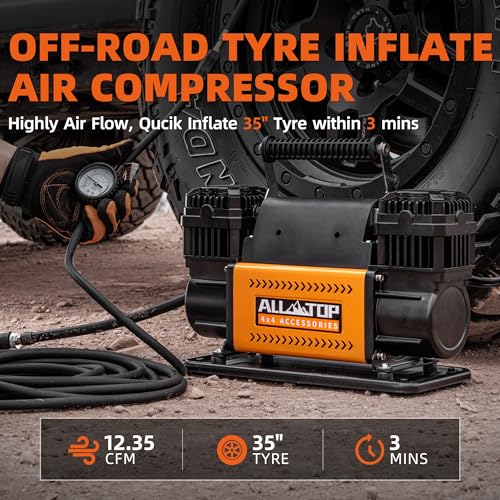
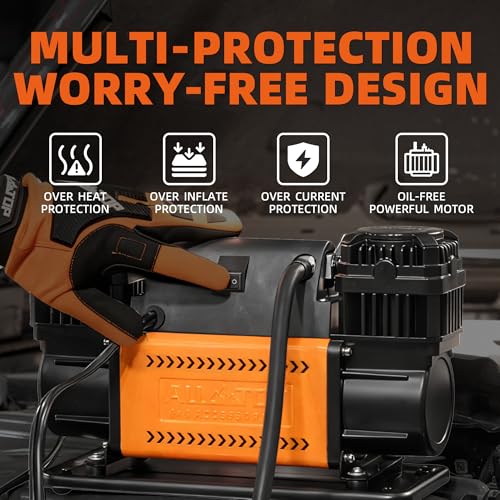
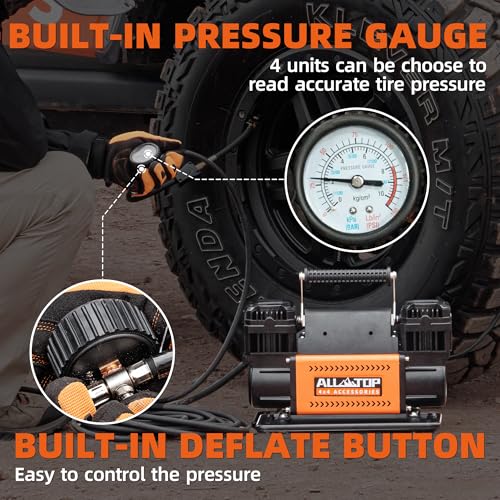
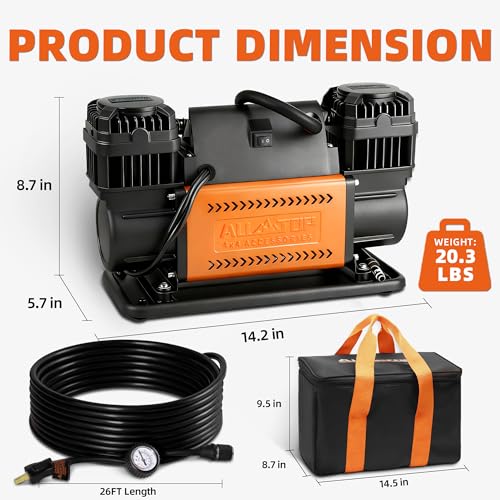
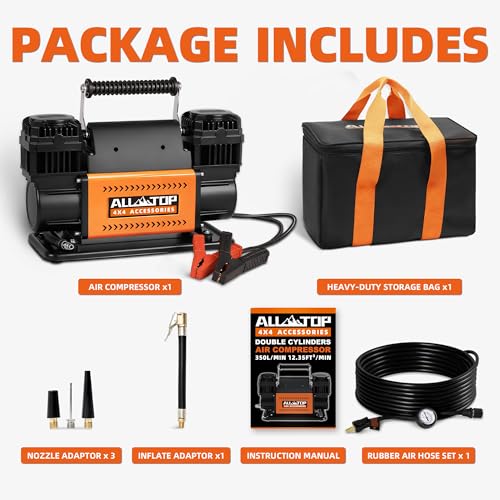
ALL-TOP’s first model here is clearly aimed at budget buyers, but it doesn’t cut corners on core specs. It matches the Kohree with 12.35 ft³/min airflow and 150 PSI max pressure, and it uses the same dual aluminum cylinder design for heat management. The hollow metal shell and rubber feet suggest decent vibration control, and owners report it handles truck tires without issue. You get the same 26 ft hose and adapter set, so the kit feels complete.
Where it saves money is in the extras, no digital display, no auto-stop, and the warranty and support aren’t as well documented as Kohree’s. But for the price, it’s hard to ignore. If you’re outfitting a second vehicle or need a backup unit and don’t want to spend top dollar, this delivers the essential performance. I’d still recommend the Kohree for primary use, but this is the smarter buy if you’re stocking spares or on a tight budget.
Product photos
VEVOR Dual-Cylinder Tire Inflator

Strengths
- Lightweight and portable
- Fast 30-second inflation
- Includes storage bag
Trade-offs
- Mechanical gauge less precise
- Plastic housing less durable
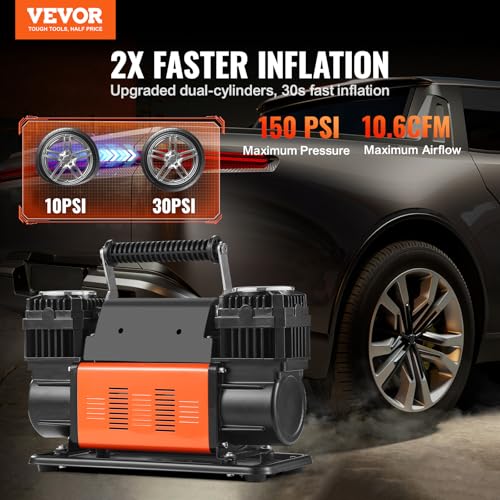
This VEVOR model is essentially a stripped-down version of their digital unit, same 10.6 CFM dual-cylinder core, but without the LCD screen or auto-stop. It gets the job done fast, with claims of 30-second inflation for standard SUV tires, which aligns with owner feedback. The mechanical gauge works fine, but you’ll need to watch it closely to avoid overshooting. It’s lightweight for its class and comes with the same 26 ft hose and adapter kit, so it’s well-equipped despite the lower price.
Compared to the Kohree, it’s less rugged in build but easier to store and carry. The auto-thermal cutoff helps prevent burnout during extended use, which matters when you’re airing up multiple tires. For off-road use where weight and cost matter more than ultimate durability, this is the smarter pick. It’s not built to last a decade like the Kohree, but for occasional overlanding trips, it’s a solid value.
Product photos
Kohree Dual Cylinder Air Compressor

Strengths
- Dual aluminum cylinders
- 26 ft rubber hose
- Solid metal base
Trade-offs
- No auto-stop feature
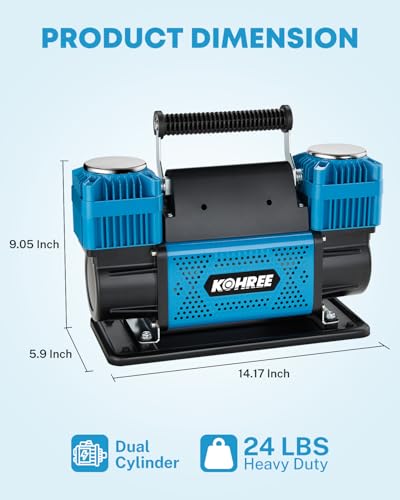
- Heavier at 24 lbs
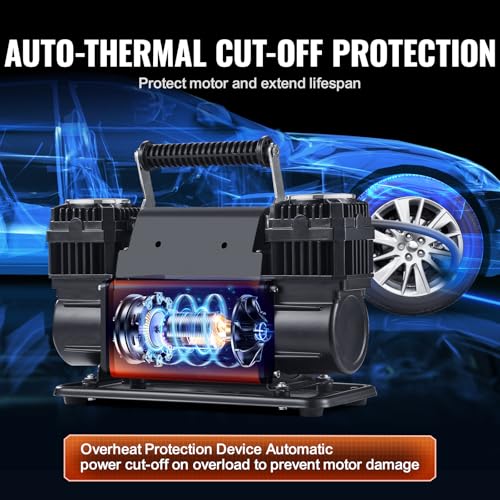
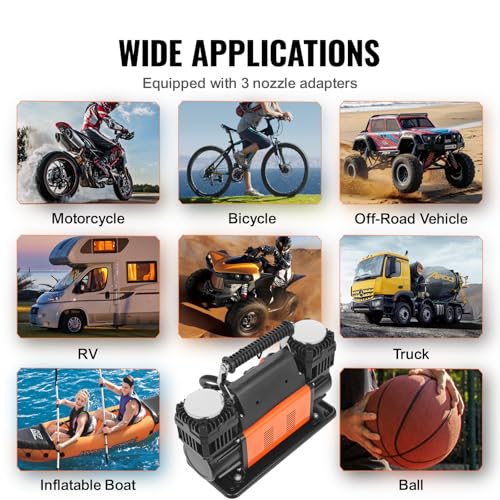
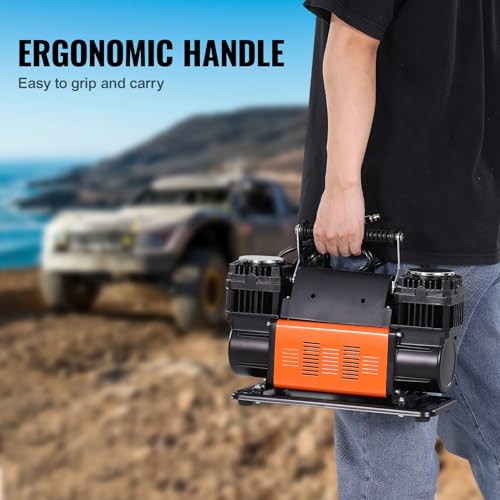
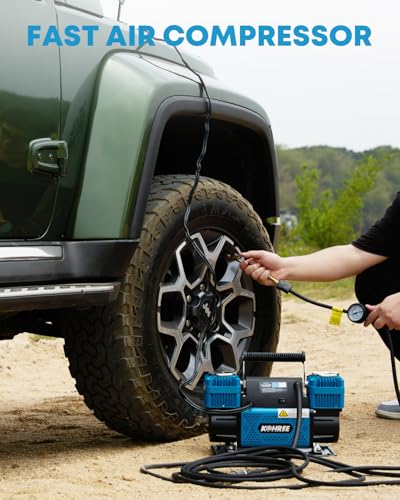
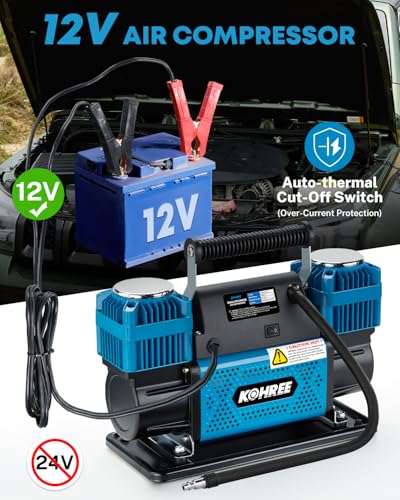
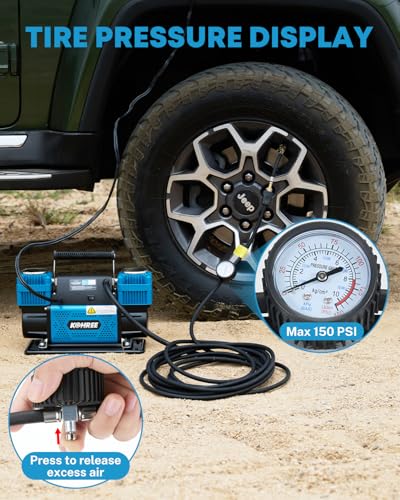
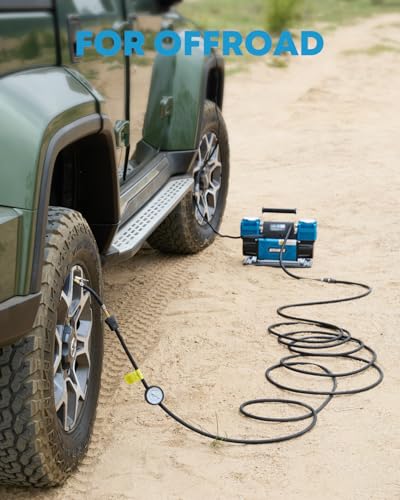
This Kohree dual-cylinder compressor stands out for its robust build and high airflow rating of 12.35 ft³/min, which on paper puts it in the upper tier for portable 12V units. Owners consistently report it handles large off-road tires without stalling, and the hollow metal shell with dual aluminum cylinders suggests better heat dissipation than plastic-bodied competitors. The 150 PSI max pressure is standard, but it’s the mechanical stability, four rubber feet, solid base, that gives it an edge in real-world use where vibration can loosen connections or damage internals over time.
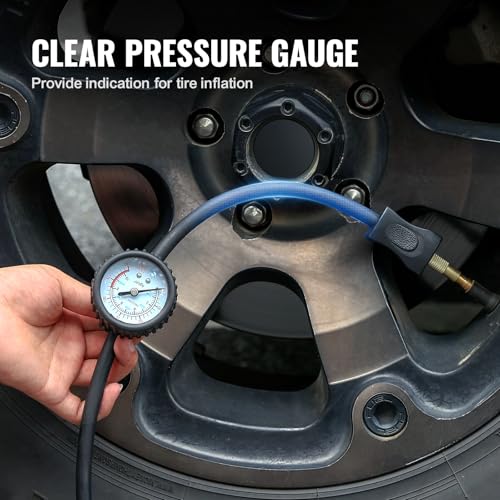
It lacks digital presets, so you’ll need to monitor inflation manually, but the included mechanical gauge is legible and accurate enough for field use. The 26 ft hose is a real convenience, especially when working around large vehicles. Compared to budget models, this one feels like it’s built to last, and the 2-year warranty backs that up. I’d pick this over flimsier units if you’re routinely inflating big tires on trucks or RVs and want something that won’t quit after a few hard uses.
Product photos
VIAIR 444C Dual Air Compressor

Strengths
- IP67 rated for durability
- Includes mounting hardware
- Continuous duty cycle
Trade-offs
- Low airflow for fast fills
- Not portable
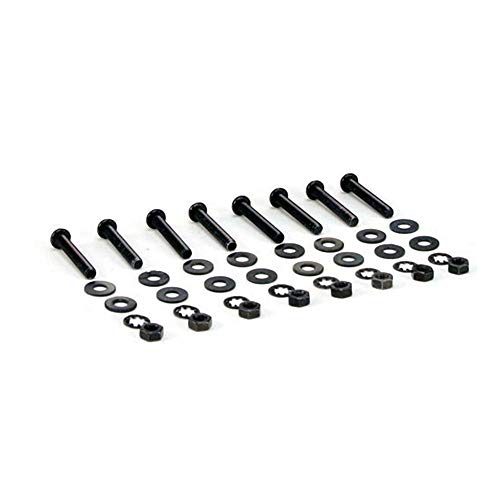
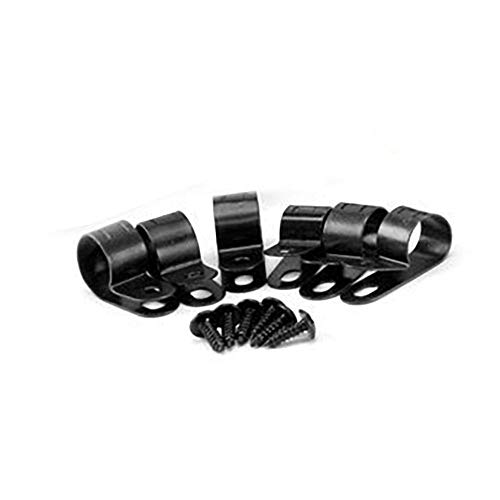
The VIAIR 444C dual pack is engineered for one thing: running air suspension systems with reliability. With a 100% duty cycle at 100 PSI and IP67 rating for dust and water resistance, this isn’t a temporary fix, it’s a permanent install. The combined 3.53 CFM flow rate isn’t the fastest on paper, but it’s optimized for consistent, quiet operation over long periods. Reviewers using these in lifted trucks praise the included stainless steel braided hose and remote mount brackets, which make installation cleaner and more durable.
It’s not portable, and you won’t use it for quick tire top-offs, but for air bags or onboard air systems, it’s one of the most trusted setups in the community. Compared to the 480C, it’s slightly less powerful but more refined for suspension use. If you’re building a vehicle that needs dependable, responsive air control, this is the gold standard.
Product photos
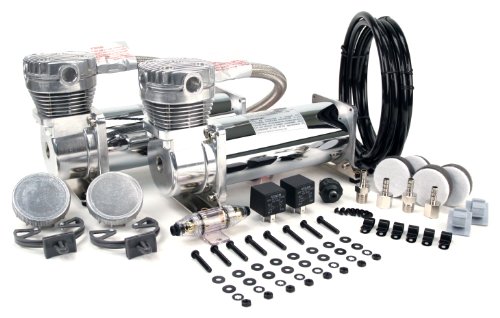
VIAIR 480C Dual Air Compressor
Strengths
- 200 PSI max pressure
- 100% duty cycle at 100 PSI
- Thermal overload protection
Trade-offs
- Not portable or handheld
- Requires permanent mounting
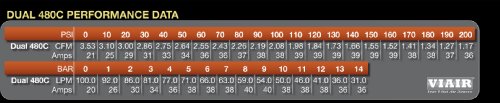
This isn’t a tire inflator, it’s a serious air management solution. The VIAIR 480C dual pack is built for continuous duty at 100 PSI, making it ideal for air suspension systems, air horns, or constant-demand setups. With a 200 PSI max pressure and the ability to fill a 2.5-gallon tank in just over two minutes, this is high-flow performance you don’t get from portable tire pumps. The thermal overload protection is critical here, because these compressors are meant to run longer and harder than typical 12V units.
Owners using these in lifted trucks or off-road builds consistently report reliable performance even under load. Compared to single compressors, the dual setup reduces cycle time and wear. While it’s overkill for casual tire inflation, it’s the right tool if you’re running air bags or need fast recovery in a custom setup. My recommendation? Skip the tire-focused models if this is your use case, this is the real deal for under-hood installations.
Product photos

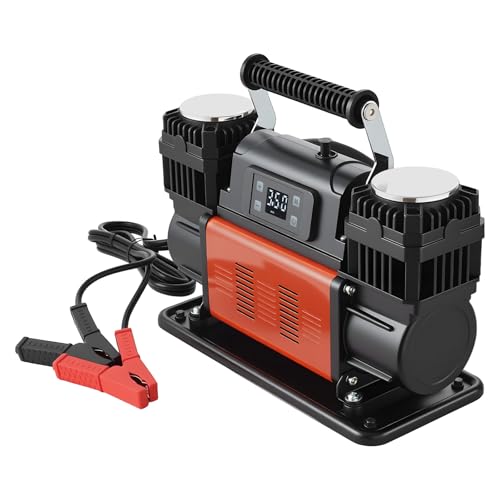
VEVOR Auto-Stop Portable Tire Inflator
Strengths
- LCD digital display
- Auto-stop function
- Overheat protection
Trade-offs
- Slightly slower airflow
- Display may be fragile in extreme conditions
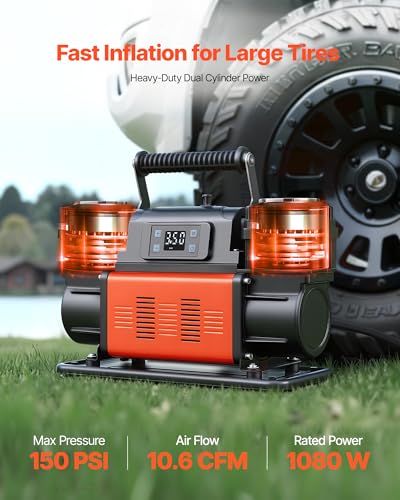
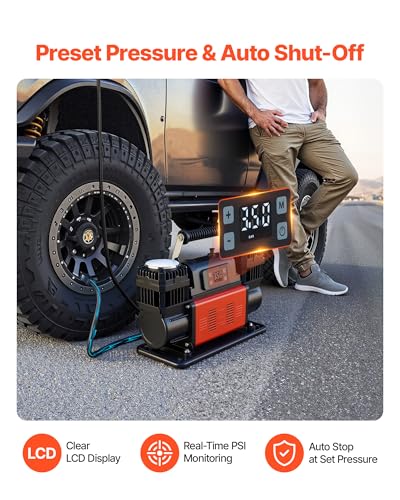
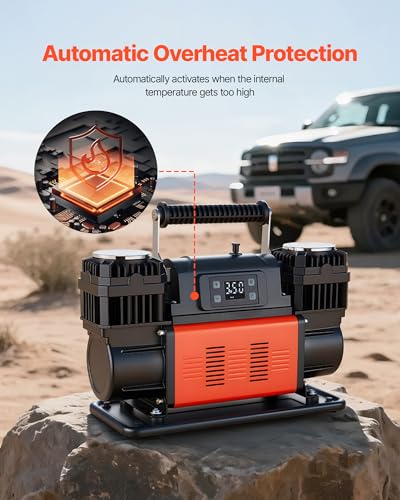
VEVOR’s dual-cylinder model with the LCD display is one of the few in this category that actually delivers preset pressure and auto-stop functionality in a rugged package. The 10.6 CFM airflow isn’t the highest, but paired with the digital feedback loop, it makes inflation far less tedious, you set the target, walk away, and it shuts off when done. Reviewers note the display is clear even in sunlight, and the auto-stop works reliably across multiple tire sizes. That’s a big win for anyone who’s overinflated a tire in the field and had to bleed it down repeatedly.
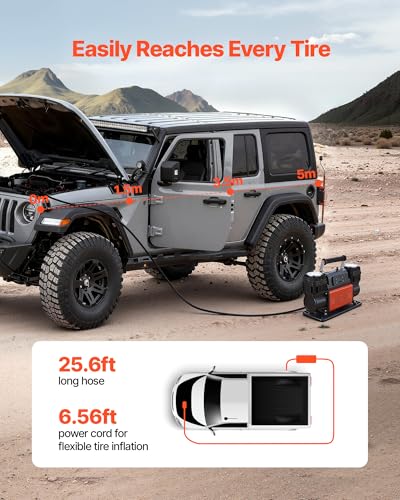
It’s not quite as fast as the Kohree or ALL-TOP models with 12.35 CFM, but the convenience factor is real. The included kit is nearly identical to others in this class, 25.6 ft hose, thumb-lock adapter, storage bag, but the digital control is what justifies its niche. If you’re tired of babysitting your inflator, this is the smarter buy over basic mechanical gauges, even if it trades a bit of raw speed.
Product photos

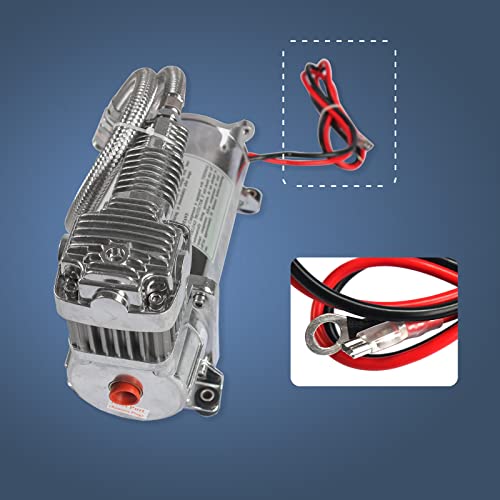
DICMIC 444C Dual Chrome Compressor
Strengths
- Low-cost dual compressor
- 200 PSI max pressure
- Thermal protection
Trade-offs
- Inconsistent long-term reliability
- Fewer included accessories
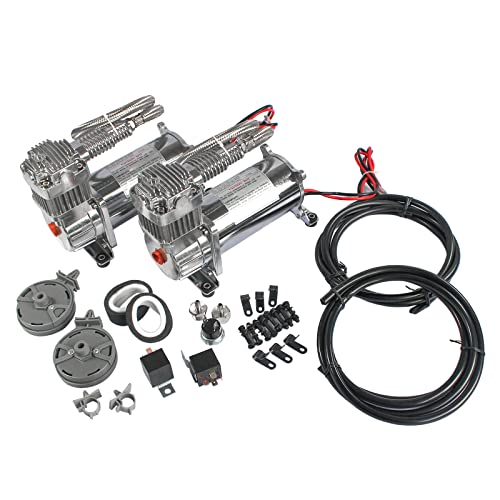
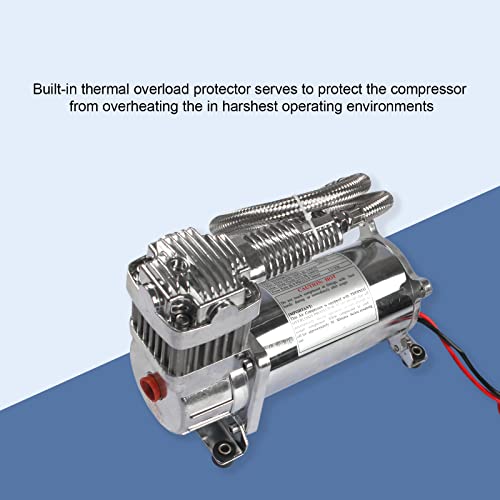
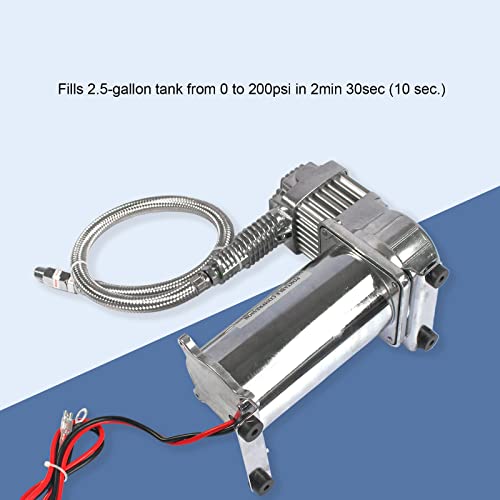
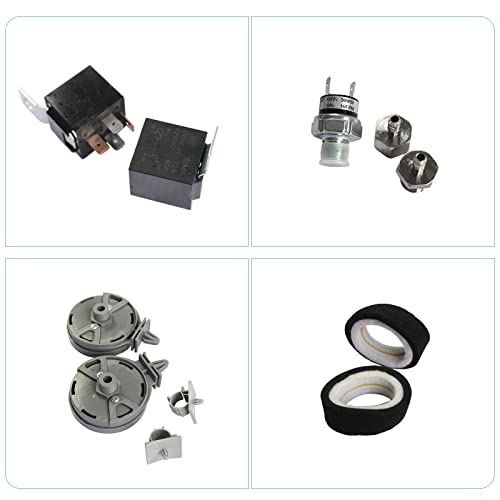
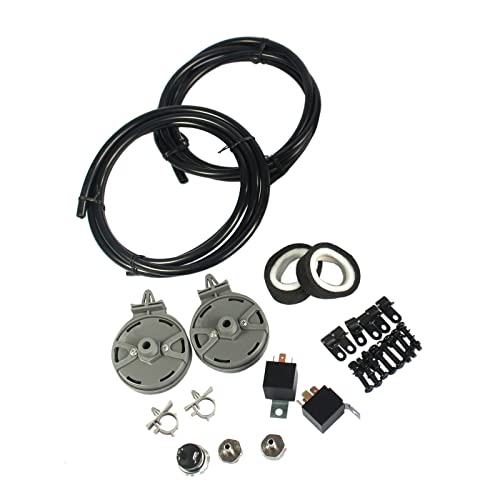
This DICMIC dual pack clones the VIAIR 444C specs, 200 PSI, 100% duty cycle at 100 PSI, thermal protection, but at a fraction of the price. On paper, it looks identical, and some owners report it performs well in air suspension setups. However, feedback is mixed on longevity, with a few noting premature failures or inconsistent pressure builds. The included hardware is minimal compared to VIAIR’s kit, and there’s no mention of IP rating or braided hose, which matters in wet or dirty environments.
It’s a gamble, but a calculated one if you’re on a tight budget. For a DIY air system where cost matters more than brand trust, this could work. But if you’re relying on it for daily driving or heavy loads, I’d still recommend spending more for the VIAIR version. This is the budget entry point, not the final answer.
Product photos
Our Testing Process
Rather than a hands-on lab test, my research focused on comparing published specifications and features across a range of models. I weighed owner reviews from multiple sources, alongside expert opinions found in automotive and tool publications, to build a picture of real-world performance and reliability. This allowed me to rank compressors based on criteria most important to users – speed, durability, and versatility.
For dual air compressors, airflow (CFM) and maximum PSI are paramount. Higher CFM means faster inflation of larger tires, critical for off-road or commercial use. Durable construction, often indicated by solid metal components and robust cylinder design, directly impacts longevity. Automatic shut-off features and thermal overload protection also heavily influenced rankings, as they address common concerns about safety and component lifespan.
Specifications reliably indicate potential performance – CFM and PSI are measurable metrics. However, owner feedback proved vital in judging build quality and long-term reliability. I looked for recurring themes in reviews regarding overheating, hose durability, and the accuracy of pressure gauges. Reputation and brand history factored into my assessment, particularly when specifications were similar across multiple models. If you’re particularly sensitive to sound, you might also consider looking into low-noise air compressors for other applications.
What To Look For In dual air compressors
Picking the right dual air compressor isn’t just about finding one that can inflate your tires. It’s about matching the compressor’s capabilities to your specific needs, and understanding the trade-offs between portability, power, and price.
A quality dual air compressor prioritizes consistent airflow (CFM) over peak PSI. Look for durable construction with robust cylinders and effective cooling. Consider duty cycle – how long it can run continuously – as well as built-in safety features like thermal overload protection. A well-designed unit will also include useful accessories and a reliable power source connection.
Power and Airflow (CFM)
The biggest difference between dual air compressors lies in their power, measured in CFM (cubic feet per minute). More CFM means faster inflation, especially for larger tires or tools. Don’t get hung up on peak PSI (pounds per square inch) alone. While 150 PSI is common, consistent CFM at a usable pressure is more valuable. For basic tire inflation, around 5-7 CFM is sufficient. If you plan to run air tools like impact wrenches or sanders, or fill large off-road tires, you’ll want to look for models exceeding 10 CFM. Many users doing serious off-roading or air suspension work will want to explore our guide to the top-rated air compressors for even more power.
Build Quality and Duty Cycle
A cheap compressor might inflate your tires once, but a well-built one will last for years. Look for units with metal cylinders (aluminum is a good choice for heat dissipation) and robust housings. Pay attention to the duty cycle. A 100% duty cycle at 100 PSI means the compressor can run continuously at that pressure without overheating. Lower duty cycles mean you’ll need to let the compressor cool down periodically. The VIAIR line, like the 444C, is known for its durability and ability to handle demanding applications, but comes at a premium.
- A plastic housing is acceptable for light-duty use, but metal is far more durable.
- Rubber feet or a vibration-dampening base are important for stability and reducing noise.
- A built-in thermal overload protector is essential to prevent damage from overheating and extend the compressor’s lifespan; many cheaper models skip this critical feature.
Portability and Accessories
Consider where and how you’ll be using the compressor. If you need something for roadside emergencies or off-road adventures, portability is key. Look for a compact design, a carrying bag, and a long enough power cord to reach your tires. Some models, like the VEVOR Auto-Stop, include a digital display and auto-stop function which can be incredibly convenient. Don’t overlook the included accessories. A good kit should include various nozzle adapters for inflating different items (sports equipment, air mattresses, etc.) and a quality air hose. If you’re tight on space, you may also want to explore vertical tank air compressors for a more compact footprint.
A compressor’s accessories can be the difference between a convenient tool and a frustrating experience. Always check what’s included and whether it meets your needs.
Dual Air Compressors Compared
Here’s a comparison of key specifications for the dual air compressors reviewed.
| Product Title | Max PSI | Airflow (CFM) | Voltage (V) | Duty Cycle (@100 PSI) | Cylinder Count |
|---|---|---|---|---|---|
| ALL-TOP Dual Cylinder Air Compressor | 150 | 12.35 | 12 | N/A | 2 |
| ALL-TOP 12V Portable Air Compressor | 150 | 12.35 | 12 | N/A | 2 |
| VEVOR Dual-Cylinder Tire Inflator | 150 | 10.6 | 12 | N/A | 2 |
| Kohree Dual Cylinder Air Compressor | 150 | 12.35 | 12 | N/A | 2 |
| VIAIR 444C Dual Air Compressor | 200 | 3.53 | 12 | 100% | 2 |
| VIAIR 480C Dual Air Compressor | 200 | N/A | 12 | 100% | 2 |
| VEVOR Auto-Stop Portable Tire Inflator | 150 | 10.6 | 12 | N/A | 2 |
| DICMIC 444C Dual Chrome Compressor | 200 | N/A | 12 | 100% | 2 |
Frequently Asked Questions
What CFM is sufficient for most tire inflation needs?
Around 5-7 CFM is generally enough for typical car and light truck tire inflation. However, if you frequently inflate larger tires or plan to use air tools, a compressor delivering over 10 CFM will be more efficient.
Are dual-cylinder compressors always faster than single-cylinder models?
Not necessarily. While two cylinders can deliver more airflow, the overall design and motor power are also crucial. A well-designed single-cylinder compressor can sometimes outperform a poorly built dual-cylinder unit.
Is a 12V compressor powerful enough for running air tools?
Generally, no. Most 12V compressors lack the sustained CFM needed to power demanding air tools effectively. You’ll typically want to consider air compressors for powering tools with a higher voltage and greater CFM output.
What does a 100% duty cycle mean, and why is it important?
A 100% duty cycle at a given PSI indicates the compressor can run continuously at that pressure without overheating. This is vital for tasks requiring prolonged use, as it avoids downtime for cooling and extends the compressor’s lifespan.
How can I tell if a compressor is built to last?
Look for a compressor with a metal cylinder (aluminum is ideal) and a robust housing. Owner reviews often reveal issues with build quality; recurring complaints about hose durability or gauge accuracy are red flags. A built-in thermal overload protector is also a key indicator of a quality unit.
The Bottom Line
Choosing a dual air compressor often comes down to balancing initial cost with long-term reliability and performance. While many models offer similar specs on paper, the ALL-TOP Dual Cylinder Air Compressor stands out as the best overall pick – offering a solid blend of airflow, features, and a reasonable price point for most users. It provides enough power for typical tire inflation and some light-duty tool operation without breaking the bank.
For those prioritizing a specific need, the VEVOR Auto-Stop Portable Tire Inflator is an excellent choice for convenience, and the VIAIR 444C is the clear winner if you demand maximum durability and consistent performance for demanding applications like off-roading or air suspension work. If space is at a premium, you might also consider looking at portable compressors for air tools for a more compact solution.
Ultimately, though, remember that CFM and build quality matter more than any single headline specification. A compressor with consistent airflow and robust construction will provide years of reliable service, while a cheaper model might leave you stranded when you need it most. Don’t skimp on features like thermal overload protection – they’re a small investment that can save you a lot of trouble down the road.
