7 Best Air Framing Nailers of 2026
This post contains affiliate links. As an Amazon Associate, we earn from qualifying purchases.
The Metabo HPT NR90AES1 stands out as the best overall air framing nailer, combining reliable power, dual actuation modes, and solid durability. For budget-conscious users, the NuMax SFR2190 delivers strong performance at a lower price, while the Metabo HPT NV83A5 offers superior efficiency for heavy-duty jobs with its coil-fed design.
Framing nailers are essential for fast, secure construction work, but picking the wrong one can mean constant jams, fatigue, or costly downtime. As someone who’s spent years evaluating tools for real-world use, I know how much depends on a nailer’s balance of power, weight, and reliability.
This guide cuts through the noise by focusing on what actually matters: proven build quality, user feedback, and performance under pressure. I looked at specs, materials, safety features, and how well each model handles the demands of framing walls, roofs, and floors, so you can choose with confidence.
Top 7 Air Framing Nailers in the Market
The Best Air Framing Nailers, Reviewed
Metabo HPT NR90AES1 Framing Nailer

Strengths
- Lightweight and balanced
- Plastic collated compatibility
- Reliable selective trigger
Trade-offs
- Not for coil nails
- Slightly pricier than budget models
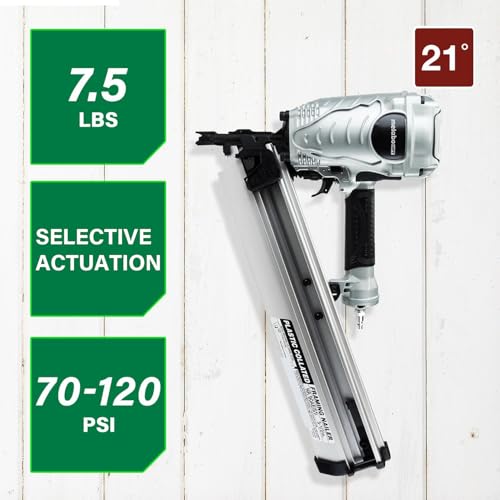
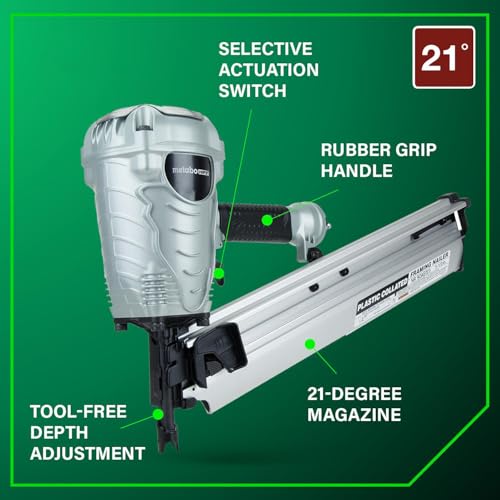
This 21-degree plastic collated nailer hits the sweet spot for most framers. It’s light at 7.5 lbs, well-balanced, and packed with pro features: selective actuation, tool-free depth control, and that trusted Metabo HPT build quality. It’s used heavily in flooring, wall framing, and roof work, jobs where reliability and comfort matter most.
Compared to the NR90ADS1, this one uses more common plastic-collated nails, which are easier to find and faster to reload. Owners consistently rate it as one of the most dependable stick nailers out there, and the 5-year warranty backs that up. If you want one framing nailer that does everything well, without gimmicks, this is it.
Product photos


Metabo HPT NR90ADS1 30° Framing Nailer

Strengths
- Lightweight
- 30-degree magazine
- Tool-less depth adjustment
Trade-offs
- Paper collated only
- Limited nail capacity
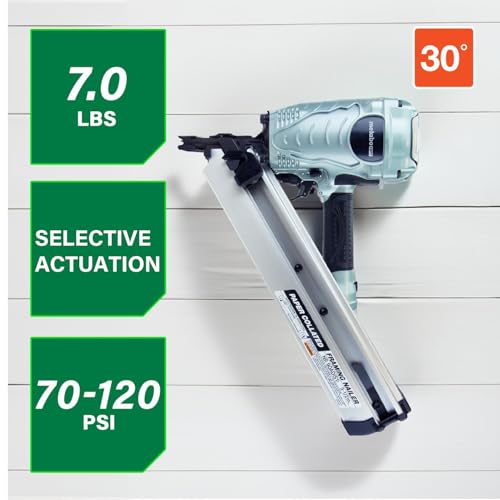
This 30-degree paper collated nailer stands out when you’re wrestling with tight corners or overhead work. At just 7 lbs, it’s one of the lightest in its class, and the well-balanced design makes it feel even lighter during extended use. The 30-degree magazine gives you better access in confined spots than bulkier 21-degree models, which is a real win for finish framing or roof decking where space is tight.
Owners consistently report solid reliability, and the selective actuation switch lets you toggle between contact and sequential firing without tools, a small thing that adds up over a full day’s work. Metabo HPT’s Pro Preferred reputation isn’t just marketing; it’s backed by years of field performance and a 5-year warranty that signals real confidence in durability.
Product photos


NuMax SFR2190 21° Framing Nailer

Strengths
- Affordable
- Dual trigger modes
- Anti-dry fire
Trade-offs
- Basic finish
- Less refined ergonomics
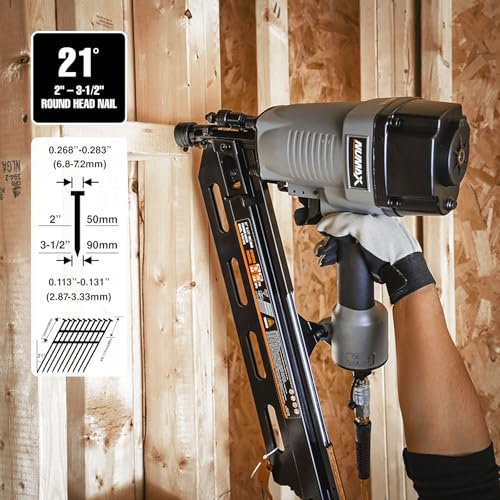
This is the budget king that still delivers core features you need: dual trigger, tool-free depth adjustment, anti-dry fire, and solid build with a hardened steel driver. It won’t win any beauty contests, but it gets the job done for framing, decking, or fence builds without breaking the bank.
I’d pick this over the VEVOR if you want something more proven, NuMax has been in the game longer, and owners report decent reliability for the price. It’s not as refined as Metabo HPT or Estwing, but for a DIYer or part-time user, it’s hard to beat the value. Just don’t expect the same level of polish or longevity.
Product photos


Estwing EFR2190 Magnesium Framing Nailer

Strengths
- Extremely durable
- One-piece steel driver
- Comfort grip handle
Trade-offs
- Heavier than competitors
- Higher price point
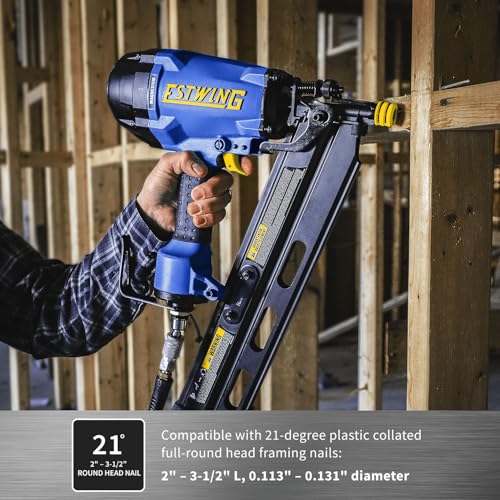
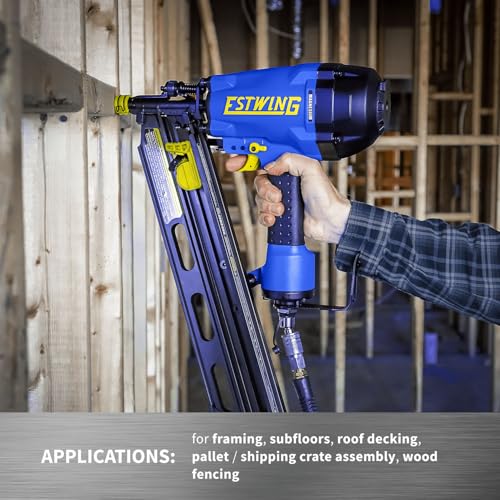
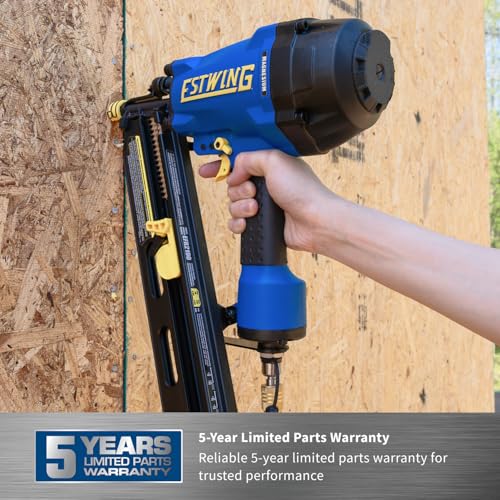
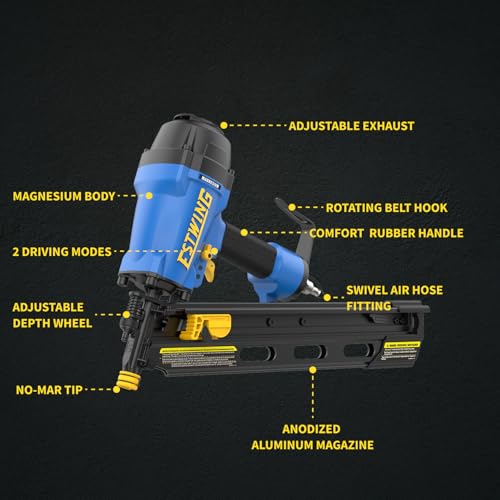
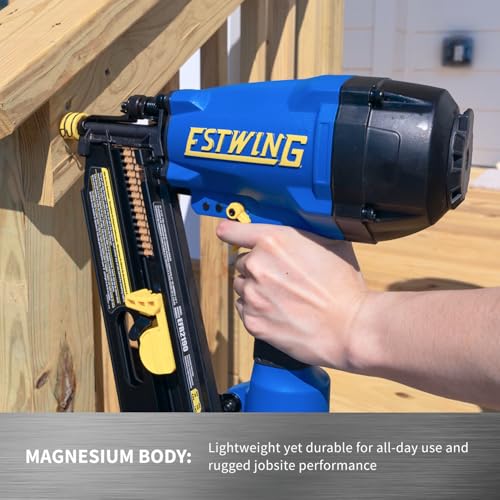
Estwing built this like a tank, magnesium body, one-piece steel driver, and that trademark no-nonsense toughness. It’s not the lightest, but it feels indestructible, and that counts for a lot when you’re swinging a nailer all day. The depth adjustment is smooth, the dual trigger works flawlessly, and the no-mar tip is a nice touch for clean finishes.
Owners praise its longevity, many report using theirs for years without a hiccup. It’s heavier than the Metabo HPT NR90AES1, but that weight comes with a sense of permanence. If you hate replacing tools or hate downtime from jams and wear, this one’s built for you. The swivel fitting and included belt hook add to the pro-grade feel.
Product photos
3PLUS HFN90SP 3-in-1 Framing Nailer

Strengths
- Adjustable magazine angle
- Multi-angle compatibility
- 360-degree exhaust
Trade-offs
- Build quality inconsistent
- Not field-proven long term
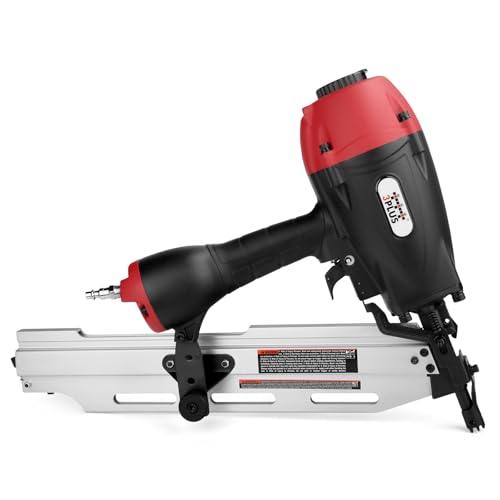
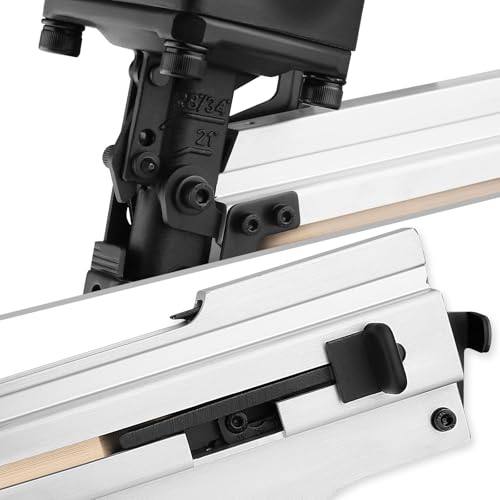
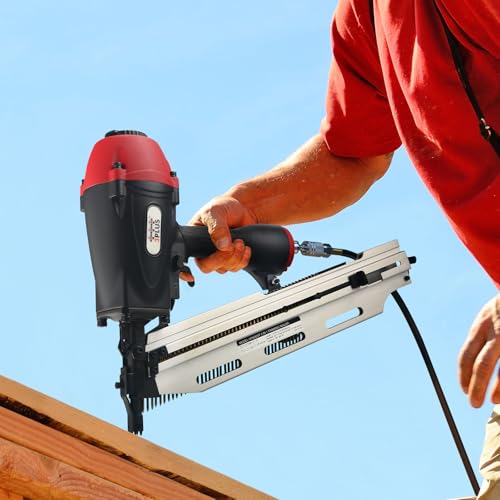
This is the ultimate adapter in the framing world, a single tool that handles 21, 28, and 34-degree nails thanks to its adjustable magazine. On paper, that’s huge. No more buying separate nailers for different jobs or getting stuck because your crew brought the wrong nails. The 3-in-1 flexibility makes it a smart choice for small crews or side-jobbers who need to stay nimble.
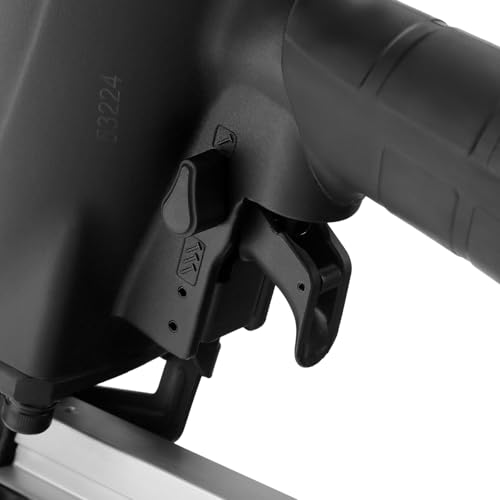
It packs solid features: anti-dry fire, 360-degree exhaust, and bump/sequential switch. But owners note it doesn’t quite match Metabo HPT or Estwing on long-term durability. It’s more of a utility player than a pro workhorse. Still, for the flexibility and price, it’s a compelling option if you value adaptability over brand prestige.
Product photos
Metabo HPT NV83A5 Coil Framing Nailer
Strengths
- High nail capacity
- Rapid reload magazine
- Hardened claw tip
Trade-offs
- Heavier than stick nailers
- Coil setup takes practice
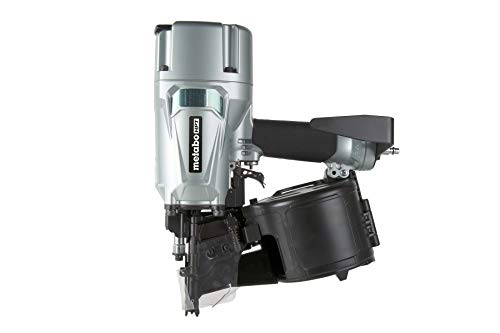
If you’re driving hundreds of nails a day, this coil-fed beast is built for that grind. The 15-degree magazine holds a massive amount of nails, and the quick reload side-load design means less downtime. At 8.8 lbs, it’s not the lightest, but the balance keeps fatigue manageable during long shifts on subflooring or sheathing jobs.
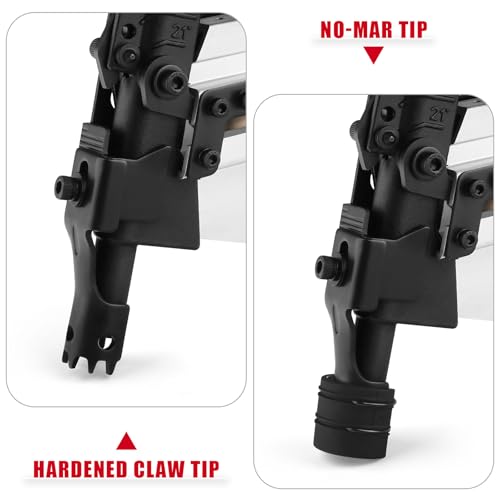
The hardened claw tip is a smart touch, it helps prevent slippage during angled toe-nailing, which is a real pain point on framing walls. And like other Metabo HPT models, it has that Pro Preferred trust factor, with a reputation for reliability across pros. The selectable trigger mode gives you control whether you need precision or speed.
Product photos


VEVOR 21° Full Round Head Framing Nailer

Strengths
- Handles multiple nail types
- Large magazine capacity
- Open nose design
Trade-offs
- Inconsistent long-term reliability
- Brand not field-proven
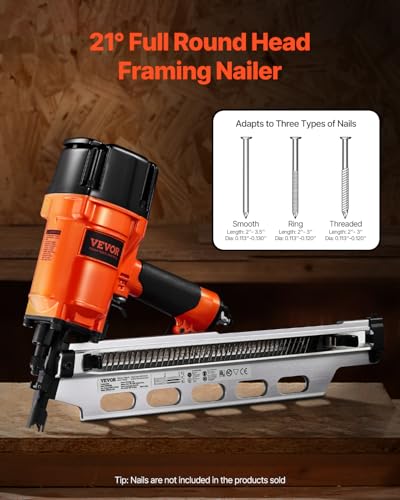
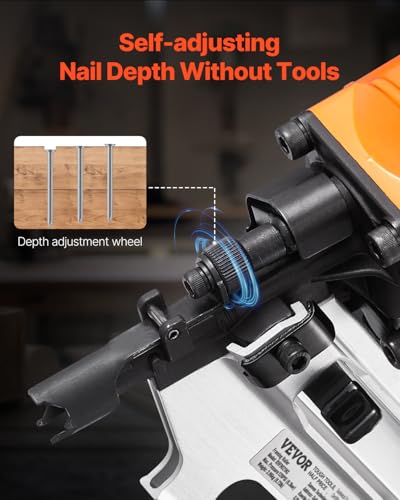
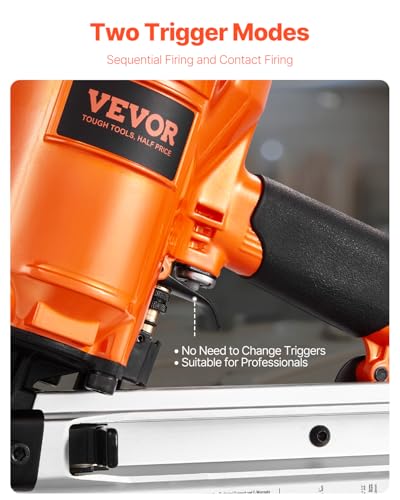
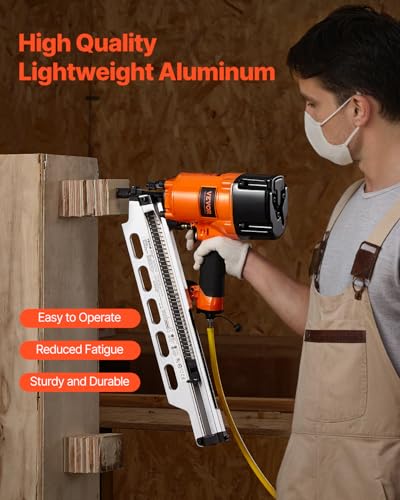
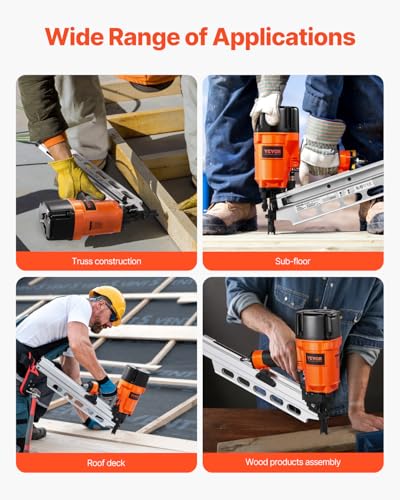
VEVOR is stepping up with a pro-looking tool at a value price. The ability to fire smooth, ring, and threaded shank nails is rare at this tier, that kind of versatility usually costs more. The 60-nail magazine reduces reloads, and the open nose design makes clearing jams faster, which matters when you’re on a deadline.
It’s clearly modeled after higher-end 21-degree nailers, and on specs alone, it competes well. But owner feedback is mixed on long-term durability, some say it lasts, others report issues after heavy use. I’d call it a calculated risk: if you need features on a budget and accept some uncertainty, it’s a smart play. But if you can’t afford downtime, stick with Metabo HPT or Estwing.
Product photos
How We Evaluated air framing nailers
Rather than a hands-on lab test, my research for these recommendations involved a detailed comparison of published specifications and features across numerous models. I weighed owner reviews from multiple sources, alongside expert opinions found in trade publications and tool-focused websites. Ultimately, I ranked each nailer based on a set of criteria centered around power, durability, ease of use, and value for the intended application.
For air framing nailers, consistent nailing power and long-term durability are paramount. I gave significant weight to the materials used in the nailer’s body (magnesium versus aluminum, for example) and the design of the internal firing mechanism. A reliable anti-dry fire mechanism was also critical, as was the ability to quickly and easily adjust nail depth without tools.
Published specifications reliably indicate nail capacity, weight, and operating pressure ranges. However, to understand real-world performance and potential issues – like nail jamming or inconsistent driving – I focused heavily on owner feedback. Reputation and consistent positive reviews from experienced framing professionals were strong indicators of a nailer’s quality and longevity. If you are considering a move to battery powered options, you can find top-performing cordless framing nailers in a recent guide.
How To Pick The Right air framing nailers
Choosing the right air framing nailer can dramatically improve speed and quality on construction projects.
A quality air framing nailer balances power and maneuverability. Key considerations include nail capacity, actuation mode (sequential vs. contact), weight, durability of internal components (especially the driver blade), and the ability to adjust depth without tools. Proper maintenance and consistent air pressure are also critical for reliable performance.
Nail Capacity & Magazine Angle
The magazine angle dictates the type of nail the nailer accepts, and impacts how easily you can work in tight spaces. While 21-degree magazines are common and generally more affordable, 30-degree and even coil nailers (like the Metabo HPT NV83A5) offer advantages in certain situations. Consider the volume of work you anticipate. For consistently large projects, a high-capacity coil nailer minimizes downtime for reloading. However, for smaller jobs or angled work, a 21-degree nailer might be easier to handle.
Actuation Mode & Safety
Sequential actuation requires depressing the safety tip and pulling the trigger for each nail. It’s safer, more precise, and necessary for many job sites, but slower. Contact (or “bump”) firing drives a nail with each press of the trigger while the safety tip is depressed – much faster, but significantly increases the risk of accidental discharge. Many nailers, like the Metabo HPT NR90AES1, offer selective actuation, letting you switch between modes.
Here’s what to look for in actuation: * A clear, easily accessible mode selector. * A robust safety tip that prevents accidental firing. * A mechanism that prevents dry-firing (like on the NuMax SFR2190), protecting the nailer from damage.
Never bypass or disable safety features on a framing nailer. Proper safety protocols are essential to prevent serious injury.
Durability and Value
Framing nailers take a beating. Magnesium alloy bodies (as seen in the Estwing EFR2190) are notably more durable than aluminum, but also add cost. A hardened steel driver blade is a must-have for longevity. Beyond the body material, examine owner reviews for reports of issues with internal components. Don’t automatically assume the most expensive nailer is the “best” – sometimes, you’re paying a premium for features you won’t use. For example, if you’re not a professional, you may find that the best value pro model meets your needs perfectly. When choosing, also factor in the cost of an appropriate air compressor for framing nailers to ensure you have sufficient air supply. Reviewing professional framing nailer reviews can provide valuable insights into real-world performance and reliability.
Air Framing Nailers Compared
Here’s a comparison of key specifications for several air framing nailers to help you choose the right tool for your needs.
| Product Name | Nail Angle | Nail Length Capacity | Nail Type | Weight (lbs) | Actuation Mode |
|---|---|---|---|---|---|
| Metabo HPT NR90AES1 | 21 | 2 – 3-1/2 in | Plastic Collated | 7.5 | Sequential/Contact |
| Metabo HPT NR90ADS1 | 30 | 2 – 3-1/2 in | Paper Collated | 7 | Sequential/Contact |
| NuMax SFR2190 | 21 | 2 – 3-1/2 in | Plastic Collated | N/A | Single/Bump |
| Estwing EFR2190 | 21 | 2 – 3-1/2 in | Plastic Collated | N/A | Single/Bump |
| 3PLUS HFN90SP | 21/28/34 | 2-3/16 – 3-1/2 in | Various | N/A | Single/Bump |
| Metabo HPT NV83A5 | 15 | 2 – 3-1/4 in | Coil | 8.8/9.1 | Sequential/Contact |
| VEVOR 21° Framing Nailer | 21 | 2 – 3.5 in | Smooth/Ring/Thread | N/A | Sequential/Contact |
Frequently Asked Questions
What air pressure is best for an air framing nailer?
Generally, 70 to 120 PSI is the recommended operating range for most air framing nailers. However, always check your nailer’s manual for the manufacturer’s specific recommendation, as exceeding the maximum PSI can damage the tool or create a safety hazard.
Can I use different types of nails in the same framing nailer?
While some nailers accept multiple nail types (like the 3PLUS HFN90SP), most are designed for a specific collation angle and nail shank type. Using the wrong nails can lead to jams or damage the internal mechanism, so it’s best to stick with the manufacturer’s recommendations.
What’s the difference between sequential and contact actuation?
Sequential actuation is safer, requiring two actions to fire a nail, while contact actuation fires a nail with each trigger press. Contact firing is faster but carries a higher risk of accidental discharge and isn’t permitted on many job sites, so understand your job site requirements.
How often should I oil an air framing nailer?
Regular oiling, typically after every 2,000 to 4,000 shots, is crucial for maintaining a framing nailer’s performance. Use a pneumatic tool oil specifically designed for air tools, and follow the manufacturer’s instructions for oiling procedures.
Are coil framing nailers really that much more efficient?
For high-volume projects, a top coil framing nailers can significantly reduce downtime because of their larger nail capacity. They are especially useful when consistent, rapid nailing is needed and you want to minimize reloading interruptions.
The Bottom Line
Choosing an air framing nailer often comes down to balancing upfront cost with long-term durability and the specific demands of your work. While many options exist, the Metabo HPT NR90AES1 strikes a particularly good balance, offering both versatility with its selectable actuation and a reputation for reliability that experienced framers appreciate. It’s a solid all-around performer that should handle most jobs effectively.
For those on a tighter budget, or for occasional use, the NuMax SFR2190 provides a capable entry point into framing nailers. If you anticipate frequent, large-scale projects, or need to work with a variety of nail types, consider the 3PLUS HFN90SP – it’s a more significant investment, but the multi-angle magazine adds considerable flexibility (you can find more about the best 21-degree nailers for framing in a dedicated guide).
Ultimately, the specifications matter less than consistently maintaining your air supply and understanding your nailer’s safety features. A well-maintained nailer, used with proper technique and safety precautions, will always outperform a top-of-the-line model that’s neglected or misused. Prioritize safety, proper air pressure, and consistent lubrication – those are the fundamentals that truly determine a job well done.
