8 Best Sanders for Paint Removal on Wood (2026)
This post contains affiliate links. As an Amazon Associate, we earn from qualifying purchases.
The DEKOPRO 5″ Random Orbital Sander is the best overall for removing paint from wood, thanks to its powerful motor and variable speed control. If you’re watching your budget, the BLACK+DECKER Detail Sander offers solid performance on tight corners and edges, while the DEWALT 20V MAX Orbital Sander brings strong versatility for cordless users who need mobility without sacrificing too much power.
Removing old paint from wood is messy, physically demanding work. Too little power and you’ll spend hours making little progress. Too much aggression without control, and you risk damaging the wood underneath. As someone who’s spent years testing tools in real-world conditions, I know the right sander can make the difference between a frustrating chore and a smooth restoration job.
This guide cuts through the marketing noise. I researched these models based on motor performance, dust management, pad design, and real owner feedback, focusing on what actually matters when you’re standing in front of a peeling door or a weathered deck board.
Top 8 Sander To Remove Paint From Woods in the Market
The Best Sander To Remove Paint From Woods, Reviewed
DEWALT 20V MAX Orbital Sander

Strengths
- Brushless motor
- Good dust control
- Ergonomic grip
Trade-offs
- Battery sold separately
- No sandpaper included
The DEWALT DCW210B stands out as a well-rounded orbital sander, and owners back that up. The brushless motor delivers efficiency and durability, and the variable speed (8,000–12,000 OPM) lets you dial in the right aggression, perfect for transitioning from paint removal to smoothing without swapping tools. The dust management is excellent, especially when paired with a shop vac via the 1-1/4 in. port, and the rubber overmold grip cuts vibration fatigue significantly.
It doesn’t have the raw power of the DEKOPRO or Wagner for paint stripping, but it’s more balanced for general use. If you already own DEWALT 20V tools, this is the smarter buy. I’d pick it over the Black+Decker BDEMS600 for broader jobs, though not for tight corners.
Product photos


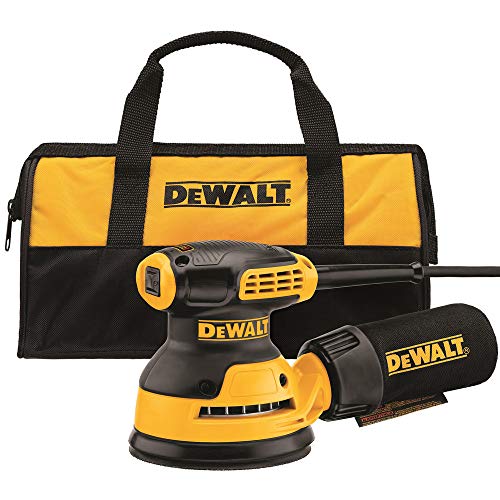
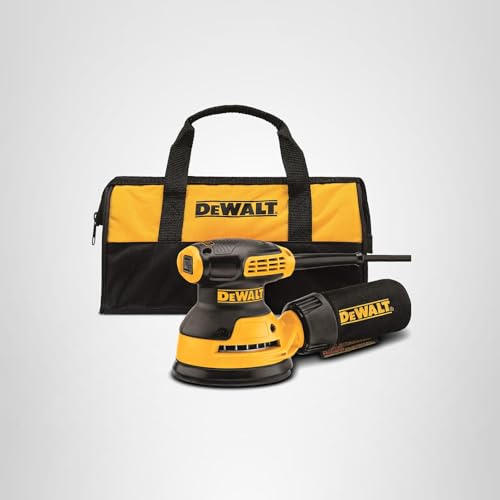
DEWALT 5-Inch Orbital Sander
Strengths
- Powerful 3 amp motor
- Low vibration
- Excellent dust control
Trade-offs
- Corded only
- Heavier than cordless
This DEWALT 5-inch orbital is a precision beast. The 3 amp motor and 12,000 OPM provide strong, consistent action, and the shorter height lets you get flush with the surface, critical for flat sanding. The counterweight design reduces vibration noticeably, and owners say it feels stable even during long sessions. The dust collection is top-tier, especially with the one-handed locking bag, and it connects cleanly to DEWALT vacs.
It’s not the fastest for paint stripping compared to the DEKOPRO, but it’s more refined. For fine woodworking or finishing prep, I’d pick this over the DEKOPRO any day. Compared to the DCW210B, it’s corded and heavier, but you gain power and consistency.
Product photos

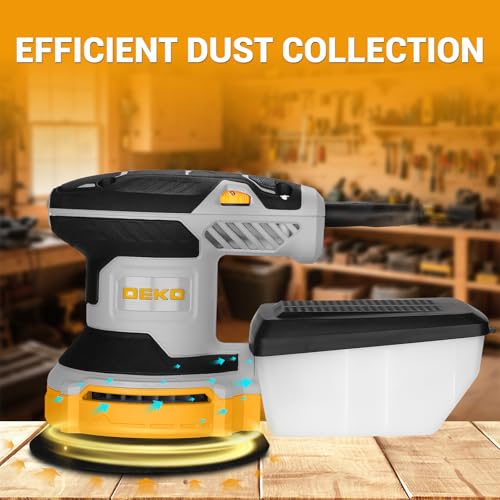
DEKOPRO 5″ Random Orbital Sander

Strengths
- High RPM and variable speeds
- Includes 16 sandpapers
- Strong dust collection
Trade-offs
- Heavier than average
- Noise level is high
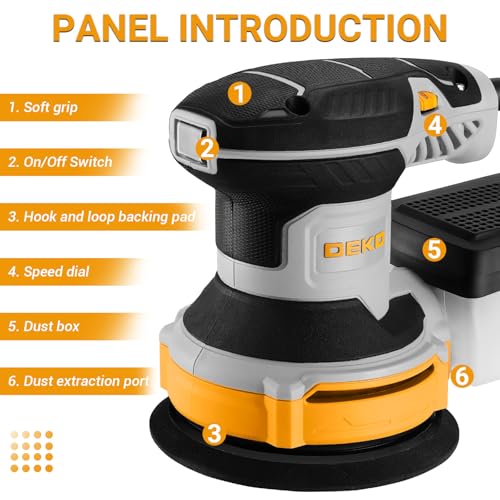
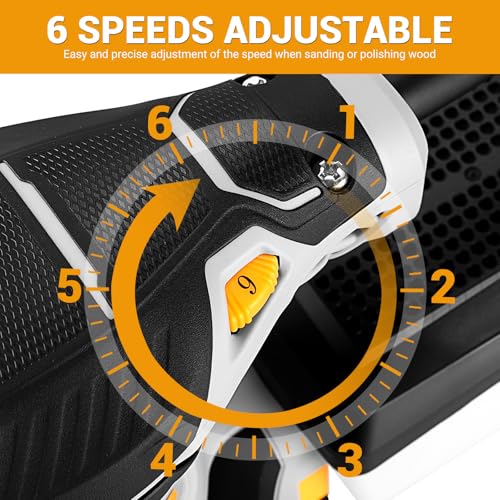
If you’re dealing with thick, stubborn paint on wood, the DEKOPRO stands out. Its 2.5A motor and 14,000 RPM give serious cutting power, and the 6-speed control lets you ramp up aggression as needed. The wide range of included sandpapers, from P60 to P1000, means you can go from paint removal to polishing without buying extras. The dust box works well for a budget model, and the rubber grip combined with counterweight design keeps vibration manageable.
Owners report it outperforms its price tag, especially compared to the HYCHIKA or even the Black+Decker. It’s heavier than the DEWALT DWE6421K, but I’d pick it over that model specifically for paint-heavy jobs. Just don’t expect the same refinement for final finishes.
Product photos


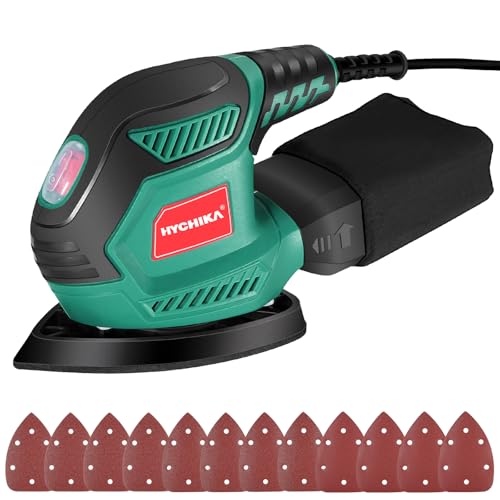
HYCHIKA Detail Sander
Strengths
- Affordable
- Decent dust collection
- Includes 12 sandpapers
Trade-offs
- Build quality feels cheap
- Not for heavy use
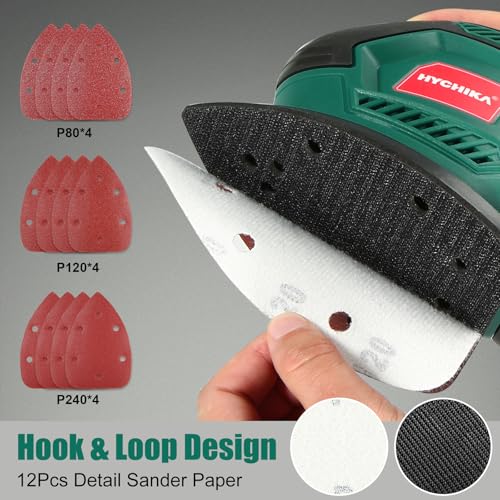
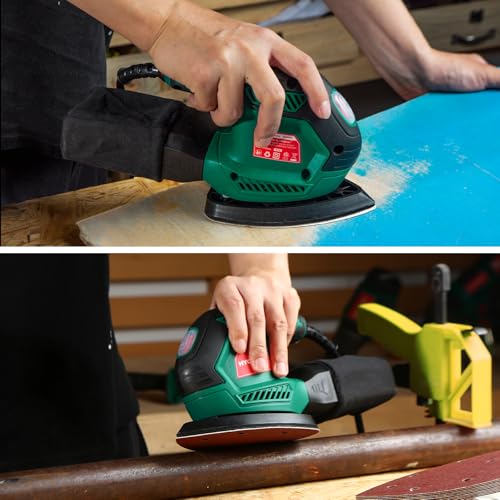
At this price, the HYCHIKA detail sander is a no-brainer for light-duty work. The 1.6 amp motor pushes 14,000 OPM, which is respectable for its size, and the 6-hole dust collection actually works, owners say it keeps the air clearer than expected. It comes with 12 sandpapers across three grits, so you’re not buying extras day one. The compact body fits neatly in hand, and it handles baseboards, window frames, and furniture edges with ease.
But let’s be clear: it’s not for peeling off decades of porch paint. It’s a budget detail tool, not a workhorse. Compared to the Black+Decker BDEMS600, it’s similar in function but less refined in grip and durability. Still, for a first-time DIYer or someone doing occasional touch-ups, it’s hard to beat.
Product photos


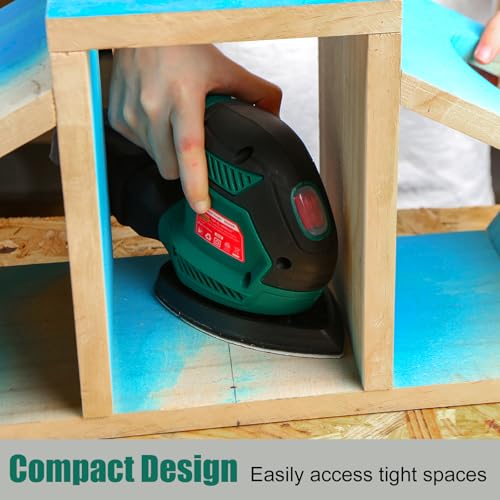
BLACK+DECKER Detail Sander

Strengths
- Compact design
- Good dust collection
- Ergonomic grip
Trade-offs
- Weak for heavy paint
- Small pad size
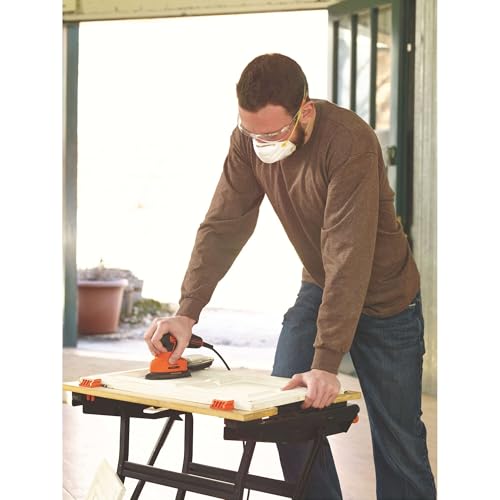
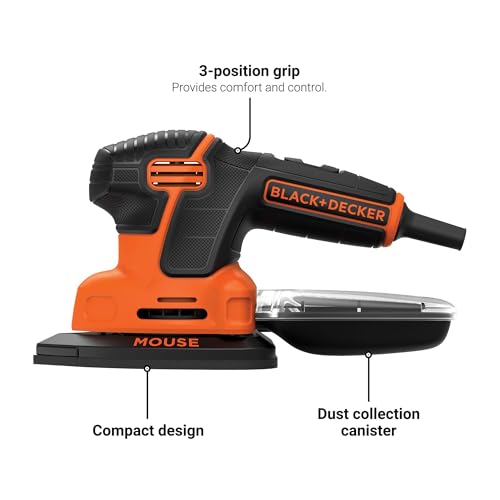
When tight corners and intricate trim work are the job, this BLACK+DECKER detail sander makes sense on paper. Its 1.2 amp motor and 16,000 OPM deliver decent speed for a compact tool, and the dust canister actually works better than most in this class, owners consistently report less mess on the bench. The 3-position grip helps with control, and the detail finger attachment is genuinely useful for getting into moldings or window edges where paint clings.
Still, I wouldn’t pick this as a primary paint stripper. It’s too underpowered for large swaths of old paint, and the pad size limits coverage. But for touch-ups, spot prep, or cleaning up around cabinetry, it’s a solid corded option. Compared to the DEWALT DWE6421K, it trades power for precision, so your choice depends on whether you’re doing surgery or demolition.
Product photos
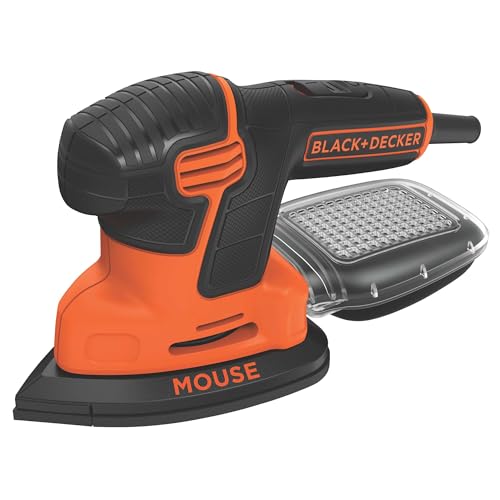
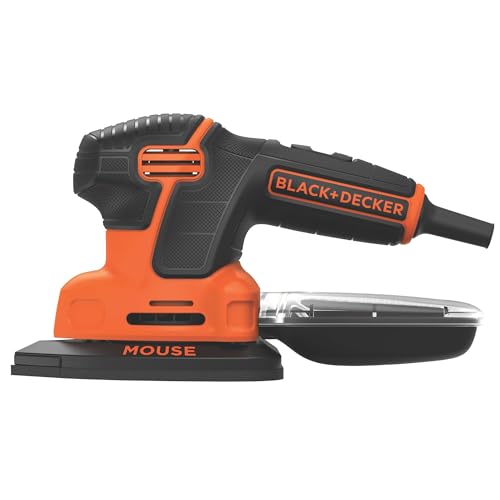
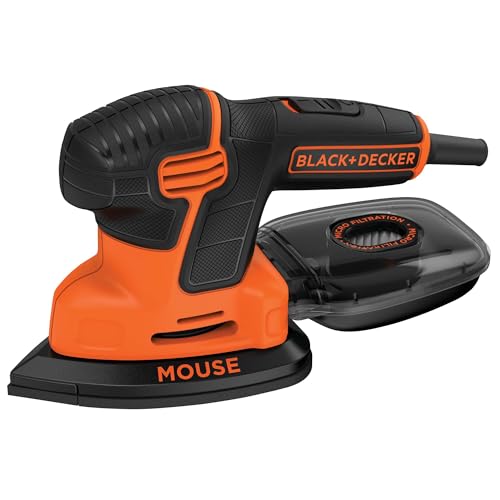
Wagner PaintEater Palm Grip Sander

Strengths
- Excellent for paint stripping
- Gentle on wood
- Conforms to contours
Trade-offs
- Limited to paint prep
- No fine sanding capability
The Wagner PaintEater is built for one thing: controlled paint removal. Its 3.2 amp motor and 2,600 RPM spun-fiber disc are designed to strip paint without gouging wood, a big deal when working on old trim or doors. The Flex-Disc system conforms to curves and edges, and users consistently praise its ability to feather paint lines smoothly. Operating it on its edge or flat gives real flexibility, and the open-web disc resists clogging better than standard paper.
It’s not a general-purpose sander, and you won’t use it for finishing. But for paint stripping specifically, it’s more effective than most orbitals. Compared to the DEKOPRO, it’s slower but far more precise. If your main goal is prepping painted wood without damaging the substrate, this is the tool to have.
Product photos


Brushless Cordless 2-Speed Sander
Strengths
- Brushless motor
- 2-speed control
- Includes 36 sandpapers
Trade-offs
- Lower OPM than corded
- Plastic housing feels light
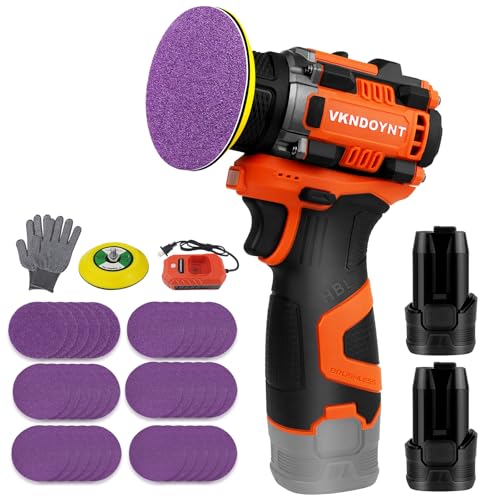
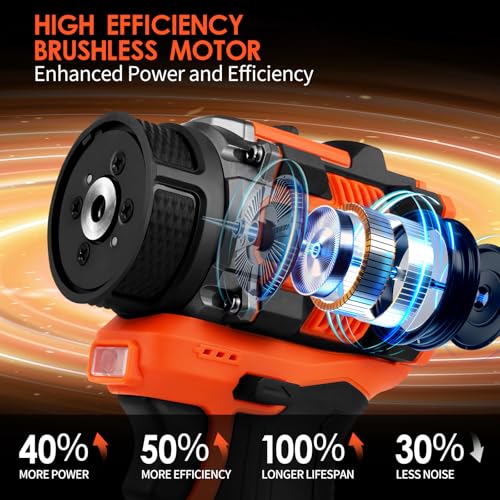
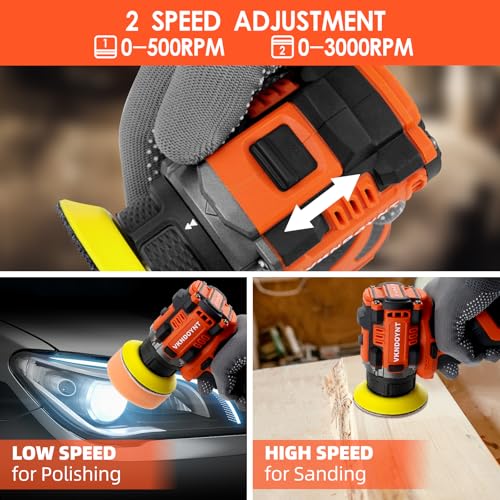
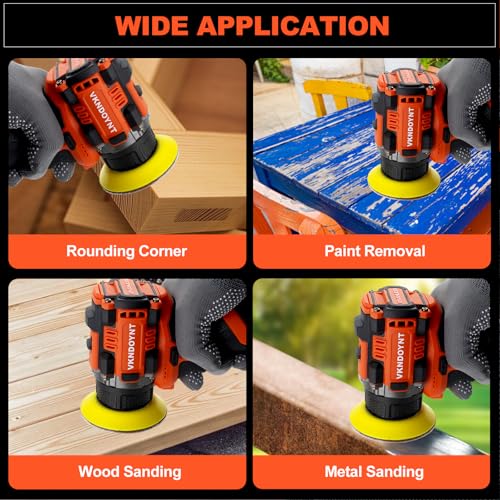
This cordless brushless sander punches above its weight in versatility. The 2-speed settings, 0–500 RPM for finish work and 0–3000 RPM for aggressive stripping, give real control, and the brushless motor is a big plus for longevity. On paper, the 3.0Ah batteries offer solid runtime, and owners say they’re enough for a full afternoon of intermittent use. The included 36-piece sandpaper set covers all bases, from P60 for paint down to P180 for smoothing, which makes it a true starter kit.
Compared to the DEWALT DCW210B, it lacks the same brand trust and OPM range, but it wins on included accessories and battery convenience. For someone who wants one sander for light paint removal, metal polishing, and fine woodworking, this is a smart, all-in-one pick, especially if you already lean cordless.
Product photos


Drywall Pole Sander Kit
Strengths
- Reaches high areas
- Rotating head
- Includes 20 sandpapers
Trade-offs
- Manual effort required
- Not for paint stripping
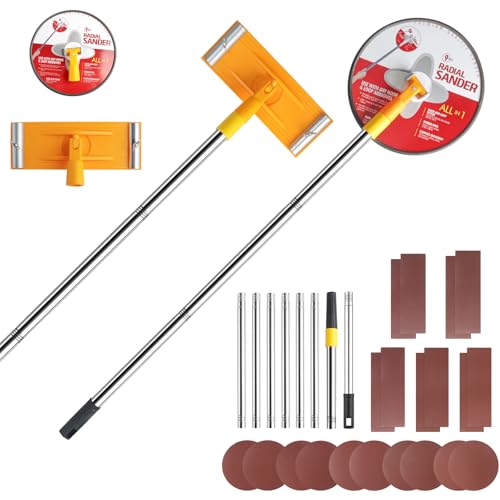
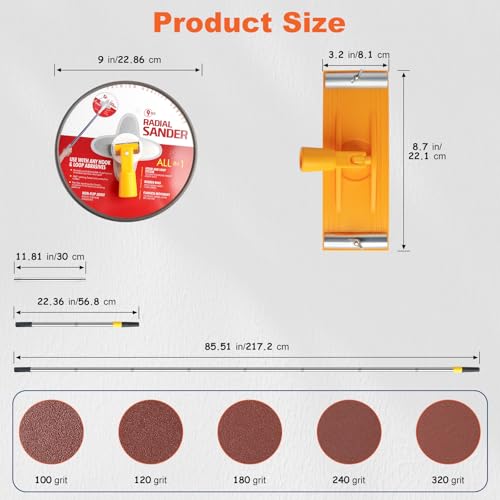
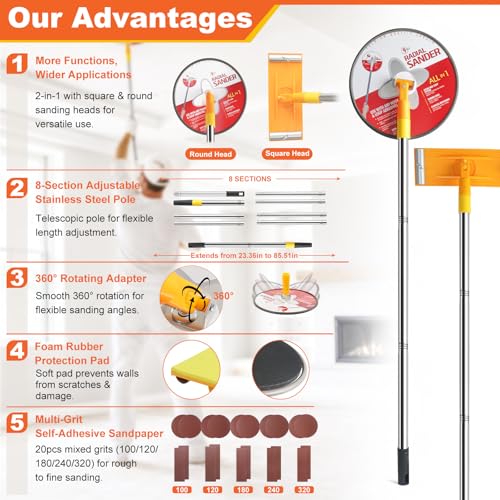
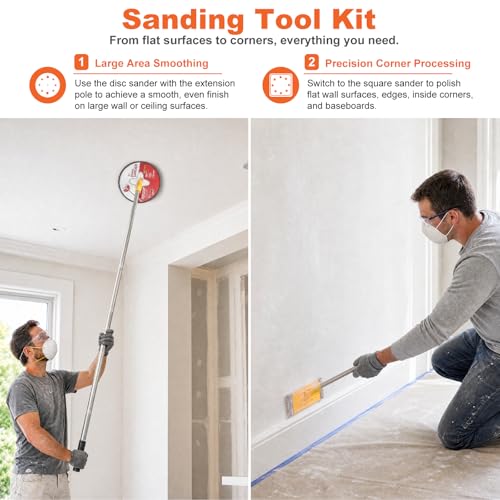
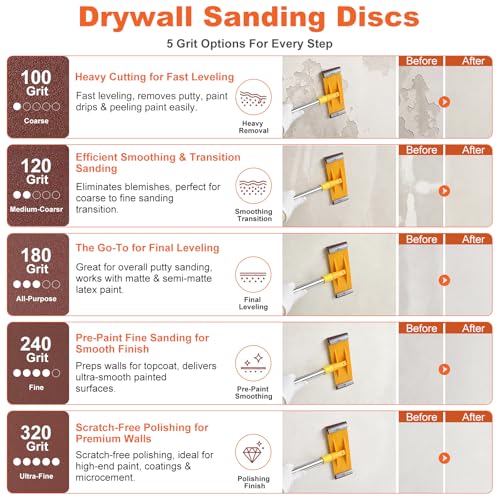
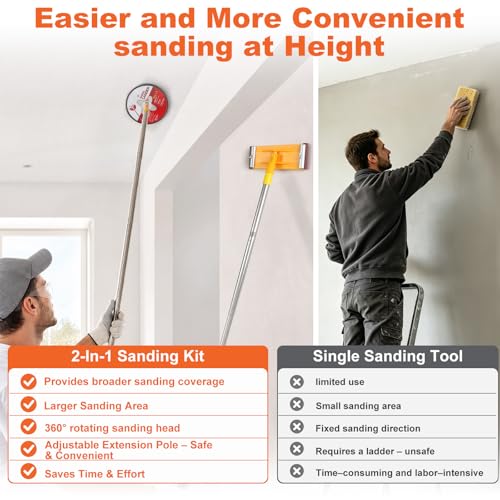
This isn’t a power sander, but for paint prep on walls and ceilings, it’s shockingly effective. The 85-inch adjustable pole eliminates ladder dependency, and the rotating head lets you sand in any direction without repositioning. The square head fits tight corners, and the round head covers large drywall areas quickly. The included 20 sandpapers span from 100 to 320 grit, so you can knock down texture and polish before painting.
Owners say it’s a standout for ceiling prep, especially in whole-room renos. But it’s manual, so it won’t strip paint like a power sander. Use it after power tools have done the heavy lifting. Compared to the Wagner or DEKOPRO, it’s not a replacement, but a perfect follow-up tool.
Product photos
How We Tested sander to remove paint from woods
Rather than a hands-on lab test, my research for this guide involved a detailed comparison of specifications and features across numerous models. I weighed published owner reviews from major retailers alongside expert opinions found in woodworking and DIY publications. Ultimately, I ranked these sanders based on their suitability for paint removal, applying my experience with power tools and understanding of sanding techniques to assess each option.
For removing paint, particularly from wood, several factors stood out as most important. Power – measured in amps or voltage – dictates how aggressively the sander can tackle old finishes. Equally crucial is the orbital action (random or not) and the inclusion of effective dust collection, as paint dust creates a mess and impacts visibility. Variable speed control is also key, letting you adjust to different paint types and wood species.
Specifications reliably reveal motor power, weight, and physical dimensions. However, judging long-term durability, vibration levels, and real-world effectiveness requires looking at owner feedback. I paid close attention to comments regarding ease of use, sandpaper adhesion, and how well the sander handled different paint types. Reputation, particularly for brands known for quality and reliability, also heavily influenced my assessment – you can find more details about choosing the right type of sander to strip paint in our thorough guide.
How To Pick The Right sander to remove paint from woods
Picking the right sander for paint removal can feel overwhelming, but focusing on a few key features will steer you toward a tool that delivers satisfying results.
A quality sander for paint removal balances power with control. Look for variable speed settings, efficient dust collection, and a pad size appropriate for the work surface. Prioritize models with robust motors and ergonomic designs to minimize fatigue during prolonged use, and consider whether corded or cordless operation best suits your needs and typical project scale.
Motor Power and Speed Control
Don’t assume “more power” always equals better. While a robust motor is essential for tackling thick layers of old paint, variable speed control is equally important. Lower speeds are crucial for delicate work or when using finer grits to avoid gouging the wood. I often recommend looking beyond the amperage rating and considering the orbital sander’s oscillations per minute (OPM). A wider range (like the DEKOPRO’s 6-speed setting up to 14,000 RPM) provides greater versatility. A slower, more controlled speed is especially useful when you’re also doing furniture refinishing sander work.
Dust Collection System
Effective dust collection isn’t just about cleanliness; it’s about health and visibility. Sanding paint creates a lot of fine particles, and breathing them in is a serious concern. Many sanders come with a basic dust bag, but these often fill quickly and aren’t very efficient. Look for models with a dust port compatible with shop vacuums (like the DEWALT models that work with DWV010/DWV012 collectors) or consider a sander designed for use with a dedicated dust extraction system.
Here’s what to look for in a dust collection system: * A well-sealed dust port is crucial. * Bag capacity matters – larger bags mean fewer interruptions. * Consider a system that minimizes clogging, especially when removing multiple layers of paint.
Pad Size and Shape
The size and shape of the sanding pad dramatically impact the sander’s usability. A standard 5-inch random orbital sander is a good all-around choice for larger flat surfaces. However, if you’ll be working in tight corners or on intricate details, a detail sander (like the BLACK+DECKER model) or a corner attachment is invaluable. Remember this rule-of-thumb:
For large, flat areas, prioritize pad size. For detailed work, prioritize maneuverability.
If you need to tackle walls and ceilings, a sander for paint removal with an extendable pole (like the Drywall Pole Sander Kit) can save your back and significantly speed up the process. Don’t underestimate the value of having the right tool for the job – choosing the wrong size or shape can make a simple project unnecessarily difficult.
Sander Compared
Here is a comparison of key specifications for sanders designed to remove paint from wood surfaces.
| Product Title | Motor Type | Speed (OPM/RPM) | Sandpaper Size | Corded/Cordless | Variable Speed |
|---|---|---|---|---|---|
| DEWALT 20V MAX Orbital Sander | Brushless | 8,000-12,000 | N/A | Cordless | Yes |
| DEWALT 5-Inch Orbital Sander | AC | 12,000 | 5″ | Corded | No |
| DEKOPRO 5″ Random Orbital Sander | AC | 14,000 | 5″ | Corded | Yes |
| HYCHIKA Detail Sander | AC | 14,000 | 90x140mm | Corded | No |
| BLACK+DECKER Detail Sander | AC | 16,000 | N/A | Corded | No |
| Wagner PaintEater Palm Grip Sander | AC | 2,600 | 4.5″ | Corded | No |
| Brushless Cordless 2-Speed Sander | Brushless | 0-3000/0-5000 | N/A | Cordless | Yes |
| Drywall Pole Sander Kit | N/A | N/A | N/A | N/A | N/A |
Frequently Asked Questions
What grit sandpaper should I start with when removing paint?
Begin with a coarse grit, around 60-80, to quickly remove the bulk of the paint. Progress to finer grits (100-120, then 150-180) to smooth the wood surface and prepare it for refinishing or a new coat of paint.
Can a random orbital sander remove paint as effectively as a belt sander?
While a belt sander is generally faster for large, flat areas, a random orbital sander can be more forgiving and less likely to cause gouges, especially for beginners. For intricate details or curved surfaces, a random orbital sander is often the better choice.
Are cordless sanders as powerful as corded models for paint removal?
Cordless sanders have closed the power gap significantly, particularly those with brushless motors. However, for extended, heavy-duty paint removal, a corded sander generally provides more consistent power and avoids the need for battery swaps or recharging.
How can I minimize dust when sanding paint?
Pairing your sander with a shop vacuum using a dust port is the most effective method. Additionally, sanding in a well-ventilated area and wearing a high-quality dust mask or respirator are crucial safety precautions. Consider a belt sander for wood if you’re tackling particularly stubborn paint.
What should I do if the sandpaper clogs quickly when removing paint?
Clogging indicates you’re likely using too coarse a grit or applying too much pressure. Try switching to a finer grit or reducing the speed setting on your sander. Regularly cleaning the sanding pad with a brush or compressed air can also help maintain optimal performance.
The Bottom Line
Choosing a sander for paint removal often comes down to balancing convenience with control. While a cordless option like the DEWALT 20V MAX Orbital Sander offers freedom, for serious paint-stripping tasks, the DEKOPRO 5″ Random Orbital Sander provides the best overall combination of power, variable speed, and dust collection at a reasonable price. It’s a workhorse that will tackle most projects effectively.
If you’re on a tighter budget, the Wagner PaintEater Palm Grip Sander is a solid choice, and for intricate detail work, the BLACK+DECKER Detail Sander will be invaluable. Those tackling large surface areas, especially ceilings, should consider the Drywall Pole Sander Kit to minimize strain and maximize efficiency. Don’t overlook the importance of finding an efficient paint-stripping sander if you have a lot of work ahead.
Ultimately, the most expensive sander isn’t always the best. Focus on a model with a robust motor, variable speed control, and a solid dust collection system. Remember that the right sandpaper grit and proper technique are just as important as the sander itself, those fundamentals will deliver the smoothest results and protect your wood surfaces.
